
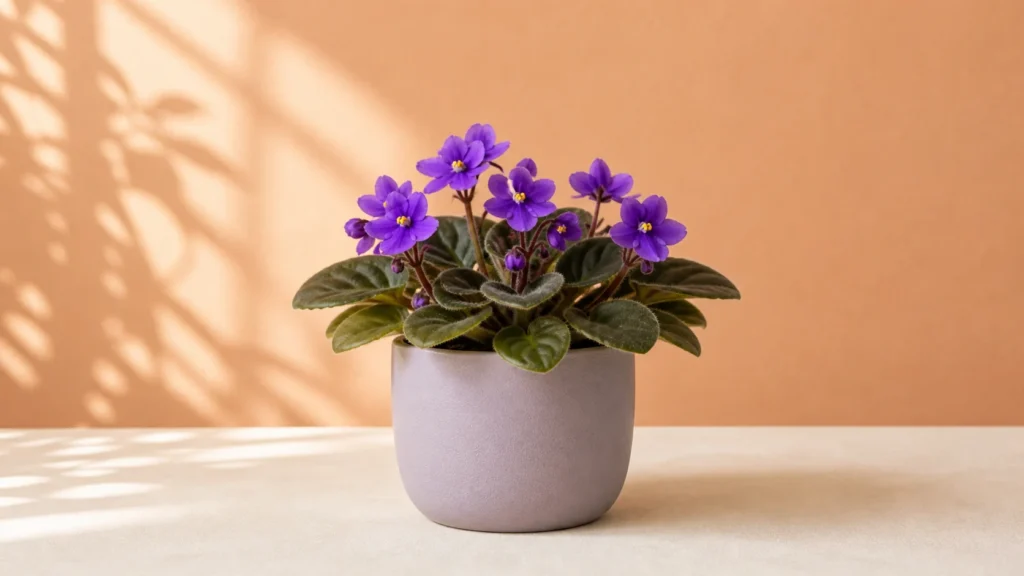
African Violet
Streptocarpus ionanthus
A compact flowering houseplant with soft fuzzy leaves and colorful blooms that prefers bright indirect light, steady moisture, and gentle indoor conditions.
Watering frequency
Every 5-7 days
Ideal temperature
65-75°F / 18-24°C
Humidity
40-60%
Care difficulty
Medium
Air purifying
No/Not Known
Growth rate
Moderate
Plant size
6-12 in / 15-30 cm
Soil type
African violet mix
Fertilizer need
Every 2-4 weeks while growing.
Care summary
- Light: bright indirect.
- Water: gentle watering or bottom-water; don’t soak crown.
- Soil: African violet mix + drainage.
- Feed: diluted fertilizer during growth.
- Note: generally pet-friendly.
Common problems
- Rot: staying wet or cold.
- Leaf spots: water on leaves.
- Few blooms: low light/feeding.
- Scorch: direct sun.
- Pests: mites/mealybugs sometimes.
Plant care guide
About African Violet
African Violet is one of the few compact houseplants that can flower repeatedly without demanding a greenhouse or a large sunny room. Its velvety leaves form a tidy rosette, while clusters of purple, blue, pink, red, or white flowers rise just above the foliage. Modern cultivars add ruffled petals, contrasting edges, variegated leaves, miniature proportions, and trailing growth. A healthy plant therefore feels less like a temporary flowering gift and more like a small, renewable indoor garden.
The name can be confusing. Plants once placed in the genus Saintpaulia are now included within Streptocarpus. The North Carolina Extension plant profile lists Streptocarpus ionanthus and notes the familiar former name Saintpaulia ionantha. Garden centers, collectors, and fertilizer labels still use “African violet,” so the common name remains the most useful shopping term. The broader database label Streptocarpus sect. Saintpaulia recognizes that this is a horticultural group containing many cultivated forms rather than one uniform clone.
African violets come from warm parts of East Africa, where their ancestors grow in protected sites rather than exposed, baking sun. That background explains the plant’s indoor preferences: bright filtered light, an airy root zone that stays lightly moist, warm water, and steady temperatures. It also explains why the plant can struggle on a cold sill even when the room itself seems comfortable.
Why You’ll Like It
African Violet offers flowers in the footprint of a small foliage plant. A standard plant usually fits easily on a desk, kitchen counter, narrow shelf, or windowsill; miniature cultivars need even less room. This makes it useful when a large Peace Lily or floor-standing foliage plant would overwhelm the space.
It is also responsive. More usable light often brings tighter leaf growth and new flower stalks. Removing old blooms makes the crown look fresh. A leaf cutting can eventually become a new plant. These visible responses help a beginner connect an action with a result, although the plant rewards consistency more than constant intervention.
African Violet is generally considered a pet-compatible choice. That does not make the potting mix, fertilizer, or pesticides edible, and any animal that repeatedly chews plants may still develop stomach upset. Keep care products secure and choose placement based on the behavior of the individual cat or dog.
What Kind of Plant Is It?
This is a tender, evergreen perennial in the Gesneriaceae family. Most familiar African violets grow as symmetrical rosettes: new leaves emerge from a central crown and older leaves form the outside rows. Trailing cultivars produce several crowns and spreading stems. The fuzzy leaf surface slows water loss, but it also holds droplets and dust, so leaf cleaning must be gentle.
Flowers arise on individual stalks from the leaf axils. A plant does not need a winter dormancy to bloom, but it may pause when days are short, temperatures fluctuate, roots are unhealthy, or light is inadequate. With stable indoor conditions, flowering can occur during several seasons or almost continuously.
The plant has a relatively fine, shallow root system. An oversized pot holds more wet mix than the roots can use and often results in leaf growth without flowers, root loss, or crown rot. African violets usually perform best slightly snug in a small container with a drainage hole.
Popular African Violet Varieties
African violets are classified not only by flower color but also by plant size, growth habit, leaf form, and flower form. Thousands of named cultivars exist, so a useful collection can be built without buying plants that look alike.
- Standard African violets are the familiar rosette plants seen in most garden centers. They offer the widest range of flower colors and are a practical starting point.
- Miniature and semi-miniature African violets bring the same flower detail to smaller pots. They need careful watering because a tiny root ball can swing from moist to dry quickly.
- Trailing African violets develop multiple crowns and can fill a shallow pot or small hanging container. Pinching and selective pruning keep the shape balanced.
- Variegated-leaf cultivars add cream, pink, or pale green patterning even between bloom cycles. Because pale tissue contains less chlorophyll, strong but filtered light is especially useful.
- Double and ruffled cultivars have extra petals or sculpted edges. Their flowers may hold spent petals longer, so grooming prevents decaying material from collecting at the crown.
Named examples in the NC State cultivar list include ‘Champagne Pink,’ ‘Diamond Tiffany,’ ‘Little Ruby,’ and ‘Nightfall.’ Availability changes frequently, and a cultivar label is more informative than a generic color label when you want to track mature size and bloom form.
For future comparisons, African Violet belongs with other compact flowering houseplants such as Phalaenopsis Orchid rather than foliage-first aroids. The care overlap is limited: do not assume an orchid bark mix or tropical aroid watering routine will suit an African violet.
Where It Works Best
An east-facing window is often ideal because it supplies gentle morning light. A bright north-facing window can also work, while a south- or west-facing exposure usually needs distance or a sheer curtain. Judge the actual light rather than relying only on compass direction: trees, neighboring buildings, seasons, and glass coatings can change what reaches the leaves.
Under weak light, leaf stems stretch, the rosette opens, and flowering becomes sparse. Under excessive sun, leaves can bleach, curl, or develop dry tan patches. Rotate the pot a quarter turn every week or two unless it sits under a broad, even grow light. Rotation helps preserve the symmetrical rosette.
African violets grow well under LEDs. Position and duration depend on the fixture, so begin at the manufacturer’s houseplant recommendation and watch new growth. A simple timer creates a more dependable day length than switching the light on occasionally.
Choose a stable, warm location away from exterior doors, heating vents, and air-conditioning blasts. The Virginia Cooperative Extension guide emphasizes light, temperature, moisture, and nutrition as interconnected parts of successful culture. A bright windowsill that becomes very cold at night is not automatically better than a slightly more distant but stable position.
How to Water an African Violet
Water when the surface has begun to dry but before the entire root ball becomes hard and shrunken. “Every 5–7 days” is a starting observation interval, not a fixed command. A small plant in a porous pot under a grow light may dry faster; a large plastic pot in winter may take longer. Lift the pot and touch the mix to learn its normal change in weight and texture.
Bottom watering is useful but not mandatory. Set the pot in a shallow container of room-temperature water, allow the mix to absorb moisture, then remove it and let it drain completely. Do not leave the plant standing in water for hours. Top watering also works if you apply water slowly to the mix, keep the crown from flooding, and empty the saucer.
The warning against wet leaves is sometimes oversimplified. A droplet does not instantly poison a leaf, but cold water, mineral residue, intense light, or water trapped on the fuzzy surface can leave spots or encourage disease. Use lukewarm water and blot accidental water from the crown. Never mist the leaves as a routine humidity treatment.
Repeatedly adding a small sip can leave the lower root ball dry and concentrate fertilizer salts. When watering is needed, moisten the whole mix and allow drainage. If water runs immediately down the pot wall without wetting the center, the mix may have become hydrophobic; soak briefly from below, drain, and reassess whether repotting is due.
Soil, Pot, and Repotting
Use a light African violet mix that combines moisture retention with air space. Commercial mixes are convenient, but some become compressed in storage. Perlite can increase aeration if the product feels dense. NC State describes a porous combination based on peat or coir with vermiculite and perlite; the objective is rapid drainage around fine roots, not a permanently wet sponge.
A drainage hole is essential. Plastic pots dry more slowly and are easy to manage; unglazed clay dries faster and may suit a grower who tends to water generously. Self-watering African violet pots can work, but the reservoir should not substitute for observation. Flush the mix from the top periodically so dissolved salts do not accumulate.
Repot about once or twice a year, or when the mix has compacted, roots have declined, or a bare “neck” develops beneath the rosette. Choose a pot only slightly larger than the healthy root mass. Remove dead roots, position the lowest healthy leaves just above the mix, and keep the central crown uncovered. After repotting, provide stable warmth and avoid heavy feeding until growth resumes.
Temperature, Humidity, and Feeding
Aim for roughly 65–75°F (18–24°C), with only modest nighttime cooling. Prolonged temperatures below about 60°F (16°C) slow growth and make wet roots more dangerous. Heat can also reduce flowering, especially when paired with dry air.
Normal household humidity is often adequate, but 40–60% helps prevent rapid drying. A room humidifier is more effective than misting. A pebble tray has limited influence beyond its immediate area and the pot must sit above, not in, the water. Good airflow matters too; humidity should not mean sealed, stagnant foliage.
Feed lightly during active growth. A fertilizer labeled for African violets is easy to dose, but a balanced houseplant fertilizer at reduced strength can also work. Apply to moist mix rather than dry roots. If leaf edges burn, a pale crust develops on the pot, or growth becomes distorted, pause feeding and flush the mix. More fertilizer cannot compensate for insufficient light.
Pruning, Grooming, and Propagation
Remove spent flower stalks at their base and take off yellowing outer leaves with a clean pinch or blade. Do not repeatedly remove healthy center leaves. Dust can be lifted with a soft, dry artist’s brush; avoid leaf-shine products, which mat the fuzzy surface.
Leaf cuttings are the classic propagation method. Select a mature, healthy leaf with its stalk, cut the petiole to roughly 1–2 inches, and insert it into a lightly moist, airy propagation mix. Keep it warm with bright indirect light. A loose clear cover can reduce moisture loss, but it must not press on the leaf and should be opened if condensation remains heavy. New plantlets form slowly near the petiole base. Separate them only after each has several leaves and enough roots to handle.
This is a months-long project, not an instant cutting. A leaf may remain unchanged for weeks before plantlets appear. Propagating a named cultivar from a leaf usually preserves it, although some chimeral flower patterns may not reproduce reliably this way.
Common Problems
- The plant will not bloom: Increase usable indirect light first. Then check whether the pot is oversized, the plant needs modest feeding, or numerous side crowns are crowding the main rosette.
- The center is soft or collapsing: Suspect crown rot from cold, trapped water, or chronically saturated mix. Isolate the plant and save healthy leaves for propagation because advanced crown rot is difficult to reverse.
- Leaves have pale rings or spots: Review water temperature, droplets, mineral residue, and direct sun. Damaged tissue will not turn green again, but corrected care protects new leaves.
- Outer leaves droop while mix is wet: Roots may be oxygen-starved or rotten. Inspect rather than adding more water.
- Leaves are small and crowded: Excess light, mites, or a stressed crown can produce tight growth. Use magnification to inspect the newest leaves before changing several care factors at once.
- Mealybugs, thrips, or mites appear: Isolate the plant, identify the pest, and use a product labeled for indoor ornamental plants. Test any spray on one leaf because fuzzy foliage can mark easily.
- Gray mold develops on flowers: Remove affected blooms, improve air movement, and avoid leaving dying petals against wet leaves. NC State notes Botrytis, crown rot, and root rot among the important disease problems.
Frequently Asked Questions
Can African violets grow in low light? They may survive in medium light, but dependable flowering needs brighter filtered light or a suitable grow light. Stretching petioles and a flat, open rosette are useful clues that light is inadequate.
Should I water only from the bottom? No. Bottom watering protects the crown and is convenient, but careful top watering followed by complete drainage is also valid. Periodic top watering helps flush salts.
Why are the new leaves smaller than the old ones? Check light, root health, fertilizer concentration, temperature, and pests. Small new leaves are a symptom, not a diagnosis; examine the crown closely before feeding more.
Is African Violet safe for cats and dogs? It is generally treated as non-toxic, but “non-toxic” does not mean suitable food. Prevent repeated chewing and contact a veterinarian if an animal develops symptoms.
How do I encourage more flowers? Provide bright filtered light, keep the crown single and the pot modest, remove spent stalks, and feed lightly while the plant is growing. Correct light is usually more important than a bloom-booster product.
Final Thought
African Violet succeeds when care is gentle and repeatable. Give its compact roots an airy mix, water thoroughly without flooding the crown, and provide bright filtered light in a warm, stable place. Once that routine is established, the plant’s new leaves and recurring flowers provide clear feedback—and a surprising amount of color from a very small pot.