
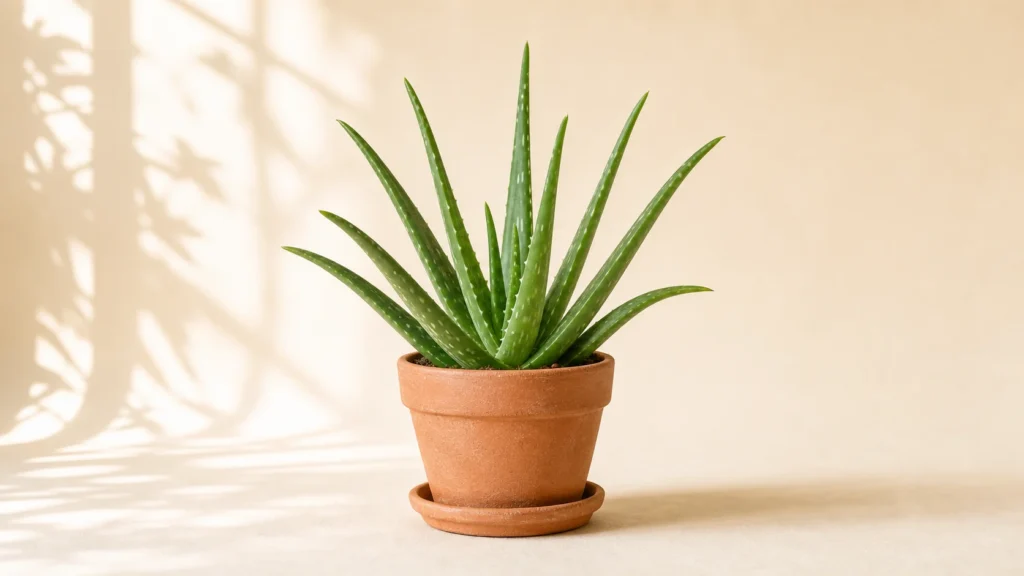
Aloe Vera
Aloe vera
A sun-loving succulent with fleshy leaves that stores water and works well for bright windowsills and dry homes.
Watering frequency
Every 2-3 weeks
Ideal temperature
65-85°F / 18-29°C
Humidity
30-50%
Care difficulty
Easy
Air purifying
No/Not Known
Growth rate
Slow
Plant size
1-2 ft / 0.3-0.6 m
Soil type
Cactus mix
Fertilizer need
Every 8-10 weeks, spring-summer.
Care summary
- Light: bright; some direct sun if introduced slowly.
- Water: let soil dry fully; water every few weeks and drain.
- Soil: cactus mix + drainage holes.
- Humidity: normal/dry is fine.
- Rule: when unsure, wait.
Common problems
- Soft/mushy leaves: overwatering/low light.
- Scorch: sudden harsh sun.
- Wrinkling: too dry too long.
- Stretching/leaning: needs more light.
- Note: not pet-friendly.
Plant care guide
About Aloe Vera
Aloe Vera is a stemless or short-stemmed succulent that stores water in thick, tapering leaves. The leaves form a rosette, often with small teeth along their margins, and develop from the center as the oldest outer leaves age. Its simple silhouette suits a kitchen sill, bright desk, or sunny plant shelf, but the same water-storage strategy that makes Aloe tolerant of neglect also makes it vulnerable to frequent watering.
The accepted botanical name is Aloe vera (L.) Burm.f. The familiar name Aloe barbadensis appears on older references and product labels, but Kew’s Plants of the World Online treats Aloe barbadensis Mill. as a synonym of the accepted Aloe vera. This candidate therefore updates the botanical field while preserving the older name here for search and identification.
Kew describes the species as a succulent perennial associated with desert or dry shrubland conditions. Indoors, that translates into three priorities: substantial light, a porous mineral-rich mix, and a complete dry-down between waterings. Aloe is easy when those conditions align. In a dim room or a pot without drainage, a calendar that says “water every two weeks” can quickly become harmful.
Why You’ll Like It
Aloe Vera is calm, architectural, and well adapted to dry indoor air. It does not need misting, constant pruning, or a humidifier. A healthy plant can tolerate a missed watering while you travel, and offsets may eventually create a small colony that can be divided and shared.
It also teaches a valuable succulent-care principle: drought tolerance does not mean “give tiny drinks.” The plant prefers a full watering followed by enough time for the entire root zone to dry. Once you learn the pot’s weight when wet and dry, care becomes far more predictable.
Although Aloe is associated with topical gels and traditional uses, a living houseplant should not be treated as a ready-to-use medical product. The leaf includes different tissues and compounds, and home processing does not provide standardized purity or dose. For burns, wounds, ingestion, pregnancy, allergies, or medication interactions, use appropriate medical advice rather than relying on a decorative plant.
What Kind of Plant Is It?
Aloe Vera belongs to the Asphodelaceae family. Its leaves contain water-rich inner tissue surrounded by tougher outer layers. In strong light, the rosette remains relatively compact and the leaves hold themselves firmly. In insufficient light, new leaves can become long, pale, thin, or floppy as the plant stretches toward the window.
Mature, well-lit plants can produce a tall flower stalk with tubular yellowish flowers, especially where seasonal light and temperature changes are noticeable. Indoor flowering is a bonus rather than a basic health requirement. A plant that is firm, rooted, and producing compact central growth can be healthy even if it never blooms.
Aloe grows more slowly indoors than many tropical foliage plants. That slow pace means problems can also take time to become visible. Roots may begin rotting well before the leaves collapse, and a plant moved into better light may need several months to replace stretched growth.
Popular Aloe Varieties and Lookalikes
The genus Aloe contains hundreds of species, while other succulent genera can share a similar rosette form. The following labels are useful when comparing plants, but identification should be based on a reliable nursery tag rather than appearance alone.
- Aloe vera is the familiar larger “true aloe,” with fleshy gray-green to green leaves and offsets around a mature base.
- Aloe vera var. chinensis is a name still used in horticulture for a spotted, freely offsetting form. Current taxonomic treatments may handle infraspecific names differently, so keep the nursery label with the plant.
- Lace Aloe has white bumps and a bristled leaf tip. It is often sold beside Aloe but is currently placed in the related genus Aristaloe.
- Tiger or Partridge-breasted Aloe is another patterned relative often sold for compact collections; it may appear under updated genus names in specialist sources.
- Soap Aloe and Coral Aloe are landscape-oriented Aloe species in warm climates and can become much larger than a windowsill Aloe vera.
For an indoor succulent collection, compare Aloe with Jade Plant, Ponytail Palm, or String of Pearls. All prefer a dry-down, but their light tolerance, root systems, and signs of thirst differ. Do not water every succulent on the same day simply because the pots share a shelf.
Where Aloe Vera Works Best
Place Aloe at the brightest practical window. In the Northern Hemisphere, an unobstructed south-facing window often provides the strongest indoor light, while west- and east-facing windows can also work. In the Southern Hemisphere the directional pattern reverses. Outdoor shade, roof overhangs, window screens, and seasonal sun angle matter more than the label alone.
Some direct sun is beneficial, but acclimation is essential. A plant shipped in a box or kept deep inside a store may scorch if moved immediately into intense afternoon sun. Increase exposure over one to three weeks, watching for bleached tan patches. Temporary bronze or reddish stress color can also appear under strong light, drought, or temperature stress; assess the whole plant rather than treating color alone as disease.
A bright kitchen can be convenient because the plant is easy to inspect, but do not place it beside a hot oven, above a steamy dishwasher, or against cold winter glass. A covered balcony or patio can provide excellent summer growth if nighttime temperatures are suitable and the plant is protected from prolonged rain. Check for pests before bringing it back indoors.
How to Water Aloe Vera
Wait until the potting mix is dry through most or all of the root ball. Then water slowly and thoroughly until excess exits the drainage hole. Empty the saucer or cachepot. Do not add another drink while the lower mix remains damp.
Every two to three weeks is a common warm-season interval, but it is not a universal schedule. A small clay pot in strong sun may dry sooner; a large plastic pot in winter may remain moist for a month or longer. Check the drainage hole, use a wooden skewer, and learn the pot’s dry weight. Moisture meters can be misleading in coarse succulent mixes and should not replace physical observation.
Reduce watering when light and growth slow. The plant does not need a rigid winter drought indoors, but it uses water more slowly. Cold, wet roots are especially prone to decay. If the leaves are still firm and the mix is not fully dry, waiting is safer than watering “because it is Sunday.”
Very wrinkled leaves can indicate thirst, but they can also occur when rotten roots can no longer absorb water. Check the soil before reacting. A thirsty plant in dry mix usually responds after a thorough watering; a loose, soft plant in damp mix needs a root inspection, not another soak.
Avoid letting water remain trapped in the central rosette, particularly in cool or low-light conditions. If water collects there, tip it out and provide airflow. There is no need to mist Aloe; the practice adds surface moisture without helping its drought-adapted roots.
Soil and Pot Choice
Use a fast-draining cactus or succulent mix. If a commercial mix stays wet for many days, add coarse mineral components such as pumice or perlite. The precise recipe depends on climate, container material, and watering habits; the finished mix should wet evenly, drain quickly, and retain enough fine material to support roots without becoming dense.
Choose a pot with at least one unobstructed drainage hole. Terracotta increases evaporation and is useful in humid climates or for generous waterers. Plastic retains moisture longer and may suit very dry, sunny rooms. A heavy pot also stabilizes a top-heavy mature rosette. Decorative cachepots are fine only if the inner nursery pot can be removed for watering and fully drained.
Do not bury the leaf bases deeply. Plant the root crown at approximately its previous level. A pot only slightly wider than the root system is usually safer than a large decorative container filled with unused wet soil.
Repotting and Offsets
Repot when roots crowd the container, the mix has compacted, the plant becomes unstable, or offsets need separating. Spring and early summer are convenient because light is increasing, but an actively rotting plant should be addressed immediately regardless of season.
Slide the plant out and inspect the roots. Healthy roots are firm; rotten tissue is dark, soft, hollow, or foul-smelling. Trim decay with a clean tool, allow cut surfaces to dry briefly, and repot into fresh, dry or barely moist mix. Delay watering for several days after major root work so injuries can callus.
Offsets, often called pups, arise near the base. They can remain for a clustered appearance or be removed once they have several leaves and preferably their own roots. Separate with a clean cut, let the wound dry, and pot in a small container. Avoid placing a tiny offset in a large wet pot.
Leaf cuttings are not the dependable propagation method for Aloe Vera that they are for many other succulents. Detached Aloe leaves often rot before producing a complete new plant. Offsets are faster and more reliable.
Temperature, Humidity, and Fertilizer
Aloe is comfortable around 65–85°F (18–29°C). Protect it from frost and prolonged cold. Brief heat is usually manageable when roots are healthy, but a plant pressed against very hot glass can scorch or dehydrate.
Normal or dry household humidity is appropriate. High humidity is not automatically fatal, but it slows evaporation, so the mix and watering interval must compensate. Air movement and drainage become more important in humid climates.
Fertilizer needs are modest. Feed at reduced strength once or twice during spring and summer, or roughly every 8–10 weeks while growth is active. Use a cactus fertilizer or a balanced product according to its label. Do not fertilize a dry, dormant, newly repotted, or root-damaged plant. Excess salts can burn roots and leave crust on the mix.
Pet Safety and Handling
Aloe Vera is not pet-friendly. The ASPCA identifies true aloe as toxic to cats and dogs, citing compounds including anthraquinones and listing vomiting and changes in urine color among possible signs. Keep the plant where pets cannot chew or pull it down. If exposure occurs, contact a veterinarian or animal poison service; do not induce vomiting unless a professional instructs you to do so.
The leaf-edge teeth can scratch skin, and a large rosette can be awkward to handle. Wear gloves if sensitive, wrap the foliage loosely with paper when repotting, and keep the plant away from narrow walkways and children’s eye level.
What About Air Purifying?
Claims that a single Aloe plant meaningfully “cleans” household air are not a sound reason to buy it. Laboratory studies of plants and isolated pollutants do not replicate the volume, ventilation, and pollutant sources of an occupied home. Ventilation and source control do most of the practical work. Aloe’s reliable benefits are visual interest, low water demand, and the satisfaction of growing a resilient succulent, so this candidate marks air-purifying performance as not established.
Common Problems
- Leaves are soft, translucent, or mushy: Suspect overwatering, poor drainage, cold damage, or rot. Stop watering and inspect the stem and roots.
- The whole plant is loose in the pot: Roots may have died. Remove the plant, cut away rot, and reroot healthy remaining tissue if possible.
- Leaves are thin and wrinkled in dry soil: Water thoroughly, drain, and reassess after several days. Do not compensate with daily sips.
- New leaves are long and floppy: Increase light gradually. Existing stretched leaves will not become compact, but new growth can improve.
- Brown, bleached patches appear after a move: This is often sun scorch. Move back to filtered light and acclimate more slowly. Damaged areas will remain scarred.
- Lower leaves dry one at a time: Occasional loss of the oldest outer leaf is normal. Rapid loss or softness around the base needs investigation.
- White cottony clusters appear: Mealybugs can hide between leaf bases and on roots. Isolate the plant and use an indoor-plant treatment labeled for the pest.
- Small brown scale-like bumps appear: Identify scale insects before scraping or treating. Recheck sheltered leaf joints over several weeks.
Frequently Asked Questions
Does Aloe Vera need direct sunlight? It needs very bright light and usually benefits from some gentle direct sun. Introduce intense exposure gradually because a shade-grown plant can burn.
How often should I water Aloe Vera indoors? Water only after the mix dries throughout, then soak and drain. Two to three weeks may be typical in active growth, but season, pot, and light can make the interval much shorter or longer.
Can Aloe Vera grow in a bathroom? Only if the bathroom has strong natural or supplemental light. Humidity is unnecessary, and a dim bathroom encourages weak growth and slow drying.
Should I cut brown leaf tips? You may trim fully dry tissue for appearance with clean scissors, following the leaf shape. First correct the underlying cause; trimming does not repair the plant.
Can I use gel directly from my houseplant? This guide treats Aloe as an ornamental plant, not a medical supply. Home-grown material is not standardized or sterile, and the outer leaf tissues contain different compounds. Seek medical guidance for treatment decisions.
Why is my Aloe not producing pups? Age, genetics, pot space, season, and light all influence offset production. Good care is more important than forcing pups with extra fertilizer.
Final Thought
Aloe Vera is low-maintenance only when its environment does the right work. Give it enough light to grow compactly, a small pot that drains freely, and a true soak-and-dry rhythm. Resist the urge to fix every wrinkle with water. With that patient approach, Aloe becomes a durable, sculptural plant rather than another succulent lost to a permanently damp pot.