
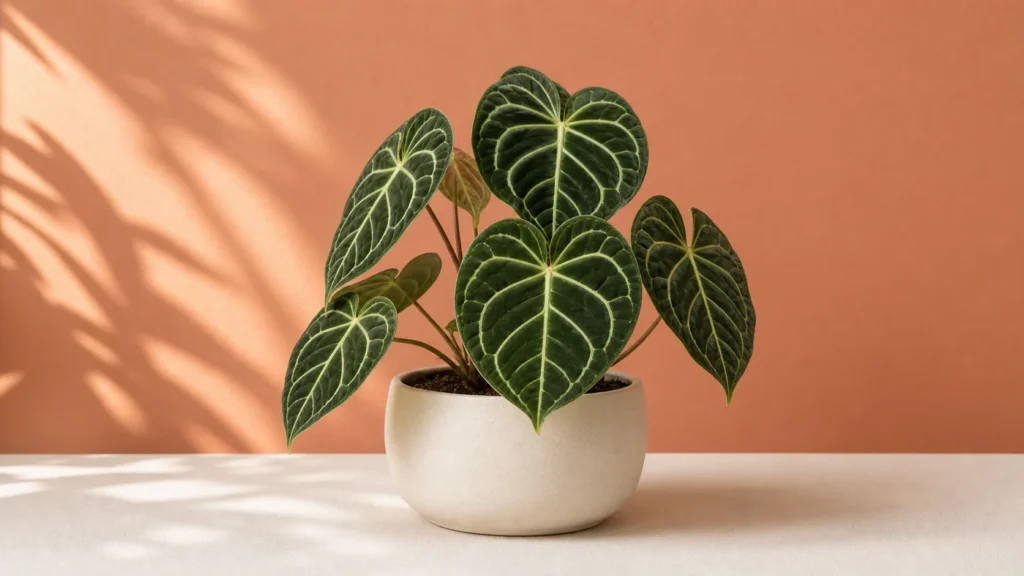
Anthurium Clarinervium
Anthurium clarinervium
A compact foliage anthurium with thick, velvet-green heart-shaped leaves traced by bold pale veins.
Watering frequency
Every 5-7 days
Ideal temperature
65-80°F / 18-27°C
Humidity
60-80%
Care difficulty
Hard
Air purifying
No/Not Known
Growth rate
Moderate
Plant size
1-2 ft / 0.3-0.6 m
Soil type
Chunky aroid mix
Fertilizer need
Every 4-6 weeks, spring-early fall.
Care summary
- Light: Bright indirect light; avoid harsh direct sun.
- Water: Let the upper mix partly dry, then water and drain.
- Soil: Use an airy, chunky mix around a compact root system.
- Humidity: Stable moderate-to-high humidity helps new leaves expand cleanly.
- Safety: Keep away from pets and children who may chew it.
Common problems
- Yellow leaves: overwatering, root stress, or normal aging.
- Brown edges: inconsistent watering, dry air, or fertilizer salts.
- Leaf spots: wet foliage, damage, or disease.
- Small leaves: weak light, root problems, or recent stress.
- Pests: thrips, mites, scale, or mealybugs.
Plant care guide
About Anthurium Clarinervium
Anthurium Clarinervium (Anthurium clarinervium) is a foliage-first aroid grown for thick, dark green leaves with a velvety surface and sharply contrasting pale veins. It is often sold as Velvet Cardboard Anthurium, while the shorter name "Velvet Anthurium" is a broader trade label that can also be used for other velvet-leaf species. Each leaf has a broad heart shape, a narrow or nearly closed sinus at the base, and a firm texture that gives a mature plant a sculptural presence without requiring the floor space of a large Monstera Deliciosa.
The accepted species is native to Chiapas in southeastern Mexico. Kew’s botanical record for Anthurium clarinervium describes it as a subshrub of a seasonally dry tropical biome. A detailed botanical treatment referenced by Kew records plants rooted among limestone rocks and in thin soil over rock. That background is important: this is not a swamp plant. It appreciates stable moisture and humidity while growing, but its roots also need oxygen and should not remain buried in dense, saturated compost.
Unlike the colorful flamingo-flower anthuriums sold for glossy spathes, A. clarinervium is chosen mainly for foliage. It can produce an aroid inflorescence—a narrow spadix accompanied by a small spathe—but the display is understated. Keeping or removing an inflorescence is a matter of preference; flowering does not mean the plant is about to die.
Why You’ll Like It
This plant delivers visual impact through a small number of exceptional leaves. Its pale venation looks almost graphic, while the velvet surface changes character as light moves across it. A compact specimen can anchor a plant shelf or side table without turning into a long vine.
It also suits growers who enjoy observation. A new leaf emerges soft and vulnerable, then expands and hardens over time. Watching that process makes stable watering, airflow, and humidity feel purposeful. The tradeoff is that damage on a long-lived velvet leaf remains visible. This is not the ideal plant for someone who needs every leaf to look flawless or who wants a houseplant that can be ignored for weeks.
Anthurium Clarinervium is often called a collector plant, but the label should not make its care mysterious. Most problems still return to familiar fundamentals: unsuitable light, a root zone that stays wet too long, abrupt environmental changes, excessive fertilizer, or pests hiding on new growth.
What Kind of Plant Is It?
This is a terrestrial or rock-associated Anthurium in the Araceae family. It grows from a short stem rather than producing long running vines. Roots may be thick relative to those of many ordinary houseplants, yet the overall root system can remain surprisingly compact. A pot chosen for the leaves rather than the roots often holds too much wet mix.
The velvet upper surface should be handled as little as possible. Rubbing, repeated wiping, leaf-shine products, and hard spray can mar it. Dust can be lifted with a very soft dry brush or a gentle stream of lukewarm water, followed by good airflow and time for the leaves to dry.
Growth is typically moderate under good indoor conditions and may pause in winter or after shipping and repotting. One well-formed new leaf is more meaningful than a promise of a fixed monthly growth rate. The plant redirects energy after root disturbance, and a new leaf can remain smaller if conditions changed while it was developing.
Popular Velvet Anthuriums and Related Plants
Several velvet-leaved Anthurium species are sold together, but they are related species rather than interchangeable varieties of A. clarinervium. Keeping the botanical label matters because mature size, leaf shape, and care tolerance can differ.
- Anthurium clarinervium: Usually has thick, broadly heart-shaped leaves, conspicuous pale veins, and a relatively compact habit. The narrow basal sinus helps distinguish it from some lookalikes.
- Anthurium crystallinum: Often develops more elongated velvet leaves with silver venation. It can become larger and is frequently used as a parent in foliage hybrids.
- Anthurium magnificum: Known for large velvet leaves and often identified in part by its more angular or winged petioles. Mature plants require substantially more room.
- Anthurium forgetii: Many forms have a closed, rounded leaf base without the familiar open heart-shaped sinus. It is distinct, not a round-leaf Clarinervium cultivar.
- Anthurium regale: Can produce very large, elongated leaves under suitable conditions. It is a different scale of plant and generally less forgiving of poor acclimation.
- Commercial velvet hybrids: Plants may combine traits from several species. Retain the full hybrid or cultivar label because appearance alone may not reveal the parentage.
If you enjoy collector foliage but want a vine, compare Philodendron billietiae or Swiss Cheese Vine. For a more widely available flowering aroid, Peace Lily offers a different texture and care rhythm. These internal comparisons are useful, but none should be assumed to use exactly the same watering schedule.
Where It Works Best
Give Anthurium Clarinervium bright indirect light. A position near an east-facing window is often straightforward. Near strong south- or west-facing glass, filter midday and afternoon sun with a sheer curtain or increase the distance. Direct hot sun can bleach or scorch the velvet surface, while insufficient light slows growth, keeps the mix wet longer, and may produce smaller leaves.
Do not classify a bright bathroom as suitable merely because it is humid. It must also have enough light and some air exchange. A living room or office with a humidifier can be more reliable than a dark, steamy bathroom. Avoid cold exterior doors, heating vents, and air conditioners that create abrupt temperature or humidity swings.
A grow light can provide consistency. Start with the fixture maker’s foliage-plant guidance, use a timer, and adjust based on new growth rather than pursuing a universal distance. Bleaching or tight, stressed growth can mean the light is too intense; long petioles leaning strongly toward the fixture can indicate too little usable light.
How to Water Anthurium Clarinervium
Water when the upper portion of the mix has begun to dry and the pot feels lighter, then wet the root ball thoroughly and allow all excess to drain. “Every 5–7 days” should be treated as a reminder to check, not an automatic schedule. A small pot in warm bright conditions may need water sooner; a recently repotted plant in winter may take much longer.
The goal is a cycle of moisture and aeration, not alternating between swampy and bone-dry. Allowing all roots to desiccate repeatedly can damage tips and make the next leaf struggle, but watering while the center remains saturated deprives roots of oxygen. Insert a wooden skewer into the mix or feel through a drainage hole if the chunky surface makes moisture difficult to judge.
Room-temperature rainwater or filtered water can reduce mineral residue where tap water is hard. The Royal Horticultural Society’s Anthurium guide recommends warmth, indirect light, a well-drained acidic mix, and rainwater or filtered water. This does not mean ordinary tap water always kills the plant; watch for salt crust, burned root tips, and worsening leaf edges, and flush the pot periodically when water quality or fertilizer buildup is a concern.
Do not let water sit in a closed cachepot. Empty the outer container after watering. Avoid routinely spraying the velvet leaves, especially late in the day or where air is stagnant.
Soil and Pot Choice
Use an airy, moisture-balanced aroid mix. A practical blend may include fine or medium orchid bark, perlite or pumice, and a moisture-retentive component such as coco coir or quality potting mix. The exact percentages should respond to the room: a coarse blend dries too quickly in some homes, while a peat-heavy blend remains airless in others.
Choose a pot with drainage holes only slightly larger than the healthy roots. Clear nursery pots can make moisture and root growth easier to inspect, but they are not required. Plastic retains water longer; breathable clay dries more quickly. Match the container to the mix and your habits rather than assuming one material is universally best.
Repot when roots have filled the container, the mix has broken down, water bypasses the root ball, or a root problem requires intervention. Avoid disturbing a healthy plant just because spring arrived. When repotting is needed, preserve firm roots, remove only dead or rotten tissue with a clean tool, and keep the short stem at approximately its previous level.
Humidity, Temperature, and Feeding
Stable moderate-to-high humidity helps new leaves unfurl without dry edges, but a precise 80% target is unnecessary in every home. Aim first for consistency around 50–70%, then observe the plant. A room humidifier is more effective than occasional misting. Very high humidity combined with wet leaves and no airflow can increase disease pressure rather than improve the plant.
Keep temperatures roughly 65–80°F (18–27°C) and avoid cold below about 60°F (16°C). RHS notes that Anthuriums prefer warmth and can be badly damaged at much lower temperatures. Root moisture should be reduced only as growth and drying slow; do not compensate for cold conditions by keeping the mix wet.
Feed lightly every four to six weeks during active growth with a diluted balanced or aroid fertilizer. Apply it to already moist mix. Pale growth is not automatically a fertilizer deficiency: root damage, intense light, pests, and natural leaf hardening can all alter color. Flush accumulated salts and pause feeding after repotting or when the roots are stressed.
Propagation
Anthurium Clarinervium is commonly propagated by division or by separating a basal offset that already has roots. Remove the plant from its pot, locate a natural division with its own growing point, and cut only if the sections do not separate cleanly. Pot each division snugly in an airy mix and keep conditions warm and stable while roots reestablish.
A stem section must include a viable growth point; a detached leaf without stem tissue does not become a new Anthurium plant. Advanced growers may root stem sections in a controlled humid environment, but decay is a significant risk if the medium stays saturated.
Seed propagation is possible only after successful pollination and berry development, and seedlings vary genetically. It is slow and unnecessary for routine home propagation. Never collect wild plants or seed; buy traceable nursery-propagated material.
Pet and Human Safety
Anthurium Clarinervium is not pet-safe. Anthuriums contain irritating compounds typical of many aroids, and the RHS Anthurium safety guidance advises keeping all parts away from children and pets and wearing gloves when handling. Chewing can cause immediate oral irritation; sap may also irritate sensitive skin or eyes.
If a pet bites the plant, remove access and contact a veterinarian or animal poison-control service for case-specific advice. Drooling, mouth pain or swelling, vomiting, and difficulty swallowing require prompt attention; breathing or swallowing difficulty is urgent. Do not induce vomiting or rely on a home remedy unless a professional directs you.
A high shelf is not automatically safe if leaves extend into jumping range or fallen trimmings remain on the floor. For determined chewers, use a closed plant cabinet or choose a genuinely pet-compatible plant.
Common Problems
- One lower leaf turns yellow: This can be normal aging, especially while a new leaf develops. Several yellow leaves plus wet mix suggest root stress or overwatering.
- Brown edges or tips: Check drying speed, water quality, fertilizer salts, drafts, and humidity. Do not raise humidity blindly while roots remain wet.
- A new leaf tears or hardens misshapen: Low humidity, physical contact, pests, or an abrupt watering change during expansion may be involved. Damaged tissue will not repair, so judge the next leaf after correcting conditions.
- Leaves fade or develop tan patches: Direct sun can scorch the surface. Move the plant to filtered light gradually; old damage remains visible.
- The plant droops in wet soil: Inspect roots instead of watering again. Rotten roots are dark, soft, or hollow and may smell sour.
- Small new growth: Review light and root health, then inspect for thrips or mites. A recently divided or repotted plant may temporarily downsize.
- Spots spread across leaves: Isolate the plant, keep foliage dry, improve airflow, and avoid splashing between plants. Rapidly spreading lesions may need diagnosis by a local extension service.
- Thrips, mites, scale, or mealybugs: Examine new leaves, petioles, and undersides with a magnifier. Isolate and use a treatment labeled for indoor ornamentals, testing it on a small velvet area first.
Frequently Asked Questions
Is Anthurium Clarinervium hard to care for? It is less forgiving than a common pothos because leaf damage is permanent and the roots dislike dense wet mix. It becomes manageable when light, drainage, warmth, and watering are stable.
Does it need 80% humidity? No universal threshold guarantees success. Many plants grow in stable moderate household humidity, though higher humidity can help soft new leaves expand. Airflow and root health remain essential.
Why is the newest leaf pale? Fresh leaves often emerge lighter and darken as they harden. If the color does not mature, also examine light intensity, nutrition, roots, and pests.
Should I cut off the flower? You may keep the inflorescence or remove it with a clean tool for a foliage-focused display. Cutting it is not a required health treatment.
Can I propagate it from one leaf? No. A leaf without a viable stem growth point cannot produce a complete new plant. Use a rooted division, offset, or suitable stem section.
Final Thought
Anthurium Clarinervium is most convincing when it is allowed to grow slowly and cleanly. Bright filtered light, a snug pot, an airy root zone, and steady rather than extreme humidity matter more than collector-plant tricks. Protect each emerging leaf, but accept that a living velvet plant will record the occasional bump or brown edge. Its beauty comes from the whole plant maturing over time, not from keeping every leaf permanently perfect.