
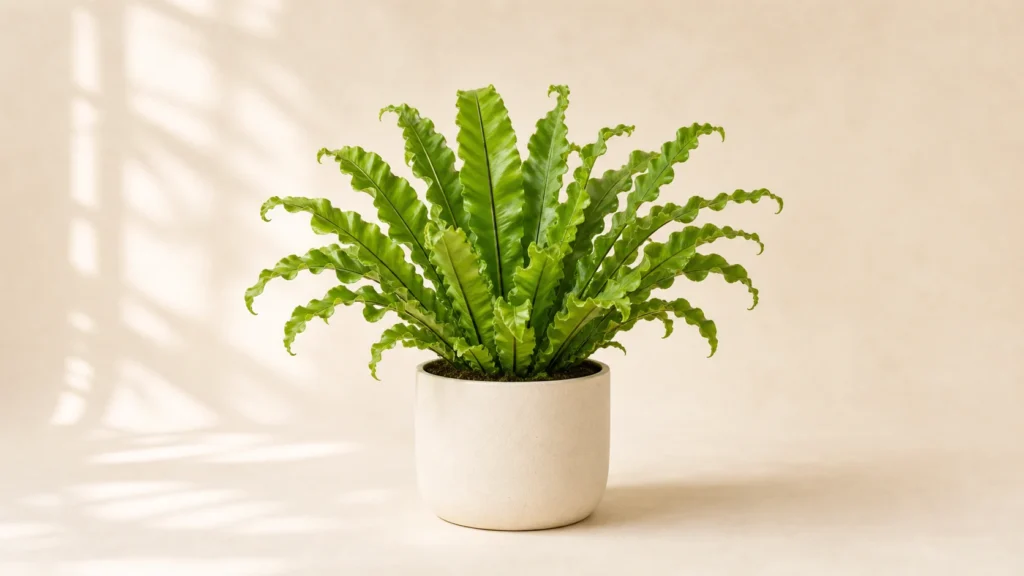
Bird’s-nest Fern
Asplenium nidus
A pet-compatible tropical fern with glossy strap-shaped fronds arranged in a nest-like rosette around a vulnerable central crown.
Watering frequency
Every 5-10 days
Ideal temperature
65-80°F / 18-27°C
Humidity
50-80%
Care difficulty
Medium
Air purifying
No/Not Known
Growth rate
Moderate
Plant size
1-2 ft / 0.3-0.6 m indoors
Soil type
Moist, porous fern mix
Fertilizer need
Every 4-6 weeks while growing.
Care summary
- Light: Medium to bright indirect light.
- Water: Keep lightly moist; water the mix around the rosette.
- Crown: Never leave water, fertilizer, or debris in the center.
- Humidity: Stable moderate-to-high humidity supports clean fronds.
- Handling: Protect the fragile central growth point.
Common problems
- Brown tips: dry air, moisture swings, or mineral salts.
- Yellow fronds: excess sun, wet roots, or aging.
- Crown rot: water and debris remain in the center.
- Spots: wet foliage, bacterial disease, or leaf nematodes.
- Pests: scale, mealybugs, or occasional mites.
Plant care guide
About Bird’s-nest Fern
Bird’s-nest Fern is a tropical Asplenium with glossy strap-shaped fronds that rise from a circular center. The overlapping bases form a funnel or “nest,” giving this fern a cleaner, more architectural outline than the feathery Boston Fern. New fronds emerge tightly rolled from a single central growing point and expand outward as older leaves arch around them.
This record uses Asplenium nidus, an accepted species within the large genus Asplenium. Identification in the nursery trade is not always simple: several related nest ferns—including A. antiquum, A. australasicum, and cultivars or hybrids—are sold under the same common name. Frond waviness alone does not prove the species. Keep the nursery label, and do not rewrite the botanical field from a photograph unless diagnostic traits and a reliable source support the change.
Kew’s accepted record for Asplenium nidus gives a native range from Malesia to northern and northeastern Queensland and describes it as an epiphyte or lithophyte of wet tropical environments. A lithophyte grows on rock. Both habits help explain why roots need humid, porous conditions rather than heavy ground soil.
NC State Extension’s Asplenium nidus profile describes the species as an evergreen epiphytic fern. An epiphyte grows on another plant for support rather than rooting in ordinary ground soil, without necessarily parasitizing its host. In rainforest habitat, the rosette catches falling organic debris and moisture. In a pot, that biology translates into a porous, organic root zone—not a dense, constantly waterlogged one.
Why You’ll Like It
Bird’s-nest Fern provides lush fern texture without shedding hundreds of tiny leaflets. Each frond is broad enough to wipe gently, and the rosette remains visually organized. A compact cultivar can fit a bathroom shelf or side table, while a mature species plant can become a substantial floor or hanging specimen.
It is commonly treated as pet-compatible, making it easier to place than toxic aroids or begonias. “Pet safe” still does not mean edible: chewing can damage the irreplaceable crown, and any plant material may cause mechanical irritation or stomach upset in an individual animal. Fertilizer, pesticides, and contaminated potting mix remain separate hazards.
The plant is especially satisfying when new fronds emerge cleanly. Because growth comes from one center, however, crown damage is more consequential than the loss of an outer leaf. Placement and watering should protect that growing point.
What Kind of Fern Is It?
Bird’s-nest Fern has simple fronds rather than the divided fronds associated with many familiar ferns. A dark midrib runs through each blade. Mature fertile fronds may develop rows of brown spore-producing structures called sori on their undersides. Sori arranged in regular lines are normal reproductive structures, not automatically scale insects or disease.
The plant has a short rhizome hidden beneath the rosette and a fibrous root system adapted to air, organic debris, and reliable moisture. It does not want to dry as deeply as a succulent, but it also lacks adaptations for standing water.
New fronds are tender and should never be pulled open. Damage to the center can deform several future leaves or stop growth. Keep hands, pet paws, watering-can spouts, and accumulated debris away from it.
Popular Bird’s-nest Fern Types
These names may refer to cultivars, related species, or trade selections. Verify the botanical label rather than assuming all are A. nidus.
- Classic Asplenium nidus: Broad green fronds with gently wavy margins and a dark central midrib.
- ‘Crispy Wave’: Sold for strongly rippled upright fronds. Commercial stock may be labeled under A. antiquum, so retain the full supplier label.
- ‘Osaka’: A trade name associated with prominently waved frond edges.
- ‘Victoria’: Often described as a compact nest fern with ruffled or crested-looking margins.
- ‘Campio’: Listed by NC State among A. nidus cultivars, with a distinctive compact or textured presentation.
- Hurricane Fern: Commonly sold for fronds that curve around the center in a swirling pattern; often associated with Asplenium antiquum ‘Hurricane’ rather than A. nidus.
- Australian Bird’s-nest Fern (A. australasicum): A separate related species that can become large and may be confused with A. nidus.
This section should support future internal links, but a separate Plant page should be created only after the identity and images of the named selection are verified.
Where It Works Best
Choose medium to bright indirect light. A bright north-facing window, filtered east light, or a position back from stronger glass often works. Too much direct sun yellows or scorches the smooth fronds; deep shade slows growth and keeps the mix wet longer.
A bathroom is useful only if it also has adequate light and ventilation. Steam for a few minutes does not compensate for a windowless room whose lights remain off most of the day. A humidifier in a bright living room may provide a more stable environment.
Avoid heating vents, air-conditioning drafts, frequently opened winter doors, and narrow locations where people brush the fronds. Keep it away from cold glass. Under a grow light, use a timer and watch new growth for bleaching or stretching rather than relying on one universal distance.
How to Water Bird’s-nest Fern
Keep the mix lightly and consistently moist, allowing the surface to begin drying before the next thorough watering. Every 5–10 days is a checking interval, not a fixed schedule. Pot size, root density, humidity, light, and season determine the real timing.
Apply water to the mix around the outer rosette. Do not pour it into the nest. Water trapped in the crown—especially in cool conditions—can rot the growing point. If water enters accidentally, tip it out or blot gently without touching the emerging frond.
Water enough to moisten the root ball, then drain completely. A decorative outer pot should be emptied. Repeated small sips leave uneven dry pockets, while a permanently filled self-watering reservoir may keep the mix too wet unless the system has been tested carefully.
Rainwater or filtered water can reduce mineral deposits where tap water is hard. Brown tips are not proof of one cause, so also check dry spells, fertilizer concentration, drafts, and root health before changing water sources.
Soil, Pot, and Repotting
Use a porous fern or epiphyte-friendly mix that holds moisture while admitting air. A quality peat-free houseplant mix amended with fine bark and perlite can work. Avoid garden soil and very coarse orchid bark used alone; one compacts, while the other may dry too rapidly for fine roots.
Choose a pot only slightly larger than the root mass, with drainage holes. Plastic retains moisture longer; terracotta increases evaporation. Either works when paired with the right mix and habits. A broad stable pot can support large arching fronds.
Repot when roots fill the container, the mix collapses, or water no longer penetrates evenly. Keep the crown above the mix and do not bury the central growing point. Handle the root ball and outer fronds, never lifting the plant by a new leaf.
Humidity, Temperature, and Feeding
Stable humidity around 50–70% is a useful target, though some cultivars appreciate more. A room humidifier provides measurable support. Pebble trays have limited reach and the pot must sit above the water. Airflow should remain gentle but present to reduce prolonged leaf wetness.
Temperatures around 65–80°F (18–27°C) support active growth. NC State notes that the species does not tolerate frost and should be protected from cold. Avoid temperatures below roughly 50–55°F (10–13°C), particularly with wet roots.
Feed lightly every four to six weeks while new fronds are forming, using a balanced liquid fertilizer at reduced strength. Apply it to moist mix, not the crown. Fern roots can burn from excess salts, so more fertilizer is not a shortcut to larger leaves.
Propagation and Spores
A single-crown nest fern generally cannot be divided without destroying the growing point. Some cultivars produce offsets that can be separated only after they have their own roots and center. A detached frond does not make a new plant.
Propagation from spores is possible but slow. Mature sori release dust-like spores that must be sown on a sterile moist surface. The first stage produces tiny gametophytes rather than miniature familiar ferns. Humidity, hygiene, and patience are essential, making spore culture an advanced project rather than a routine repotting task.
Buying and Acclimating a Nest Fern
Look into—but do not touch—the central crown. It should be firm, clean, and actively producing a new frond. Avoid plants with a black soft center, a chemical or sour smell, spreading translucent spots, or scale clustered along the midrib. Minor tears on older outer fronds are mostly cosmetic.
Keep the original species and cultivar label. The trade mixes several nest ferns, and pet-safety and mature-size statements should follow the identified plant rather than the retail common name alone. Quarantine new plants and inspect them under good light before placing them beside other ferns.
During acclimation, maintain warmth and humidity without immediately placing a nursery-grown plant in direct sun or a sealed terrarium. Avoid repotting unless the mix is failing, roots are severely crowded, or pests require it. A stable transition reduces the chance that the vulnerable new frond stalls or deforms.
Seasonal Care
In spring and summer, increasing light and warmth usually produce more frequent fronds, so moisture checks and light feeding become more important. In autumn and winter, indoor growth may slow even though the fern remains evergreen. Reduce fertilizer and lengthen the watering interval only as the pot actually dries more slowly.
The RHS profile for Asplenium nidus likewise recommends bright indirect light, moist but well-drained compost, moderate humidity, and light feeding in the growing season. Winter care should prevent both cold wet roots and a fully desiccated root ball.
Pet Safety
Bird’s-nest Fern is widely regarded as non-toxic to cats and dogs, but exact species identification matters because common names are unreliable. The database classification should apply only to a verified Asplenium nest fern. Discourage chewing, keep treatments and soil inaccessible, and consult a veterinarian if an animal becomes unwell after eating any plant.
Pet-safe status does not protect the plant. Cats can crush the crown or shred young fronds. Use a stable elevated position that truly remains out of reach if the animal is interested in foliage.
What About Air Purifying?
There is no good evidence that one Bird’s-nest Fern meaningfully cleans an occupied room. Laboratory chamber studies do not reproduce normal ventilation rates and continuing pollutant sources. Ventilation, filtration, and source control remain the practical tools; grow this fern for foliage and atmosphere.
Common Problems
- Brown tips: Review humidity, missed watering, salts, hot drafts, and root health.
- Yellow or bleached fronds: Reduce direct sun and check whether the mix stays saturated.
- Soft or black center: Crown rot is serious. Stop pouring into the nest, improve warmth and airflow, and remove decayed debris without damaging living tissue.
- Brown lines under leaves: Regular parallel sori are normal. Irregular raised bumps, stickiness, or insects elsewhere may indicate scale.
- Spreading wet-looking spots: Isolate the plant, avoid wet foliage, sanitize tools, and seek diagnosis; NC State lists bacterial leaf disease and leaf nematodes among possible issues.
- Distorted new growth: Inspect the crown for physical damage, pests, fertilizer exposure, or trapped debris.
Frequently Asked Questions
Should I water into the nest? No. In a container, water the mix around the rosette and keep the crown free of standing water.
Can it grow in a windowless bathroom? Not without a suitable grow light. Humidity cannot replace photosynthetically useful light.
Are the brown marks under the fronds pests? Orderly rows are probably sori, the fern’s spore-producing structures. Scale insects are raised and irregular and may occur with sticky residue.
Can I divide it? Do not cut through a single crown. Divide only naturally offsetting plants after each section has roots and its own growing point.
Final Thought
Bird’s-nest Fern looks simple because its leaves are broad and clean, but success depends on protecting one crucial center. Give it filtered light, porous moist mix, stable humidity, and warmth, then water around—not into—the rosette. With the crown undisturbed, each new frond adds to a durable, sculptural nest.