
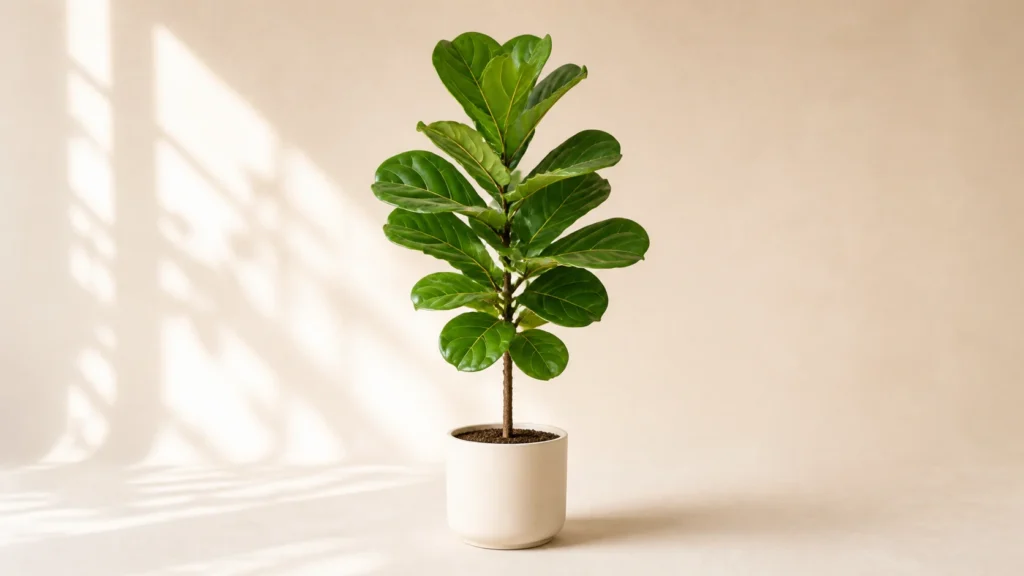
Fiddle Leaf Fig
Ficus lyrata
An architectural indoor fig with large violin-shaped leaves that needs strong light, careful watering, and a stable warm position.
Watering frequency
Every 7-14 days
Ideal temperature
65-80°F / 18-27°C
Humidity
40-60%
Care difficulty
Easy
Air purifying
Yes
Growth rate
Moderate
Plant size
4-8 ft / 1.2-2.4 m
Soil type
Well-draining mix
Fertilizer need
Monthly, spring-summer.
Care summary
- Light: Give bright indirect light and acclimated gentle sun.
- Water: Water after the upper portion dries, then drain completely.
- Stability: Avoid cold drafts and frequent location changes.
- Structure: Rotate regularly and prune healthy growth to shape or branch.
- Safety: Milky sap and plant material can irritate; keep away from pets.
Common problems
- Leaf drop: Review light, cold drafts, relocation, pests, and soil moisture.
- Dark brown spots: Check for wet soil, damaged roots, edema, or infection.
- Crispy edges: Review drought, heat, salts, and very dry air.
- Small new leaves: Increase usable light and inspect roots and pests.
- Pests: Check leaf undersides and stems for mites, scale, and mealybugs.
Plant care guide
About Fiddle Leaf Fig
Fiddle Leaf Fig (Ficus lyrata) is a tropical evergreen tree recognized by large, leathery leaves shaped somewhat like a violin or lyre. It has become a familiar indoor statement plant because a single trunk and broad canopy can visually anchor a bright room. The same large leaves also make stress conspicuous: one brown patch or dropped leaf is more noticeable than it would be on a fine-leaved shrub.
Kew's accepted botanical record places the species in tropical western and west-central Africa and describes it as a hemiepiphytic tree in wet tropical habitats. In nature it can begin life on another tree before establishing roots in the ground. Indoors, it is grown conventionally in a container and remains far smaller.
The plant is sometimes marketed as difficult, but most failures have recognizable causes: insufficient light, saturated soil, cold drafts, abrupt environmental changes, or delayed pest detection. It does not need constant attention. It needs a suitable location and a routine based on actual soil and seasonal conditions.
Why You'll Like It
Few houseplants deliver the same scale and silhouette. The large leaves create impact without a dense tangle of stems, and a mature plant can become part of a room's architecture. It can be maintained as a single-column tree, allowed to form several branches, or grown as a fuller multi-stem pot.
It also rewards long-term observation. New leaves unfurl at the growing tip, trunks gradually harden, and correctly timed pruning can change the entire structure. This makes it satisfying for someone who wants to develop one specimen over years rather than continually replace small decorative plants.
If your space has less light, a Rubber Plant may be somewhat more adaptable, although it still prefers a bright position. A Dwarf Umbrella Tree offers a branching indoor-tree shape with much smaller leaflets. Choose Fiddle Leaf Fig only when you can give it a genuinely bright, stable home.
What Kind of Plant Is It?
Fiddle Leaf Fig belongs to the fig family, Moraceae. Its foliage and stems contain white latex. Wear gloves when pruning, avoid contact with eyes and mouth, and clean tools afterward. The plant rarely flowers or fruits indoors; its value is foliage and form.
Each stem has nodes where leaves attach and dormant buds can activate. Removing the active tip may encourage a bud below the cut to grow, but branching is not guaranteed at every desired point. Light, season, plant health, and remaining leaf area all affect the response.
NC State Extension's Fiddle-leaf Fig profile documents the species, its western and central African origin, large lyre-shaped foliage, and irritating sap. It also notes that indoor plants can grow several feet tall, though final size depends on light, pruning, root space, and time.
Popular Forms
- Standard Fiddle Leaf Fig is the familiar tall form with full-size leaves and longer internodes.
- 'Bambino' is a compact selection sold for smaller spaces. Verify the cultivar label because a young standard plant is not automatically 'Bambino'.
- Multi-stem pots combine several rooted plants for an immediately fuller canopy; they are a nursery format, not a separate variety.
- Branched tree forms have been pruned and trained to create a clear trunk with a crown. Their future care is the same species care, but the top-heavy form needs stable support.
Avoid treating “dwarf,” “bush,” or “tree form” as verified cultivar names unless the label provides a recognized selection. Growth style can result from age, pruning, or multiple plants in one pot.
Where It Works Best
Place it close to a large east, south, or west window. Bright indirect light is the baseline, and an acclimated plant can benefit from gentle morning or late-afternoon sun. A position that looks bright across the room may deliver little usable light to the leaves.
Leave space between foliage and cold or hot glass. Avoid heater vents, air conditioners, exterior doors, and high-traffic locations where the leaves are repeatedly bumped. Once a position works, keep it stable. Rotation is useful for even growth, but moving between rooms with different light every few days is not.
A grow light can supplement weak winter conditions. Position and duration should follow the light manufacturer's guidance. Light from above supports straighter growth better than a small lamp aimed at one side.
How to Care for Fiddle Leaf Fig
Light
Strong light supports larger leaves, shorter gaps between them, and faster soil drying. Lower light slows growth and leaves roots in wet mix longer, making overwatering more likely. Small leaves, a leaning stem, long bare spaces, and no growth during a warm bright season suggest a light limitation.
Increase direct sun gradually. Pale bleached patches on the most exposed side after a move can indicate scorch. Damaged tissue will not turn green again, so judge the correction by new growth.
Watering
Allow the upper two or three inches of mix—or roughly the upper portion appropriate to the pot—to dry before watering. Check with a finger or wooden skewer and learn the pot's lighter dry weight. Then water the entire root ball until excess drains. Empty the saucer or cachepot.
Seven to fourteen days is only a starting estimate. A large plant in summer sun can use water faster; a small plant in a cool winter room may take much longer. Pot size, root density, material, humidity, and soil composition all change the interval.
Do not give frequent measured sips. They can wet only part of the mix and encourage uneven roots. Conversely, do not let the root ball become so dry that it shrinks away from the pot repeatedly. Consistency means responding at a similar stage of dry-down, not watering on the same weekday.
Soil and Container
Use a structured, well-draining indoor mix. Potting mix amended with fine bark, perlite, or pumice can hold moisture while preserving air spaces. Garden soil is usually too dense for an indoor container. Drainage holes are essential.
Choose a pot only modestly larger than the root ball. An oversized pot stays wet around roots that cannot yet use the moisture. A tall tree may need physical stability; place the correctly sized draining pot inside a heavier cachepot rather than burying it in excess soil.
Humidity and Temperature
Average household humidity of about 40–60 percent is generally workable. Very dry heated air can contribute to crisp edges, but brown tissue also results from drought, salts, root damage, or heat. A humidifier is more effective than occasional misting.
Keep temperatures around 65–80°F (18–27°C) and avoid cold drafts. Sudden cold can mark leaves or trigger drop. Winter growth slows as light declines, even in a warm room.
Fertilizer and Leaf Care
Feed monthly at a diluted label rate during active spring and summer growth. Reduce or stop when growth pauses. Fertilizer cannot correct low light or diseased roots, and excess salts may burn leaf margins.
Wipe the large leaves with a damp soft cloth, supporting each blade with one hand. This removes dust and reveals early pests. Avoid oily leaf-shine products that leave residue.
Rotation, Pruning, and Branching
Rotate the pot about a quarter turn every week or two while growth is active. If a plant already leans heavily, rotation alone will not instantly straighten old wood, but it can improve new growth.
Prune a healthy stem just above a node in spring or early summer. Wear gloves for latex. Keep enough leaves below the cut to support recovery. One or more buds may activate; allow shoots to develop before deciding which to retain.
“Notching” is sometimes promoted as a guaranteed way to force a branch, but response is inconsistent and every wound introduces risk. Ordinary tip pruning on a vigorous, well-lit plant is simpler for most home growers.
How to Propagate Fiddle Leaf Fig
Use a stem cutting that includes at least one node. A leaf with only its petiole may form roots but cannot reliably develop into a complete tree without a viable stem bud.
Take a healthy tip or section, protect yourself from sap, and place the lower node in water or an airy propagation medium. Give warmth and bright indirect light. Large leaves lose water quickly, so reduce their number or loosely raise humidity while maintaining airflow.
Change propagation water regularly or keep the medium lightly moist, not soggy. Pot the cutting when it has a branching root system capable of supporting the leaf area. Do not move immediately into a large container.
Air layering is useful on a tall plant because the top forms roots while still attached. Once a substantial visible root mass develops in the wrapped medium, cut below it and pot the rooted top.
When to Repot
Repot when roots densely circle, emerge from drainage holes, the mix has structurally collapsed, or the plant dries so quickly that thorough watering no longer lasts. An annual calendar is unnecessary. Spring or early summer gives the strongest recovery conditions.
Move up one pot size, maintain the same planting depth, and avoid combining severe root pruning, heavy top pruning, low light, and overfeeding. Some temporary adjustment is possible, but widespread decline calls for a moisture and root check.
Toxicity and Pet Safety
Fiddle Leaf Fig is not pet-safe. Its latex and plant material can irritate skin and the digestive tract. ASPCA's houseplant safety guidance describes Fiddle Leaf Fig as mildly toxic to cats and dogs and notes possible vomiting, diarrhea, and skin irritation from sap.
Keep foliage and prunings away from pets and children. If chewing or ingestion occurs, contact a veterinarian or animal poison-control service and provide Ficus lyrata. For human exposure, contact the appropriate poison-control or medical service. Breathing or swallowing difficulty needs urgent help.
Common Problems and Practical Fixes
Leaves drop after a move
Transport changes light, temperature, humidity, and watering at once. Place the plant in its intended bright position, check moisture, and allow it to stabilize. Do not respond by repeatedly relocating or fertilizing it.
Dark brown spots
Soft dark areas with wet soil may indicate damaged roots or moisture-related edema; expanding lesions may involve infection. Check roots, drainage, airflow, and whether leaves remain wet. Remove only badly damaged tissue and clean tools.
Crispy brown margins
Inspect for prolonged drought, hot glass, low humidity, and mineral or fertilizer salts. Water deeply when due and flush healthy mix occasionally. Old damage remains; improvement appears on new leaves.
Yellow lower leaves
One old leaf may age naturally. Several yellow leaves with wet soil suggest overwatering or poor drainage. If the pot is dry and very light, severe drought is possible instead.
Red or brown pinpoints on new leaves
Small marks can be edema from uneven water uptake and may become less prominent as a leaf matures. Large spreading damage, webbing, or distortion requires a closer pest and disease inspection.
Mites, scale, or mealybugs
Isolate the plant. Inspect leaf undersides, veins, stems, and new growth. Clean accessible pests and use a treatment labeled for the identified pest and indoor plants, repeating checks as directed.
Frequently Asked Questions
Can Fiddle Leaf Fig grow in low light?
It may persist for a time, but strong growth and manageable watering require bright light. A windowless room needs an adequate grow light.
Why is my plant not growing?
Season, light, root health, recent relocation, pests, and pot moisture all matter. Do not assume it needs more fertilizer until these are checked.
Should I shake the trunk?
Gentle air movement and normal handling are enough. Shaking is not a substitute for light or proper structure and can damage roots or leaves if done forcefully.
Can I cut the top off?
Yes, on a healthy actively growing plant. The remaining stem may branch, and the removed top can be propagated if it contains a node.
How often should I rotate it?
A quarter turn every week or two during active growth is a practical starting point. Keep the overall location and light level stable.
Final Thought
Fiddle Leaf Fig care becomes simpler when light and stability come first. Give it a bright permanent position, water from soil evidence, protect the airy root zone, and make structural changes during active growth. It will never hide stress as quietly as a small-leaved plant, but that visibility also makes its needs readable.