
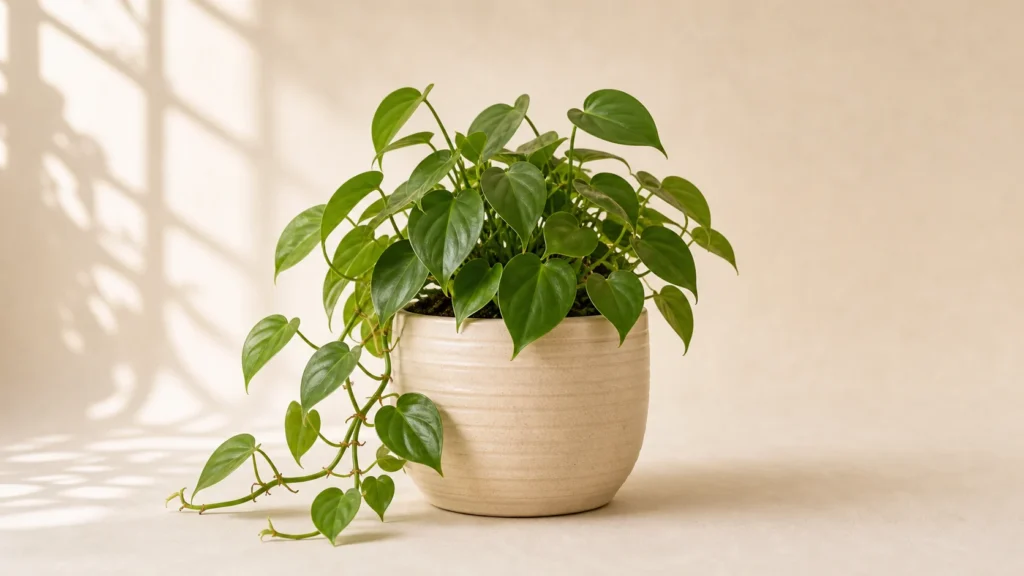
Heartleaf Philodendron
Philodendron hederaceum
A fast-growing heart-shaped aroid vine that can trail or climb and adapts well to medium or bright indirect light.
Watering frequency
Every 7-10 days
Ideal temperature
65-85°F / 18-29°C
Humidity
40-60%
Care difficulty
Easy
Air purifying
Yes
Growth rate
Fast
Plant size
2-6 ft / 0.6-1.8 m
Soil type
Loose aroid mix
Fertilizer need
Monthly, spring-summer.
Care summary
- Light: Medium to bright indirect light; lower light slows and stretches growth.
- Water: Water when the upper layer dries, then drain thoroughly.
- Growth: Let vines trail or give them a support for larger, more mature leaves.
- Shape: Prune above nodes and replant rooted cuttings for fullness.
- Safety: Calcium oxalate makes all plant parts unsafe to chew.
Common problems
- Yellow leaves: Check wet soil, drainage, light, and normal leaf aging.
- Long gaps and small leaves: Increase usable light or provide climbing support.
- Brown tips: Review drought, salts, damaged roots, and very dry air.
- Root rot: Remove soft roots and replace waterlogged mix.
- Pests: Inspect new growth for mites, scale, mealybugs, aphids, and thrips.
Plant care guide
About Heartleaf Philodendron
Heartleaf Philodendron (Philodendron hederaceum) is a tropical evergreen vine with glossy heart-shaped leaves and slender stems that can trail from a shelf or climb a support. It is also sold as Sweetheart Plant or under older botanical names such as Philodendron scandens and P. oxycardium. Those older labels refer to the familiar plant but should not replace the currently accepted identity in the database.
NC State Extension's species profile documents the common names, former scientific names, climbing habit, tropical American range, and named cultivars. Heartleaf Philodendron remains a strong consumer-facing title because it distinguishes this vine from self-heading and tree-like plants also marketed broadly as philodendrons.
Its reputation for tolerating low light is accurate only in a limited sense. It can remain alive and produce some growth in weaker light, but brighter filtered light makes fuller vines, shorter spaces between leaves, and more manageable watering. No green plant grows indefinitely in a truly windowless room without an appropriate artificial light source.
Why You'll Like It
This is one of the most adaptable vining aroids. It grows quickly once established, roots readily from nodes, and can be styled in several ways. Let it cascade from a hanging basket, guide it around a window, or train it upward to encourage larger leaves.
It is also easy to renew. If a pot becomes sparse, prune healthy vines, root the cuttings, and plant them back around the crown. That capacity makes an aging plant recoverable rather than disposable.
For a similar trail with thicker texture and yellow patterning, compare Golden Pothos. For a brighter named form within this species, Philodendron 'Lemon Lime' is already represented in the project but currently shares the same intended plant route, so duplicate internal-page behavior must be reviewed before publishing both. Heartleaf Philodendron is the base green species page. For a pink-variegated relative in the same genus, compare Pink Princess Philodendron, a different species whose pink blotching comes from a chimeric mutation.
What Kind of Plant Is It?
The plant is a climbing aroid in the Araceae family. Nodes occur where leaves attach to the vine. Each viable node can contain a bud and may produce aerial roots. A cutting needs a node; a detached leaf and petiole alone cannot make a complete new vine.
New leaves emerge protected by a thin sheath called a cataphyll, which later dries and may fall away. This feature helps distinguish Heartleaf Philodendron from pothos. The petiole is generally rounded rather than distinctly grooved or winged.
In nature, stems climb toward brighter canopy conditions. Indoors, trailing stems often keep smaller leaves, while supported stems with good light can mature and produce larger foliage. A moss pole is optional; a plank, coir pole, trellis, or other secure support can work if stems are attached gently.
Popular Heartleaf Philodendron Varieties
- Green Heartleaf Philodendron is the standard solid-green species form covered by this page.
- 'Brasil' has a central chartreuse-to-yellow stripe over green leaves. Pattern stability can vary by stem.
- 'Lemon Lime' produces bright yellow-green to chartreuse foliage and needs sufficient light to maintain strong color.
- 'Rio' is known for elongated leaves with silver, cream, and green striping; use the name only with reliable provenance.
- 'Cream Splash' carries cream and green patterning that can be confused with other selections.
- 'Silver Stripe' is another named striped form and should not be collapsed into a generic “variegated philodendron” identity.
Named cultivars belong to the same species but can differ in color stability, vigor, and light needs. Retain the seller's cultivar label and avoid assigning a collector name from one leaf photograph.
Where It Works Best
Place it close to an east, south, or west window with filtered light. It can grow farther back in a bright room, but monitor internode length and soil drying. A north window may work in an unobstructed bright exposure.
Trailing plants suit shelves and hanging baskets, but check whether pets can reach lengthening vines. A high pot is not safe once stems cascade to the floor. For climbing, position support at potting time or insert it carefully without damaging a dense root ball.
Average living rooms, bedrooms, and offices are suitable if they have natural light. Avoid cold drafts, heater blasts, and dark bathroom placement based only on humidity. Humidity cannot replace light.
How to Care for Heartleaf Philodendron
Light
Medium to bright indirect light produces the best balance of growth and manageable watering. Gentle morning sun is usually acceptable after acclimation. Harsh direct exposure can bleach or scorch leaves, especially pale cultivars.
Long gaps between leaves, very small new foliage, and vines leaning hard toward a window indicate insufficient light. Move closer gradually or add a grow light. Pruning without improving light only produces another stretched shoot.
Watering
Water when the upper one or two inches of mix begin to dry, then saturate the root ball and let excess drain. Empty standing water. Heartleaf Philodendron prefers some moisture but needs oxygen around its roots.
Seven to ten days is only a starting estimate. A small hanging basket in summer may dry faster; a large plastic pot in low winter light may take much longer. Check soil and pot weight rather than relying on a weekday.
Soft yellow leaves with wet soil suggest overwatering or root stress. Limp foliage in dry mix suggests thirst. A wilted plant in wet soil may have roots too damaged to take up water; do not automatically add more.
Soil and Container
Use a loose aroid-style mix that holds moderate moisture while draining freely. Indoor potting mix amended with fine orchid bark and perlite is a practical formula; exact ratios should be adjusted to the room and watering habits.
Drainage holes are essential. Hanging cachepots often hide standing water, so remove the inner pot to water and allow it to drain before rehanging. Increase pot size modestly when roots genuinely fill the container.
Humidity and Temperature
Average humidity around 40–60 percent works well. Higher humidity may support unfurling and aerial roots, but constant wet leaves can promote spotting. Use a humidifier for sustained improvement and maintain airflow.
Keep the plant around 65–85°F (18–29°C), away from cold windows and drafts. Growth slows in winter; reduce water and fertilizer accordingly.
Fertilizer
Feed monthly at a diluted label rate from spring through early fall, while the vine is producing new leaves; reduce or pause in winter when growth slows. Fresh commercial mix may already contain fertilizer. Pale growth can result from low light, wet roots, or pests, so do not assume every color change is a nutrient shortage.
Flush healthy soil occasionally if fertilizer or hard-water crust accumulates. Never fertilize severely dry roots without first rehydrating them.
Trailing, Climbing, and Pruning
For trailing growth, rotate the pot and pinch tips periodically to encourage branching. For climbing, attach stems loosely with soft ties and guide aerial-root nodes toward the support. Do not bind petioles, which need freedom to orient leaves.
Prune just above a node on the parent vine. The node below the cut may activate. Bare sections can be cut into node segments for propagation, while rooted tip cuttings can be returned to the pot for density.
How to Propagate Heartleaf Philodendron
Take a stem cutting with at least one node and one healthy leaf. Place the node—not the leaf—in water, sphagnum, perlite, or an airy propagation mix. Give warmth and bright indirect light.
Change water regularly or keep solid media lightly moist. Pot when roots have begun branching rather than when one tiny root appears. Use a small container to avoid a large wet zone.
For a fuller result, root several cuttings and distribute them around the pot. A long leafless vine can be divided into “wet sticks,” each with a viable node, but growth is slower because there is no leaf supplying energy. Maintain humidity and airflow and discard any segment that becomes soft.
When to Repot
Repot when roots densely circle, emerge from holes, the mix has collapsed, or the plant dries too quickly despite thorough watering. A little root crowding is acceptable. Move up one size during active growth.
If vines are long, arrange and support them before unpotting so they are not torn. This is also a good time to add a climbing support or replant rooted cuttings.
Seasonal Care
Spring and summer support pruning, propagation, support training, and regular feeding. Check baskets more often as foliage and roots increase water use. Outdoor summer placement must be sheltered and gradually acclimated.
In winter, move closer to available light, extend the watering interval, and reduce fertilizer. Cold glass and heater air can damage leaves. Inspect for mites and scale before crowded plants spend months indoors.
Buying and Establishing a Full Pot
Many retail pots contain several cuttings, which creates fullness immediately. Check that each stem is firm and rooted rather than loosely inserted for appearance. Inspect new leaves and the spaces where petioles meet vines for thrips, mealybugs, or scale. Avoid plants with a sour-smelling root ball or widespread soft yellow growth.
Quarantine a new plant and place it in its intended light. If the pot has only one or two long vines, you do not need a larger container to make it fuller. Prune healthy tips, root them, and return them around the crown. This adds growing points without surrounding a small root system with excess wet mix.
When combining cuttings, use stems from the same verified species or cultivar. Mixing green Heartleaf Philodendron and an unidentified patterned vine may look attractive initially but makes later identity, reversion, and internal-link decisions harder.
Toxicity and Pet Safety
Heartleaf Philodendron is not pet-safe. ASPCA's species-specific guidance identifies insoluble calcium oxalates and possible mouth pain and swelling, drooling, vomiting, and difficulty swallowing in cats and dogs.
Keep every part away from pets and children, including trailing vines and propagation jars. If chewing occurs, contact a veterinarian or animal poison-control service and provide Philodendron hederaceum. Difficulty swallowing or breathing requires urgent professional attention. Sap may irritate sensitive human skin, so gloves are sensible for major pruning.
Common Problems and Practical Fixes
Yellow leaves
Check soil moisture first. Wet mix and multiple yellow leaves suggest overwatering or root damage. One old leaf may be normal. Dry mix and limp foliage point toward thirst.
Small leaves and long gaps
Increase light and consider climbing support. Trailing vines naturally stay less mature, but severe stretching is an environmental signal.
Brown tips
Review drought, fertilizer salts, hard water, low humidity, and roots. Old damage remains; assess the next leaves after correcting the cause.
Curling or stuck new leaves
Check moisture consistency, humidity, cold, and pests. Do not forcibly peel a new leaf. Improve conditions and let it release naturally.
Root rot
Remove the plant from wet compacted mix, trim soft dark roots, and repot healthy tissue in an airy mix. Salvage firm node cuttings as insurance.
Mites, scale, thrips, or mealybugs
Isolate the plant and inspect both surfaces and new growth. Identify the pest and use a treatment labeled for indoor plants. Repeat checks because vines provide many hiding places.
Frequently Asked Questions
Is Heartleaf Philodendron the same as pothos?
No. Both are climbing aroids, but they belong to different genera and have different petiole and new-leaf structures.
Can it grow in low light?
It tolerates lower light better than many plants, but growth becomes slower and leggier. Windowless spaces require a grow light.
Does it need a moss pole?
No. It can trail successfully. A support is useful when larger, more mature leaves are the goal.
Why is the top of the pot bare?
Old vines may have lost lower leaves. Root tip cuttings and plant them around the crown; also improve light so new growth stays dense.
Can I propagate a leaf?
Only if stem tissue with a viable node is attached. A leaf alone cannot create a complete vine.
Should aerial roots be cut off?
They can be left, guided toward a support, or trimmed for appearance without harming a healthy established plant. Preserve the node itself, and do not confuse a dry aerial root with a rotting stem.
Final Thought
Heartleaf Philodendron is forgiving because it communicates clearly and renews easily. Give it enough light, water from soil evidence, decide whether it should trail or climb, and prune at real nodes. Its ease does not remove the calcium-oxalate risk, so placement must remain genuinely inaccessible to pets.