
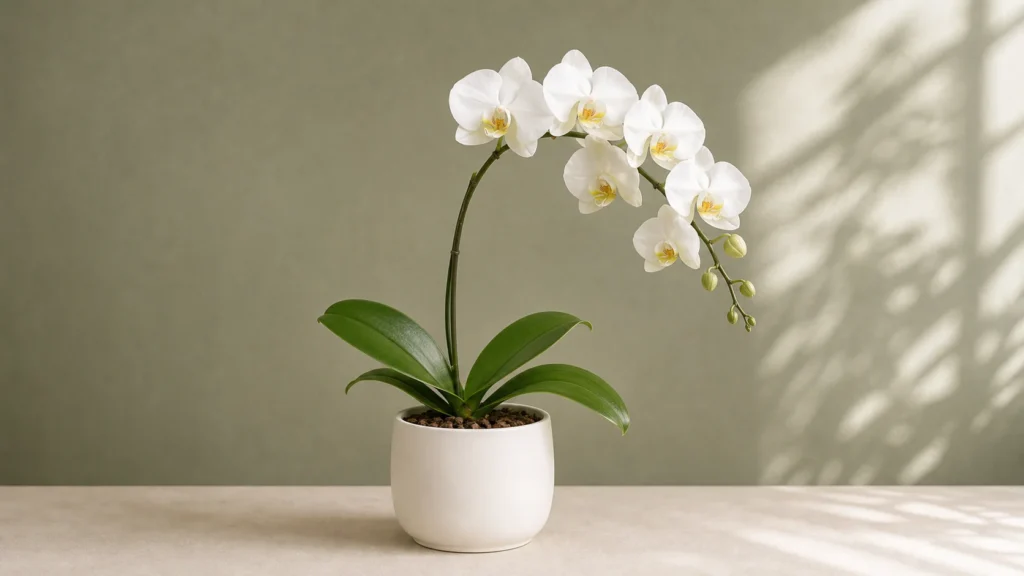
Phalaenopsis Orchid
Phalaenopsis spp.
A long-blooming moth orchid whose fleshy roots need filtered light, airflow, and an airy orchid medium rather than ordinary potting soil.
Watering frequency
Every 7-10 days
Ideal temperature
65-85°F / 18-29°C
Humidity
50-70%
Care difficulty
Medium
Air purifying
No/Not Known
Growth rate
Slow
Plant size
1-2 ft / 0.3-0.6 m
Soil type
Airy orchid bark or managed sphagnum
Fertilizer need
Every 2-4 weeks while roots and leaves grow.
Care summary
- Light: Give bright filtered light without hot midday sun.
- Water: Water when the medium nears dryness, then drain completely.
- Roots: Use airy orchid medium and never bury the crown.
- Rebloom: Maintain healthy leaves and roots before managing the old spike.
- Safety: ASPCA includes Phalaenopsis among pet-friendly plants.
Common problems
- Soft brown roots: Check decomposed medium, poor drainage, and excess water.
- Wrinkled leaves: Inspect both dry medium and damaged roots.
- Bud blast: Review temperature, drafts, relocation, drought, and ripening fruit.
- Crown rot: Remove trapped water and improve warmth and airflow.
- Pests: Inspect flowers, leaf joints, and roots for scale and mealybugs.
Plant care guide
About Phalaenopsis Orchid
Phalaenopsis Orchid is the familiar Moth Orchid sold in supermarkets, florists, and garden centers. This page covers cultivated Phalaenopsis species and the complex hybrids most buyers receive without a cultivar name. The arching flower spike can hold blooms for many weeks, but the permanent plant is the short central stem, leaves, and roots—not the decorative stake or flowers.
Most Phalaenopsis are epiphytic orchids: in nature their roots attach to trees without parasitizing them. Pot culture must therefore supply moisture and oxygen at the same time. Ordinary dense houseplant soil closes the air spaces around roots and is one of the fastest ways to lose an otherwise healthy orchid.
The thick roots are covered by velamen, a pale spongy tissue that absorbs water. Exposed healthy roots commonly look silver when dry and green after wetting. Color is useful in a clear pot, but it is not the only watering rule: interior roots, medium type, pot weight, season, and temperature also matter.
Why You'll Like It
Phalaenopsis gives a large floral display from a relatively small footprint. A mature plant can rebloom for years when owners keep the roots and leaves healthy after the gift flowers fade. Flowers appear in white, yellow, pink, purple, spotted, striped, and novelty combinations, so the genus offers variety without requiring a different basic indoor setup for every color.
It is also a lower-risk choice for pet households. ASPCA's pet-friendly plant guide includes Phalaenopsis Orchid. Non-toxic does not mean edible, and floral sprays, systemic pesticides, decorative picks, and potting materials can carry separate hazards.
Compare African Violet for a compact flowering plant in conventional potting mix, Anthurium Clarinervium for dramatic foliage with toxic aroid tissue, or Peace Lily for white spathes that are often mistaken for orchid-like flowers but require a different root environment.
What Kind of Plant Is It?
Phalaenopsis grows monopodially, meaning one central growing point produces leaves upward. New roots and flower spikes emerge from the short stem between leaves. It does not make pseudobulbs, the water-storage structures found in many other orchids, so its leaves and roots should not be left severely dry for extended periods.
A root is round with a smooth growing tip; a flower spike is flatter, often mitten-shaped at the tip, and develops small nodes beneath papery bracts. New roots can grow into the air. Do not force every aerial root into the pot or cut it merely because it looks untidy.
Leaves naturally form in a two-sided fan. The oldest bottom leaf eventually yellows and drops, while multiple simultaneous yellow leaves demand investigation. A healthy crown should remain firm and dry rather than buried in moss or filled with water.
Phalaenopsis Types and Flower Forms
Most mass-market plants are unnamed hybrids, and a flower color is not a cultivar identity. Useful categories include:
- Standard large-flowered hybrids: The classic staked gift orchid with broad overlapping blooms.
- Multiflora hybrids: Smaller flowers carried in greater numbers on branching spikes.
- Mini Phalaenopsis: Compact hybrids often sold in very small pots; their tiny root volume can dry quickly even when packed moss looks wet outside.
- Novelty Phalaenopsis: Hybrids influenced by fragrant, waxy, or sequentially flowering species; some bloom from green spike tips over a long period.
- Harlequin types: Hybrids with irregular spots or blotches; the pattern describes breeding style, not a single cultivar.
- Peloric flowers: Blooms whose petals partly resemble the lip because of a floral mutation; this is a flower form rather than a separate care group.
Keep an original breeder tag when present. It carries more identity value than a replacement label saying only “purple orchid.”
Where It Works Best
An east window is an excellent starting point. A bright north window or a shaded south or west exposure can also work. The American Orchid Society's Phalaenopsis culture sheet recommends a bright window with little or no harsh sun and emphasizes that filtered light, temperature, water, humidity, and airflow work together.
Leaves should receive useful light without becoming hot. Dark olive leaves and no rebloom can indicate insufficient light, while yellow-green bleached patches on the window side may indicate scorch. Leaf color also varies genetically, so assess growth and flowering rather than using one exact shade as a universal meter.
Keep blooming plants away from exterior-door drafts, heating vents, and bowls of ripening fruit. Ethylene from fruit and abrupt environmental changes can shorten flower life or cause buds to abort. A bright bathroom works only if it has real light and air movement.
How to Care for Phalaenopsis Orchid
Light
Give bright filtered light for most of the day. Gentle morning sun is often tolerated after acclimation; intense midday or afternoon sun through glass can overheat leaves. Rotate only when needed for balanced growth—repeatedly changing the orientation of a developing spike can create awkward bends.
If a plant grows healthy leaves but never initiates a spike, improve light gradually before increasing fertilizer. Artificial light can work when positioned close enough and used consistently according to the fixture's plant-light guidance.
Water: Bark Versus Moss
Treat seven to ten days as an inspection reminder. Bark contains large air spaces and may dry faster, while tightly packed sphagnum can remain wet deep inside long after its surface looks dry. A small plant in moss may need less frequent watering than a larger plant in coarse bark.
Water when the medium is approaching dryness but before leaves dehydrate. Soak thoroughly in the morning and let all excess drain. Do not leave the growing pot submerged in a decorative sleeve. If water collects in the crown or leaf joints, blot it promptly, especially in cool conditions.
Ice cubes are not a botanical requirement. Room-temperature water applied thoroughly lets the entire root zone become evenly moist and allows salts to flush. The correct volume and interval depend on the medium and pot, not on a fixed number of cubes.
Orchid Medium and Pot
Use fresh orchid bark, a bark-based blend, managed sphagnum, or another porous orchid medium. A clear slotted plastic pot makes roots and moisture easier to observe but is not mandatory. The container should be just large enough for the functioning root system and should drain freely.
Never bury the crown or pack moss tightly against the stem. Air roots may remain outside. A decorative ceramic cachepot can stabilize the plant, but remove the inner pot for watering and empty runoff.
Humidity, Airflow, and Temperature
Aim for about 50–70 percent humidity with gentle air movement. Higher humidity without airflow increases the time leaves and the crown remain wet. Misting flowers can spot them and is not a substitute for room humidity.
Typical indoor temperatures around 65–85°F (18–29°C) suit common hybrids. Warm days support leaf and root growth; a modest period of cooler nights in fall can help many hybrids initiate spikes. Do not expose a blooming plant to abrupt cold, which may cause bud blast.
Fertilizer
Feed weakly every two to four weeks while new roots or leaves are growing; in a typical bright home this is most often spring through early fall, but resume whenever active growth returns. Follow an orchid-fertilizer label at a diluted rate, wet dry roots with plain water first, and flush occasionally with plain water to limit salt buildup, especially in sphagnum.
“Weakly, weekly” is a grower shorthand, not a command for every home. A cool plant growing slowly needs less fertilizer than a warm, bright, actively growing one. Fertilizer does not repair rotten roots.
Flower-Spike Decisions
After the last flower falls, inspect the spike. A brown dry spike can be cut near the base. A green spike may be left, cut above a dormant node for a possible side branch, or removed at the base so the plant directs energy to roots and leaves. Weak plants benefit from complete spike removal.
A secondary branch is not guaranteed and may carry fewer flowers. The priority is a healthy crown with firm leaves and active roots; reblooming follows good culture rather than a pruning trick alone.
How to Propagate Phalaenopsis
Home propagation is limited. A plant may occasionally form a keiki, a small plantlet on a flower spike or at the base. Allow a spike keiki to develop several leaves and multiple substantial roots before separating it with a clean tool and potting it in fine orchid medium.
Cutting an ordinary leaf or root will not produce a new Phalaenopsis. Commercial growers propagate by seed under sterile laboratory conditions or through tissue culture. Avoid internet methods that promise orchids from chopped leaves in kitchen ingredients.
When and How to Repot
Repot when medium has decomposed, roots are suffocating or rotting, the pot no longer drains reliably, or the plant has outgrown an unstable container. One to three years is a broad interval, not a deadline. The best time is often after flowering as new roots begin, but failing medium should be replaced promptly.
Soak roots to make them flexible, remove old medium, and trim only hollow, mushy, or dead roots with sterilized tools. Firm living roots can be green, silver, yellow, or white depending on light exposure. Position the crown above the medium and stabilize the plant so new root tips do not rub.
Pet and Household Safety
Phalaenopsis is regarded as non-toxic to cats and dogs by ASPCA's pet-friendly guidance. Discourage chewing because any fibrous plant material can cause gastrointestinal upset. Confirm that the plant is truly a Phalaenopsis rather than relying on the word “orchid” alone.
Keep fertilizer, pesticides, stakes, clips, and decorative moss away from pets and children. If an exposure produces symptoms, contact a veterinarian, animal poison-control service, human poison-control service, or medical professional as appropriate.
Common Problems and Practical Fixes
Wrinkled or limp leaves
The plant is not receiving enough water, but the cause may be dry medium or dead roots unable to absorb moisture. Slide the inner pot out, inspect roots, and smell the medium before watering more. Fix the root system rather than repeatedly soaking rot.
Soft brown or hollow roots
Decomposed medium, poor drainage, cold wet conditions, or overly frequent watering may be responsible. Remove dead tissue, repot in fresh porous medium, and adjust the interval to the actual drying rate.
Crown rot
A soft dark center or easily detached newest leaf is serious. Keep water out of the crown, provide warmth and airflow, and isolate the plant. Prevention is far more reliable than rescue because the single central growing point can be destroyed.
Bud blast
Buds can yellow and fall after drought, temperature swings, drafts, low light, relocation, root stress, or ethylene exposure. Stabilize conditions. The aborted buds will not reopen, but the plant can flower in a later cycle.
Yellow leaves
One bottom leaf may age naturally. Several yellow leaves suggest root trouble, excess sun, cold, or crown stress. A new top leaf yellowing or pulling loose deserves urgent crown inspection.
Pests
Mealybugs hide in leaf joints and flowers; scale attaches to leaves and spikes; mites cause stippling; fungus gnats can breed in decomposed wet medium. Isolate, identify, and use a treatment labeled for orchids and the pest. Protect open blooms from products that may spot them.
Frequently Asked Questions
Do I water when roots turn silver?
Silver exposed roots are one useful clue. Also check interior medium, pot weight, temperature, and root health. Green roots can remain visible while packed moss inside is dangerously wet.
Should I cut the flower spike?
Cut a dry spike at the base. A green spike may be kept, shortened above a node, or removed; choose based on plant strength and the display you want.
Why are roots growing outside the pot?
Aerial roots are normal for an epiphytic orchid. Leave healthy roots intact unless they are dead or make repotting impossible.
Can I repot while it is flowering?
Yes when roots or medium are failing, although flowers may fade sooner. Plant survival is more important than preserving a temporary display.
How soon will it rebloom?
There is no guaranteed schedule. Hybrid genetics, light, temperature, plant strength, and season all matter. Maintain leaves and roots rather than forcing a weak plant to spike.
Final Thought
Phalaenopsis care becomes logical once the transparent gift pot is treated as an epiphyte's root environment, not a vase of flowers. Supply filtered light, porous medium, thorough watering followed by drainage, and a dry crown with gentle airflow. Healthy roots support durable leaves; durable leaves provide the energy for the next bloom.