
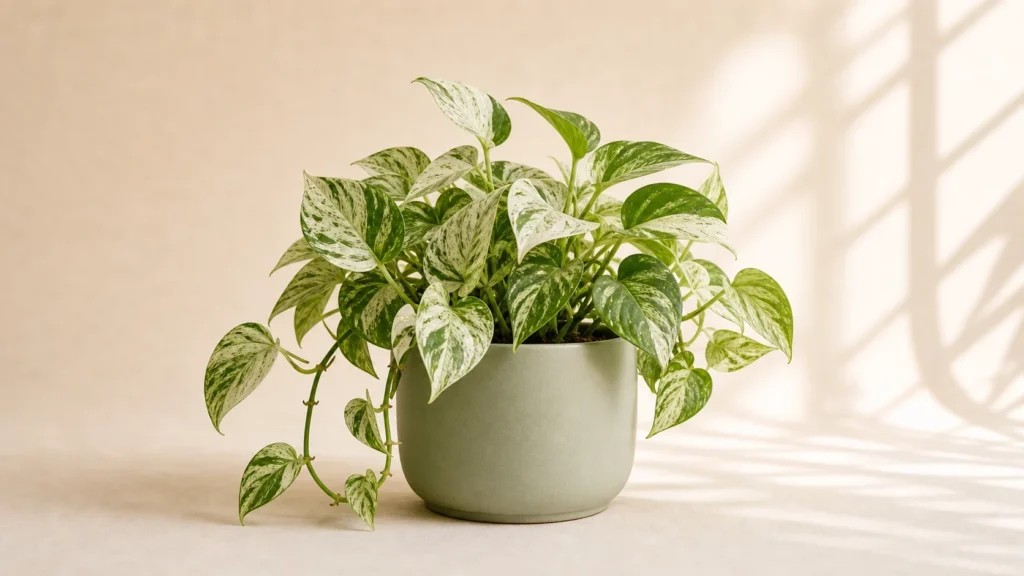
Pothos ‘Glacier’
Epipremnum aureum 'Glacier'
A compact pothos with creamy silver-white variegation — one of the most refined pothos, and one that demands brighter light than the classic golden form.
Watering frequency
Every 7-10 days
Ideal temperature
65-85°F / 18-29°C
Humidity
40-60%
Care difficulty
Easy
Air purifying
Yes
Growth rate
Fast
Plant size
Trails 3-6 ft / 0.9-1.8 m
Soil type
Well-draining potting mix with perlite
Fertilizer need
Monthly, spring-summer.
Care summary
- Light: Bright indirect light is essential for the variegation.
- Water: Water when the top inch of soil dries, then water thoroughly and drain.
- Soil: Well-draining mix in a pot with drainage holes.
- Growth: Compact and vining; prune for fullness.
- Propagation: Stem cuttings root easily in water or soil.
- Safety: Not pet-safe; toxic if chewed.
Common problems
- Variegation fading: not enough light — the white pattern needs bright indirect light.
- Brown spots on white areas: sunburn — pale leaf parts scorch easily.
- Yellow leaves: overwatering or poor drainage.
- Brown tips: dry air or mineral buildup.
- Slow, leggy growth: low light.
Plant care guide
About Pothos 'Glacier'
Pothos 'Glacier' is a horticultural selection sold within Golden Pothos (Epipremnum aureum), whose accepted species record is maintained by Kew Plants of the World Online. It is sold for creamy white and gray-green patterning across relatively small leaves. Retail identification can overlap with other compact white-variegated pothos, so preserve a reliable cultivar label or provenance rather than identifying an unlabeled cutting by color alone.
It is treated as the same species as Golden Pothos, so the broad care principles follow the species: bright indirect light, watering after the upper mix begins to dry, and propagation from node-bearing stem cuttings. NC State Extension's Epipremnum aureum profile supports those species-level care principles. Glacier's pale tissue makes adequate filtered light especially important, but more light does not justify harsh, prolonged sun.
This page covers the cultivar specifically. For the full species guide — light, watering, soil, propagation, and troubleshooting — see the Golden Pothos care guide.
Why You'll Like It
Glacier looks like a "special" plant without asking for special treatment. The creamy marbling is beautiful up close and striking from across a room, and the compact growth habit means it stays tidy on a shelf instead of turning into a wild tangle. It trails gracefully, climbs happily, and roots from cuttings so easily that one plant can become a whole collection.
It also grows faster than most variegated plants — variegation usually slows plants down, but pothos are vigorous enough that Glacier still puts on visible growth through the season. If you like the marbled look, Marble Queen Pothos is the larger-leafed, more dramatically marbled sibling; Neon Pothos gives you the same easy care in solid lime instead.
What Kind of Plant Is It?
Three traits explain how Glacier behaves.
- It is a vining aroid. Stems lengthen continuously and root at nodes where they touch soil or moss, so the plant trails, climbs, and is trivially easy to propagate.
- Its variegation is genetic and light-dependent. The creamy white areas are part of the plant's DNA, but the pattern only stays bright with enough light. In low light, the plant produces more green to survive, and the variegation fades.
- Its pale areas are delicate. White leaf tissue has no chlorophyll, so it sunburns easily and shows brown spots in direct sun — the one way people accidentally damage this plant.
Where It Works Best
Give Glacier bright indirect light — a few feet from a south, east, or west window, or on a bright shelf. This is the one non-negotiable: in medium or low light the variegation fades toward green and the growth stretches. Never put it in direct sun, where the white areas burn into brown patches within hours.
It suits living rooms, home offices, and kitchens with good light, trailing from a high shelf or bookcase. A bright bathroom also works well thanks to the extra humidity. Avoid dark corners and cold drafts.
How to Care for Pothos 'Glacier'
Watering: Water when the top inch of soil feels dry — typically every 7-10 days — then water thoroughly and let the excess drain. The plant droops noticeably when thirsty and recovers within hours of a drink; a constantly soggy pot causes yellow leaves and root rot. The watering guide explains how to judge the soil by touch.
Light: Bright indirect light keeps the variegation bright and the growth compact. In medium light the plant survives but the pattern fades; in low light it becomes leggy and mostly green. The light guide helps you judge what a room actually provides.
Soil: Use a well-draining potting mix with perlite added, in a pot with drainage holes. Pothos tolerate a wide range of soil as long as it doesn't stay soggy.
Temperature: Comfortable household temperatures of 65-85°F (18-29°C) suit it well. Keep it away from cold drafts, heat vents, and winter windows.
Humidity: Average indoor humidity is fine; higher humidity (a bright bathroom, or a humidifier nearby) keeps leaf edges clean. Very dry air browns the tips, especially on the pale leaf areas.
Fertilizer: Feed monthly in spring and summer with a balanced houseplant fertilizer at half strength. Reduce feeding in winter; excess fertilizer builds salts that brown the tips and edges.
Pruning: Prune long vines to encourage branching and keep the plant full. Each cut just below a node typically pushes two new stems, and the pruned sections root easily — nothing is wasted.
How to Propagate
Stem cuttings root in water or soil within weeks. Cut a vine just below a node, remove the bottom leaf, and set the cutting in water — roots appear in about two weeks, and once they reach an inch or so, pot the cutting in fresh mix. Glacier propagates true from cuttings: every new plant inherits the same marbled variegation, so one healthy plant can produce unlimited copies. Take several cuttings at once in spring or early summer for the fastest results.
When to Repot
Repot every one to two years in spring, when roots fill the pot or growth slows. Move up one pot size and use fresh, well-draining mix. The plant tolerates repotting well and usually responds with a flush of new growth. The repotting guide walks through the process.
Do not repot simply because a vine grows slowly. First check light, temperature, pests, and root condition. A large decorative pot around a small root system can remain wet for too long. When repotting is needed, keep the stem at its previous depth and direct a few healthy nodes across the surface so they can root and thicken the crown.
Training, Pruning, and Maintaining a Full Pot
Glacier can trail, climb a support, or remain a compact shelf plant. Trailing emphasizes its fine pattern, while climbing may encourage stronger attachment and larger foliage. Tie the stem rather than the leaf petiole, and never force a hardened vine around a narrow support.
For a fuller pot, improve the light first, prune a healthy vine just above a node on the parent, then root several node-bearing cuttings and return them to the crown. A node is the joint where a leaf and aerial root emerge; a leaf without a node cannot produce a new vine. Layering is even lower risk: pin a node into the same pot while it remains attached, wait for roots, and cut it free later.
Remove fully yellow or damaged leaves with clean scissors. Avoid repeatedly trimming brown white sections into living tissue. Existing damage cannot regain color, and healthy green tissue is especially valuable on a highly patterned plant.
Seasonal Care
In spring and early summer, stronger daylight usually increases growth and water use. This is the most practical time to prune, propagate, repot if required, and resume light feeding. Move the plant toward stronger light gradually because leaves produced in winter shade can scorch easily.
During summer, monitor heat at the glass as well as light. A leaf can burn even when the room seems comfortable. Check the mix more often without turning that check into automatic watering, and inspect new growth for thrips, mites, and mealybugs.
In autumn, reduce feeding as growth slows. The same pot may remain damp much longer after daylight decreases. In winter, keep it away from cold glass and heating vents, maximize filtered light, and water according to dry-down rather than preserving the summer interval.
Choosing and Identifying Pothos 'Glacier'
Glacier is frequently confused with compact white selections such as 'N'Joy', 'Pearls and Jade', and 'Manjula'. Leaf size, white placement, green-on-green speckling, growth habit, and reliable nursery provenance should be considered together. A single unusually patterned leaf is not enough to rename an unlabeled plant. The silver-splashed Satin Pothos, a Scindapsus pictus rather than an Epipremnum cultivar, is another retail shelf-mate that shares the pothos care style but belongs to a different genus.
Choose a specimen with firm nodes, active new growth, and roots that smell fresh rather than sour. Inspect tight leaf joints and undersides for pests. A few brown marks in white tissue are cosmetic, but several yellowing vines in saturated mix suggest root trouble.
Quarantine a new plant and learn how its nursery mix dries before replacing it. Immediate relocation, repotting, pruning, and fertilizing make later leaf loss difficult to diagnose.
Toxicity and Pet Safety
Pothos 'Glacier' is not pet-safe. The ASPCA Devil's Ivy profile lists Epipremnum aureum as toxic to cats and dogs because of insoluble calcium oxalates, with oral irritation, excessive drooling, vomiting, and difficulty swallowing among possible signs. Keep it out of reach of pets and children, and wash your hands after pruning.
If a pet chews the plant, remove it from reach and contact your veterinarian. For pet-friendly homes, Parlor Palm, Spider Plant 'Bonnie', or Pilea Peperomioides offer easy greenery without the toxicity.
Common Problems and Practical Fixes
- Variegation fading: Not enough light. Move it brighter and the new growth will come out marbled again; existing faded leaves will not recover. This is the most common Glacier complaint by far.
- Brown spots on white areas: Sunburn — direct sun scorches the chlorophyll-free white tissue. Move the plant out of direct sun and cut off badly burned leaves.
- Yellow leaves: Overwatering or poor drainage. Let the soil dry further between waterings and confirm the pot drains. The yellow leaves guide helps compare causes.
- Brown tips: Dry air, mineral buildup, or irregular watering. Raise humidity, flush the soil occasionally, and steady the watering rhythm; the brown tips guide covers the diagnosis.
- Leggy, stretched growth: Low light. Move it brighter and prune the bare vines to encourage branching.
Frequently Asked Questions
Why is my pothos losing its variegation?
Not enough light. Variegated pothos need bright indirect light to keep their white pattern; in darker spots the plant produces more green chlorophyll and the variegation fades. Move it brighter — new leaves will come out marbled again.
Why are the white parts of my pothos turning brown?
Direct sun. The white leaf tissue has no chlorophyll and burns easily, leaving brown patches. Keep the plant in bright indirect light, never in direct sun.
Is Pothos 'Glacier' different from Marble Queen?
Yes. Plants sold as Glacier usually have smaller leaves with finer, denser silver-white marbling and a more compact habit, while Marble Queen has larger leaves with broader, more dramatic white marbling. Their basic pothos care overlaps, but light level and growth rate can differ with variegation and plant identity.
How much light does a Glacier pothos need?
Bright indirect light — more than a golden pothos needs. It tolerates medium light but loses its variegation and grows leggy in darker spots.
Is Pothos 'Glacier' toxic to pets?
Yes. All pothos contain insoluble calcium oxalate crystals and are toxic to cats and dogs if chewed. Keep it out of reach.
Why is my Glacier pothos growing slowly?
Variegated plants grow a little slower than plain green ones because the white areas photosynthesize less. If growth has stalled entirely, check the light (likely too low) and the watering rhythm.
Will a completely white cutting survive?
Not reliably. White tissue lacks enough chlorophyll to support sustained growth. Choose cuttings with healthy green tissue as well as attractive pale patterning, and do not remove the parent's strongest green leaves merely to make it look whiter.
Should I mist the leaves?
Routine misting is unnecessary. It creates only a brief humidity change and can leave water marks. Stable room humidity, an appropriately watered root zone, useful light, and gentle airflow matter more.
Final Thought
Pothos 'Glacier' is the refined pothos: same easy vining habit, smaller leaves, and a creamy marbling that looks far more expensive than the plant's care demands. The whole secret is light — bright indirect light keeps the pattern bright, while low light quietly turns it back into a plain green vine. Water it when the top inch dries, keep it out of direct sun, and prune it when it gets leggy, and Glacier stays crisp, compact, and beautifully marbled for years.