
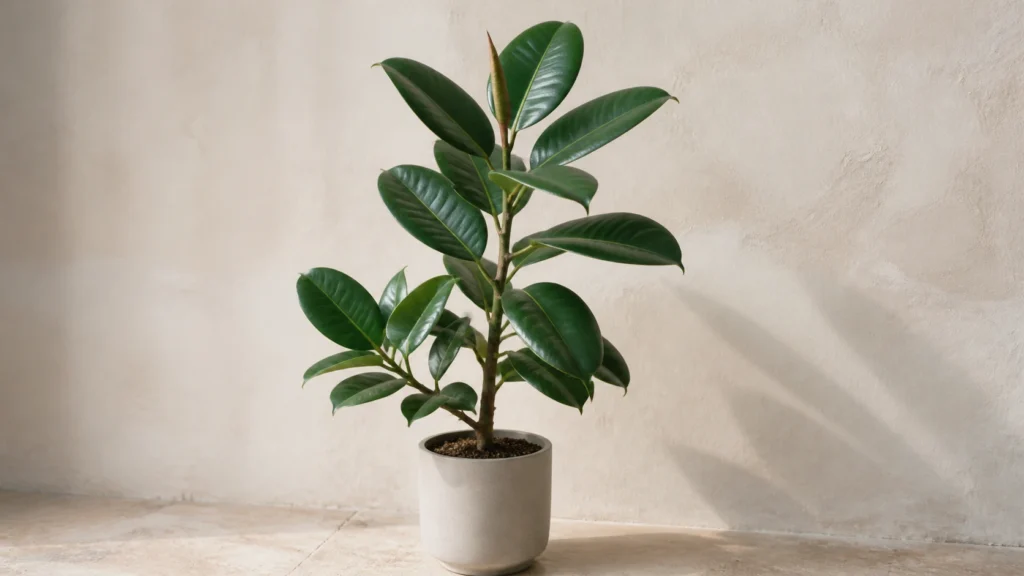
Robusta Rubber Plant
Ficus elastica 'Robusta'
The most widely sold Ficus elastica cultivar, with broad deep-green glossy leaves and the classic upright tree-like habit of the rubber plant.
Watering frequency
Every 7-14 days
Ideal temperature
65-80°F / 18-27°C
Humidity
40-60%
Care difficulty
Easy
Air purifying
Yes
Growth rate
Moderate
Plant size
3-8 ft / 0.9-2.4 m
Soil type
Well-draining houseplant mix
Fertilizer need
Monthly, spring-summer.
Care summary
- Light: Give bright indirect light and acclimated gentle sun.
- Water: Let the upper mix dry, then soak and drain thoroughly.
- Shape: Prune the stem above a node to encourage branching.
- Sap: Wear gloves and protect surfaces when cutting latex-filled stems.
- Safety: Keep away from pets and children who may chew it.
Common problems
- Yellow leaves: Check wet soil, low light, cold, and natural aging.
- Leaf drop: Review relocation, drafts, watering swings, roots, and pests.
- Brown patches: Check sun scorch, cold contact, drought, and leaf disease.
- Leggy growth: Improve useful light and prune above a node if needed.
- Pests: Inspect stems and leaf undersides for scale, mites, and mealybugs.
Plant care guide
About Robusta Rubber Plant
The Robusta Rubber Plant is the most widely sold cultivar of Ficus elastica — the deep-green form most people picture when they hear "rubber plant." It keeps the species' large, stiff, glossy leaves and strong upright silhouette, with broad deep-green blades that look slightly wider and flatter than some other green selections. NC State Extension's Rubber Plant profile notes that wild trees can become enormous, while indoor plants are kept smaller through containers, light management, pruning, and support.
Kew's accepted species record places the species' native range from Nepal through western Yunnan and western Malesia and identifies it as a wet-tropical tree. This range is more precise than calling it generically "from Southeast Asia," while the consumer-facing Robusta name remains the familiar, reliable choice for a green rubber plant.
The species name refers to its white latex sap, once explored as a rubber source. It is not the commercial source of most natural rubber, and the sap is not a household material: it can irritate skin and surfaces and contributes to the plant's pet-safety concern. The Robusta carries the same latex as any F. elastica.
Robusta Rubber Plant is sometimes confused with Baby Rubber Plant, Peperomia obtusifolia, or with other figs called Indian Rubber Plant. This page covers Ficus elastica 'Robusta'. Baby Rubber Plant stays compact and is ASPCA-listed non-toxic; F. elastica becomes woody and should be kept away from chewing pets.
Why You'll Like It
A single Robusta Rubber Plant can supply the visual weight of an indoor tree without the broad violin-shaped leaves of Fiddle Leaf Fig. It is the default green rubber plant in most garden centers, which means it is usually the easiest to find, the easiest to compare in person, and the most predictable to care for. The trunk takes pruning, healthy shoots can branch, and the deep-green foliage holds its color in ordinary indoor light.
The plant tolerates average household humidity and moderate missed waterings once established. It does not enjoy constant environmental changes, so it rewards owners who choose a bright stable place and inspect soil before watering.
Compare Fiddle Leaf Fig for a larger sculptural leaf, Golden Leaves Ficus for a smaller-leaved ficus cultivar, or Dwarf Umbrella Tree for palmate leaflets and a different branching structure.
What Kind of Plant Is It?
Robusta Rubber Plant grows from a main stem with nodes where leaves and dormant buds attach. New leaves emerge rolled inside a colored sheath called a stipule. The stipule drops after the leaf opens; this is normal debris, not a fallen flower.
An unpruned plant often maintains one leader and grows tall and narrow. Cutting above a node removes apical dominance and may activate one or more buds below. Branching is influenced by light, season, plant vigor, and genetics, so one cut does not guarantee a perfectly symmetrical tree.
Roots can produce woody surface structure and, in tropical habitat, aerial roots. Indoor roots still require an aerated container mix. Thick leaves reduce water loss but do not make the tree a succulent.
Popular Rubber Plant Varieties
The Robusta is the common deep-green form this guide covers. Other selections of Ficus elastica worth knowing:
- 'Decora': A classic green cultivar with broader leaves and a pale ivory midrib; often grouped with 'Robusta' in retail, but the two are distinct selections.
- 'Burgundy': Very dark green to burgundy foliage and red new-growth sheaths; strong light maintains the richest color.
- 'Abidjan': Another dark-leaved cultivated form often confused with 'Burgundy' in retail labeling.
- 'Tineke': Cream-and-green patterned leaves, sometimes flushed pink on new growth.
- 'Ruby': Pink, cream, and green patterning that requires excellent filtered light without scorch.
- 'Shivereana': A speckled or mottled cultivar often sold under trade variations; verify the nursery label rather than reducing it to "variegated rubber plant."
Patterned cultivars contain less fully green tissue and generally need brighter useful light. Their pale areas also show scorch and mechanical damage more readily. For the variegated side of the group, compare the Tineke Rubber Plant and Ruby Rubber Plant, or the dark-leaved Burgundy Rubber Plant for the same easy care in a nearly black leaf.
Where It Works Best
Place Robusta Rubber Plant close to an east window, near a bright north window, or set back behind a sheer curtain at a south or west exposure. Gentle acclimated sun is useful; abrupt intense afternoon sun can bleach or burn leaves.
Allow room for height and leaf spread. Keep the plant out of narrow traffic paths because bent leaves retain scars. A stable living-room or office position away from cold doors and HVAC vents is preferable to frequent moves for decoration.
Protect floors and furniture from drainage water and milky sap. A heavy mature plant needs a stable pot or cachepot but must never sit in collected runoff.
Robusta Rubber Plant Care
Light
Bright indirect light produces sturdy stems, closer leaf spacing, and the richest green color. The Robusta is a solid-green cultivar, so it tolerates medium light better than patterned rubber plants, but lower light slows soil drying and increases legginess.
Rotate a young single-stem plant periodically for balanced growth. If it leans strongly or makes smaller widely spaced leaves, increase useful light gradually. Do not use fertilizer as a substitute for light.
Water
Use seven to fourteen days only as an inspection interval. Let the upper quarter or several inches of mix dry, depending on pot depth, then water thoroughly across the root ball. Empty the saucer or decorative pot.
Water use drops during dark winter periods and rises in a warm root-filled pot near a bright window. Check below the surface with a skewer and learn the pot's weight. Frequent small sips leave uneven dry pockets; permanent saturation removes oxygen from roots.
Drooping or leaf loss does not automatically mean thirst. Wet-soil symptoms can come from decaying roots. Inspect before responding.
Soil and Container
Use a quality houseplant mix amended with perlite, pumice, or bark for drainage and structure. It should retain some moisture but not remain muddy. A drainage hole is mandatory.
Choose a pot only modestly larger than the root ball. An oversized container increases the wet volume around the roots. Heavy ceramic can stabilize a tall tree, while an inner nursery pot can make watering and inspection easier.
If a nursery plant arrives with several stems, determine whether they are separate rooted cuttings or branches of one plant before dividing. Separating intertwined cuttings can produce multiple thinner trees but also damages roots. Keeping them together creates a fuller canopy and is usually the lower-risk choice.
Humidity and Temperature
Average indoor humidity around 40–60 percent is adequate. A humidifier may help during very dry winters, but brown edges can also come from drought, salts, heat, or damaged roots. Misting broad leaves is unnecessary.
Keep temperatures around 65–80°F (18–27°C), avoiding prolonged chill and sudden drafts. Cold contact can create dark patches and leaf drop. A plant moved from a greenhouse to a home may shed some leaves while adapting.
Fertilizer
Feed monthly at a diluted label rate during active spring and summer growth. Reduce or pause when growth slows. Water dry roots first and flush the pot occasionally to limit salt accumulation.
Fertilizer supports healthy new growth but will not restore dropped leaves or correct root rot. Do not stack multiple supplements without a diagnosed deficiency.
Cleaning, Support, and Pruning
Wipe each leaf with a damp cloth while supporting it from below. Dust removal improves appearance and makes pests visible. Avoid oily leaf-shine products.
Stake a young leaning trunk loosely if necessary, checking ties as it thickens. Improve light so support does not become a permanent substitute for strong growth.
Prune during active growth just above a node. Wear gloves, protect eyes and surfaces, and blot sap carefully. Clean tools before and after. The cut stem can become propagation material.
How to Propagate
Stem cuttings and air layering are practical. A cutting must include stem and at least one node; a leaf with only its petiole may root but cannot reliably form a complete new trunk.
For a cutting:
- Cut below a node with a sterile tool.
- Rinse or blot latex and allow the flow to stop.
- Remove lower leaves and keep one manageable leaf, rolling or loosely securing it if large.
- Root in water or a warm airy propagation medium under bright indirect light.
- Pot after a branching root system develops.
Air layering is useful for a tall bare plant. Wound or girdle the stem according to a reliable method, surround the site with moist sphagnum, and wrap it while maintaining air and moisture. Cut below the new root mass only after roots are established.
When to Repot
Repot when roots densely circle the pot, water no longer penetrates compacted mix, the plant dries unusually fast, or stability is poor. Visible roots alone do not require an annual move.
Increase by one practical pot size and preserve the previous stem depth. Spring active growth offers favorable recovery. For a very large tree, replacing the upper layer of mix may be safer than frequent full repotting, provided drainage and roots remain healthy.
After repotting, return the tree to its established light rather than combining root disturbance with a major relocation. Do not fertilize immediately simply because fresh growth is desired. First allow roots to resume water uptake and watch for a normal new leaf.
Toxicity and Sap Safety
Robusta Rubber Plant is not pet-safe. ASPCA classifies Ficus plants as toxic to cats and dogs and identifies irritating ficus compounds in its Weeping Fig safety record. NC State also flags the genus for cats, dogs, children, and latex-related skin irritation.
Keep leaves, cuttings, and sap away from pets and children. Wash exposed skin and avoid eye contact. If ingestion or significant exposure occurs, contact a veterinarian, animal poison-control service, human poison-control service, or medical professional as appropriate.
Common Problems and Practical Fixes
Leaf drop
Review recent moves, cold drafts, drought, saturation, root condition, and pests. Robusta Rubber Plant often reacts to combined changes. Stabilize light and temperature and adjust water based on the root zone rather than chasing each fallen leaf.
Yellow leaves
One old bottom leaf may age naturally. Several yellow leaves with wet mix indicate possible overwatering or low-light root stress. Yellowing after a cold event may be temperature damage.
Brown or black patches
Crisp tan areas on the exposed side suggest sun scorch. Soft dark tissue can follow cold contact or root problems. Spreading spots with halos may indicate disease; isolate and keep foliage dry while confirming the cause.
Leggy growth
Increase useful light, then prune above a node during active growth if branching is desired. A larger pot or extra fertilizer cannot shorten existing internodes.
Curling leaves
Check temperature, moisture, heat, and pests. A new leaf may remain partly rolled while opening, but persistent distortion deserves inspection of the growth tip and roots.
Pests
Scale looks like attached brown bumps; mealybugs form cottony clusters; mites cause stippling and webbing. Isolate the plant, clean broad leaves, and apply a product labeled for the confirmed pest and indoor use. Repeat as directed.
New leaf is stuck or damaged
A new leaf may stall when humidity and root moisture fluctuate, or after cold and pest damage. Do not peel the stipule open. Stabilize conditions and inspect the growing point. A permanently scarred leaf can still support the plant if most tissue remains green.
Trunk is leaning
Confirm that roots are firm and the pot is stable, then improve directional light and rotate gradually. A temporary loose stake can support the trunk, but ties must not cut into bark. A soft leaning base in wet soil is a root problem, not a staking problem.
Frequently Asked Questions
Is Robusta Rubber Plant the same as Baby Rubber Plant?
No. Robusta Rubber Plant is a cultivar of Ficus elastica, a latex-bearing tree. Baby Rubber Plant is Peperomia obtusifolia, a compact non-woody species with different pet safety.
How do I make it branch?
Provide good light and cut the main stem just above a node during active growth. One or more buds may activate below the cut, but the exact number is not guaranteed.
Can it live in low light?
The Robusta is a solid-green cultivar, so it persists in medium light better than variegated rubber plants, but bright indirect light supports stronger growth and safer dry-down.
Why is white sap leaking?
Ficus tissue releases latex when cut or damaged. Wear gloves, protect surfaces, and keep the sap away from eyes, mouths, pets, and children.
Can I place it outdoors in summer?
Yes in suitable warm weather, but acclimate it slowly from shade to brighter filtered light and protect it from cold nights and strong wind. Quarantine and inspect it before bringing it back indoors.
Does Robusta Rubber Plant purify air?
The database retains an air-purifying category, but a few potted plants do not replace ventilation or mechanical filtration in a normal room. Grow it for foliage and structure, not as an air-quality device.
Final Thought
Robusta Rubber Plant becomes dependable when it receives a bright stable position, partial dry-down, thorough drainage, and deliberate pruning. It is the plant most people mean when they say "rubber plant," and that familiarity is earned: it is easy to find, easy to care for, and generous with its glossy deep-green leaves. Respect the latex and pet-safety boundary, and distinguish it from similarly named Peperomia. With healthy roots and enough light, a single upright stem can mature into a substantial, well-branched indoor tree.