
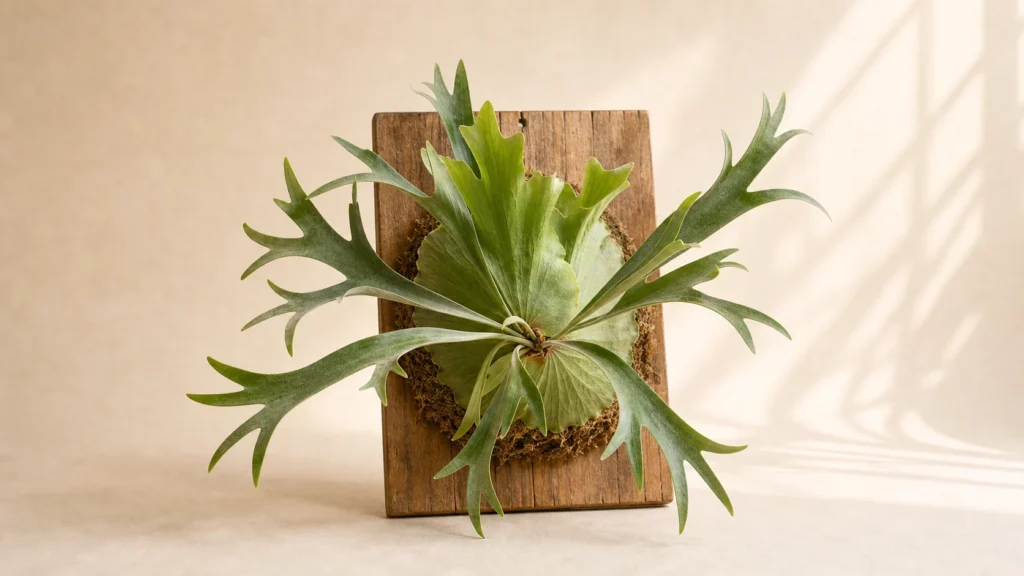
Staghorn Fern
Platycerium bifurcatum
The common staghorn fern (Platycerium bifurcatum), an adaptable epiphytic fern with protective shield fronds and antler-like fertile fronds that needs filtered light, airy mounting material, moisture, and airflow.
Watering frequency
Every 7-14 days
Ideal temperature
65-80°F / 18-27°C
Humidity
50-80%
Care difficulty
Hard
Air purifying
No/Not Known
Growth rate
Moderate
Plant size
1-3 ft / 0.3-0.9 m
Soil type
Airy sphagnum or mounted epiphyte medium
Fertilizer need
Monthly, spring-summer.
Care summary
- Light: Give medium to bright filtered light; avoid deep shade and hot sun.
- Water: Soak or saturate the root pad, then drain and partly dry.
- Mount: Use breathable sphagnum and secure without crushing the rhizome.
- Shields: Preserve brown sterile fronds that protect and feed the colony.
- Safety: ASPCA lists Platycerium bifurcatum as non-toxic to pets.
Common problems
- Soft black base: Check prolonged wetness, cold, and poor airflow.
- Shriveled fertile fronds: Review drought, low humidity, and root health.
- Brown shield fronds: Usually normal maturation; do not remove them.
- Fine brown patches below fronds: Confirm spores before treating as pests.
- Pests: Inspect beneath shields and along fronds for scale and mealybugs.
Plant care guide
About Staghorn Fern
Staghorn Fern (Platycerium bifurcatum) is an epiphytic fern whose forked gray-green fronds resemble antlers. Kew's accepted species record places its native range from Java through parts of Australia to New Caledonia and identifies it as an epiphyte—a plant that uses another plant for support without drawing food from it as a parasite.
It produces two different frond types. Rounded sterile shield fronds press against the mounting surface, protect the short rhizome and roots, and trap organic debris. Forked fertile fronds project outward and produce spores on their undersides. A shield naturally turns tan and papery with age; removing it damages the plant's architecture and nutrient-catching system.
The common Staghorn Fern can form offsets and eventually a colony. This distinguishes it from solitary species such as P. ridleyi and P. wandae, which cannot be divided and may need different heat, moisture, and mounting care. Correct species identity matters because rare species have distinctly different requirements from this adaptable common species.
Why You'll Like It
Staghorn Fern can be displayed vertically like living sculpture. It occupies wall space rather than a shelf, and the shield gradually hides the hardware as the colony grows. The two-frond system also makes its biology visible in a way ordinary potted foliage does not.
It is pet-safer when correctly identified. ASPCA's Common Staghorn Fern record lists Platycerium bifurcatum as non-toxic to cats, dogs, and horses. Mounting wire, board finishes, fertilizer, and pesticide remain separate hazards.
Compare Bird's-nest Fern for a pet-safe rosette fern in a pot, Boston Fern for a dense hanging basket, or Foxtail Fern for an asparagus relative that is not a true fern and is not pet-safe.
What Kind of Plant Is It?
The rhizome is short and hidden under overlapping shields. Roots occupy the thin pad of sphagnum, bark, or organic debris between fern and support. This small airy root zone can dry fast but rots if enclosed in stagnant wet material.
Fertile fronds carry a pale felt of protective hairs. Do not scrub or oil it off. Mature spore patches appear as dry brown felt on consistent areas of the frond underside; they are reproductive structures, not automatically scale or disease.
Shields emerge green, expand over the root zone, then become brown and papery. New green shields grow over old ones. This layered nest traps fallen organic matter in nature and should remain intact indoors.
Popular Staghorn Fern Species
- Common Staghorn Fern (P. bifurcatum): Adaptable, offset-forming, and the scope of this page.
- Ridley's Staghorn Fern (P. ridleyi): Sought-after species with deeply wrinkled, brain-like shield fronds and upright antler fronds; solitary, spore-only propagation. See the Ridley's Staghorn Fern care guide.
- Queen Staghorn Fern (P. wandae): The largest staghorn species, with towering basket-shaped shields and asymmetric two-lobed fertile fronds that can cascade six feet; solitary, needs high heat and humidity. See the Queen Staghorn Fern care guide.
- Superb Staghorn Fern (P. superbum): Large solitary Australian species with tall nest shields; do not divide like P. bifurcatum.
- Elephant Ear Staghorn (P. elephantotis): Broad, shallowly forked fertile fronds resembling elephant ears; needs consistent tropical warmth.
- Madagascar Staghorn (P. madagascariense): Rare African species with deeply veined, brain-like shield fronds and ant symbiosis; offset-forming, unlike P. ridleyi.
These are different species, not cultivars of one care-identical plant. Verify the label before transferring Common Staghorn advice.
Where It Works Best
Hang or pot it near an east or bright north window, or behind a sheer curtain at a stronger exposure. Medium to bright filtered light supports sturdy shields and fertile fronds. The canonical low-light field is removed because deep shade weakens growth and keeps the mount wet longer.
A bright bathroom can supply humidity, but a windowless one is unsuitable. Living rooms and offices work when the mount is accessible for soaking and drainage. Do not hang over moisture-sensitive furniture or drywall without protecting them.
Keep the fern away from heating vents, cold drafts, and narrow walkways. Mature fertile fronds are easily creased. Outdoors in summer, use filtered shade and protect from wind and cold nights.
How to Care for Staghorn Fern
Light
Give bright indirect light or dappled sun. Gentle morning exposure may be tolerated after acclimation, but hard afternoon sun can bleach fertile fronds. Weak floppy new growth suggests inadequate light; pale crisp patches on the exposed side suggest scorch.
Rotate only if the mount's display allows it. A grow light can support winter conditions when positioned close enough and used consistently.
Watering a Mounted Fern
Use seven to fourteen days only as an inspection range. When the root pad feels light and approaches dryness, submerge or thoroughly saturate it for several minutes, then allow it to drain completely before rehanging. Large dense colonies may need a longer soak than a small new mount.
Do not keep sphagnum permanently saturated. Conversely, do not let the entire colony remain crisp-dry for a prolonged period. Temperature, humidity, airflow, mount size, and season change the interval dramatically.
Water earlier in the day so the crown and shields do not stay cold and wet overnight. Avoid forcing water into enclosed pockets where it cannot evaporate.
Watering a Potted Fern
A basket or shallow pot should contain an epiphyte mix such as loose sphagnum, bark, or a blend with large air spaces. Saturate the medium and drain. Do not transplant into ordinary dense potting soil.
Lift the container to judge moisture. Surface sphagnum can dry while the center remains wet, so check the full pad before soaking again.
Humidity and Airflow
Aim for 50–80 percent humidity with gentle airflow. Humidity slows excessive water loss, while air movement helps wet shields and roots dry to a safe level. Pursuing humidity without ventilation encourages black spotting and decay.
A humidifier is more effective than occasional misting. Never spray oily leaf shine on felted fronds.
Temperature
Keep the Common Staghorn broadly between 65 and 80°F (18–27°C). Protect from frost, cold glass, and abrupt temperature drops. Cooler conditions require slower watering because the mount dries less quickly.
Fertilizer
Feed monthly at a very diluted label rate during active spring and summer growth. Apply to a moist root pad, not a bone-dry mount. Reduce or pause in winter.
Do not pack banana peels or food scraps behind the shield; decomposition invites pests and uncontrolled salts. A measured complete fertilizer is more predictable.
Mounting and Remounting
Use an untreated or plant-safe sealed board, breathable sphagnum, and corrosion-resistant line or wire. Position the growing point upright and secure the root pad without crushing the rhizome. Leave room for future shields to cover the ties.
Remount when the board is failing, the colony is unstable, or roots and shields have far exceeded the support. Preserve old shields and root material rather than stripping the fern bare.
How to Propagate Staghorn Fern
Common Staghorn Fern produces pups from branching rhizomes. Divide only a pup with its own growing point, shield, and roots.
- Work during warm active growth.
- Identify the boundary between the pup and parent beneath the shields.
- Cut through the connecting rhizome with a sterile blade while preserving roots.
- Mount the division on fresh damp sphagnum.
- Provide warmth, humidity, filtered light, and cautious moisture during recovery.
Spore propagation is possible but slow and technically different from sowing seed. Fine spores produce a gametophyte stage before a fern appears and require controlled hygiene and moisture. Division is more practical at home.
Understanding the Shield-and-Nest System
The shield is more than a protective cover. Its upper edge can form a pocket that catches leaves, bark fragments, and other organic debris. As that material decomposes, it supplies a small nutrient reservoir around the roots. Indoors, normal aging shields and a breathable root pad recreate part of that system without food scraps.
Young shields are green and photosynthetic. As they become tan and papery, they continue to protect moisture and structure beneath them. Cutting them away exposes roots, removes stored organic matter, and can damage the hidden rhizome. New shields naturally overlap older layers.
When remounting, do not try to make the underside cosmetically clean. Preserve sound shields and root material. If a shield is genuinely soft and rotten rather than dry and papery, investigate the moisture source and remove only compromised tissue necessary to reach healthy growth.
Seasonal Water Management
In warm bright summer conditions, a small exposed mount can dry rapidly and may need checks more often than once a week. Air conditioning can also increase water loss even when a room feels cool. Use mount weight and sphagnum texture rather than a calendar alone.
During darker winter conditions, evaporation and growth slow. A large shielded colony can remain moist internally for much longer than the visible outer moss. Extend the interval and water earlier in the day so the plant does not stay cold and saturated overnight.
Mounted plants outdoors receive rain differently from potted plants: one shower may wet only the shield surface while the root pad stays dry, or repeated rain may keep the nest soaked. Check the mount after weather instead of assuming rain has supplied the correct amount.
Buying and Display Safety
Choose a fern with a firm growing point, intact green or papery shields, and no sour odor. Fine brown spore felt is normal; scattered sticky bumps or cottony deposits are not. Inspect the back of the board for mold and failing hardware.
A mature watered mount is far heavier than a dry new purchase. Use wall hardware rated for the expected load and appropriate for the wall type. Keep dripping water away from electrical outlets and protect painted or porous surfaces. A removable hanging system makes soaking and inspection safer.
If the board is decorative reclaimed wood, confirm it is free of toxic treatments, peeling paint, and rot. Copper wire can damage some plants and corroded metal can fail; plant-safe coated line or corrosion-resistant hardware is preferable.
Pet Safety
ASPCA classifies Platycerium bifurcatum as non-toxic to cats and dogs. Confirm the species because “fern” appears in unrelated common names, and some true ferns have different toxicology.
Discourage chewing and secure the heavy mount. Contact a veterinarian if an animal consumes material and develops symptoms.
Common Problems and Practical Fixes
Brown shield fronds
This is normally maturation. Leave the shield attached. Concern is warranted when the base becomes soft, black, foul-smelling, or collapses rather than drying papery brown.
Shriveled fertile fronds
Check root-pad dryness, humidity, recent heat, and root health. Wet rotten roots can also fail to hydrate fronds. Inspect before increasing soaking frequency.
Black spots or soft base
Prolonged wetness, cold, and poor airflow are likely contributors. Isolate, allow safer drying, and inspect the rhizome. Do not simply increase humidity.
Brown patches under fertile fronds
Uniform dry felt in expected reproductive areas may be spores. Irregular sticky bumps, cottony material, or mobile insects indicate pests. Confirm before applying chemicals.
Scale or mealybugs
Pests hide beneath shield edges where treatment is difficult. Do not tear shields away. Isolate, treat exposed insects carefully with a fern-safe labeled product, and repeat according to the life cycle.
No new growth
Review season, light, temperature, root-pad condition, and pests. Common Staghorn growth may pause in winter. Extra fertilizer cannot substitute for light or viable roots.
Frequently Asked Questions
Should I remove brown shields?
No. Mature brown shields protect roots and trap nutrients. Remove only tissue confirmed rotten under an appropriate rescue plan.
Can it grow in soil?
Not ordinary dense potting soil. Use a shallow airy epiphyte medium or mount that keeps roots moist but oxygenated.
How long should I soak it?
Long enough to saturate the root pad, usually several minutes, then drain completely. Size, material, and dryness matter more than one universal duration.
Are the brown marks spores or scale?
Spores form consistent dry patches on fertile frond undersides. Scale appears as individual attached bumps, often with sticky residue. Inspect closely before treatment.
Is it pet-safe?
ASPCA lists the correctly identified Common Staghorn Fern as non-toxic to cats and dogs. Mounting hardware and care products still require safe placement.
Can I hang it inside a shower?
Only if the shower has strong natural or supplemental light, good airflow, suitable water quality, and the mount can partly dry. Constant spray and darkness create rot rather than ideal humidity.
Why is the white fuzz on the frond?
The pale felt is a normal protective covering. Do not scrub it off. Mealybugs form localized cottony clusters rather than an even natural coating.
Final Thought
Staghorn Fern care makes sense when the plant is treated as a litter-trapping epiphyte. Preserve its shields, hydrate the airy root pad thoroughly and then let it breathe, combine humidity with airflow, and protect the one living mount from harsh sun and stagnant moisture. The result is not merely a potted fern but a growing vertical colony.