
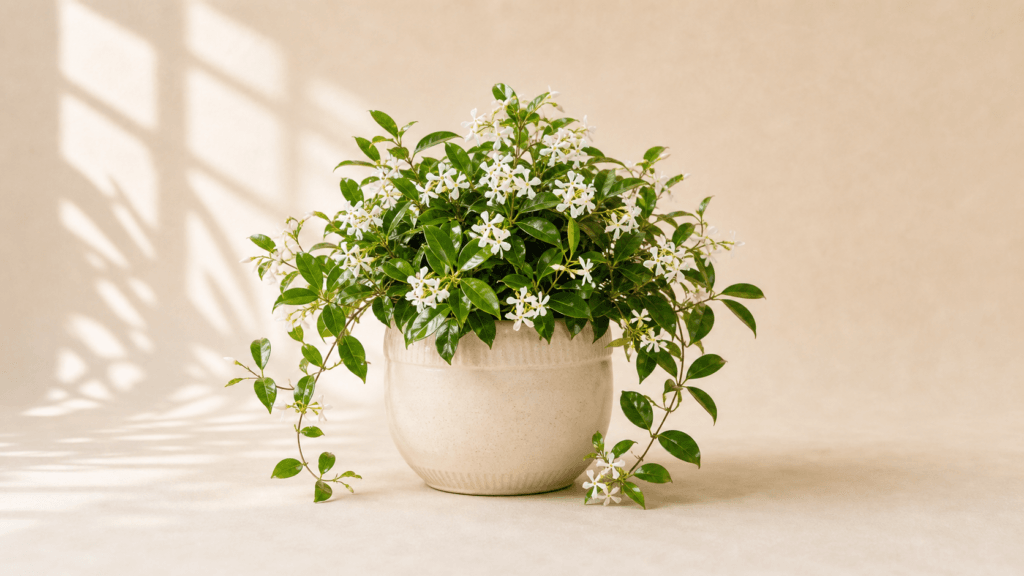
Star Jasmine
Trachelospermum jasminoides
A fragrant evergreen twining vine with pinwheel-shaped white flowers that needs strong light, support, seasonal temperature cues, and a draining root zone.
Watering frequency
Every 7-10 days
Ideal temperature
60-85°F / 16-29°C
Humidity
40-60%
Care difficulty
Medium
Air purifying
No/Not Known
Growth rate
Fast
Plant size
3-6 ft / 0.9-1.8 m
Soil type
Fertile, well-draining mix
Fertilizer need
Every 4 weeks, spring-summer.
Care summary
- Light: Provide several hours of strong light or acclimated sun for flowers.
- Water: Let the surface dry, then soak and drain thoroughly.
- Support: Train twining stems around a trellis without tight ties.
- Pruning: Shape after the main flowering period to preserve future buds.
- Safety: ASPCA lists Trachelospermum jasminoides as non-toxic to pets.
Common problems
- Few flowers: Review useful sun, winter conditions, maturity, and pruning time.
- Yellow leaves: Check wet soil, drought, cold, nutrients, and normal aging.
- Bud drop: Review relocation, drought, temperature swings, and pests.
- Sticky residue: Inspect for scale or sap from damaged stems.
- Pests: Check stems and leaf undersides for scale, mites, aphids, and mealybugs.
Plant care guide
About Star Jasmine
Star Jasmine (Trachelospermum jasminoides) is an evergreen woody twining vine with glossy opposite leaves and fragrant white pinwheel flowers. Despite its common name and scent, it is not a true jasmine in the genus Jasminum. It belongs to Apocynaceae, the dogbane family.
Kew's accepted species record places its native range from western and southern Japan to Vietnam and describes it as a subtropical liana. NC State Extension's Star Jasmine profile emphasizes sunny sheltered conditions, support for twining growth, pruning after flowering, and sticky milky sap from cut stems.
Although it can be clipped and overwintered indoors, Star Jasmine is fundamentally a high-light outdoor or conservatory vine. A warm dim living room may preserve leaves but rarely supports the dense fragrant flowering buyers expect.
Why You'll Like It
The scent is the main attraction: a well-grown plant can cover a trellis with strongly fragrant spring flowers and occasional later bloom. Glossy foliage remains useful between flower cycles and may bronze in cool conditions.
Its flexible shoots can be trained around a hoop, small trellis, balcony railing, or wall support. Pruning turns a potentially long vine into a container specimen, but flowering and size management require seasonal attention.
ASPCA provides an important correction to the old canonical safety field: its Confederate Jasmine record identifies Trachelospermum jasminoides and classifies it as non-toxic to cats and dogs. That ruling does not apply to every plant called jasmine. Some Cestrum, Gelsemium, and nightshade vines are toxic.
For a different fragrant flowering plant, compare Phalaenopsis Orchid, which occupies much less space and needs orchid medium. Star Jasmine is a woody vine rather than an indoor tabletop bloomer; for foliage-first climbing growth, Golden Pothos tolerates lower light but is not pet-safe.
What Kind of Plant Is It?
Star Jasmine is a woody twiner. Stems wrap around supports rather than attaching with tendrils or aerial roots. Guide flexible new shoots before they harden and use loose ties only to establish direction.
Leaves occur in opposite pairs. Cut or bruised stems release white latex-like sap that can be sticky and irritating to sensitive skin, despite the plant's non-toxic pet classification. Wear gloves and clean tools after pruning.
Flowers form most heavily under strong light on mature growth. Pruning at the wrong stage can remove developing flower wood. The precise cycle varies with climate, but shaping immediately after the main bloom is safer than hard pruning just before expected flowering.
Star Jasmine and Commonly Confused Plants
- Star Jasmine (Trachelospermum jasminoides): White pinwheel flowers, woody twining stems, glossy opposite leaves, ASPCA-listed non-toxic.
- True Jasmine (Jasminum spp.): A separate genus in Oleaceae; safety and care must be checked by species.
- Confederate Jasmine: Another common name for Star Jasmine, not a separate plant.
- Madison Jasmine: A cold-tolerant cultivated selection of Star Jasmine; verify the cultivar tag.
- Variegated Star Jasmine: Patterned selections exist, but use the named cultivar where known rather than creating a plant identity from “variegated.”
- Carolina Jessamine (Gelsemium sempervirens): A different yellow-flowered toxic vine.
- Night-blooming Jasmine (Cestrum nocturnum): A toxic nightshade relative, not true jasmine.
- Gardenia (Gardenia jasminoides): Fragrant white flowers with a jasmine-like scent, but a Rubiaceae relative of coffee, not a true jasmine.
- Coffee Plant (Coffea arabica): Fragrant white flowers in the coffee family (Rubiaceae); the leaves and beans carry caffeine, which is toxic to pets.
Botanical identity is especially important here because similar fragrance-based common names cross several families and safety categories.
Where It Works Best
A sunny balcony, patio, conservatory, or very bright window is best. Indoors, place it directly at a south or west exposure after acclimation, or at an unobstructed east window with supplemental light if needed. The structured field is expanded to include full sunlight because flowering usually needs more than generic bright-indirect conditions.
Provide a trellis before stems tangle. Ensure airflow around foliage while keeping the root zone from overheating against hot glass. A cool but frost-free bright winter position can be more useful than year-round warm dim conditions.
Fragrance can be intense in a small room. Consider allergies and personal scent tolerance before placing a heavily blooming vine in a bedroom.
How to Care for Star Jasmine
Light
Give several hours of strong light or acclimated direct sun for the best flowering. Move a nursery plant gradually because leaves formed under shade cloth can scorch. Sparse long growth and absent buds indicate weak light; bleached crisp patches indicate excessive abrupt exposure.
Rotate a container or train vines so all sides receive light. A grow light can support winter foliage but must deliver meaningful intensity to encourage flowers.
Water
Use seven to ten days as an inspection cue. Let the top inch or two dry, then water thoroughly until excess drains. Do not keep the pot permanently wet or allow a flowering plant to repeatedly wilt.
Outdoor summer containers may need frequent checks in heat and wind. Winter use falls in cool conditions. A wet pot with yellow leaves needs drainage and root inspection, not more water.
Soil and Container
Use a fertile, well-draining container mix amended with perlite, pumice, or fine bark. A drainage hole is mandatory. Choose a stable pot because a trained trellis becomes top-heavy.
Increase pot size gradually. An oversized pot holds excess water, while a severely root-bound vine dries too fast and may fail to support bloom. Keep the stem at its original depth.
Temperature and Humidity
Normal indoor humidity around 40–60 percent is adequate. Good airflow matters more than misting. Keep actively growing plants around 60–85°F (16–29°C), while a brighter cooler winter rest can help the seasonal cycle.
Protect container roots from hard freeze and leaves from sudden cold drafts. If the plant spends summer outdoors, bring it in according to local minimum temperatures rather than waiting for damage.
Fertilizer
Feed lightly every four weeks in spring and summer using a balanced or flowering-plant fertilizer at a diluted label rate. Do not use high nitrogen to compensate for weak light; it can produce long leafy vines with fewer flowers.
Pause during cool winter slowdown and flush salts periodically. Fertilize only healthy roots.
Training and Pruning
Wind young shoots around a trellis in their natural direction and secure loosely. Check ties as stems thicken. Do not force woody stems around a tight curve.
Prune after the main flowering period, cutting just above a node or side branch. Remove dead, crossing, and pest-damaged stems. Wear gloves because milky sap is sticky and may irritate skin.
How to Propagate Star Jasmine
Stem cuttings and layering are practical.
For cuttings:
- Take a healthy non-flowering semi-ripe shoot with several nodes.
- Remove lower leaves and rinse or blot sap.
- Insert a node into a moist, airy propagation medium.
- Keep warm in bright indirect light with moderate humidity.
- Pot after a branching root system and new growth develop.
For layering, bend a flexible attached stem to a nearby pot, lightly wound or pin one node into the mix, and detach only after roots form. Layering keeps the shoot supplied by the mother plant and can be more forgiving.
When to Repot
Repot when roots densely circle the pot, water runs through without wetting the core, mix has collapsed, or the plant dries abnormally fast. Spring before strong growth is convenient.
Move up one practical size and preserve roots. A large trained specimen may be top-dressed rather than fully repotted every year, provided drainage remains sound.
Encouraging Flowers Indoors
Flowering starts with accumulated energy. Keep the vine in genuinely strong light through the growing season and preserve healthy mature shoots. A warm living room several feet from a window may look bright but rarely supplies the intensity of an outdoor trellis.
Avoid high-nitrogen feeding, which favors long soft shoots. Provide balanced nutrition only while roots are active. A bright, cooler winter period can preserve the seasonal signal, but never expose a container to a damaging freeze. Temperature should support the cycle rather than shock the plant.
Pruning matters because a hard cut immediately before the normal bloom period removes potential flower-bearing growth. Shape after the main flush, then use lighter corrections. If a newly purchased forced-flowering plant does not repeat on the same calendar at home, judge whether the new environment supplies enough light before assuming disease.
Buds are vulnerable to drought and relocation. Once they are visible, keep moisture and temperature stable. Do not move the pot repeatedly to display the flowers in darker rooms.
Overwintering a Patio Container
Inspect and quarantine before bringing the vine indoors. Remove dead leaves, check the trellis and stems for scale, and rinse foliage where practical. Move it before cold damage rather than after leaves blacken.
Choose the brightest cool frost-free location available. Reduce watering as growth and evaporation slow, but do not let fine roots remain completely dry for long periods. Pause fertilizer until spring activity returns.
If space is limited, prune moderately after flowering or before the move while retaining enough leaf area. Do not combine hard root pruning, a severe top cut, pesticide stress, and a drastic light reduction unless the plant's survival requires it.
Return outdoors gradually after frost risk passes. Begin in sheltered bright shade, then increase sun and wind exposure over one to two weeks.
Managing a Trellis in a Container
Anchor the support at repotting time so it does not wobble and tear roots. A hoop suits a compact display, while a taller narrow trellis accommodates repeated loops. Guide stems while flexible and do not weave them so tightly that later pruning becomes impossible.
Leave access to the soil surface for moisture checks. Dense tangled growth blocks light and hides scale, so thin selected crossing shoots after bloom. Never attach a container vine permanently to a wall if it must be moved for watering or winter protection.
Pet and Household Safety
Star Jasmine's canonical Not pet safe field is corrected to Pet safe based on ASPCA's exact species record. Non-toxic does not make it edible; swallowed foliage can still cause stomach upset.
The milky sap may irritate sensitive skin, so wear gloves and wash after pruning. If a pet eats plant material and becomes unwell, contact a veterinarian. Confirm identity before applying this safety result to another “jasmine.”
Common Problems and Practical Fixes
Few or no flowers
Review strong light, plant maturity, cool-season conditions, fertilizer balance, and pruning time. A warm dark room produces foliage rather than reliable bloom.
Bud drop
Abrupt relocation, drought, heat, cold drafts, and pests can abort buds. Stabilize conditions. Lost buds will not reopen, but later cycles can succeed.
Yellow leaves
Check wet soil, drought, cold, roots, and normal lower-leaf aging. Patterned yellowing may reflect nutrients only after root and pH problems are excluded.
Sticky foliage
Damaged stems release sap, while scale or aphids produce sticky honeydew. Inspect stems and leaf undersides before assuming the source.
Root rot
Soft roots, sour odor, and persistent wetness require repotting into fresh draining mix and correction of pot size, light, and watering.
Pests
Scale, mites, aphids, and mealybugs can hide in a dense trellis. Isolate, identify, prune badly infested shoots, and use an indoor treatment labeled for the pest.
Frequently Asked Questions
Is Star Jasmine a true jasmine?
No. It is Trachelospermum jasminoides in Apocynaceae, not a member of Jasminum.
Can it flower indoors?
Yes, but it needs exceptional window or supplemental light, seasonal cues, mature growth, and appropriate pruning. Many ordinary rooms are too dark.
When should I prune it?
Shape it after the main flowering period so you do not remove developing buds before bloom. Remove dead or diseased material whenever necessary.
Does it need a trellis?
Yes for an upright display. It twines around supports and does not attach itself with adhesive roots.
Is Star Jasmine pet-safe?
ASPCA lists the correctly identified species as non-toxic to cats and dogs. Do not transfer that ruling to Carolina Jessamine, Night-blooming Jasmine, or other common-name lookalikes.
Why are leaves turning bronze or red?
Cool conditions can produce seasonal bronze tones, while stress from cold, drought, or roots may also discolor leaves. Check firmness, soil, and temperature before treating the color as a deficiency.
Can it grow as a hanging plant?
It can trail temporarily, but its natural twining habit and woody weight are easier to manage on support. A hanging pot must be strong, accessible for watering, and pruned to prevent long tangled stems.
Final Thought
Star Jasmine is a sun-hungry woody vine that can be overwintered indoors, not a low-light houseplant that happens to flower. Give it strong light, a draining root zone, a trellis, and pruning timed after bloom. Correct identification transforms the page twice: it sets realistic flowering expectations and replaces an inaccurate pet warning with an exact ASPCA-backed result.