
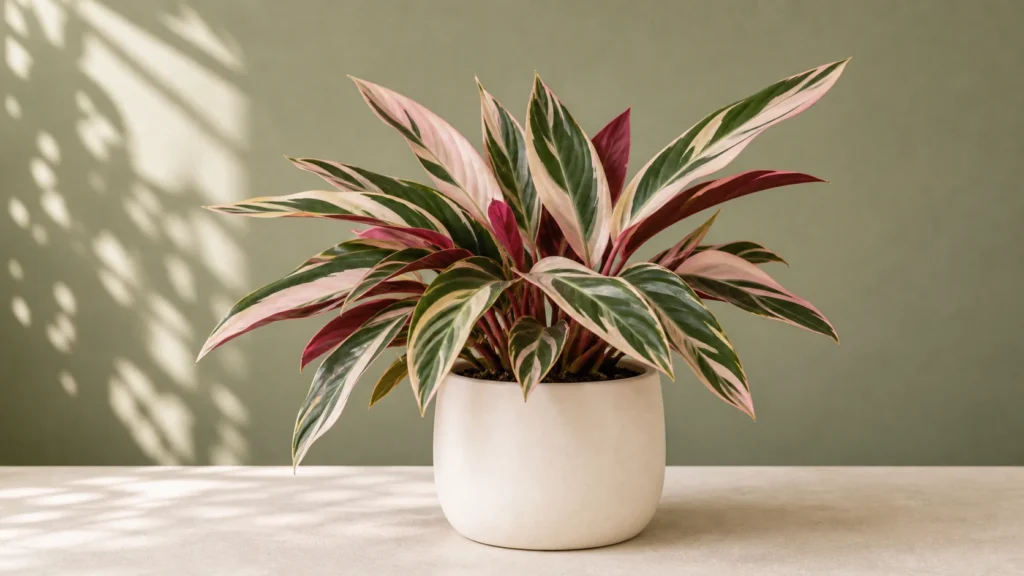
Stromanthe ‘Triostar’
Stromanthe thalia 'Triostar'
A colorful prayer-plant relative with cream, green, and pink leaves that needs filtered light, even moisture, warmth, and stable humidity.
Watering frequency
Every 5-7 days
Ideal temperature
65-80°F / 18-27°C
Humidity
50-70%
Care difficulty
Hard
Air purifying
No/Not Known
Growth rate
Moderate
Plant size
1-3 ft / 0.3-0.9 m
Soil type
Moist, aerated tropical mix
Fertilizer need
Every 4-6 weeks, spring-summer.
Care summary
- Light: Provide bright filtered light and protect leaves from strong direct sun.
- Water: Water when the surface begins to dry; never leave the root ball saturated.
- Humidity: Maintain stable moderate-to-high humidity with gentle airflow.
- Water quality: Reduce accumulated salts if brown tips persist.
- Safety: Generally treated as pet-safe, but discourage chewing any houseplant.
Common problems
- Brown tips: Check dry air, mineral salts, drought, roots, and hot airflow.
- Curling: Review moisture, cold, excess sun, heat, and pests.
- Faded color: Improve useful filtered light without exposing leaves to harsh sun.
- Yellowing or soft stems: Inspect saturation, drainage, and roots.
- Pests: Check undersides for spider mites, mealybugs, and aphids.
Plant care guide
About Stromanthe 'Triostar'
Stromanthe ‘Triostar’ is a variegated selection of Stromanthe thalia in the prayer-plant family, Marantaceae. It is still widely sold under the older name Stromanthe sanguinea ‘Triostar’ and under retail spellings such as “Tristar” or “Tricolor.” NC State Extension’s Stromanthe profile recognizes ‘Triostar’ and describes the species as a warm, humid, rhizomatous tropical that prefers filtered light and moist, well-drained soil.
The consumer-facing name stays familiar while the Botanical Name field is updated. This is exactly the situation in which a useful synonym belongs in the opening rather than replacing a recognizable shopping name.
The leaves combine olive green, cream, pale pink, and deeper rosy tones, often with burgundy undersides. Like many prayer-plant relatives, the blades change angle through the day and may fold more upright at night. That movement is normal; persistent tight curling, limpness, or distorted new growth is a stress signal.
Why You’ll Like It
‘Triostar’ provides the visual effect of a flowering arrangement without depending on flowers. It remains colorful through the year when conditions are stable, and its upright clumping habit fits a table or floor stand better than a long trailing vine.
It is a rewarding plant for an owner who already understands indoor light and moisture. It is less forgiving than Prayer Plant or a drought-tolerant ZZ Plant, but it communicates stress visibly. Learning to read its leaf posture, drying rate, and new growth can turn a supposedly “fussy” plant into a predictable one.
For other members of this visual group, compare Calathea Orbifolia for broad silver-striped foliage and Calathea Makoyana for peacock-like markings. They share a family, not identical household tolerance.
What Kind of Plant Is It?
Stromanthe grows from rhizomes—horizontal underground stems that produce roots and new shoots. Several shoots together form a clump. This structure explains why division, not a random leaf cutting, is the dependable home propagation method.
Variegated tissue contains less chlorophyll than fully green tissue. The plant therefore needs enough filtered light to sustain growth and maintain color, yet pale areas scorch more readily in intense sun. Humidity can reduce water loss from leaf edges, but it cannot compensate for dark placement or unhealthy roots.
Indoor plants usually remain smaller than specimens grown outdoors in a wet tropical climate. New leaves emerge rolled and gradually unfurl. Avoid manually forcing them open; low humidity, pests, root stress, or mineral deposits should be corrected at the source.
Popular Prayer-Plant Relatives
Retail labels frequently mix common names across Marantaceae. These are related plants, not interchangeable cultivars:
- Prayer Plant (Maranta leuconeura): Lower-growing, often spreading, with strongly patterned leaves.
- Peacock Plant (Goeppertia makoyana): Sold as Calathea makoyana and recognized for paired feather-like markings.
- Calathea Orbifolia (Goeppertia orbifolia): Produces broad round leaves with silver-green bands.
- Rattlesnake Plant (Goeppertia insignis): Has long wavy blades with dark oval markings.
- Never Never Plant (Ctenanthe spp.): Another related group often confused with Stromanthe in retail displays.
Verify the botanical identity before applying cultivar names or making safety claims.
Where It Works Best
Use a bright room where direct midday sun is softened by a sheer curtain or distance from the glass. An east window often works, as can a bright north exposure or a protected position near a south or west window. Turn the pot periodically for balanced growth.
A bathroom is useful only when it also has adequate daylight. A dark steamy room produces weak growth and wet soil. Bedrooms and living rooms can work with a humidifier or naturally stable humidity. Keep the plant away from heating vents, air conditioners, exterior doors, and cold windowpanes.
Group it with plants that genuinely share moisture needs, leaving room for airflow and inspection. Crowding foliage against walls can trap water and hide mites. Place the pot where you can check the surface and empty a saucer easily.
How to Care for Stromanthe 'Triostar'
Light
Bright indirect light produces the most balanced growth and color. Medium light may be tolerated, but the plant may grow more slowly or produce greener leaves. Harsh sun can bleach cream sections and leave tan patches. Move it toward stronger light in stages and judge the response over new leaves, not one afternoon.
Water
Check the mix every few days, but water according to its condition. When the surface begins to dry, water thoroughly until excess drains. The root ball should remain lightly and evenly moist during active growth without staying saturated.
Do not compensate for a missed watering with a permanently full saucer. If the plant wilts in wet soil, inspect roots rather than adding more water. Reduce frequency when light and growth decline in winter, but avoid letting the entire root ball become severely dry.
Water quality
Brown edges may become worse where tap water contains high soluble salts or where fertilizer accumulates. Rainwater, distilled water, or appropriately filtered water can help when water chemistry is the confirmed problem. Periodically flush an established, freely draining root ball and discard the runoff. Water quality does not fix low humidity, damaged roots, or chronic drought.
Soil and container
Use an organic but aerated mix: quality houseplant mix amended with fine bark and perlite is a practical starting point. It should retain even moisture while allowing oxygen around the rhizomes. Avoid dense garden soil and containers without drainage.
Choose a pot only modestly larger than the root mass. Plastic or glazed pots hold moisture longer; terracotta may dry too quickly in a warm, dry home. Let the drying behavior of your room guide the choice.
Humidity and temperature
Stable humidity around 50 percent or higher often helps leaves unfurl cleanly and reduces crisp margins. A room humidifier is more effective than misting. Keep gentle airflow so persistent surface moisture does not encourage problems. Normal warm household temperatures are appropriate; protect the plant from chills and abrupt swings.
Fertilizer
Feed lightly during active spring and summer growth with a diluted balanced fertilizer. Do not fertilize a recently repotted, severely dry, pest-infested, or root-damaged plant. Reduce feeding when growth slows. Pale leaves are not automatically hungry; assess light, roots, and cultivar pattern first.
Pruning and cleaning
Remove a fully damaged leaf by cutting its petiole near the base with clean scissors. Do not trim every brown edge into the green tissue repeatedly. Wipe broad leaves gently with water and a soft cloth; leaf-shine products can leave residue and complicate pest treatment.
How to Propagate Stromanthe 'Triostar'
Divide an established clump, ideally when it is already being repotted. Water normally beforehand so roots are hydrated, remove the plant, and identify natural groups of shoots with their own roots and rhizome tissue. Separate them by hand where possible or make a clean cut through a stubborn connection.
Pot each division into a small container of similar mix, keeping the crown at its previous depth. Provide warm filtered light, stable humidity, and careful moisture while damaged roots recover. Do not create many tiny divisions simply to maximize plant count; larger rooted sections establish more reliably.
A detached leaf and petiole without rhizome tissue will not recreate the clumping plant. Seed propagation is impractical for maintaining a named variegated cultivar and may not reproduce ‘Triostar’ coloration.
When to Repot
Repot when roots and rhizomes crowd the container, water no longer penetrates evenly, the mix has collapsed, or the plant repeatedly wilts despite appropriate moisture. Spring or early active growth is convenient, but root health matters more than a calendar.
Move up one size, preserve healthy roots, and avoid burying the crown. A newly oversized pot stays wet longer, so monitor it rather than continuing the old schedule automatically.
Pet and Household Safety
This project classifies Stromanthe ‘Triostar’ as Pet safe. It belongs to Marantaceae, a family containing several plants that veterinary references treat as non-toxic; for example, the ASPCA lists Prayer Plant as non-toxic to dogs and cats. However, that ASPCA entry names a different prayer-plant relative rather than Stromanthe thalia, so it should not be misrepresented as a species-specific toxicology study.
“Pet safe” means no established toxic principle was identified in the evidence used here, not that chewing is beneficial. Any plant material can cause mechanical irritation or gastrointestinal upset, and potting mix, fertilizer, and pesticides create separate hazards. Contact a veterinarian if an animal eats a substantial amount or develops symptoms.
Common Problems and Practical Fixes
Brown tips and edges
Review humidity, dry-down, water chemistry, fertilizer salts, hot airflow, and root health. Several small stresses can occur together. Improve the environment for future leaves; damaged tissue will not turn green again.
Leaves curl tightly
Check soil moisture first, then temperature, sun exposure, humidity, and mites. Nighttime leaf movement is normal, but persistent tight curling during the day needs investigation.
Leaves fade or become greener
Increase useful filtered light gradually. Some variation between leaves is normal. Do not expose pale tissue abruptly to midday sun or add fertilizer as a substitute for light.
Yellow leaves or soft stems
Inspect whether the mix stays wet too long. Empty the saucer, improve drainage, and examine roots if decline continues. One old yellow leaf may be normal; several new yellow leaves suggest a system problem.
New leaves stick or tear
Improve stable humidity and watering, then inspect the rolled leaf for mites or physical obstruction. Do not peel it open. Damaged unfurling often reflects conditions experienced before the leaf became visible.
Spider mites, mealybugs, or aphids
Inspect undersides, petiole bases, and new growth. Isolate the plant, rinse or wipe where practical, and apply a treatment labeled for the specific pest. Repeat according to the label because one pass rarely reaches every life stage.
Frequently Asked Questions
Is it really a Calathea?
No. It belongs to the same family but is a Stromanthe. Retailers may group it with Calatheas because their appearance and general care overlap.
Should I mist it every day?
No. Misting produces only a brief local change and may spot leaves. A humidifier, suitable room placement, even root moisture, and airflow are more dependable.
Can it grow in low light?
It may survive for a time, but color and growth are better in bright filtered light. Humidity cannot make up for insufficient light.
Why are new leaves less pink?
Light level, leaf age, season, and normal cultivar variation all affect color. Judge several new leaves after improving filtered light rather than forcing sun exposure.
Can I propagate it from a leaf?
No. Use a rooted rhizome division containing one or more shoots. A decorative leaf cutting lacks the structure needed to rebuild the plant.
Seasonal Care and a Practical Weekly Check
Spring and early summer usually bring the strongest growth as daylight increases. This is the best period to assess whether the plant needs division or fresh mix, begin light feeding, and move it gradually closer to useful filtered light. A healthy new leaf should emerge rolled, expand without being forced, and harden over several days. Watch the newest growth because it reflects current conditions more clearly than an old damaged edge.
During hot summer weather, do not confuse higher humidity with slower water use. Warm roots, longer days, and a full crown may dry the pot quickly even when the air feels humid. Check moisture more often, shade the plant from intense glass-amplified sun, and keep the humidifier from blowing directly onto foliage. If traveling, move the plant slightly back from the window and arrange a reliable human check rather than leaving it standing in deep water.
Autumn is a transition. Shorter days reduce photosynthesis and slow dry-down before indoor heating may lower humidity. Reduce fertilizer first, then lengthen the watering interval according to the mix. Do not make several abrupt changes—repotting, relocation, division, and a new watering routine—at the same time, because the resulting leaf response becomes hard to diagnose.
In winter, prioritize stable warmth and usable light. A plant beside cold glass can suffer even when the room thermostat looks appropriate. Keep it out of a radiator plume, clean dust from the leaves, and inspect carefully for mites. Water thoroughly when needed, but never maintain spring frequency simply because the calendar says “every five to seven days.”
A short weekly check is more useful than daily fussing:
- Feel the mix and lift the pot before deciding to water.
- Look at the newest rolled leaf and the undersides of two mature leaves.
- Check the saucer or cachepot for forgotten runoff.
- Notice whether a vent, curtain, or seasonal sun angle has changed.
- Record a recurring symptom before applying fertilizer or pesticide.
Choosing and Acclimating a Healthy Plant
At the shop, choose a plant with several firm shoots, an intact center, and new growth that is not heavily distorted. A few brown tips are cosmetic and common; widespread webbing, sticky residue, cottony clusters, soft stems, or a sour-smelling root ball are more serious. Inspect inside the decorative sleeve because standing water may be hidden there.
Quarantine the new plant from the collection for a reasonable observation period. Give it a stable position and learn how quickly its existing mix dries before repotting. Nursery peat may behave differently from your usual mix, so watering cannot be copied from another plant. If it is healthy, allow it to acclimate before changing the pot. If roots are actively rotting, immediate inspection is more important than avoiding disturbance.
Color varies naturally. Do not reject a healthy ‘Triostar’ because one leaf contains more green, and do not assume an extremely white division will be more vigorous. A balanced leaf retains enough green tissue to support the plant. Persistent fully green shoots can be evaluated over several leaves, but indiscriminate removal may weaken a small specimen.
Final Thought
Stromanthe ‘Triostar’ is manageable when its four main needs remain in balance: useful filtered light, an evenly moist but aerated root zone, stable warmth, and meaningful humidity. Diagnose brown edges systematically, divide only rooted rhizome sections, and retain the familiar trade name while documenting the updated botanical identity.