
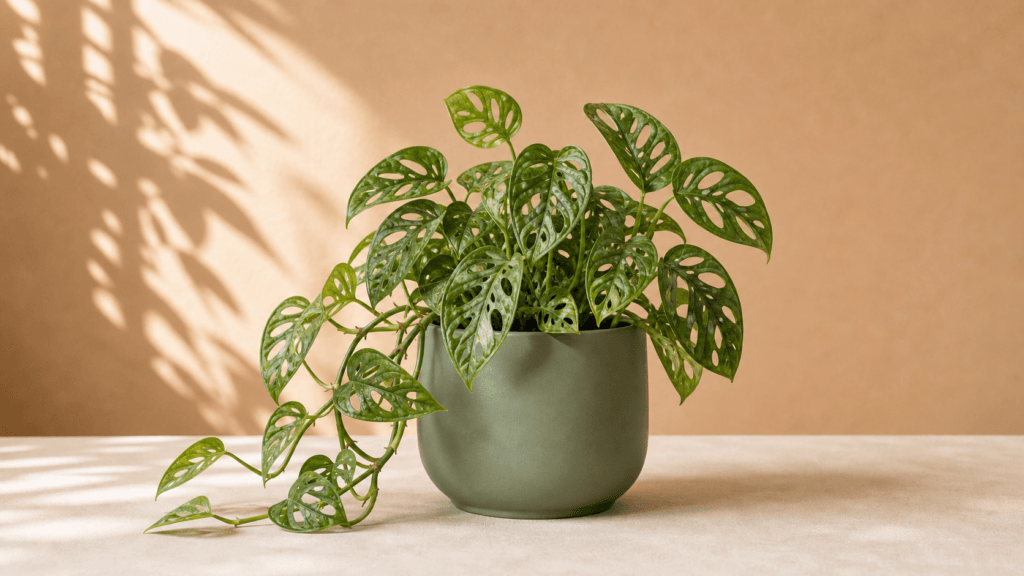
Swiss Cheese Vine
Monstera adansonii
A climbing Monstera with naturally perforated leaves that develops best with filtered light, an airy root zone, warmth, and vertical support.
Watering frequency
Every 7-10 days
Ideal temperature
65-85°F / 18-29°C
Humidity
50-70%
Care difficulty
Easy
Air purifying
No/Not Known
Growth rate
Fast
Plant size
2-8 ft / 0.6-2.4 m
Soil type
Loose aroid mix
Fertilizer need
Every 4-6 weeks, spring-summer.
Care summary
- Light: Provide medium to bright indirect light; stronger filtered light supports growth.
- Water: Water after the upper mix dries, then drain completely.
- Soil: Use an airy aroid mix in a pot with unobstructed drainage.
- Support: Train stems upward for larger, more mature foliage.
- Safety: Contains insoluble calcium oxalates and is not pet-safe.
Common problems
- Yellow leaves: Review wet soil, drainage, light, roots, and natural aging.
- Brown edges: Check drought, salts, low humidity, heat, and roots.
- Small leaves or few holes: Improve light, support, maturity, and overall health.
- Black or soft tissue: Inspect for cold injury or rot.
- Pests: Check new growth and leaf undersides for mites, thrips, and mealybugs.
Plant care guide
About Swiss Cheese Vine
Swiss Cheese Vine is the consumer name used here for Monstera adansonii, a tropical American climbing aroid recognized by openings, or fenestrations, inside the leaf blade. NC State Extension’s Monstera adansonii profile describes a warm, humid climber with aerial roots that prefers bright indirect light and moist, well-drained soil.
It is smaller-leaved and more vine-like than Monstera Deliciosa. Retail confusion is common: juvenile plants may have few holes, and “Swiss cheese plant” can refer to more than one Monstera. This page is specifically about M. adansonii, not M. deliciosa or the shingling plant Monstera dubia.
Why You’ll Like It
This is a flexible display plant. Let it trail from a shelf for a soft informal look, or give it a pole or plank for more orderly vertical growth and potentially larger leaves. Its naturally perforated foliage creates visual detail without a variegation-related loss of chlorophyll.
It grows more quickly than many statement aroids under good conditions and propagates from node-bearing stem cuttings. It is not ideal for a pet that chews plants, and its fast growth means the eventual reach of every stem must be considered.
Compare Heartleaf Philodendron for solid heart-shaped climbing foliage and Golden Pothos for another vigorous trainer. All three are aroids and all three are unsafe to chew.
What Kind of Plant Is It?
Swiss Cheese Vine climbs by producing aerial roots from nodes along the stem. A node is the joint where a leaf, root, or new shoot can emerge. The section between nodes is the internode. A leaf or petiole without a node cannot grow into a complete new vine.
Young plants may creep or trail. When a stem finds vertical support, leaf size can increase as the plant matures. Fenestration is influenced by genetics, maturity, light, support, and health; no fixed indoor age guarantees holes. Cutting a leaf cannot create new fenestrations in existing tissue.
Related Monsteras and Lookalikes
- Monstera deliciosa: Larger, thicker leaves that may split to the margins as well as form internal holes. Its variegated cultivars, the Thai Constellation Monstera and the Albo Variegata Monstera, are the collector favorites.
- Monstera adansonii forms: Retail plants vary in leaf width, hole pattern, and growth without every difference representing a formal cultivar.
- Monstera obliqua: A rare botanical species routinely misapplied as a retail label to ordinary M. adansonii.
- Rhaphidophora tetrasperma: Often called Mini Monstera, but belongs to a different genus and develops edge splits rather than the same perforation pattern.
- Monstera dubia: A shingling juvenile that presses flat leaves against a support.
Use botanical identity, not a dramatic marketplace label, before creating a new plant page.
Where It Works Best
Place it near an east window or several feet from a bright south or west exposure, adjusting for curtains, trees, and season. The original record included low light, but tolerance is not preference. In dim placement, internodes lengthen, leaves stay small, soil dries slowly, and overwatering risk rises.
A bright bathroom can provide useful humidity. A living room is often better because there is more space for a pole and easier pest inspection. Keep foliage from pressing against cold glass, heating vents, and rough traffic paths.
How to Care for Swiss Cheese Vine
Light
Give medium to bright indirect light, with gentle sun only after acclimation. Harsh midday rays can bleach or scorch leaves, especially against hot glass. A grow light can support a plant far from a window, but decorative room lighting cannot.
Water
Water when the upper portion of the mix has dried while the root zone remains slightly moist. Soak evenly and discard runoff. Do not use “every 7–10 days” as a command: light, pot material, root mass, and season alter the interval. Wilting in wet soil calls for root inspection, not another drink.
Soil and pot
Use an airy aroid mix combining moisture-retentive material with bark and mineral aeration. The pot must have drainage holes. Avoid an oversized container, which keeps unused soil wet around a small root system. A clear nursery pot can make moisture and roots easier to observe inside a cachepot.
Humidity and temperature
Average indoor humidity can work, but stable moderate humidity helps new leaves unfurl. A humidifier is more effective than frequent misting. Keep the plant warm, away from cold drafts, and provide airflow without placing it directly in a vent.
Fertilizer
Feed lightly every four to six weeks from spring through early fall, while the vine is producing new leaves, with a diluted balanced fertilizer; pause when light and growth decline in winter. Flush accumulated salts occasionally in a freely draining pot. Fertilizer will not repair low light, rot, or pest damage.
Training and pruning
Attach the main stem loosely to a moss pole, plank, or trellis without tying petioles. Direct aerial roots toward a support or mix; do not force them. Prune above a node to shorten a vine and encourage a new growing point. Remove only fully damaged foliage and keep tools clean.
How to Propagate Swiss Cheese Vine
Cut a healthy section containing at least one node. A top cutting with one or two leaves is convenient; a bare node section can work but has less stored energy and no leaf to photosynthesize. Root in water, damp sphagnum, perlite, or a light aroid mix while maintaining warmth and bright indirect light.
Keep the node appropriately moist but not sealed in stagnant saturation. Move a water-rooted cutting to mix after it has developed a useful root system, then maintain slightly steadier moisture during adjustment. Do not promise a fixed rooting time.
Layering is lower-risk: pin a node into a small pot while it remains attached to the parent, wait for roots, then cut between the two plants.
When to Repot
Repot when roots circle densely, push from drainage holes, the mix collapses, or water no longer penetrates evenly. Move up one modest size. If a tall plant tips over, a heavier cachepot or better support may solve stability without giving the roots an unnecessarily large wet container.
Toxicity and Pet Safety
Swiss Cheese Vine is not pet-safe. Like other Monstera, it contains insoluble calcium oxalate crystals. The ASPCA’s houseplant safety guidance associates Monstera exposure with oral irritation, drooling, nausea, appetite loss, vomiting, and diarrhea; swelling that affects breathing or swallowing requires urgent care.
Keep the pot, vines, prunings, and fallen leaves away from cats, dogs, and children. If ingestion occurs, contact a veterinarian or poison-control professional. Do not give an unsupervised home remedy that could delay assessment.
Common Problems and Practical Fixes
Yellow leaves
Check the root-zone moisture and drainage first, then light, cold exposure, pests, and whether only an old lower leaf is aging. Several yellow leaves in wet mix suggest root stress.
Brown tips or margins
Drought, salt accumulation, hot airflow, damaged roots, and low humidity can overlap. Flush only if roots are healthy and the pot drains. Correct the condition for future growth; damaged areas remain brown.
Few holes or small leaves
Improve filtered light, offer vertical support, and maintain steady growth. A juvenile cutting will not instantly produce mature leaves simply because it is fertilized.
Black patches or soft stems
Check for cold glass, sudden chill, and rot. Cut away advancing soft tissue with clean tools and preserve healthy node cuttings if the base is failing.
Pests
Thrips can scar emerging leaves; mites stipple foliage; mealybugs hide at nodes. Isolate, identify, and treat according to a labeled product, repeating as directed.
Frequently Asked Questions
Does it need a moss pole?
No, it can trail, but upward support can produce a more mature habit and larger leaves. Match the choice to your space.
Can it grow in water permanently?
Cuttings root in water, but long-term water culture requires deliberate nutrition, oxygen, and maintenance. A glass of unchanged water is not a complete care system.
Why did a new leaf have no holes?
Juvenility, insufficient light, a recent cutting, weak roots, or interrupted growth can reduce fenestration. Evaluate the whole plant rather than one leaf.
Is it the same as Monstera deliciosa?
No. They are different species with distinct mature scale and leaf architecture, despite sharing a common-name theme.
Building a Better Climbing Setup
A support changes more than appearance. Start with a pole, cedar plank, coir column, or trellis that is tall enough for several months of growth and stable inside the pot. Install it during repotting when possible so roots are not repeatedly pierced later. Place the main stem against it with nodes and aerial roots facing the surface, then use soft reusable ties around the stem—not around leaf petioles.
A true moss pole can be kept lightly moist so aerial roots enter it, but that adds maintenance and is not mandatory. A dry plank still provides orientation and physical support. Coir poles often act mainly as stakes. Choose the system you will actually maintain rather than buying the most elaborate one.
As the vine reaches the top, extend the support, take a top cutting, or bend and layer the stem. Do not let a heavy unsupported top pull the root ball from the pot. If the plant must remain trailing, prune regularly and place rooted cuttings back into the crown for density. Trailing stems often retain smaller leaves, which is a valid display choice rather than a care failure.
Seasonal Care
In spring, reassess roots, replace degraded mix, and install support before vigorous growth begins. Resume light feeding only after the plant is rooted and producing new leaves. Increase light gradually as the sun angle changes.
Summer brings faster water use and pest pressure. Check a supported plant from every side because thrips and mites hide behind the pole. Warm bright conditions can produce rapid growth; guide a new stem before it hardens in the wrong direction.
In autumn, reduce fertilizer as daylight shortens. Soil that dried in seven days during summer may remain wet much longer. Move the plant for better light if necessary, but avoid a cold window.
Winter growth may slow or pause. Keep the root zone warm, water according to dry-down, and use a grow light if the only window becomes inadequate. Do not interpret every smaller winter leaf as a need for more fertilizer.
Buying and Identifying the Plant
Look for a clearly labeled Monstera adansonii with firm nodes, clean unfurling leaves, and roots that smell earthy rather than sour. Examine silvery scarring and tiny black specks for thrips, and check the undersides for mites. A few torn holes are not damage—fenestrations have smooth naturally formed margins, while mechanical tears look irregular.
Be cautious with costly labels such as “obliqua,” “mint,” or “rare form” unless the seller documents identity and propagation. Natural variation in leaf width or hole placement does not automatically create a named cultivar. Variegated plants require separate verification and may grow more slowly because pale tissue produces less energy.
Quarantine a new plant, learn the behavior of its nursery mix, and avoid immediate routine upsizing. A tightly rooted but healthy vine can acclimate first; a waterlogged rotten plant needs prompt intervention.
A Symptom-First Diagnostic Routine
When the plant changes, check in this order: current soil moisture, root smell and firmness if warranted, recent light or temperature change, pest evidence, and only then nutrition. Photographing the newest leaf and noting the watering date helps separate a repeating pattern from normal aging.
One symptom can have opposite causes. Curling may reflect dry roots or roots lost in wet soil. Yellowing may follow saturation, drought, cold, pests, or natural lower-leaf aging. The correct fix comes from the surrounding evidence, not the color alone.
After any correction, wait for new growth before declaring success. Existing yellow, torn, or scorched tissue cannot become healthy again, and repeated interventions may create a second problem before the first response is visible.
Final Thought
Swiss Cheese Vine performs best as a real climber receiving useful filtered light, an airy root zone, and water based on dry-down. Give every cutting a node, keep the plant away from pets, and let maturity—not exaggerated promises—produce its characteristic holes.