
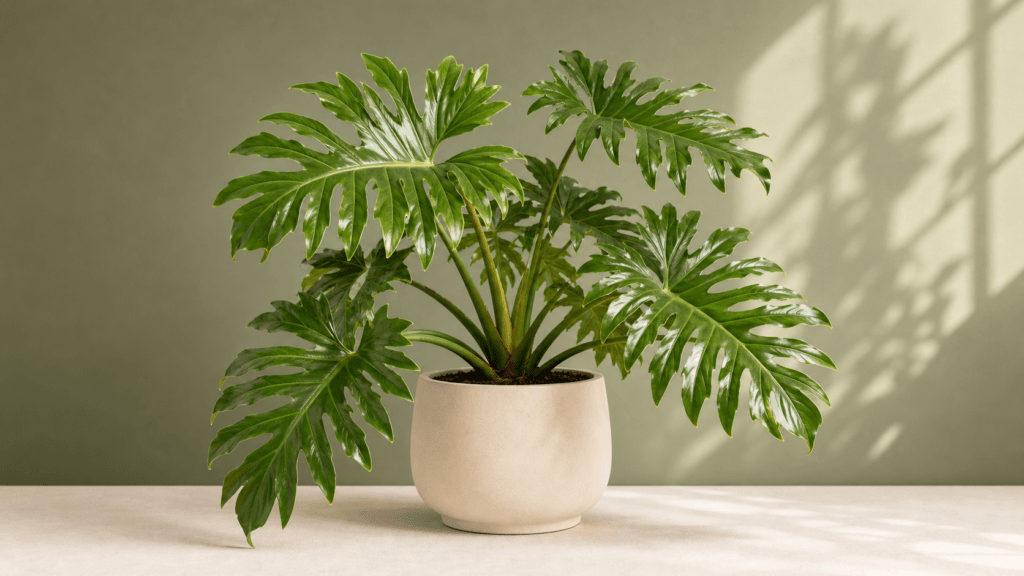
Tree Philodendron
Philodendron bipinnatifidum
A broad self-heading aroid with deeply divided leaves that needs filtered light, an airy root zone, stable warmth, and generous floor space.
Watering frequency
Every 7-10 days
Ideal temperature
65-85°F / 18-29°C
Humidity
40-70%
Care difficulty
Medium
Air purifying
Yes
Growth rate
Fast
Plant size
4-8 ft / 1.2-2.4 m
Soil type
Chunky aroid mix
Fertilizer need
Every 4-6 weeks, spring-summer.
Care summary
- Light: Provide medium to bright indirect light with room for the crown to spread.
- Water: Water after the upper mix dries, then drain completely.
- Soil: Use a chunky aerated mix in a stable draining container.
- Habit: Expect a broad self-heading plant with a reclining trunk, not a climbing vine.
- Safety: Contains irritating calcium oxalates and is not pet-safe.
Common problems
- Yellow leaves: Check wet soil, drainage, roots, light, and natural aging.
- Brown edges: Review drought, salts, hot airflow, humidity, and root health.
- Leaning or sprawling stem: Provide space and physical stability, not a vine pole.
- Scorched patches: Reduce harsh direct sun and heat at the glass.
- Pests: Inspect petiole bases and leaf undersides for scale, mites, and mealybugs.
Plant care guide
About Tree Philodendron
Tree Philodendron is the long-established common name for the large self-heading aroid currently accepted by Kew as Philodendron bipinnatifidum. It is also widely labeled Thaumatophyllum bipinnatifidum, and older retail material may call it Philodendron selloum. Kew’s current record treats Thaumatophyllum bipinnatifidum as a synonym and gives a native range from eastern Bolivia through southern and southeastern Brazil to northeastern Argentina.
This draft therefore retains the consumer name, stable slug, and familiar synonym in context while correcting the Botanical Name field to the authority currently used. Taxonomic systems differ, so readers may still encounter the genus Thaumatophyllum in respected horticultural sources.
Why You’ll Like It
The appeal is architectural scale. Mature leaves are deeply divided into many lobes, and a single healthy specimen can anchor a bright room without needing several smaller pots. It develops a substantial stem and a wide crown rather than sending thin vines around a pole.
That size is also the main ownership constraint. Tree Philodendron is not a desktop plant and should not be bought on the assumption that pruning will keep it indefinitely compact. Allow clearance around the leaves and a stable route for moving the container.
Compare Heartleaf Philodendron for a true climbing or trailing habit and Monstera Deliciosa for another large aroid with fenestrated rather than finely lobed leaves.
What Kind of Plant Is It?
This is a self-heading, trunk-forming aroid. New leaves emerge from the central growing region, while old leaf bases mark the thick stem. As the plant ages, the trunk may recline or creep and produce adventitious roots. That behavior is normal and differs from a vine seeking a moss pole.
Each leaf is held on a long petiole, so the plant’s effective width is greater than the pot. Leaves turn toward light, and an uneven source can create a lopsided crown. Rotate gradually, since suddenly reversing a large plant can place pale leaf surfaces in harsh sun.
Related Plants and Names
- Philodendron ‘Hope’ / ‘Little Hope’: Compact selections sold for a similar divided-leaf look; identity and mature size should be verified before treating a trade label as a cultivar.
- Thaumatophyllum spruceanum: A related trunking aroid with a different leaf form, sometimes sold as Philodendron goeldii.
- Thaumatophyllum xanadu: Commonly sold as Philodendron ‘Xanadu’, with a smaller clumping habit.
- Split-leaf Philodendron: An ambiguous common name also used for Monstera deliciosa; botanical identity prevents care and image errors.
These names are useful future links but should not be merged into the Tree Philodendron record.
Where It Works Best
Provide a bright living room, sunroom with filtered light, or spacious office. An east exposure or a position back from hot south or west glass is a practical starting point. Medium light can sustain the plant, but growth slows and soil remains wet longer.
Leave space for leaf spread and place the pot on a sturdy surface. Avoid narrow halls where passing people break lobes, and keep it away from cold drafts, radiators, and air conditioners. Outdoor summer placement can work in warm weather after gradual acclimation, but strong sun and cool nights can damage indoor-grown leaves.
How to Care for Tree Philodendron
Light
Give medium to bright indirect light. Gentle sun can be tolerated after acclimation, but intense hot rays may bleach or scorch. If the crown leans, rotate a small amount periodically rather than making abrupt 180-degree changes.
Water
Water after the upper portion of the mix dries, soaking the entire root ball and discarding runoff. The 7–10-day field is only a starting range. A large dense pot in winter may need far less frequent water; a root-filled plant in strong summer light may dry faster.
Drooping does not automatically mean thirst. Check the root zone: wet mix, yellowing, and soft roots indicate that adding water could worsen the problem.
Soil and container
Use a chunky aroid mix with organic material, bark, and mineral aeration. The goal is water retention plus oxygen, not an extremely dry orchid basket. A heavy pot or weighted cachepot can stabilize the broad crown, but drainage holes must remain open.
Move up only one size when repotting. An enormous decorative planter full of dense soil can stay wet around a limited root system. If using a large outer planter, keep the plant in a correctly sized inner nursery pot.
Humidity and temperature
Normal indoor humidity is often adequate, while moderate humidity can support cleaner leaf expansion. Do not use misting as a substitute for root care. Keep temperatures stable and warm, with protection from cold glass and drafts.
Fertilizer
Feed lightly every four to six weeks from spring through early fall, while new leaves are forming; reduce or pause in winter when growth slows. A large plant can use nutrients, but fertilizer is not a cure for low light or failing roots. Apply to moist, healthy mix and flush salts periodically where water quality allows.
Grooming and support
Clean leaves gently so pests and damage remain visible. Remove an old leaf by cutting its petiole near the trunk without injuring the growing point. Do not cut healthy aerial roots simply for appearance; guide them toward the mix where practical.
A stake can stabilize a leaning juvenile or heavy trunk, but a moss pole will not convert the plant into a vertical vine. Plan for the natural reclining habit.
Propagation
Home propagation is more difficult than taking a common Philodendron vine cutting. A viable stem section must contain an active growing point or suitable node tissue; a leaf and petiole alone will not reproduce the plant. Large basal offsets can sometimes be separated if they have their own roots.
Commercial growers may use seed or tissue culture. For an old plant that must be reduced, air layering a suitable stem section before cutting is safer than making an unrooted trunk cut. Because damage can be difficult to reverse, inexperienced owners may prefer to keep one plant and manage its space rather than divide it aggressively.
When to Repot
Repot when roots crowd the container, push through drainage holes, lift the plant, or when degraded mix no longer wets and drains evenly. A plant that merely leans may need stabilization rather than more soil. Wear gloves, use help for a heavy specimen, and protect the growing point during the move.
Toxicity and Pet Safety
Tree Philodendron is not pet-safe. The ASPCA’s Tree Philodendron record lists the older scientific name Philodendron selloum and identifies insoluble calcium oxalates. Chewing can cause oral pain and burning, drooling, vomiting, and difficulty swallowing.
Keep leaves, sap, prunings, and fallen material away from pets and children. Wear gloves if sap irritates your skin and wash tools. Contact a veterinarian or poison-control professional after ingestion; breathing or swallowing difficulty needs urgent care.
Air-Purifying Claims
The legacy database retains an Air Purifying taxonomy for compatibility, but this plant should be chosen for foliage and spatial impact, not as a health device. Laboratory chamber studies do not show that a few pots replace ventilation or an appropriately selected air purifier in an occupied home.
Common Problems and Practical Fixes
Yellow leaves
One old lower leaf can be normal. Multiple yellow leaves call for a check of wetness, drainage, roots, light, temperature, and pests. Do not diagnose from color alone.
Brown tips or margins
Review severe dry-down, salt buildup, hot airflow, root damage, and humidity. Trim only dead tissue and improve conditions for future leaves.
The trunk leans or creeps
That can be mature natural growth. Stabilize the container, give the stem room, and use a discreet stake if needed. Do not bury the trunk deeply in wet soil.
New leaves are small
Check useful light, roots, feeding during active growth, and whether the plant recently experienced damage or repotting. A larger pot by itself does not produce larger leaves.
Scorched or bleached patches
Move the plant back from hot glass and acclimate it more gradually. Existing damage remains, but new leaves can adapt under balanced light.
Scale, mites, or mealybugs
Inspect leaf undersides and petiole bases. Isolate the plant and apply a treatment labeled for the pest, repeating as directed. Large leaves make wiping possible, but hidden joints still need inspection.
Frequently Asked Questions
Is it still a Thaumatophyllum?
You will see both classifications. Kew currently accepts Philodendron bipinnatifidum and lists Thaumatophyllum bipinnatifidum as a synonym; the latter remains common in horticulture.
Does it need a moss pole?
No. It is self-heading and trunk-forming, not a thin climbing vine. It may need physical stabilization as it grows, which is a different purpose.
Can I keep it small?
You can slow growth with sensible conditions and remove damaged leaves, but repeated severe pruning fights the plant’s natural architecture. Choose a compact related selection if space is permanently limited.
Can I propagate a leaf?
No. A leaf without viable stem and growing tissue cannot rebuild the plant.
Planning for Mature Size
Measure the location before buying or moving a Tree Philodendron. The relevant dimension is not only height: long petioles can create a crown several feet wide, and the reclining trunk may shift the center away from the pot. Leave clearance from furniture, walls, curtains, and paths. A leaf repeatedly bent by traffic will not repair itself.
Use a plant caddy rated for the combined weight of the container, wet mix, and mature plant. Locking wheels make watering and cleaning safer, but the platform must remain level. If the plant leans, rotate it gradually and stabilize the trunk; do not bury more stem in a deep layer of wet mix.
In a small home, the honest solution may be a naturally compact relative rather than repeated drastic cutting. Pruning old leaves reduces width temporarily but does not change the genetic scale of future foliage. Giving away a healthy plant before it becomes unmanageable is better than allowing it to deteriorate in a dark cramped corner.
Seasonal Care
Spring is the preferred time for planned repotting, root inspection, and renewed feeding. Stronger daylight can accelerate water use, so observe the transition rather than keeping a winter interval. Clean the leaves and inspect the tight petiole bases where pests hide.
During summer, protect indoor foliage from sudden direct sun after moving outdoors. Wind can shred lobes and topple a top-heavy pot. If the plant remains outside, check moisture more frequently while ensuring the saucer does not fill after rain.
Autumn is the time to bring an outdoor plant in before nights become cool, inspect it away from the collection, and reduce feeding as growth slows. A relocation may cause one or two older leaves to decline; stabilize conditions before making another move.
In winter, maximize useful light and keep roots away from a cold floor or window. Let the upper mix dry appropriately, but do not allow a root-filled plant beside heating to desiccate repeatedly. Dust removal improves inspection and presentation even though it is not an air-purification treatment.
Choosing a Healthy Tree Philodendron
Confirm the label and leaf habit. A juvenile Monstera deliciosa is frequently sold under “split-leaf philodendron,” while Tree Philodendron develops lobed leaves without the same internal holes. Look for a firm growing point, clean new leaf, stable trunk, and roots that are pale and firm rather than dark and mushy.
Inspect the deep sinuses of lobed leaves, petiole bases, and underside veins for scale, mites, or mealybugs. Cosmetic tears are common on large foliage; widespread mottling, sticky residue, webbing, or distorted new growth deserves caution.
After purchase, quarantine and acclimate it. Learn how the nursery mix dries before replacing it. Do not move a healthy plant immediately into a huge “forever pot”; indoor roots expand more safely through a sequence of modest containers.
A Practical Diagnosis Order
When decline appears, start with root-zone moisture and temperature. Next check light and recent relocation, then pests, and finally nutrition. This order prevents the common mistake of fertilizing damaged roots. If a symptom affects only one oldest leaf, monitor it; if it advances through new growth, investigate promptly.
Final Thought
Tree Philodendron is a long-term floor plant, not an enlarged tabletop Philodendron. Give its broad crown filtered light, its roots an airy draining mix, and its trunk room to mature. Accurate naming, realistic space planning, and strict pet separation matter as much as watering.