
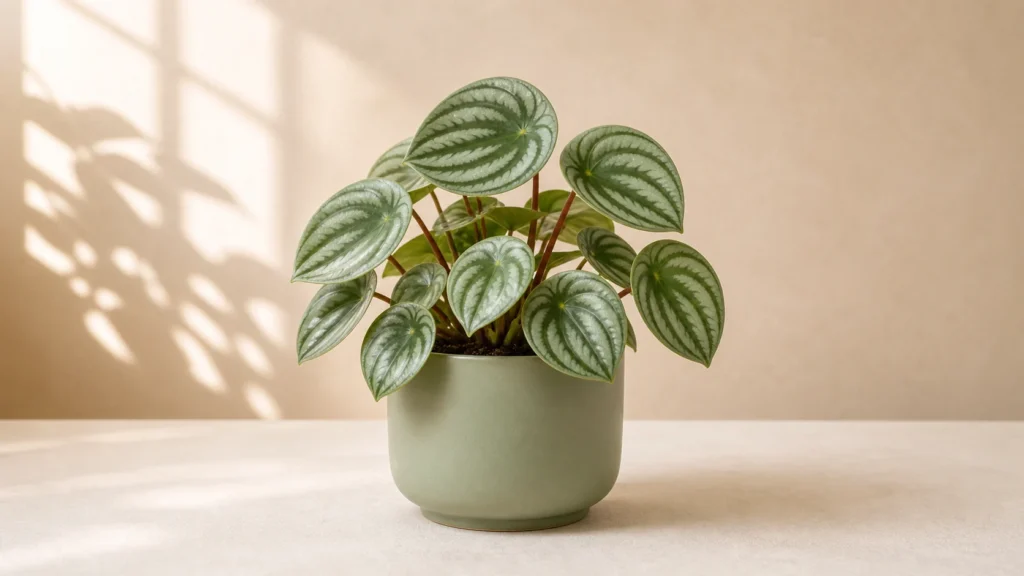
Watermelon Peperomia
Peperomia argyreia
A compact pet-safe peperomia with silver-striped peltate leaves that needs filtered light, a small aerated pot, and a measured moisture cycle.
Watering frequency
Every 7-10 days
Ideal temperature
65-80°F / 18-27°C
Humidity
40-60%
Care difficulty
Easy
Air purifying
No/Not Known
Growth rate
Moderate
Plant size
6-12 in / 15-30 cm
Soil type
Fine, aerated houseplant mix
Fertilizer need
Every 6-8 weeks, spring-summer.
Care summary
- Light: Provide medium to bright indirect light and avoid harsh midday sun.
- Water: Let the surface dry, then water evenly and drain completely.
- Soil: Use a fine aerated mix in a small pot with a drainage hole.
- Handling: Protect the brittle petioles and keep water out of a crowded crown.
- Safety: ASPCA lists the species as non-toxic to dogs and cats.
Common problems
- Yellow or soft leaves: Check saturated mix, poor drainage, and root or crown rot.
- Drooping: Review dryness, wet roots, heat, cold, and recent repotting.
- Brown edges: Check drought, salts, hot airflow, and damaged roots.
- Faded striping: Improve useful filtered light without harsh sun.
- Pests: Inspect petiole bases and leaf undersides for mealybugs, mites, and scale.
Plant care guide
About Watermelon Peperomia
Watermelon Peperomia, Peperomia argyreia, is a compact South American member of the pepper family grown for round silver-and-green leaves resembling watermelon rind. NC State Extension’s species profile uses the spelling Peperomia argyraea while listing P. argyreia among previous names, and it documents bright filtered light, sensitivity to both saturation and severe drought, and propagation by division or leaf cutting.
The leaf is peltate: its petiole joins the underside inside the blade rather than at the edge. Red petioles rise from a short central crown, creating a low rosette. Those petioles are brittle, so handling damage is more common than on a flexible vine.
Why You’ll Like It
Watermelon Peperomia brings a strong graphic pattern to a small space. It suits a desk, plant shelf, or bright bedroom without quickly outgrowing the surface. Its narrow root system prefers a modest pot, and light feeding is enough.
It is also one of the database’s clearly supported pet-safe choices. For a taller relative compare Baby Rubber Plant; for another round-leaved but unrelated plant compare Pilea Peperomioides. The similarity in names has caused retail confusion, but Pilea is a different genus.
What Kind of Plant Is It?
This is a short herbaceous perennial with fleshy leaves and fine roots. The leaves store some water, but the species is not managed like a desert cactus. It dislikes staying wet and also reacts to prolonged severe drought. The practical goal is a moderate cycle: water after the surface dries while the deeper mix has not remained bone-dry for an extended period.
Small cream-colored flower spikes may appear. They look like slender rat tails rather than showy petals. Flowering is normal and can be left in place or removed if the owner prefers foliage.
Popular Peperomia Relatives
- Baby Rubber Plant (Peperomia obtusifolia): Upright branching stems and thick oval leaves.
- Ripple Peperomia (Peperomia caperata): Heart-shaped, deeply corrugated foliage in many named cultivars.
- String of Turtles (Peperomia prostrata): A delicate trailer with small patterned leaves.
- Raindrop Peperomia (Peperomia polybotrya): Larger teardrop leaves, often confused with Pilea.
- Red-edge Peperomia (Peperomia clusiifolia): Elongated thick leaves, sometimes sold in variegated cultivars.
These share a genus but differ in root mass, leaf structure, and drying speed. Keep future internal links species-specific.
Where It Works Best
Use an east-facing windowsill with gentle light, a bright north exposure, or a protected place near a south or west window. A bright desk works only if daylight or a proper grow light reaches the leaves. Medium light is tolerated, but growth slows and the mix dries more slowly.
Keep the rosette away from cold drafts and hot vents. A bright bathroom may work, but high humidity does not excuse wet soil. Give enough space that neighboring pots do not snap the long petioles.
How to Care for Watermelon Peperomia
Light
Provide medium to bright indirect light. Strong filtered light maintains compact growth and clear striping. Harsh midday sun can bleach or scorch the leaf surface. Increase exposure gradually and judge new growth.
Water
Allow the surface of the mix to dry to the touch, then water thoroughly and let all excess drain. Do not pour small daily amounts into the crown. A 7–10-day interval is a monitoring reminder, not a guarantee.
Drooping can mean either thirst or root failure. Dry lightweight mix suggests watering; wet mix with soft petioles suggests excess moisture or damaged roots. In winter or low light, the same pot may need much longer between drinks.
Soil and container
Use a fine-textured but aerated houseplant mix amended with perlite and a small amount of fine bark. Very large bark chunks leave the fine roots unsupported, while dense peat stays wet. A small plastic or glazed pot often balances moisture better than oversized terracotta.
Drainage is essential. Empty the cachepot or saucer after watering. Keep the crown at the original depth; burying petiole bases encourages rot.
Humidity and temperature
Normal household humidity works, and moderate humidity can support clean leaf expansion. Avoid stagnant wet enclosures. A humidifier is more predictable than misting, which can leave spots or water in the crown. Maintain stable warmth and protect from cold glass.
Fertilizer
Feed lightly every six to eight weeks from spring through early fall, while new leaves are forming, using a diluted balanced fertilizer; pause in winter when growth slows. Skip feeding after repotting or when roots are stressed. Excess fertilizer can accumulate salts in a small pot and burn fine roots.
Grooming
Remove a damaged leaf by cutting the petiole near its base with clean scissors. Support leaves from below when cleaning. Do not use oily shine products. Turn the pot gradually so petioles do not lean permanently toward one side.
How to Propagate Watermelon Peperomia
Division is the quickest method for a multi-crowned plant. During repotting, identify a natural section with leaves and its own roots, separate gently, and pot it into a small container.
Leaf cuttings can also work. Take a healthy mature leaf with its petiole, insert the petiole into a lightly moist propagation medium, and maintain warmth and bright indirect light. Another method cuts a leaf horizontally and places sections so the correct basal edge contacts the medium. New plantlets arise after rooting; the original cutting may decline later.
Do not keep a large propagation container saturated. Fine roots need both moisture and oxygen. Propagation speed varies with season, temperature, leaf condition, and light, so avoid a rigid guarantee.
When to Repot
Repot when roots densely occupy the pot, the mix has compacted, drainage has changed, or the plant repeatedly wilts despite correct moisture. Watermelon Peperomia tolerates a snug container and does not need annual upsizing.
Move up one small size and handle the crown rather than pulling petioles. A shallow broad pot can accommodate the rosette, but it still needs enough depth for roots and an unobstructed drainage hole.
Pet and Household Safety
Watermelon Peperomia is Pet safe. The ASPCA’s exact Peperomia argyreia record lists the species as non-toxic to dogs and cats, and a second ASPCA Watermelon Begonia record also lists it as non-toxic to dogs, cats, and horses.
Pet safe is not a feeding recommendation. Chewed foliage can still cause nonspecific stomach upset, and fertilizer, pesticides, and potting mix create separate risks. Contact a veterinarian if a pet eats a large amount or develops symptoms.
Common Problems and Practical Fixes
Leaves droop
Check moisture below the surface. Dry mix, heat, or recent root disturbance may cause temporary droop. Wet mix with worsening softness requires root inspection. Do not water solely because the leaf angle changed overnight.
Yellow or soft leaves
Excess moisture and poor drainage are common causes. Remove standing water, improve light and aeration, and inspect the crown and roots if soft tissue spreads.
Leaves curl or cup
Review inconsistent moisture, heat, cold, strong sun, root health, and pests. Some natural cupping is part of the leaf shape; compare new leaves over time.
Brown edges
Consider prolonged drought, salt accumulation, hot moving air, root damage, and low humidity. Flush only through healthy freely draining roots and reduce fertilizer if salts are likely.
Faded striping or stretched petioles
Increase useful filtered light gradually. Do not expose a shade-grown plant abruptly to intense midday sun.
Mealybugs, mites, or scale
Inspect petiole bases and leaf undersides. Isolate the plant, remove visible pests, and treat with a product labeled for the pest. Test sprays because textured or waxy leaves may show damage.
Frequently Asked Questions
Is it actually a Begonia?
No. “Watermelon Begonia” is an old common name, but the plant is a Peperomia in Piperaceae. True Begonias belong to Begoniaceae and may have different toxicity and care.
Should the soil dry completely?
Let the surface dry and avoid prolonged saturation, but do not impose cactus-style extended drought on the fine roots. Use pot weight and deeper moisture to judge.
Can it grow in low light?
It may persist in medium conditions, but strong filtered light supports clearer pattern and compact growth. Low light also makes overwatering more likely.
Can I grow it from one leaf?
Yes, a healthy leaf cutting can produce new plantlets when orientation, warmth, moisture, and light are suitable. Division is faster when the parent already has multiple rooted crowns.
Why are the petioles breaking?
They are naturally brittle. Give the rosette clearance, support leaves during cleaning, and move the pot by its container rather than its foliage.
Seasonal Care
Spring usually brings the clearest active growth. This is the best time to inspect roots, divide an overcrowded clump, refresh compacted mix, and resume very light feeding. As sunlight becomes stronger, move the plant gradually so tender leaves are not scorched.
During summer, warmth and longer days may shorten the watering interval. Check the pot rather than increasing water automatically. A rosette beside hot glass can wilt while the mix is still wet; shading and temperature control may be more appropriate than another drink. Continue checking the crown for trapped water and the undersides for mites.
Autumn reduces growth and water use. Stop or reduce fertilizer and observe how much longer the mix stays damp. If moving the plant closer to a window, protect it from cold night glass and sudden direct sun at a changed angle.
In winter, maximize filtered light, maintain stable warmth, and keep the root zone from remaining cold and wet. A few old leaves may be lost, but widespread softness needs root inspection. Do not repot simply because growth pauses.
Choosing a Healthy Plant
Look for a compact rosette with firm red petioles, clear leaf pattern, and at least one healthy emerging leaf. Inspect the crown for black or translucent tissue. Lift the inner pot from any sleeve to check for standing water and smell the mix; sour odor plus soft roots suggests decline.
Check leaf undersides, petiole bases, and flower spikes for mealybugs, mites, or scale. Small healed tears are cosmetic, but distorted new growth or fine webbing deserves caution. A tightly packed plant may contain several crowns and can later be divided, though immediate separation after purchase adds stress.
Quarantine the plant, give it stable filtered light, and learn the nursery mix before changing the container. If it is rooted in very dense peat, water carefully during acclimation and replace the mix during active growth rather than placing the entire plug inside a much larger wet pot.
Display and Container Choices
A low pot emphasizes the radial foliage, but it must still hold the fine roots and drain freely. A container only slightly wider than the root mass reduces the volume that remains unused and wet. Decorative planters with narrow openings can trap the rosette and make later removal destructive, so choose a simple shape.
Place the pot where leaves are not brushed whenever someone reaches across a desk. Use a saucer or removable inner pot so watering does not require carrying the plant by its foliage. A small grow light above the rosette can keep growth symmetrical if window light comes from only one side.
Do not top-dress thickly with stones. They can hide moisture, compress fine growth, and make crown inspection harder. If using a decorative top layer, keep it thin and away from petiole bases.
A Diagnostic Sequence
Before treating a symptom, check moisture at depth, pot weight, root smell, recent temperature and light changes, and pests. Only then consider fertilizer. This sequence matters because drought and root rot can both produce droop, while low light and excess nitrogen can both create weak growth.
Keep notes on watering and take a photo when a new leaf opens. A pattern across several leaves is more informative than one imperfect blade.
Final Thought
Watermelon Peperomia is compact and forgiving when its fine roots receive a balanced moisture cycle in a small aerated pot. Protect the brittle crown, give the pattern real filtered light, and rely on the species-specific ASPCA record for its Pet safe classification.