
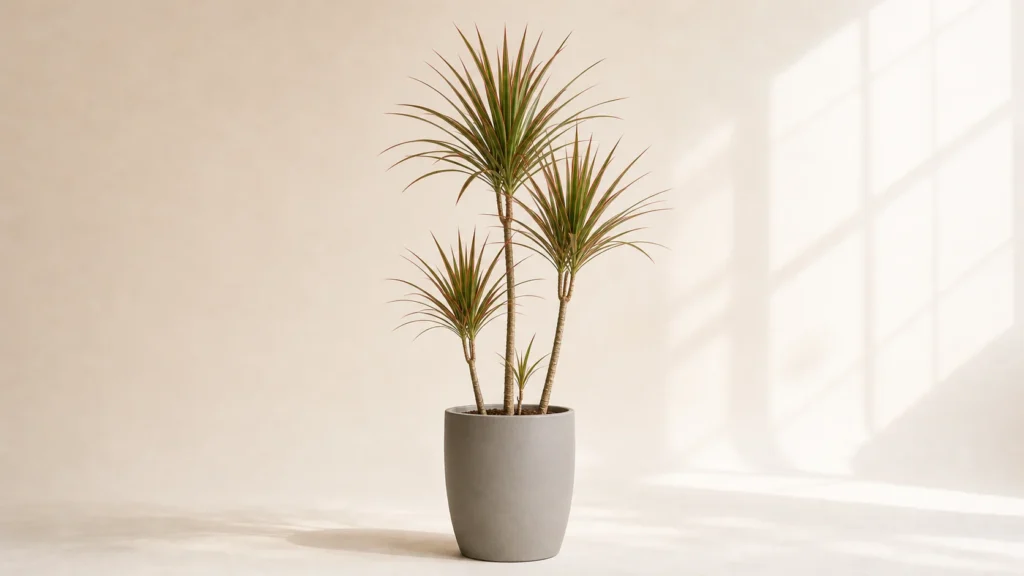
Dragon Tree
Dracaena reflexa var. angustifolia
A sculptural, slow-growing indoor tree with narrow red-edged leaves that prefers bright filtered light and substantial dry-down.
Watering frequency
Every 10-21 days
Ideal temperature
65-80°F / 18-27°C
Humidity
30-50%
Care difficulty
Easy
Air purifying
Yes
Growth rate
Moderate
Plant size
3-6 ft / 0.9-1.8 m
Soil type
Well-draining mix
Fertilizer need
Every 6-8 weeks, spring-summer.
Care summary
- Light: Bright indirect light is ideal; lower light slows growth.
- Water: Let much of the mix dry before watering thoroughly.
- Soil: Use an airy mix and a stable pot with drainage holes.
- Shape: Cut healthy canes in active growth to encourage new heads.
- Safety: Toxic to cats and dogs; keep foliage out of reach.
Common problems
- Yellow leaves: Check for wet soil, poor drainage, or natural aging.
- Brown tips: Review water quality, salts, drought, heat, and dry air.
- Soft cane: Treat as possible rot and inspect roots promptly.
- Sparse growth: Increase usable light and rotate the plant.
- Pests: Inspect leaf bases for mites, scale, and mealybugs.
Plant care guide
About Dragon Tree
Dragon Tree is the familiar retail name for the narrow-leaved Dracaena long sold as Dracaena marginata. Current botanical references accept it as Dracaena reflexa var. angustifolia. Kew's accepted record treats D. marginata as a synonym, so both names may appear on legitimate labels. Keeping Dragon Tree as the page title helps shoppers recognize the plant; using the accepted name in Botanical Name keeps the record botanically current.
The plant develops slender woody canes topped by rosettes of narrow green leaves, usually edged in dark red. Lower leaves age and fall, revealing ringed stems and creating the palm-like outline for which the plant is valued. It is slow indoors but can eventually become a tall floor specimen.
Dragon Tree is often described as a low-light plant. More accurately, it tolerates lower light while using water and growing more slowly. Bright indirect light produces denser, stronger growth. It also tolerates some dry-down, but “drought tolerant” does not mean a small root ball should stay bone dry for months.
Why You'll Like It
Its narrow footprint and vertical form suit apartments, offices, and awkward corners where a broad shrub would block movement. Multi-cane pots create an instant layered silhouette, while a single cane can become a minimalist specimen. The plant also responds to pruning: a shortened healthy cane can activate dormant buds and form new leafy heads.
Choose Dragon Tree for form and resilience, not as an air-cleaning appliance. The database retains its existing Air Purifying category, but sealed-chamber research does not show that a normal number of plants replaces ventilation or a suitable air purifier in a real room.
For a stiffer drought-tolerant form, compare Snake Plant. Yucca prefers more direct light, while Ponytail Palm stores water in a swollen base. Similar silhouettes do not mean identical watering.
What Kind of Plant Is It?
Dragon Tree belongs to the asparagus family, Asparagaceae, and is native to Madagascar and nearby Indian Ocean islands. NC State Extension's current profile documents the accepted name, older Dracaena marginata usage, narrow red-edged foliage, and a preference for well-drained mix with drying between waterings.
Leaves emerge from growing points at the top of canes. A leaf cutting without cane tissue cannot reproduce the full plant. Stem sections containing viable buds can produce shoots and roots. This growth pattern also means lower-stem bareness is normal as the plant matures.
Popular Dragon Tree Varieties
- Dragon Tree usually refers to the green form with narrow reddish margins.
- 'Tricolor' adds cream or pale striping between the green center and red edge.
- 'Colorama' has stronger pink-red coloration and generally needs strong light to maintain it.
- 'Tarzan' is sold for a thicker cane and dense, spiky head; verify the label rather than assuming every robust plant is this cultivar.
- 'Bicolor' is used for forms with contrasting green and red-toned striping.
Named forms may need brighter light to preserve their color. Avoid renaming an unidentified striped plant “variegated Dragon Tree” as if that were a cultivar.
Where It Works Best
Place it near an east, south, or west window where it receives bright filtered light. A few feet from a window can work only if the position remains genuinely bright throughout the day. Rotate the pot because new heads lean toward light.
Avoid cold glass, exterior-door drafts, and direct air-conditioning. Tall multi-cane plants need a stable container but should not be placed in an oversized volume of wet soil merely to prevent tipping; use a heavier cachepot around a correctly sized draining nursery pot if needed.
How to Care for Dragon Tree
Light
Bright indirect light is ideal. Lower light slows growth and extends drying time, increasing overwatering risk. Weak leaning growth and small pale leaves suggest more light is needed. Acclimate gradually to direct sun because harsh exposure can bleach leaves.
Watering
Allow the upper half or more of the potting mix to dry, then water thoroughly until excess drains. Check deeper with a skewer or moisture feel and learn the weight of the pot. Ten to twenty-one days is an estimate, not a schedule; winter, low light, or a large glazed pot may require longer.
Do not leave water in a decorative pot. Constant moisture deprives roots of oxygen and can soften roots or canes. Conversely, months of complete drought can wrinkle stems and produce crispy leaves. Adjust from evidence rather than alternating floods and neglect.
Soil and Container
Use a loose indoor mix amended with perlite, pumice, or fine bark. Drainage holes are essential. Choose a pot only slightly larger than the roots. A deep heavy container may stabilize tall canes, but the root zone still needs air.
Humidity and Temperature
Average home humidity is usually sufficient. Brown tips can involve mineral-rich water, salt accumulation, uneven watering, heat, or root damage as well as dry air. Diagnose before assuming a humidifier is the only answer.
Keep the plant around 65–80°F (18–27°C) and away from cold drafts. It grows slowly in cool, dim winter conditions, so reduce water and pause fertilizer accordingly.
Fertilizer and Leaf Care
Feed lightly every six to eight weeks from spring through early fall, when light and warmth support new leaves, following the product label; pause in winter when growth slows. Dracaena is not a heavy feeder. Flush healthy soil occasionally if salts accumulate and consider rainwater, distilled water, or properly filtered water when repeated tip burn coincides with hard or fluoridated water.
Wipe both leaf surfaces with a damp cloth and inspect the leaf bases. Do not use oil-based shine products.
Pruning and Branching
Cut a healthy cane at the desired height during active growth with a clean tool. One or more buds below the cut may produce new heads. Keep the removed top for propagation. Avoid cutting every cane at exactly the same height if you want a natural layered form.
Brown tips can be trimmed cosmetically following the leaf shape, leaving a narrow brown margin so healthy tissue is not repeatedly wounded. Remove fully yellow lower leaves only when they detach easily.
How to Propagate Dragon Tree
Top cuttings and cane sections are both possible. For a top cutting, remove a healthy leafy head with several inches of cane, allow the cut surface to dry briefly, and place it in water or an airy, lightly moist medium. Provide warmth and bright indirect light.
Long bare canes can be divided into sections, but mark which end was uppermost; planting upside down reduces success. Place sections upright or horizontally with viable buds positioned appropriately. Keep the medium lightly moist, never saturated. Root and shoot development is variable, so rely on visible new growth rather than a fixed deadline.
When to Repot
Repot when roots circle densely, the mix has collapsed, drainage fails, or the plant is unstable. Dragon Trees often tolerate being somewhat root-bound, so an annual calendar is unnecessary. Move up one pot size and keep canes at the same depth.
If a cane is soft or the soil smells sour, treat it as a health intervention: inspect roots, remove rotten tissue with clean tools, retain firm sections for propagation, and replace saturated mix.
Buying, Seasonal Care, and Long-Term Structure
When choosing a Dragon Tree, inspect the center of every leafy head and the junctions where leaves wrap the cane. These protected areas can hide mites, scale, or mealybugs. Canes should feel firm from top to soil line. Avoid a plant with a soft dark base, sour-smelling mix, or a decorative pot holding old water.
Several canes in one pot are often separate rooted pieces arranged at different heights, not branches from one trunk. If one cane fails, the others may still be healthy. Diagnose each cane and its nearby roots rather than discarding the whole arrangement automatically. Likewise, a cut cane sealed with wax at the nursery is normal; new heads grow from buds below the old cut.
Spring and summer are the best times for height reduction, propagation, and repotting because light and warmth support recovery. Check moisture more frequently as growth accelerates, but still wait for substantial dry-down. In fall and winter, move the plant closer to available light, keep it away from cold window glass, reduce fertilizer, and expect the pot to remain moist longer.
Plan the eventual silhouette before pruning. Cut different canes at staggered levels, or shorten only the tallest one and wait to see where buds activate. Newly developing heads are fragile; avoid repeatedly rotating or brushing them against a wall. If the plant becomes top-heavy, stabilize the correctly sized draining pot inside a heavier outer container instead of burying the roots in an oversized wet pot.
Brown lower leaves, old pruning scars, and ringed canes are part of the mature appearance. The goal is not to preserve every leaf forever but to support firm canes and healthy new heads. Photographing the plant monthly is often more useful than judging slow growth day by day.
Toxicity and Pet Safety
Dragon Tree is toxic to cats and dogs. ASPCA's Madagascar Dragon Tree guidance identifies saponins and lists signs including vomiting, drooling, appetite loss, weakness, and—in cats—dilated pupils.
Keep leaves and pruned stems out of reach, remembering that fallen lower leaves can become accessible. If ingestion occurs, contact a veterinarian or animal poison-control service promptly and provide both names, Dracaena reflexa var. angustifolia and Dracaena marginata. Do not induce vomiting unless instructed professionally.
Common Problems and Practical Fixes
Brown tips
Review water quality, salt deposits, drought history, roots, hot drafts, and humidity. Correct the most likely cause and judge improvement by new foliage; old brown tissue will not turn green.
Yellow lower leaves
One older lower leaf at a time can be normal. Several yellow leaves plus wet soil indicate possible overwatering. Improve drying conditions and inspect roots if decline continues.
Soft cane or foul soil
This suggests rot. Unpot promptly, remove dead roots and soft stem tissue, and salvage firm tops. Do not try to cure a saturated root system with fertilizer.
Leaning or sparse growth
Increase usable light and rotate the pot. Stake temporarily if needed, but correct the light source so new growth is structurally stronger.
Mites, scale, or mealybugs
Isolate the plant, inspect leaf bases and undersides, clean accessible pests, and use a labeled indoor treatment. Repeat inspection over several weeks.
Frequently Asked Questions
Is Dragon Tree the same as Dracaena marginata?
Yes in the houseplant trade. Dracaena marginata is the familiar synonym; the currently accepted name used here is Dracaena reflexa var. angustifolia.
Can it grow in a windowless room?
Not without a suitable grow light. Tolerating lower light is not the same as living without usable light.
Why is the trunk bare?
Lower leaves naturally age and fall as the cane lengthens. Sudden widespread loss, however, should prompt checks for wet roots, cold, drought, or pests.
Can I cut it shorter?
Yes. A healthy cane cut during active growth can branch below the cut, and the removed top can be rooted.
Should I water with distilled water?
It is worth trying when repeated brown tips coincide with hard, highly mineralized, or fluoridated tap water. Rainwater or suitably filtered water may also help. First confirm that salts, inconsistent watering, damaged roots, hot drafts, or severe dryness are not the larger cause.
How quickly does Dragon Tree grow?
Indoor growth is usually slow to moderate and changes sharply with light, temperature, root health, and cultivar. Bright filtered light produces more progress than a dim corner. Avoid promises about a fixed number of leaves or inches per year.
Can a leaf cutting make a new tree?
No. A detached leaf lacks the cane node and bud needed to build a complete new plant. Use a leafy top with cane attached or a viable cane section.
When should I remove a cane entirely?
Remove it when it is soft, rotten, completely dry, or structurally unsafe. If part remains firm, cut back to healthy tissue and consider rooting the sound top. Disinfect tools between cuts so decaying material is not spread.
Final Thought
Dragon Tree succeeds through restraint: bright filtered light, thorough but infrequent watering, an airy root zone, and light feeding. Its old retail name remains useful, while the updated botanical field keeps the record accurate. Protect it from pets and cold, and it can develop into a durable, sculptural indoor tree.