
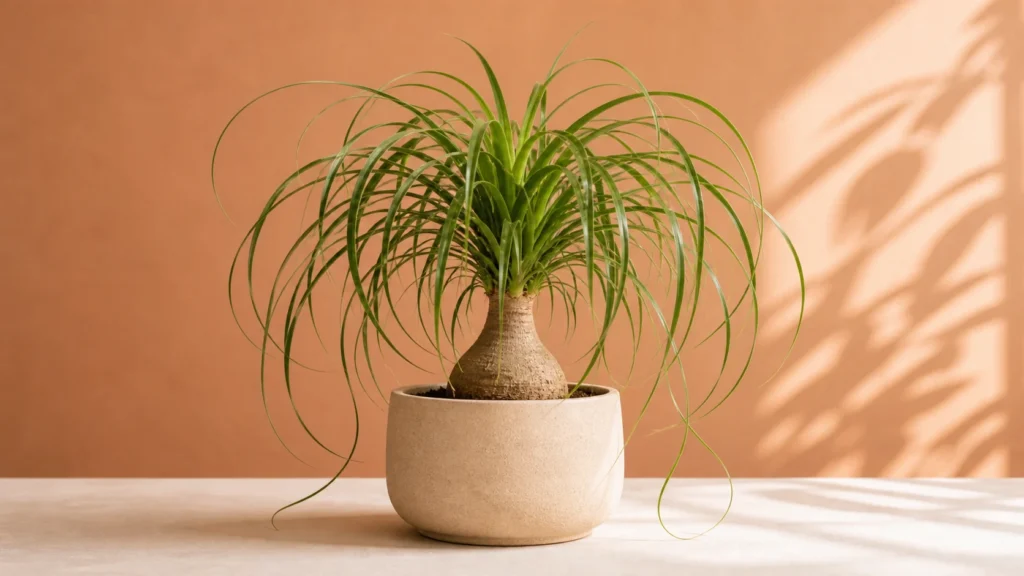
Ponytail Palm
Beaucarnea recurvata
A slow-growing Mexican succulent relative with a swollen water-storing base and a fountain of narrow leaves, despite its palm-like common name.
Watering frequency
Every 2-4 weeks
Ideal temperature
65-85°F / 18-29°C
Humidity
30-50%
Care difficulty
Easy
Air purifying
No/Not Known
Growth rate
Slow
Plant size
1-4 ft / 0.3-1.2 m indoors
Soil type
Fast-draining succulent mix
Fertilizer need
Every 8-10 weeks, spring-summer.
Care summary
- Light: Give very bright light and acclimated direct sun.
- Water: Let the entire root ball dry, then soak and drain.
- Soil: Use a gritty mix in a snug pot with open drainage.
- Base: Keep the caudex above the soil line and monitor firmness.
- Safety: ASPCA lists Beaucarnea recurvata as non-toxic to pets.
Common problems
- Soft base: Treat as possible rot and inspect roots immediately.
- Brown tips: Check drought history, salts, damage, and root health.
- Pale stretched growth: Increase useful light gradually.
- Yellow leaves: Review wet soil, cold, and natural lower-leaf aging.
- Pests: Inspect leaf bases for scale, mealybugs, and mites.
Plant care guide
About Ponytail Palm
Ponytail Palm (Beaucarnea recurvata) is not a true palm. It is a drought-adapted Mexican member of Asparagaceae, the asparagus family, with a swollen trunk base called a caudex. The caudex stores water, while the narrow recurved leaves form a fountain-like crown that inspired the common name.
Kew's accepted botanical record confirms the accepted name and describes the species as a Mexican caudex tree of desert or dry-shrubland environments. That dry-biome origin helps explain why chronic wetness is more dangerous indoors than an occasional delayed watering.
NC State Extension's Ponytail Palm profile describes it as slow-growing, drought-tolerant, native to Mexico, and suited to sunny windows and well-drained soil. In habitat it can become a substantial tree; container growth is much slower and usually remains manageable indoors for years.
Young nursery plants look like grassy bulbs. With age, the base expands, the trunk lengthens, and one or more leafy heads may develop. That sculptural change is slow. Frequent water and fertilizer cannot safely accelerate a plant adapted to store resources and grow conservatively.
Why You'll Like It
Ponytail Palm combines the presence of a miniature tree with succulent-like watering. It tolerates dry heated air, does not require high humidity, and forgives a missed watering more readily than a missed dry-down. The long leaves move gracefully without the broad footprint of a large ficus.
It is also pet-safer when correctly identified. ASPCA's Pony Tail record lists Beaucarnea recurvata as non-toxic to dogs, cats, and horses. This must not be confused with Sago Palm, a cycad that is dangerously toxic.
Compare Parlor Palm for a true palm that accepts medium light and more regular moisture, ZZ Plant for another drought-tolerant silhouette that is not pet-safe, or Dragon Tree for a cane-forming plant with similar strap leaves but different toxicity and watering behavior.
What Kind of Plant Is It?
The caudex is living stem tissue, not a bulb to bury. It should sit above the soil line where firmness and condition can be observed. A healthy base is solid. Slight natural texture or wrinkling differs from a spreading soft, dark, or foul-smelling area that suggests rot.
Leaves emerge from a central growing point and arch outward. Old lower leaves gradually dry and may be removed, leaving a trunk marked by leaf bases. Cutting the entire top can destroy the growing point or force unpredictable branching; normal size control relies on light, a modest pot, and patience rather than topping.
Some mature plants produce offsets near the base or new heads after damage. Offsets are not guaranteed, and removing them risks wounding the caudex. The simplest design is usually to let the plant develop naturally.
Ponytail Palm Forms and Similar Plants
Named cultivars are less important in ordinary trade than correct species identification.
- Standard Ponytail Palm: Beaucarnea recurvata, with a broadening caudex and recurved narrow leaves.
- Branched specimens: Older plants with several heads, often created by nursery pruning or natural growth; they are not necessarily a separate cultivar.
- Curly-leaf selections: Commercial plants may be chosen for more strongly curling foliage, but a descriptive label is not automatically a verified cultivar name.
- Sago Palm: Cycas revoluta, a cycad with stiff pinnate fronds and severe pet toxicity; not related to Ponytail Palm.
- Elephant's Foot: Another common name for Beaucarnea recurvata, referring to the expanded base.
- Bottle Palm: A confusing common name also used for true palms; verify the botanical label before applying care or safety advice.
Where It Works Best
Choose the brightest practical indoor position. A south or west window can work after acclimation, while an east window provides gentler direct sun. Several feet back in a dim room usually produces weaker, slower growth and soil that remains wet too long.
The plant tolerates ordinary dry rooms, making it useful in bright offices and living rooms. Keep leaves out of walkways because repeated bending creates brown broken tips. Avoid cold windows, exterior drafts, and a decorative pot that traps runoff.
Outdoor summer growth can be strong on a protected patio. Acclimate over one to two weeks, beginning with filtered light, because indoor leaves can scorch under sudden full sun. Bring it inside before cold nights and inspect for pests.
How to Care for Ponytail Palm
Light
Very bright light is essential for compact, resilient growth. Acclimated direct sun is appropriate; the canonical full-sun field is therefore retained. If a plant has lived in a store or shaded room, increase exposure gradually. Pale bleached patches on the exposed side indicate scorch, while a weak leaning crown suggests inadequate light.
Rotate the pot periodically for even growth, but do not move it constantly between dark and sunny rooms. A grow light can supplement winter windows when it is sufficiently strong and close.
Water
Treat two to four weeks as an inspection range, not a promise. Let the entire root ball dry before watering again. Check deep with a wooden skewer, learn the dry pot weight, and consider the season. A large glazed pot in winter may remain wet far beyond four weeks.
When dry, soak thoroughly until water leaves the drainage holes, then empty the saucer. Avoid frequent small sips, which can wet the caudex surface without evenly hydrating roots. Greatly reduce water during cool, low-light winter conditions.
A slightly wrinkled base can indicate depleted reserves, but first verify that roots are healthy. A soft base in wet soil is not thirst and must not be treated with more water.
Soil and Container
Use a fast-draining cactus or succulent mix improved with pumice, perlite, or coarse mineral material. The exact recipe should match your climate and pot, but it must not collapse into dense peat that stays saturated.
A drainage hole is mandatory. Keep the container relatively snug because a large volume of unused mix holds water. A shallow, heavy pot can balance the expanding top and caudex. Do not bury the swollen base during repotting.
Terracotta speeds drying and adds stability; plastic retains moisture and is lighter. Either can work when the mix and watering are adjusted. Never solve a top-heavy plant by placing it in an enormous wet pot.
Humidity and Temperature
Normal to dry indoor humidity around 30–50 percent is suitable. Brown tips are not automatic proof that humidity is too low; check salts, physical damage, drought history, and roots. Misting is unnecessary and can leave water in the crown.
Keep the plant around 65–85°F (18–29°C) during active growth. It tolerates ordinary household cooling but should not remain cold and wet. Protect it from frost and cold glass.
Fertilizer
Feed very lightly every eight to ten weeks during active spring and summer growth, using a balanced fertilizer at a diluted label rate. Skip feeding in winter or when the plant is stressed. Excess fertilizer creates salts and weak growth rather than meaningful speed.
Flush the pot occasionally with plain water and allow it to drain. Do not apply fertilizer to a bone-dry root ball; hydrate first.
Grooming and Pruning
Remove fully brown lower leaves by cutting or gently pulling only when they release easily. Trim brown tips cosmetically by following the leaf's natural taper and leaving a thin brown margin. Cut edges will not regenerate.
Do not cut the leafy crown simply to shorten it. If a mature multi-headed plant needs reshaping, plan the cut during active growth and understand that branching is not guaranteed. Wear eye protection around stiff leaf tips and use clean tools.
Propagation
Commercial plants are commonly grown from seed. Home growers may separate a well-developed basal offset, but it needs its own roots or enough stem tissue to root, and the wound must be protected from wet rot.
- Wait until an offset is substantial and the plant is actively growing.
- Expose its attachment during repotting rather than digging blindly into the caudex.
- Separate with a sterile blade only if the offset can be removed without severe parent damage.
- Let cut surfaces dry appropriately, then use a small, barely moist, gritty medium.
- Keep warm in bright indirect light and water cautiously until rooted.
A detached leaf cannot grow a new plant. Because offset removal is risky and growth is slow, buying a seed-grown plant is often more practical.
When to Repot
Repot when roots have densely filled the pot, drainage has failed, the mix has broken down, or the plant is physically unstable. Slow top growth alone is not a reason. Ponytail Palm can remain slightly root-bound.
Move up one modest size, preserve healthy roots, and position the caudex at its old height. Drying the mix before work makes the plant lighter and reduces wet damage; wait briefly after root injury before the next heavy watering.
Pet Safety
ASPCA classifies Beaucarnea recurvata as non-toxic to cats and dogs. Correct identification matters because plants sold with “palm” in the common name include unrelated toxic species, especially Sago Palm.
Long leaves can invite chewing, and swallowed fibers may still cause stomach upset. Secure the heavy pot, keep fertilizers and pesticides inaccessible, and contact a veterinarian if an animal eats material and develops symptoms.
Common Problems and Practical Fixes
Soft caudex or trunk
Softness with dark tissue, odor, or wet mix suggests rot. Stop watering, remove the plant, inspect roots and the base, and cut away decay only when a viable healthy section remains. Advanced caudex rot may be irreversible. Correct pot size, drainage, warmth, and light before replanting.
Brown leaf tips
Check old drought, accumulated salts, hard water, repeated handling, and damaged roots. A uniformly dry millimeter at many tips can be cosmetic; rapidly advancing browning demands investigation. Trim dead tissue but judge the fix on new leaves.
Yellow lower leaves
One old lower leaf can age naturally. Many yellow leaves with wet soil point to root stress; yellowing after cold exposure may be temperature injury. Do not assume every yellow leaf needs fertilizer.
Pale or stretched growth
Increase useful light gradually. New growth formed in better light should be firmer. Existing stretched tissue will not shorten, and a larger pot will not correct shade.
Shriveled base
If the soil is fully dry and roots are healthy, water thoroughly. If soil is wet or roots are dead, the plant cannot access water; solve the root problem instead of soaking repeatedly.
Pests
Scale, mealybugs, and spider mites hide among leaf bases. Isolate the plant, identify the pest, wipe or rinse where practical, and follow a labeled indoor treatment. Avoid filling the crown with treatment solution.
Frequently Asked Questions
Is Ponytail Palm a true palm?
No. It belongs to Asparagaceae and stores water in a caudex. Its palm-like leaf crown created the common name.
How often should I water?
Only after the entire root ball dries. Two to four weeks is a starting check range; winter, pot size, and light can make the actual interval much longer.
Can it grow in low light?
It may survive temporarily, but weak light slows growth and soil dry-down. Very bright light and acclimated sun are better long-term conditions.
Should I cut brown tips?
You may trim dead tissue for appearance, but the cut stays visible. Correct the underlying water, salt, root, or damage issue to improve future leaves.
Can I cut the top to make it branch?
Some plants branch after loss of the growing point, but the result is unpredictable and rot can enter the wound. Do not top a healthy plant casually.
Is it safe for pets?
ASPCA lists the correctly identified species as non-toxic. This does not apply to Sago Palm or every plant whose common name contains “palm.”
Final Thought
Ponytail Palm thrives when its water-storing anatomy sets the routine: maximize light, use a small fast-draining root zone, wait for full dry-down, then water deeply. Protect the caudex from burial and chronic moisture. Its slow growth is not a defect; patience is what allows the tiny grassy bulb to become a durable sculptural tree.