
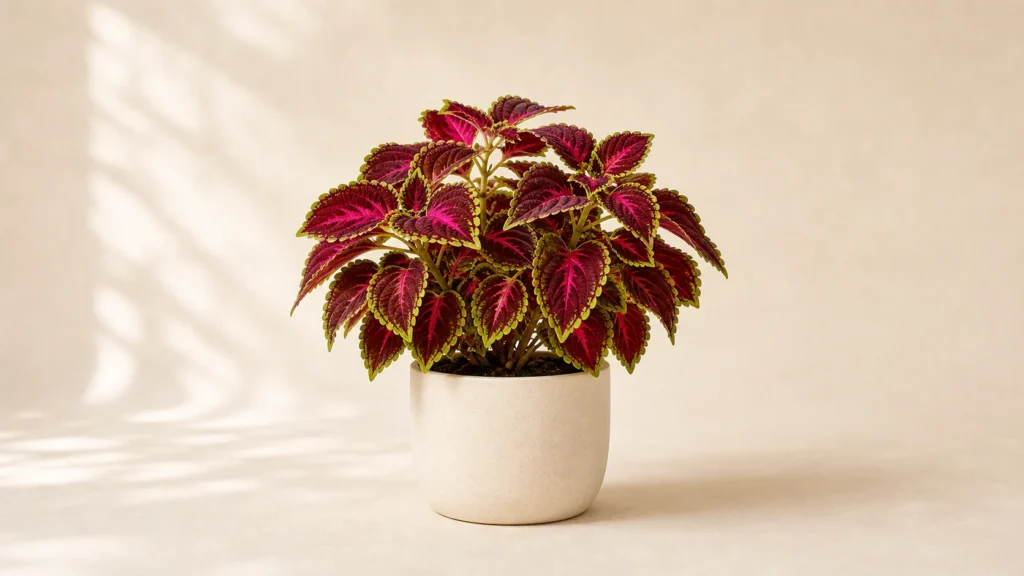
Coleus
Coleus scutellarioides
A fast-growing foliage plant with brilliantly patterned leaves that stays colorful and compact with strong light and regular pinching.
Watering frequency
Every 5-7 days
Ideal temperature
65-85°F / 18-29°C
Humidity
40-60%
Care difficulty
Easy
Air purifying
No/Not Known
Growth rate
Fast
Plant size
1-3 ft / 0.3-0.9 m
Soil type
Rich, well-draining mix
Fertilizer need
Every 2-4 weeks while growing.
Care summary
- Light: Give bright indirect light; acclimated plants can take gentle sun.
- Water: Keep evenly moist, watering when the surface starts to dry.
- Shape: Pinch tips often to encourage branching and remove weak flower spikes.
- Winter: Expect slower growth and reduce water and fertilizer indoors.
- Safety: Keep away from pets and contact a veterinarian after ingestion.
Common problems
- Wilting: Check for dry soil first, but inspect roots if the mix is already wet.
- Root rot: Reduce watering frequency and improve drainage and light.
- Faded color: Adjust light based on the cultivar and avoid deep shade.
- Leggy growth: Increase usable light and pinch healthy growing tips.
- Pests: Check soft growth and leaf undersides for mites, aphids, or mealybugs.
Plant care guide
About Coleus
Coleus (Coleus scutellarioides) is a fast-growing member of the mint family cultivated for foliage rather than flowers. Depending on the cultivar, its leaves may combine burgundy, lime, pink, copper, purple, cream, or nearly black in edged, splashed, or veined patterns. The forms are just as varied: some make compact mounds, some trail, and others become upright plants several feet tall.
Kew's accepted botanical record recognizes Coleus scutellarioides as the accepted name. Older labels may use Plectranthus scutellarioides or Solenostemon scutellarioides. Those synonyms are useful for understanding an old tag, but Coleus remains the clear consumer-facing name and should stay the page title.
In cold climates, Coleus is often sold as an outdoor annual, yet it can grow indoors if it receives enough light. The biggest indoor compromises are lower light, reduced winter vigor, and pests that follow a plant inside. Rather than expecting a patio-sized plant to look unchanged all winter, many growers take cuttings and maintain smaller young plants until spring.
Why You'll Like It
Coleus provides flower-like color without waiting for a bloom cycle. It grows quickly, roots readily from stem cuttings, and responds to pruning within weeks. That responsiveness makes it a good teaching plant: more light, a better watering rhythm, or a well-placed pinch produces visible changes.
It also offers more design choice than a single green species. A lime cultivar can brighten a mixed display; a burgundy cultivar adds depth; a trailing selection can soften a shelf or container edge. Compare its painted foliage with the thicker leaves of Croton, the seasonal tubers of Caladium, or the metallic color of Persian Shield. These plants can all provide color, but their growth habits and moisture needs are different.
Coleus is easy to propagate but not maintenance-free. Its stems elongate rapidly, its relatively thin leaves lose water faster than succulent foliage, and old plants can become woody or sparse. Regular pinching and timely renewal are normal care, not evidence that the plant has failed.
What Kind of Plant Is It?
Coleus is a tender perennial in warm climates and is commonly treated as an annual elsewhere. Opposite leaves grow in pairs along square-ish stems, a typical mint-family feature. Each point where leaves attach is a node. Nodes are important because they can produce branches and roots; a cutting must include at least one viable node.
The plant naturally tries to grow upward and eventually flower. Pinching removes the soft terminal growing point, allowing buds lower on the stem to develop into side branches. Repeating this process produces a fuller plant. Flower spikes are usually blue to lavender and attractive to pollinators outdoors, but indoors they may redirect energy from foliage and signal that a stem is maturing. Remove them when foliage density is the priority.
Color response to light is cultivar-dependent. Most indoor Coleus needs bright light to avoid stretching, but some light-leaved cultivars scorch more easily and some dark cultivars color best with a little gentle sun. Observe the actual plant rather than applying the rule “more sun is always better.”
Popular Coleus Varieties
Coleus has hundreds of named selections, and availability changes by region. Use a verified cultivar label when one is supplied instead of turning a color description into a name.
- 'Kong Rose' has very large leaves with a rose center and green margin. Its broad foliage can scorch in intense sun, so bright filtered light is a sensible indoor starting point.
- 'Wizard Mix' refers to a compact seed-grown series offered in multiple colors. Individual plants may vary, making the series more useful for mixed containers than for exact color matching.
- 'Black Dragon' is valued for deeply colored, textured foliage. Strong light helps maintain its dark color, although it should still be acclimated to direct sun.
- 'Wasabi' is a vivid chartreuse selection that creates a very different effect from burgundy forms. Pale foliage can show sun damage quickly.
- 'Fishnet Stockings' is known for dark veining over bright green leaves. The verified cultivar name is more informative than calling it merely a “variegated coleus.”
Cultivar size and sun tolerance differ, so keep the original tag when possible. A compact cultivar should not be expected to reach the height of a vigorous landscape selection, and a full-sun claim from an outdoor trial does not automatically describe performance behind hot window glass.
Where It Works Best
Indoors, place Coleus close to an east, south, or west window, adjusting direct exposure to the cultivar. East light is often gentle enough for a broad range of colors. At a strong south or west window, a sheer curtain can soften midday sun. A grow light can maintain compact growth where winter daylight is weak.
Coleus works well on a bright windowsill, plant stand, or warm enclosed balcony. It is less suitable for a dim hallway or a shelf far from windows. Rotate the pot regularly because stems lean quickly toward light.
Outdoors, move it only after temperatures are reliably warm. Acclimate it over several days, starting in shade and increasing light gradually. Check soil more frequently outdoors because wind and heat speed drying. Before bringing it inside, inspect the entire plant for insects and consider taking clean cuttings rather than moving a large pest-prone specimen.
How to Care for Coleus
Light
Bright indirect light is a safe baseline. Gentle morning or late-afternoon sun can improve color and compactness. Deep shade often produces long spaces between leaves, small new growth, and color that shifts toward green. Harsh unacclimated sun can bleach or crisp exposed tissue.
If the plant is leggy, solve the light problem before pruning. Otherwise, the replacement shoots will stretch again. Move it closer to a window in stages or place a grow light above the canopy, then cut healthy stems back just above nodes.
NC State Extension's Coleus profile recommends bright indoor light and also emphasizes pinching to maintain a dense plant. Use that as a framework, then adjust for the cultivar's color and leaf thickness.
Watering
Coleus prefers more consistent moisture than Croton, Dragon Tree, or succulent houseplants. Water when the surface begins to feel dry, before the entire pot becomes dry enough for repeated hard wilting. Water thoroughly and let excess drain.
The five-to-seven-day frontmatter interval is only a planning estimate. A small root-filled pot outdoors may need water much sooner, while a cool indoor plant may take longer. Check the soil and pot weight rather than adding a little water on schedule.
Wilting is not always proof of thirst. If the soil is dry and the pot is light, water promptly. If the soil is wet and stems remain limp, root damage, heat stress, or disease may be preventing water uptake. Adding more water to already saturated soil will make the problem worse.
Soil and Container
Use a fertile, moisture-retentive but well-drained potting mix. Standard indoor potting mix with added perlite or fine bark usually works. A drainage hole is essential. Coleus roots can fill a small pot rapidly, so check whether a plant that dries unusually fast has become root-bound.
Avoid a dramatic jump in pot size. One modest size larger supplies fresh mix without leaving a large wet zone around a small root ball. If several cuttings are planted together for fullness, distribute them evenly and monitor the pot because the combined root system may use water quickly.
Humidity and Temperature
Average indoor humidity of about 40–60 percent is usually adequate. Very dry heat can increase edge browning and pest pressure, but constant wet foliage is not a good solution. Provide airflow and use a room humidifier if conditions are persistently dry.
Keep the plant warm, ideally around 65–85°F (18–29°C). Protect it from cold windows, drafts, and outdoor chills. Growth slows substantially in short winter days, so allow slightly more drying and reduce fertilizer rather than trying to maintain summer speed.
Fertilizer
Feed from spring through early fall, while the plant is producing new stems and leaves, with a balanced fertilizer diluted according to the label roughly every two to four weeks; reduce or pause in winter. Plants in fresh pre-fertilized mix need less. Too much fertilizer can produce weak growth, salt injury, or more maintenance without solving low light.
Water plain water through the mix occasionally to reduce salt buildup. Pause or reduce feeding when growth slows, after severe root stress, or while unrooted cuttings are establishing.
Pinching, Pruning, and Flowers
Pinch the newest soft tip above a leaf pair once the stem has enough healthy growth. Two side shoots often develop below the cut. Repeat as those branches lengthen. To renovate a leggy plant, cut stems back above healthy nodes, but retain enough foliage for recovery.
Remove flower spikes early if the goal is a compact foliage plant. Outdoors, you may leave some flowers for pollinators, accepting that the plant can become less leafy. Clean pruners and remove weak or diseased growth rather than composting pest-infested material indoors.
How to Propagate Coleus
Coleus is one of the easiest houseplants to propagate from stem cuttings.
- Cut a healthy non-flowering stem just below a node.
- Keep two or more nodes and remove the lowest leaves.
- Place the lower node in water or a lightly moist propagation mix.
- Give the cutting warmth and bright indirect light.
- Pot it when it has a small branching root system, not merely one fragile root.
Water propagation makes roots visible, but change the water regularly and transfer before roots become a tangled mass. Mix propagation avoids the transition from water to soil but requires closer moisture control. In either method, do not submerge leaves.
Pinch the rooted cutting after it resumes growth. Several cuttings can share one pot to create a fuller plant, but crowding increases water use and reduces airflow. Label named cultivars so their identities are not lost.
When to Repot or Renew
Repot when roots circle tightly, emerge from drainage holes, or use water so quickly that the plant cannot remain evenly moist. Spring is convenient, but a severely root-bound plant can be moved during active growth whenever needed.
Older Coleus may develop bare woody lower stems. Repotting alone will not restore leaves to every old section. Take tip cuttings, root them, and start a fresh pot while keeping the parent as insurance. Renewal is often the cleanest way to preserve a favorite cultivar through winter.
Toxicity and Pet Safety
Coleus should be kept away from pets and young children who may chew it. NC State Extension classifies Coleus scutellarioides as having low-severity poison characteristics and notes possible contact dermatitis. This page does not use the ASPCA page titled “Coleus” as species-specific evidence because that page refers to Coleus amboinicus, a different plant often called Indian borage.
If a pet eats Coleus, contact a veterinarian or animal poison-control service and give the exact botanical name from the label. For human ingestion or a significant skin reaction, contact the appropriate poison-control or medical service. Do not induce vomiting or apply an unverified home remedy unless a professional directs you.
Common Problems and Practical Fixes
The whole plant wilted
Feel the soil. Dry soil and a light pot indicate thirst; water thoroughly and drain. Wet soil with persistent wilting suggests root trouble or heat stress. Inspect roots and improve drainage rather than watering again.
New growth is leggy and pale
Increase usable light, rotate the pot, and pinch after the plant is growing strongly. If the window cannot provide enough light, use a grow light placed according to its instructions.
Leaf color is fading
Low light is common, but excessive direct sun can also bleach leaves. Compare old protected foliage with the most exposed leaves. Adjust exposure gradually and remember that cultivar color changes naturally as leaves age.
Leaves have crisp patches
Sudden direct sun, prolonged drought, hot glass, or fertilizer salts may be responsible. Damaged areas will not turn green again; correct the cause and judge recovery by new leaves.
Mites, aphids, whiteflies, or mealybugs appear
Isolate the plant and inspect leaf undersides and soft tips. Rinse away pests where practical, remove heavily affected stems, and use a product labeled for the identified pest and indoor plants. Repeat checks because one treatment may miss eggs.
Frequently Asked Questions
Can Coleus grow indoors all year?
Yes, with bright light, warmth, pruning, and pest monitoring. Winter growth is usually slower. Maintaining young cuttings is often easier than keeping one large outdoor specimen perfect.
Does Coleus need direct sun?
Not necessarily. Bright indirect light can support good growth, while some cultivars benefit from gentle sun. Introduce direct light gradually and watch the actual leaf response.
Why does it keep getting tall after I prune it?
The plant is probably still reaching for light. Improve light first, then pinch new tips repeatedly so side branches remain compact.
Should I remove its flowers?
Remove flower spikes if foliage density is your priority. Leave some outdoors if you value the flowers and pollinator activity more than perfect compactness.
Is Coleus the same plant as Caladium?
No. Coleus is a leafy mint-family perennial grown from stems, while Caladium grows from a tuber and commonly enters dormancy. Their colored leaves may fill similar design roles, but their life cycles differ.
Final Thought
Coleus is most satisfying when treated as a responsive, renewable foliage plant. Give it strong light, keep the mix evenly moist but drained, pinch before stems become long, and root backups of favorite named cultivars. Its fast growth asks for attention, but that same speed makes correction, propagation, and creative shaping unusually rewarding.