
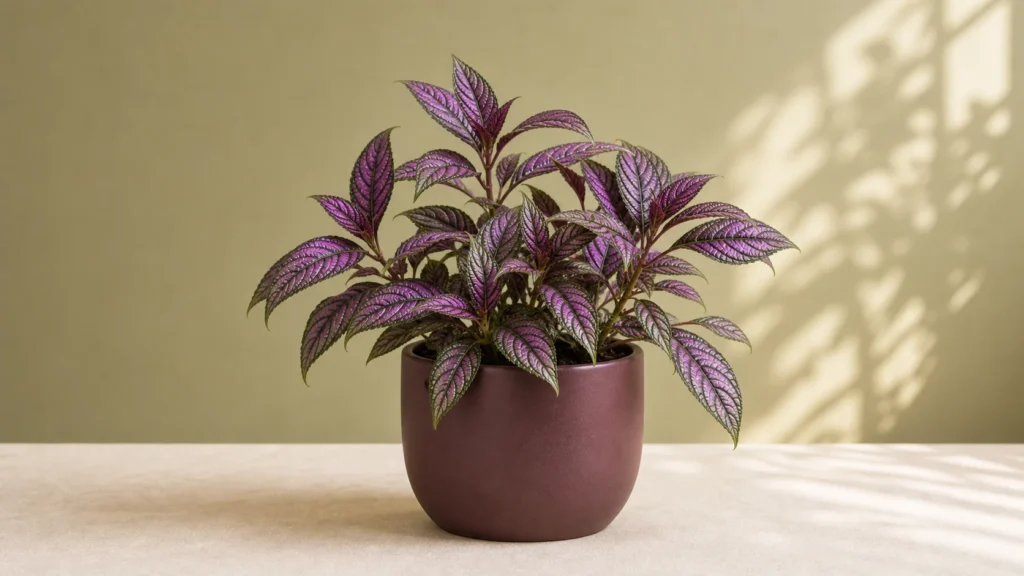
Persian Shield
Strobilanthes auriculata var. dyeriana
A warm-tropical shrub prized for metallic purple-and-silver leaves that needs bright filtered light, steady moisture, and regular pinching indoors.
Watering frequency
Every 5-7 days
Ideal temperature
65-85°F / 18-29°C
Humidity
50-70%
Care difficulty
Medium
Air purifying
No/Not Known
Growth rate
Moderate
Plant size
1-3 ft / 0.3-0.9 m
Soil type
Moist, organic-rich mix
Fertilizer need
Every 4 weeks, spring-summer.
Care summary
- Light: Give bright filtered light for strong metallic color.
- Water: Keep evenly moist but never leave the pot waterlogged.
- Humidity: Provide stable moderate-to-high humidity with airflow.
- Shape: Pinch tips regularly and renew aging stems from cuttings.
- Safety: Species-specific veterinary evidence is insufficient; prevent chewing.
Common problems
- Wilting: Check dry-down, saturated roots, heat, and cold damage.
- Faded color: Improve useful light while preventing harsh sun scorch.
- Brown edges: Review drought, salts, hot airflow, and root health.
- Leggy stems: Increase light and pinch healthy tips above nodes.
- Pests: Inspect leaf undersides for spider mites and whiteflies.
Plant care guide
About Persian Shield
Persian Shield is a tropical foliage shrub grown for iridescent leaves that shift between purple, silver, green, and magenta as light crosses their surface. The familiar retail name has remained stable even though the accepted botanical identity has changed. Kew's accepted record treats the plant as Strobilanthes auriculata var. dyeriana and lists the older Strobilanthes dyeriana as a synonym.
Kew records its native range in Bangladesh, Myanmar, and Thailand, despite the “Persian” common name. It is a wet-tropical shrub or subshrub in the acanthus family, Acanthaceae. The common name remains the best consumer-facing title because it is what buyers recognize; the botanical field carries the corrected scientific identity.
Indoors, Persian Shield is often more demanding than its seasonal bedding-plant abundance suggests. It wants useful light for color, regular moisture without stagnant soil, warmth, humidity, and pruning. It can grow quickly in a bright summer but stretch, shed lower leaves, or attract mites during a dark dry winter.
Why You'll Like It
The foliage supplies a color that few ordinary houseplants can match. The metallic effect comes from leaf structure and pigmentation rather than flowers, so a healthy plant can remain visually interesting for months. Regular pinching turns long stems into a fuller display, and healthy tips root readily enough to renew an aging plant.
It works especially well for someone willing to treat indoor care seasonally: enjoy rapid warm-weather growth, prune before space becomes a problem, and provide supplemental winter light or keep rooted backup cuttings. If you prefer durable multicolor foliage with a woodier habit, compare Croton. Coleus offers easier color selection and renewal from cuttings, while Caladium provides dramatic patterned leaves but follows a stronger dormancy cycle.
What Kind of Plant Is It?
Persian Shield forms upright, branching stems with opposite leaves. Each pair emerges at a node—the stem joint from which buds and roots can develop. Cutting just above a node encourages dormant buds below it to grow, while a cutting that includes nodes can produce roots.
Leaves are elongated, toothed, and strongly veined. Fresh color can differ from hardened foliage, and the upper surface may appear more silver in one direction and deeper purple in another. Older lower leaves eventually become less perfect, especially after drought or winter stress.
Small funnel-shaped flowers may appear on mature plants under seasonal conditions, but indoor growers usually value foliage more. Flowering can coincide with a shift in growth and a leggier shape. Pruning after bloom and renewing from cuttings can restore a compact display.
Persian Shield Identity and Related Color Plants
This page covers the one commonly traded Persian Shield rather than a group of interchangeable purple plants.
- Persian Shield: Strobilanthes auriculata var. dyeriana, still widely labeled by the synonym S. dyeriana.
- Coleus: Numerous cultivated forms of Coleus scutellarioides offer purple, red, lime, and patterned leaves but have a different texture and branching habit.
- Purple Waffle Plant: Hemigraphis alternata is a low-growing tropical with puckered foliage and different moisture behavior.
- Purple Heart: Tradescantia pallida is a sun-loving trailing plant with narrow purple leaves and greater drought tolerance.
- Croton: Codiaeum variegatum forms a woody shrub with many color patterns but dislikes abrupt environmental changes.
- Caladium: Cultivated Caladium grow from underground tubers and commonly enter dormancy, unlike the continuously stem-growing Persian Shield.
Do not substitute care solely because the leaves are purple. Botanical identity determines whether a plant climbs, branches, stores water, or rests underground.
Where It Works Best
Place it at a bright east window, close to a bright north window, or behind a sheer curtain at a stronger exposure. A small amount of acclimated gentle sun can enhance sturdy growth, but sudden intense afternoon sun may bleach or crisp leaves. NC State Extension's Persian Shield profile supports partial shade and moist, well-drained growing conditions.
A bright bathroom or kitchen can work if the room has real window light and air movement. A dim humid bathroom is not equivalent. In a living room, avoid heating vents that dry thin leaf edges and favor spider mites.
Outdoors in warm months, use a sheltered patio or filtered-light garden position and acclimate gradually. Bring the plant in before cold nights, and quarantine and inspect it for whiteflies, mites, aphids, and scale before placing it among indoor plants.
How to Care for Persian Shield
Light
Bright filtered light is the main tool for maintaining saturated color and close internodes. In insufficient light, stems lengthen, the canopy thins, and new leaves may look greener or duller. Low light is therefore removed from this draft's recommended structured range even though an established plant may survive a temporary dim period.
Direct sun is not a simple yes-or-no category. Gentle morning light through glass or outdoor dappled sun can be useful after acclimation; intense midday and afternoon exposure can overheat leaves. Make changes over a week or more and judge the response of new growth.
Winter day length may be inadequate even at a window. A suitable grow light can help preserve a compact plant. Position and run it according to the light manufacturer's plant-use guidance; a distant decorative bulb is usually ineffective.
Water
Persian Shield uses water faster than thick-leaved Peperomia or many aroids. Treat five to seven days as an inspection cue, not a fixed order. Check the upper inch of mix and water when the surface has begun to dry while the root zone remains lightly moist.
Soak the entire pot until water exits the drainage holes, then empty the saucer. A badly wilted plant in dry soil may recover, but repeated collapse damages leaf edges and encourages lower-leaf loss. A wilted plant in wet soil may have decaying roots and must not receive automatic extra water.
Outdoor summer pots can dry far faster than indoor winter pots. Wind, heat, root density, and pot material all change the interval. Check daily during hot transitions without assuming daily watering will always be needed.
Soil and Container
Use an organic-rich but aerated mix that distributes moisture evenly. Quality houseplant mix amended with perlite, pumice, or fine bark is suitable. Extremely chunky aroid mix may dry too unevenly around its fine roots, while dense garden soil remains airless.
Choose a draining pot only modestly wider than the roots. A moisture-retentive plastic pot can simplify care in bright warm conditions; terracotta may be helpful to a heavy waterer but can dry quickly in summer. Never let an inner pot stand in runoff inside a decorative cover.
Humidity and Temperature
Aim for stable humidity around 50–70 percent with airflow. Dry air can compound drought and mite problems, but humidity is not a cure for poor roots or weak light. A room humidifier is more effective than misting; wetting leaves repeatedly without airflow can encourage spotting.
Keep temperatures around 65–85°F (18–29°C). This tropical plant reacts poorly to chill, cold glass, and sudden drafts. A combination of cold and wet mix can be more damaging than either stress alone.
Fertilizer
Feed a healthy actively growing plant about monthly at a diluted label rate in spring and summer. Reduce or pause when growth slows. Excess fertilizer can burn fine roots and leaf margins, and it will not restore color in inadequate light.
If the plant is watered frequently, periodic thorough flushing can reduce soluble-salt accumulation. Do not fertilize a severely wilted, root-damaged, or newly rooted cutting until it resumes growth.
Pinching and Pruning
Pinch or cut a healthy shoot just above a leaf pair to activate buds below the cut. Start while stems are young rather than waiting until the plant is a tall bare cane. Repeated light pruning produces a more stable, branched shape than one drastic late cut.
Use clean tools and remove weak, dead, or pest-damaged growth. If a stem is bare but healthy at the base, shorten it during active growth and keep the rooted top as insurance. Rotate the pot so all sides receive useful light.
Wipe or gently rinse foliage rather than applying oily leaf-shine products, which can dull the natural metallic surface and complicate pest treatment.
How to Propagate Persian Shield
Stem-tip cuttings are straightforward when the plant is warm and actively growing.
- Cut a healthy non-flowering tip below a node.
- Remove the lowest leaves, leaving one or two nodes available for rooting.
- Place nodes in clean water or a lightly moist airy medium.
- Keep the cutting warm in bright indirect light with moderate humidity.
- Pot after several branching roots form and acclimate gradually to normal room humidity.
Large leaves can lose water faster than new roots replace it. If necessary, shorten the cutting or remove one lower leaf rather than enclosing saturated foliage indefinitely. Water-rooted plants need consistently moist mix during the first transition but should not remain waterlogged.
Taking several cuttings near the end of summer creates a compact backup that is easier to light through winter than one large, pest-prone shrub. Several rooted tips can be combined in one snug pot for fullness.
When to Repot
Repot when roots densely occupy the pot, the plant dries abnormally fast, or mix has collapsed and no longer drains evenly. Rapid top growth alone does not require a huge container. First prune for balance and examine the roots.
Move up one practical size, maintain the previous stem depth, and water evenly afterward. Spring or early active growth is convenient. An older leggy plant may be better renewed from cuttings than repeatedly moved into larger pots.
Pet and Household Safety
The existing canonical record described Persian Shield as pet-friendly, but this review did not find a direct species-specific ASPCA or equivalent veterinary poison-control classification supporting that claim. Absence from a toxic-plant list is not proof of non-toxicity. This draft therefore uses the project's conservative Not pet safe structured value pending authoritative evidence.
Prevent pets and children from chewing the plant, and consider potting products and pesticides as separate hazards. If ingestion occurs or symptoms develop, contact a veterinarian, animal poison-control service, human poison-control service, or medical professional as appropriate. Do not rely on an unsourced retail statement as a safety diagnosis.
Common Problems and Practical Fixes
Faded purple color
Review useful light first. Gradually move the plant closer to filtered window light or improve a grow-light setup. Also distinguish normal aging and viewing angle from true fading. Fertilizer cannot compensate for darkness.
Leggy stems and bare lower growth
Low light, winter slowdown, crowding, and lack of pruning can all contribute. Increase light gradually, cut healthy stems above nodes, and root the tops. Avoid burying long bare stems deeply because buried tissue can rot.
Wilting
Dry soil calls for a thorough watering and better inspection timing. Wet soil calls for root and drainage inspection. Heat, cold, and recent repotting can also cause wilt, so read soil condition before reacting.
Brown edges or crisp leaves
Check drought cycles, direct hot sun, heating vents, fertilizer salts, and root damage. Raising humidity helps only when dry air is genuinely part of the problem. Existing damage will remain; use later leaves to assess the fix.
Yellow leaves or soft stem bases
Persistent saturation is a primary concern. Slide the plant out, smell the mix, and inspect roots for brown mushy tissue. Remove decay, improve drainage, and save healthy tops as cuttings when the base is compromised.
Spider mites and whiteflies
Mites create pale stippling and fine webbing, particularly in dry warmth. Whiteflies lift from leaf undersides when disturbed. Isolate the plant, rinse it where practical, and use an indoor product labeled for the confirmed pest. Repeat according to the label and inspect neighboring plants.
Frequently Asked Questions
Is Persian Shield really from Persia?
No. Kew records the accepted taxon as native to Bangladesh, Myanmar, and Thailand. Persian Shield is a familiar trade name, not a statement of native range.
Why does the botanical name look different from my plant tag?
Many tags still use Strobilanthes dyeriana. Kew currently accepts Strobilanthes auriculata var. dyeriana and lists the older name as a synonym. Both can refer shoppers to the same plant, but the database should store the accepted name.
Can it live in low light?
It may persist temporarily, but color and compact growth usually decline. Medium to bright filtered light is a more honest recommendation.
Should I mist it every day?
No fixed misting schedule is needed. Stable humidity, even root moisture, useful light, and airflow matter more. Misting does not eliminate mites or repair drought-damaged roots.
Is Persian Shield pet-safe?
A reliable species-specific veterinary classification was not found during this review, so the page should not promise safety. Prevent chewing and seek professional advice after an exposure.
Can I keep it from year to year?
Yes, if you provide winter light, warmth, pest monitoring, and pruning. Many growers also keep rooted cuttings because smaller young plants are easier to manage indoors.
Final Thought
Persian Shield is best understood as a responsive tropical shrub rather than a permanent low-light ornament. Give it bright filtered light, steady but aerated moisture, warmth, and regular pinching. Renew it from cuttings when winter or age leaves the base bare. The reward is exceptional metallic foliage—supported by accurate taxonomy and a safety claim that stays within the available evidence.