
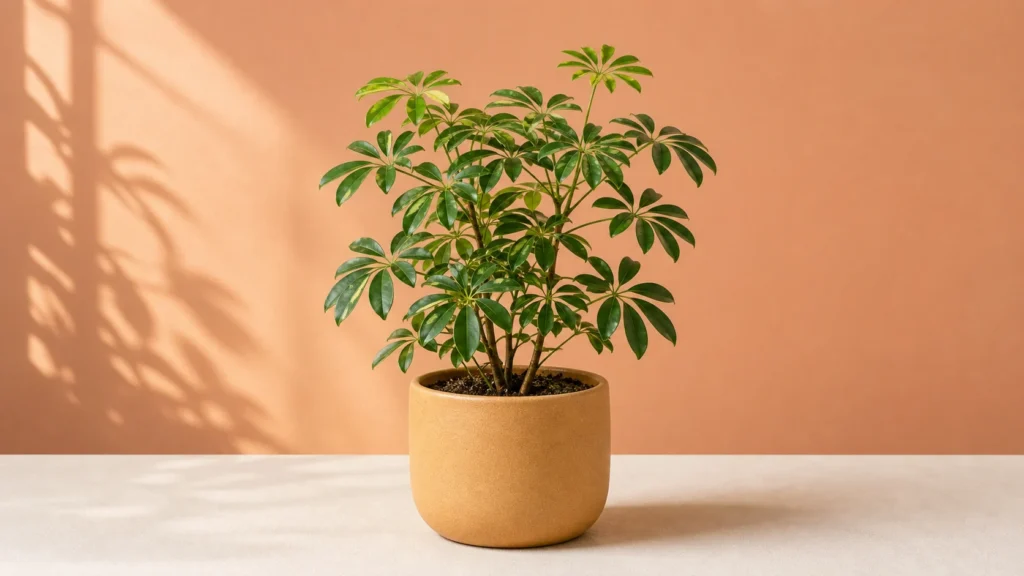
Dwarf Umbrella Tree
Heptapleurum arboricola
A glossy, branching indoor shrub with umbrella-like leaf clusters that responds well to bright light and regular pruning.
Watering frequency
Every 7-14 days
Ideal temperature
65-80°F / 18-27°C
Humidity
40-60%
Care difficulty
Easy
Air purifying
Yes
Growth rate
Moderate
Plant size
3-6 ft / 0.9-1.8 m
Soil type
Well-draining mix
Fertilizer need
Monthly, spring-summer.
Care summary
- Light: Give medium to bright indirect light; brighter light supports fullness.
- Water: Let the surface dry, then water thoroughly and drain.
- Shape: Prune above nodes to control height and encourage branching.
- Soil: Use an airy mix in a correctly sized pot with drainage.
- Safety: Calcium oxalate makes it unsafe for cats and dogs.
Common problems
- Yellow leaves: Check saturated soil, drainage, and light.
- Leaf drop: Review relocation, cold drafts, drought, and root moisture.
- Leggy growth: Increase usable light and prune above healthy nodes.
- Sticky leaves: Inspect for scale, aphids, or other honeydew-producing pests.
- Mites: Check leaf undersides in warm, dry rooms.
Plant care guide
About Dwarf Umbrella Tree
Dwarf Umbrella Tree is a woody evergreen houseplant recognized by glossy leaflets radiating from one point like umbrella spokes. It is still widely sold as Schefflera arboricola, but current botanical sources accept Heptapleurum arboricola. Kew's accepted record treats the Schefflera name as a synonym and records its native range in Hainan and Taiwan.
The common name remains the best consumer-facing identity, while the accepted name belongs in the botanical field. It also distinguishes this page from the larger Umbrella Tree, Heptapleurum actinophyllum, which is a separate species. Both may be labeled “Schefflera,” so check the leaflets and botanical tag rather than assuming the names are interchangeable.
Indoors, Dwarf Umbrella Tree can be a dense tabletop shrub, a braided novelty plant, a bonsai subject, or a multi-stem floor specimen. It tolerates routine pruning and average household humidity, but it drops leaves when roots remain wet, light is too weak, or conditions change abruptly.
Why You'll Like It
Its compound leaves make a full canopy without oversized leaf blades. The plant can be shaped formally or allowed to branch naturally, and healthy stems respond to cuts by producing shoots below the pruning point. This makes it easier to control than many single-stem indoor trees.
Use it when you want an adaptable green shrub in a bright room. Money Tree has a different palmate leaf and swollen-trunk growth habit; Umbrella Tree becomes much larger; Cast Iron Plant tolerates lower light but lacks the tree-like form.
The existing Air Purifying taxonomy is retained for database compatibility, but the plant should be purchased for foliage and structure. It does not replace ventilation or mechanical air filtration.
What Kind of Plant Is It?
This species belongs to the Araliaceae family. Each leaf is compound, usually carrying seven to nine glossy leaflets. New stems are flexible and green, then become woody. In tropical landscapes it can become much larger, but container roots and pruning usually hold an indoor specimen around 3–6 feet.
NC State Extension's Dwarf Umbrella Tree profile explains the updated name, former Schefflera arboricola identity, filtered-light preference, drainage needs, pest risks, and calcium-oxalate toxicity.
Popular Dwarf Umbrella Tree Varieties
- 'Gold Capella' has yellow to cream patterning and needs strong light to maintain contrast.
- 'Trinette' is sold for cream-colored leaf variegation; protect pale tissue from abrupt harsh sun.
- 'Compacta' is selected for denser, smaller growth and is useful where mature space is limited.
- 'Dazzle' is another named patterned selection found in the trade.
- Green Dwarf Umbrella Tree is the standard solid-green form, not a cultivar name.
Retain verified labels. Do not convert “variegated dwarf umbrella tree” into a supposed cultivar when the actual selection is unknown.
Where It Works Best
Place the plant near a bright east, south, or west window with filtered light. Medium light is tolerated, but growth becomes looser and the pot dries more slowly. Rotate it regularly to prevent the canopy leaning heavily toward the window.
It suits a living room, bright office, or entryway with real daylight. Keep it away from cold doors and HVAC blasts. Outdoors in warm weather, provide a sheltered position and acclimate it gradually; direct sun that an outdoor landscape plant tolerates can scorch indoor-grown leaves.
How to Care for Dwarf Umbrella Tree
Light
Bright indirect light supports dense branching and patterned cultivars. A little gentle morning sun is usually acceptable after acclimation. Widely spaced leaves, long thin stems, and loss of variegation suggest insufficient light. Correct light before pruning or new shoots will stretch again.
Watering
Let the upper inch or two of mix dry, then water thoroughly until excess drains. Empty the saucer or cachepot. The seven-to-fourteen-day range is a starting estimate only; root density, season, light, temperature, and container material determine the interval.
Both wet and severely dry soil can cause leaf drop. Feel deeper into the pot before deciding. Yellow leaves with persistently wet mix suggest excess moisture. Crisp foliage with a very light pot suggests drought.
Soil and Container
Use an airy indoor potting mix amended with perlite or fine bark. A pot with drainage holes is essential. Move up only one size when repotting; excessive soil around a small root system remains wet too long.
For a top-heavy specimen, place the draining pot inside a stable heavy cachepot rather than overpotting. Never allow runoff to remain around the nursery pot.
Humidity and Temperature
Average household humidity works, although 40–60 percent can reduce stress in dry heated rooms. Misting is not a cure for mites or root problems. Use a humidifier for sustained improvement and keep air moving.
Aim for 65–80°F (18–27°C). Cool drafts can trigger leaf loss. During low-light winter conditions, growth and water use slow, so reduce feeding and extend the interval between waterings.
Fertilizer and Cleaning
Feed monthly at a diluted label rate while the plant is producing new leaves. Pause in winter or after root stress. Excess fertilizer can damage roots and leave crust on the mix.
Wipe leaflets with a damp cloth and inspect stems and undersides. Sticky residue often signals honeydew from scale or aphids, not a normal leaf coating.
Pruning and Training
Cut a healthy stem just above a node during active growth. Buds below the cut can branch, producing a fuller plant. Pinch soft tips for light shaping or shorten selected stems to create tiers. Avoid removing most foliage from a weak plant.
Braided trunks are a nursery training style, not a biological requirement. Do not tighten old ties as stems expand. Stakes should support rather than constrict the plant.
How to Propagate Dwarf Umbrella Tree
Take a healthy stem-tip cutting with several nodes. Remove lower leaves, insert at least one node into a clean airy medium, and provide warmth, bright indirect light, and lightly moist—not saturated—conditions. A loose humidity cover can reduce water loss, but open it regularly for airflow.
Rooting is less immediate than Coleus. Look for sustained new growth and resistance to a gentle tug rather than promising a fixed date. Pot rooted cuttings into a small container; several can be grouped for a bushier result.
Air layering is useful on an older tall stem because the developing top remains attached while roots form. Once a visible root mass develops in the wrapped medium, cut below it and pot the new plant.
When to Repot
Repot when roots circle densely, drainage slows because mix has collapsed, or the plant dries unusually fast despite thorough watering. Spring and early summer offer the best recovery conditions. Keep the stem at the same depth and avoid a dramatic increase in pot size.
Leaf drop alone does not automatically mean repotting. First check location changes, cold, moisture, and pests. Root disturbance can compound environmental stress.
Buying, Seasonal Care, and Recovery
At the store, inspect stems and the underside of every leaflet cluster. Scale may resemble small brown bumps, while mites create fine stippling or webbing. Check that the trunks are firm and that ties around braided plants have not begun cutting into expanding bark. Soil should be evenly moist, not swampy or foul-smelling.
Quarantine a new plant before placing it among a collection. Give it a stable bright position and learn how quickly its pot dries before changing the container. Immediate leaf drop after transport may reflect environmental shock rather than a need for fertilizer or a much larger pot.
During spring and summer, stronger light supports pruning, cuttings, and more active feeding. Check water more often because a leafy canopy and dense roots may empty a pot quickly. A protected outdoor summer can produce vigorous growth, but introduce sun gradually and inspect thoroughly before bringing the plant back indoors.
In winter, shorter days slow water use. Move the plant closer to light, keep it warm, and allow a longer interval between waterings while still checking the root ball. Pause or reduce fertilizer until clear new growth returns. A grow light placed above the canopy can prevent stretched shoots and one-sided growth.
If a plant has lost many leaves, test stems rather than assuming it is dead. Firm green stems with healthy roots can branch again. Correct cold, light, or moisture problems, then prune only dead or badly stretched sections. If roots are rotten, preserve firm stem tips as cuttings while treating the parent. Recovery is judged by stable buds and new leaves, not by forcing quick growth with fertilizer.
For long-term form, decide whether you want a bush or a small tree. Frequent tip pinching creates more low branches. Gradually removing selected lower shoots reveals trunks, but stripping them all at once can leave a weak, top-heavy plant. Shape over several growth cycles.
Toxicity and Pet Safety
Dwarf Umbrella Tree is not pet-safe. It contains insoluble calcium oxalate crystals that can cause intense mouth irritation, drooling, vomiting, and difficulty swallowing. ASPCA's Schefflera toxicity guidance classifies the group as toxic to cats and dogs, while NC State's species page specifically flags Heptapleurum arboricola.
Keep plants and cuttings away from pets and children. If chewing occurs, contact a veterinarian or animal poison-control service and provide both current and former botanical names. Difficulty swallowing or breathing needs urgent professional attention. Sap may irritate sensitive skin, so gloves are sensible when pruning.
Common Problems and Practical Fixes
Sudden leaf drop
Review recent relocation, cold exposure, drought, saturated soil, and abrupt light changes. Stabilize the plant and avoid changing several factors daily. Inspect for pests if leaves feel sticky or stippled.
Yellow leaves
Check deep soil moisture. Wet mix, a heavy pot, and slow drainage point to overwatering. Improve light and drainage and inspect roots if decline continues. Occasional old lower leaves can yellow naturally.
Leggy growth
Move it into brighter indirect light gradually, then prune long healthy stems above nodes. Rotation helps distribute growth but cannot replace adequate light.
Sticky foliage or bumps on stems
Scale insects commonly create sticky honeydew. Isolate the plant, remove accessible pests, clean foliage, and use a treatment labeled for scale and indoor plants. Reinspect because crawlers may appear later.
Fine stippling and webbing
Spider mites thrive in warm dry conditions. Inspect undersides closely, rinse foliage, isolate the plant, and apply an appropriate labeled control repeatedly as directed.
Frequently Asked Questions
Is Dwarf Umbrella Tree still a Schefflera?
It is still sold under Schefflera arboricola, but the accepted botanical name used in this record is Heptapleurum arboricola.
Is it the same as Umbrella Tree?
No. The larger Umbrella Tree is generally Heptapleurum actinophyllum. Confirm the botanical name when shopping.
Can it grow in low light?
It tolerates medium light, but deep shade produces sparse growth and raises overwatering risk. Bright indirect light is better.
Can I cut the top off?
Yes. Pruning a healthy stem above a node can control height and encourage branching, and the removed top can become a cutting.
Why are its leaves sticky?
Inspect for scale, aphids, or other sap-feeding insects. Sticky honeydew is a pest warning, especially when accompanied by bumps or sooty residue.
Does it need a moss pole?
No. It is a woody branching shrub, not a climbing aroid that requires a pole. A temporary stake can steady a weak or newly repotted stem, but lasting structure should come from adequate light, careful pruning, and healthy roots.
Can it be grown as bonsai?
Yes, it is often trained as an indoor bonsai because it branches after pruning and has compound foliage. Bonsai care changes container volume and watering frequency dramatically, so a shallow trained specimen cannot follow the same interval as a standard houseplant pot.
Why is new growth smaller?
Insufficient light, crowded roots, recent stress, pests, or a normal early stage of a new shoot may be involved. Inspect conditions before fertilizing. Persistent small, widely spaced growth usually points toward weak light.
Should aerial roots or low shoots be removed?
Only for a deliberate shaping goal. Low shoots help create a bushy plant; removing selected shoots exposes a tree-like trunk. Make changes gradually while the plant is actively growing.
Final Thought
Dwarf Umbrella Tree earns its popularity through glossy foliage and flexible shaping, but it performs best with more light and drainage than its “easy office plant” reputation suggests. Use the familiar common name, recognize both botanical names, water from soil evidence, prune for structure, and keep it securely away from pets.