
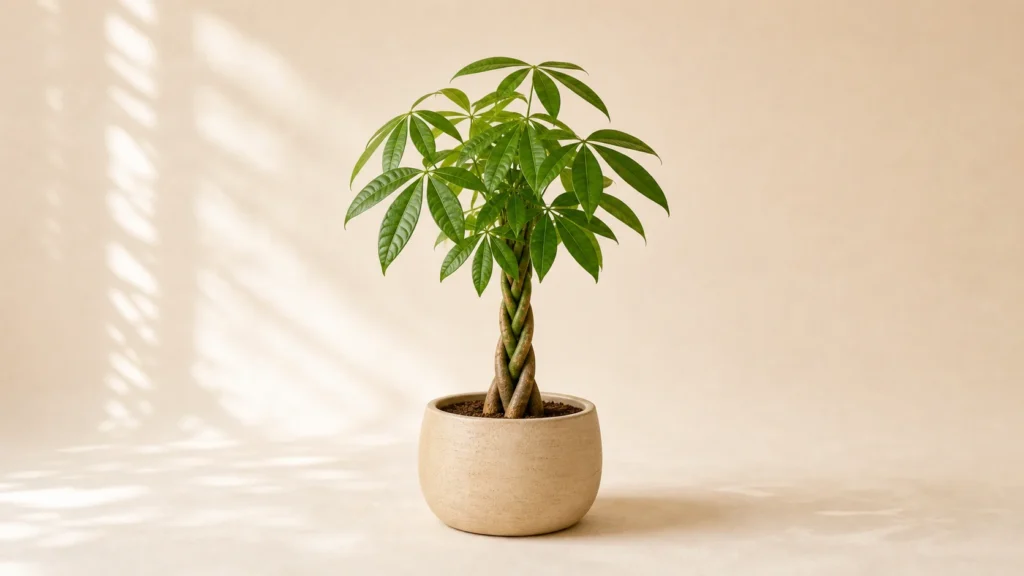
Money Tree
Pachira aquatica
A tropical indoor tree with hand-shaped leaves and often-braided trunks that needs bright filtered light, drainage, warmth, and careful watering.
Watering frequency
Every 7-14 days
Ideal temperature
65-85°F / 18-29°C
Humidity
40-60%
Care difficulty
Easy
Air purifying
Yes
Growth rate
Moderate
Plant size
3-6 ft / 0.9-1.8 m
Soil type
Well-draining mix
Fertilizer need
Monthly, spring-summer.
Care summary
- Light: Give bright indirect light and gentle acclimated sun.
- Water: Let the upper mix dry, then water thoroughly and drain.
- Trunks: Inspect every stem in a braid and loosen restrictive ties.
- Shape: Prune healthy shoots above nodes during active growth.
- Safety: ASPCA lists Pachira aquatica as non-toxic to cats and dogs.
Common problems
- Yellow leaves: Check saturated soil, poor drainage, low light, and roots.
- Leaf drop: Review drought, cold drafts, relocation, pests, and root condition.
- Soft trunk: Treat as possible rot and inspect that individual stem promptly.
- Brown tips: Review drought, salts, dry air, and damaged roots.
- Pests: Inspect for mites, scale, mealybugs, aphids, and fungus gnats.
Plant care guide
About Money Tree
Money Tree (Pachira aquatica) is a tropical wetland tree grown indoors for its glossy palmately compound leaves—several leaflets radiating from one point—and its often-braided trunks. It is also called Guiana Chestnut, Malabar Chestnut, or Money Plant. The common name must not be confused with Jade Plant, Crassula ovata, which is also called Money Plant but has succulent leaves and is toxic to pets.
Kew's accepted botanical record places Pachira aquatica from Mexico through tropical South America and describes it as a wet-tropical tree. Its waterside habitat does not mean a container should remain waterlogged. In the ground, roots occupy a large oxygenated environment; in a pot, stagnant saturated mix can rot them.
Braiding is a nursery training practice. Several young flexible plants are commonly planted together and woven before their stems harden. Each trunk may have its own root system and can decline independently, so every stem deserves inspection.
Why You'll Like It
Money Tree provides the look of a small indoor tree without the enormous leaves of Fiddle Leaf Fig. The hand-shaped foliage creates a light canopy, and healthy shoots respond to pruning. A modest pot can remain a manageable floor or tabletop specimen for years.
Its association with prosperity and feng shui makes it a popular gift, while ASPCA's non-toxic classification makes it easier to place in a pet household than Jade Plant or many ficus species. Pet-safe still does not mean edible, and pot stability remains important.
Compare it with Jade Plant when common names cause confusion or with Dwarf Umbrella Tree for another palmately arranged leaf shape. These plants have different toxicity and watering needs.
What Kind of Plant Is It?
Money Tree belongs to the mallow family, Malvaceae. In habitat it can become a large tree and produce dramatic flowers and woody fruits. Indoor braided plants rarely flower because of container limits, light, age, and training.
NC State Extension's Pachira aquatica profile documents its native wetland range, indoor dimensions, indirect-light preference, well-drained pot culture, braided-stem history, and potential root rot and pests. It also notes conflicting information about the safety of eating seeds. This page therefore gives no edible-seed recommendation.
New branches emerge from buds at nodes on living stems. Healthy green-brown trunks should feel firm. Soft dark tissue, an unpleasant smell, or bark slipping away suggests rot rather than ordinary flexibility.
Braided, Single-Trunk, and Bonsai Forms
- Braided Money Tree combines several young trunks. Ties must be loosened as stems expand.
- Single-trunk plants show the species' natural structure more clearly and avoid competition among braided seedlings.
- Multi-stem bush forms may be pruned low to produce a fuller canopy.
- Bonsai-style Money Trees grow in much smaller soil volumes and need more frequent moisture checks than standard pots.
These are training formats, not named cultivars. Do not list “braided” as a botanical variety. Retail Money Trees can also be confused with closely related Pachira species, so retain trustworthy labels and avoid making fruit-level identification claims about a non-flowering houseplant.
Where It Works Best
Place Money Tree close to an east, south, or west window with bright filtered light. Gentle morning sun can support stronger growth after acclimation. Hot direct afternoon sun behind glass may bleach or scorch leaflets.
It suits living rooms, offices, and bright entryways with stable temperatures. Avoid exterior doors, air-conditioning vents, radiators, and dark corners. Rotate the pot regularly because new shoots lean toward light.
Give the canopy and braided trunks room for inspection. A decorative basket should not hide a waterproof liner filled with runoff. Remove the inner pot to water and drain it completely.
How to Care for Money Tree
Light
Bright indirect light supports a dense canopy and predictable water use. Medium light is tolerated, but growth slows and soil remains wet longer. Small leaves, weak leaning shoots, and rapid lower-leaf loss can indicate insufficient light.
Increase sun gradually. Scorched patches appear on the most exposed foliage after abrupt changes. A grow light above the canopy can supplement winter daylight and reduce one-sided growth.
Watering
Let the upper one or two inches of mix dry, then water the whole root ball until excess drains. Empty the saucer. Avoid small frequent sips and avoid leaving the base submerged.
Seven to fourteen days is only a starting estimate. Large nursery pots may remain wet deep inside, especially in winter. Use a skewer, soil feel, and pot weight. A small warm pot may need water sooner.
Leaf drop occurs from both drought and root damage. Dry soil and a light pot point toward thirst; wet soil, yellow leaves, and soft trunks point toward excess moisture. Check before acting.
Soil and Container
Use a moisture-retentive but well-aerated mix. Indoor potting mix amended with perlite, pumice, or fine bark is suitable. Drainage holes are essential.
Choose a pot only modestly larger than the roots. A heavy cachepot can stabilize a tall plant without adding an oversized volume of wet soil. Keep trunk bases at their original depth and do not mound mix against the braid.
Humidity and Temperature
Money Tree appreciates moderate humidity around 40–60 percent but adapts to many homes. Brown tips can involve drought, salts, heat, roots, or dry air. Use a humidifier for sustained improvement and maintain airflow.
Keep it around 65–85°F (18–29°C). Cold drafts and sudden temperature drops can trigger leaf loss. Protect from frost and cold window glass.
Fertilizer
Feed monthly at a diluted label rate during active spring and summer growth. Reduce or stop in winter. Fresh mix may already contain fertilizer. Feeding does not cure low light or rot and can worsen salt stress.
Cleaning, Rotation, and Pruning
Wipe leaflets with a damp cloth and inspect their undersides. Rotate the pot a quarter turn every week or two while growth is active.
Prune healthy shoots just above a node in spring or summer to control height or encourage branching. Do not cut a soft infected trunk and then use the same unclean tool on healthy stems.
Check all ties above and below the visible braid. Remove or loosen any material cutting into stems. Do not force hardened trunks into a tighter braid; they may crack.
How to Propagate Money Tree
Softwood or semi-ripe stem cuttings are the practical home method. Take a healthy tip with several nodes, remove lower leaves, and place a node in water or an airy propagation medium. Provide warmth, bright indirect light, and moderate humidity with airflow.
Wait for a branching root system before potting into a small container. One cutting produces one trunk; a commercial braid requires several young plants and long-term training.
Air layering can root a taller stem while it remains attached, helping shorten an overgrown plant. Seed propagation is possible from fresh viable seed but is uncommon indoors. Do not consume seeds gathered from ornamental plants given the conflicting safety information.
When to Repot
Repot when roots densely circle, drainage fails, the mix has collapsed, or the plant dries too quickly despite complete watering. Spring or early summer supports recovery.
Slide the root mass out and inspect each braided trunk's roots. One rotten stem may need removal while others remain firm. Move healthy roots into one modestly larger pot, maintaining the original depth.
Do not repot merely because a newly purchased plant drops a few leaves. First stabilize light, warmth, and moisture unless signs of rot demand immediate action.
Seasonal Care
Spring and summer bring active shoots and faster water use. Prune, propagate, repot, and feed during this period. A sheltered outdoor stay is possible after gradual shade-to-light acclimation.
In winter, maximize filtered light, reduce fertilizer, and extend watering intervals. Heated air increases mite pressure while cool wet soil increases rot risk, so inspect both leaves and roots.
Buying and Acclimating a Money Tree
Inspect every trunk separately. Each should feel firm from the canopy to the soil line, with no dark soft areas or unpleasant odor. Look beneath decorative moss and sleeves for trapped moisture, exposed ties, or fungus gnats. Check leaf undersides for mites and mealybugs.
Ask whether the pot has drainage and remove any foil or outer liner that traps runoff. A beautiful braid in a sealed decorative pot is a high-risk purchase. Count the trunks and photograph them so later changes can be traced to a specific stem.
Quarantine the plant and place it in its intended bright filtered light. Do not water automatically on arrival; the nursery mix may already be saturated. Learn how moisture moves through the existing pot before repotting unless a soft trunk demands immediate root inspection.
Some leaf drop after transport can be adjustment. Preserve firm trunks and stable conditions rather than responding with extra fertilizer. If ties are tight, loosen them carefully without forcing the hardened braid apart.
Recovering a Partly Rotted Braid
If one trunk becomes soft, isolate the problem quickly. Remove the root ball, identify which roots belong to the failing stem where possible, and cut away rotten material with clean tools. Protect the firm neighboring trunks from contamination and replace wet collapsed mix.
The remaining braid may look uneven, but plant health takes priority over symmetry. Do not re-braid rigid trunks to close the gap. Prune the canopy gradually later, after healthy roots resume growth. Save a firm leafy cutting from the affected trunk as insurance if rot has not reached it.
Toxicity and Pet Safety
ASPCA's Money Tree record lists Pachira aquatica as non-toxic to cats and dogs. The same record notes that nausea, vomiting, or loose stool can still follow ingestion, illustrating why non-toxic does not mean edible.
Keep foliage and potting mix away from habitual chewers, secure the top-heavy pot, and contact a veterinarian if symptoms develop. Always provide the botanical name because “Money Plant” may instead mean toxic Jade Plant.
Common Problems and Practical Fixes
Yellow leaves
Check deep soil moisture, drainage, light, and roots. Wet heavy mix is a common cause. One older leaf may yellow naturally, but widespread symptoms require investigation.
Leaf drop
Recent relocation, cold, drought, root rot, or pests may be involved. Stabilize conditions and avoid changing several variables at once.
One trunk becomes soft
Treat that stem as potentially rotten. Unpot if necessary, separate soft tissue from firm trunks with clean tools, and remove contaminated mix. Save healthy tips as cuttings.
Brown tips
Review drought, salts, low humidity, hot glass, and root damage. Correct the cause and judge improvement by new foliage.
Mites, scale, or mealybugs
Isolate the plant, inspect leaflet undersides and trunk junctions, clean accessible pests, and use a treatment labeled for that pest and indoor plants. Fungus gnats also suggest persistently moist mix.
Frequently Asked Questions
Is Money Tree the same as Jade Plant?
No. Money Tree is Pachira aquatica and ASPCA lists it as non-toxic. Jade Plant is Crassula ovata and is toxic to cats and dogs.
Should I keep braiding the trunks?
Only very young flexible stems can be guided gently. Do not force hardened trunks, and remove restrictive ties.
Can it grow in low light?
It tolerates medium light but grows best in bright filtered light. Very low light increases weak growth and overwatering risk.
Why is there a band under the soil?
Some commercial braids are secured during production. Any band constricting expanding trunks or roots should be carefully removed during inspection.
Can I eat the nuts?
This guide does not recommend it. Sources conflict about seed safety, and indoor ornamental identity or treatment may be uncertain.
Why is the braid becoming tight?
The individual trunks are expanding. Loosen ties and check for constriction. The braid itself cannot expand freely if wire, rubber bands, or buried bindings remain in place.
Should I mist it daily?
No. Daily misting does not replace stable room humidity or correct root stress. Use a humidifier when needed and keep foliage clean with good airflow.
Final Thought
Money Tree is easiest when the decorative braid does not distract from the living roots. Give every trunk bright filtered light, a draining root zone, and watering based on actual dry-down. Inspect ties, distinguish it from Jade Plant, and preserve healthy firm stems rather than treating the braid as one indivisible object.