
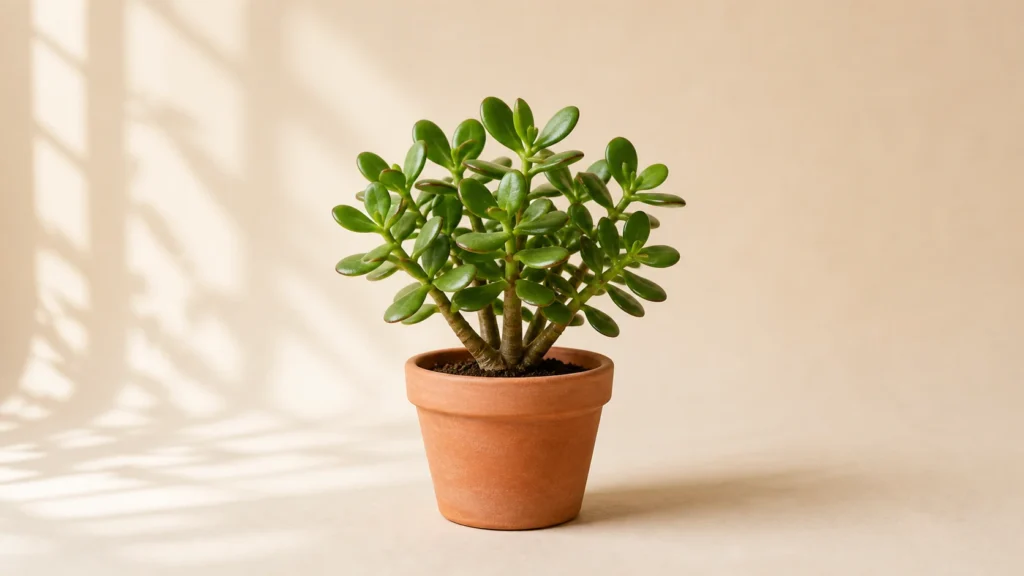
Jade Plant
Crassula ovata
A long-lived tree-like succulent with thick oval leaves that stays compact with strong light, a gritty root zone, and thorough but infrequent watering.
Watering frequency
Every 2-3 weeks
Ideal temperature
65-80°F / 18-27°C
Humidity
30-50%
Care difficulty
Easy
Air purifying
No/Not Known
Growth rate
Slow
Plant size
1-3 ft / 0.3-0.9 m
Soil type
Succulent mix
Fertilizer need
Every 8-10 weeks, spring-summer.
Care summary
- Light: Give very bright light and acclimated direct sun.
- Water: Let the mix dry deeply, then soak and drain completely.
- Soil: Use a gritty succulent mix in a pot with drainage holes.
- Shape: Prune above leaf pairs during active growth to encourage branching.
- Safety: Toxic to cats and dogs; keep fallen leaves out of reach.
Common problems
- Soft stems or translucent leaves: Check for saturated soil and rot.
- Wrinkled leaves: Confirm that dry roots, not rot, are limiting water uptake.
- Leggy growth: Increase usable light gradually and prune healthy stems.
- Sudden leaf drop: Review moisture, cold, relocation, and root condition.
- Pests: Inspect leaf joints for mealybugs and stems for scale.
Plant care guide
About Jade Plant
Jade Plant (Crassula ovata) is a woody succulent with opposite pairs of thick oval leaves and fleshy stems that gradually develop a trunk-like appearance. It is also called Jade Tree, Lucky Plant, and sometimes Money Plant. That last name can create confusion: this page covers Crassula ovata, not the braided tropical Money Tree, Pachira aquatica.
NC State Extension's Jade Plant profile identifies the species, its fleshy egg-shaped leaves, succulent structure, bright-light preference, drought tolerance, and toxicity concerns. Older labels may use Crassula argentea, a synonym still found in pet-safety databases.
Jade Plant is often handed down because a healthy specimen can live for decades. Its longevity does not come from being indestructible. The plant stores water in leaves and stems, so its roots need air and significant dry-down. Low light plus frequent watering is the most common destructive combination indoors.
Why You'll Like It
Jade develops character slowly. A young cutting begins as a few green stems; with light, pruning, and time, it becomes a miniature-looking tree with a broad crown and textured trunk. It can serve as a bright windowsill succulent when small and later become a tabletop or floor specimen.
The plant also gives clear feedback. Firm full leaves usually indicate adequate water storage. Stretched weak stems signal insufficient light. Soft translucent tissue and a wet root ball warn of excess moisture. Once you learn these signals, care is less about a calendar and more about observation.
Compare its branching form with Ponytail Palm, which stores water in a swollen base, or Aloe Vera, which grows as a rosette. All are drought-tolerant, but their growth points and propagation methods differ.
What Kind of Plant Is It?
Jade Plant belongs to the Crassulaceae family and uses a water-conserving photosynthetic strategy common among many succulents. Thick leaves and stems act as reservoirs. This means water loss is slower than in thin-leaved plants, especially during cool, dim winter conditions.
New stems are green and brittle. Older stems become gray-brown and more woody-looking, but they remain relatively easy to break at joints. Support comes from balanced growth and strong light, not from tying a weak plant upright indefinitely.
Mature, well-lit plants may produce clusters of small star-shaped white or pink-tinged flowers after cool nights and shorter days, but indoor blooming is not guaranteed. Do not create severe drought or cold simply to force flowers.
Popular Jade Plant Varieties
- Standard Jade Plant has broad oval green leaves that may develop reddish margins in strong light.
- 'Hummel's Sunset' is a named cultivar with yellow, green, and red coloration. It needs strong light to express color.
- 'Gollum' has tubular leaves with widened, cup-like tips.
- 'Hobbit' has curled or partly fused leaves and is often confused with 'Gollum'.
- 'Minima' is sold for smaller foliage and compact growth; verify the label because any young plant may be called “mini jade.”
- Variegated cultivars should be recorded under a verified cultivar name rather than treated as one generic “variegated jade.”
Several unrelated succulents are also sold as jade plants, including Portulacaria afra. Check the botanical name before applying care or toxicity guidance.
Where It Works Best
Place Jade Plant at the brightest window available. An unobstructed south or west window is often useful in North America, while east light can work for smaller plants. Gentle direct sun helps stems remain compact and may bring out red leaf edges.
Acclimate gradually. A plant raised under greenhouse shade can scorch when moved directly into intense afternoon sun. Increase exposure over one or two weeks and watch the most exposed leaves.
Avoid bathrooms or dim offices chosen only because the plant is called low maintenance. Dry air is acceptable, but weak light encourages soft stretched growth and keeps soil wet longer. A grow light can provide a better option for a windowless office.
How to Care for Jade Plant
Light
Give several hours of strong light, including acclimated direct sun where possible. A compact plant has short spaces between leaf pairs and sturdy stems. Leggy shoots, small pale leaves, and leaning growth point to insufficient light.
Move toward stronger light before pruning. If the environment remains dim, replacement shoots will stretch again. Rotate the pot so the crown develops evenly.
Watering
Let the potting mix dry deeply—often nearly throughout the container—before watering thoroughly. Then soak the entire root ball until water exits the drainage hole and discard runoff. Do not provide small daily sips.
The two-to-three-week field is a starting estimate, not a schedule. A terracotta pot in summer sun may dry sooner; a large glazed pot during winter can remain moist far longer. Check the mix at depth and feel the pot's weight.
Wrinkled leaves can mean the plant is using stored water, but wet soil plus wrinkles suggests damaged roots cannot take up moisture. Inspect before adding more. A severely dry root ball may repel water; soak slowly and confirm that the center becomes moist.
Soil and Container
Use a gritty, fast-draining succulent mix. Commercial cactus mix often benefits from extra pumice, coarse perlite, or another stable mineral amendment. Avoid fine dense mixes that collapse and remain saturated.
A drainage hole is essential. Terracotta increases evaporation and can help growers who water frequently, while plastic retains moisture longer. Choose a pot only slightly larger than the roots. A wide heavy pot can stabilize a mature crown without creating excessive depth of wet soil.
Humidity and Temperature
Normal to dry household humidity, around 30–50 percent, suits Jade Plant. Do not mist it as a routine humidity treatment; lingering water in dense foliage can mark leaves and encourage problems.
Aim for 65–80°F (18–27°C) during active growth. The plant tolerates cooler nights if kept above damaging cold and the soil is not wet. Protect from frost, cold windows, and sudden HVAC blasts.
Fertilizer
Feed lightly every eight to ten weeks in spring and summer using a succulent fertilizer or diluted balanced formula. Fresh potting mix may already contain nutrients. Excess fertilizer produces salt buildup and cannot compensate for weak light.
Pause during cool, low-light winter conditions or after root damage. Water dry roots before applying fertilizer according to label instructions.
Pruning and Shaping
Prune during active growth just above a pair of leaves. Dormant buds below the cut can produce branches, gradually creating a fuller crown. Remove one section at a time and preserve enough foliage for recovery.
Jade is often styled like bonsai, but it is not a woody bonsai species with flexible branches. Its succulent stems snap easily and wire can cut into expanding tissue. Directional pruning and gentle support are safer for ordinary indoor shaping.
How to Propagate Jade Plant
Stem cuttings are the fastest method. Cut a healthy section, remove the lowest leaves, and allow the wound to dry and callus briefly. Insert it into a small pot of dry-to-lightly-moist succulent mix. Give bright filtered light and wait before watering heavily because the cutting has few roots.
Leaf propagation also works when a complete healthy leaf is removed cleanly from the stem. Let the base dry, place it on or barely into gritty mix, and wait for roots and a new plantlet. Not every leaf succeeds, and overwatering is a greater risk than modest dryness.
Do not propagate soft, translucent, pest-damaged, or severely etiolated tissue. Retain several healthy cuttings when rescuing a plant with stem rot.
When to Repot
Repot when roots densely circle, drainage slows because the mix has broken down, the plant becomes dangerously top-heavy, or the pot is damaged. Jade tolerates some root crowding and does not need annual repotting.
Spring is convenient. Use one modestly larger pot, remove only dead or rotten roots, and keep the trunk at the same depth. Wait several days before heavy watering if roots were significantly disturbed.
Seasonal Care
During spring and summer, stronger light drives new branches and faster water use. This is the best time to prune, propagate, and repot. Outdoor summer placement is possible after gradual acclimation and while nights remain warm.
In winter, maximize light, reduce watering, and pause fertilizer as growth slows. Keep the pot away from cold glass. A cool bright rest may support future flowering in mature plants, but cold wet roots invite rot.
Buying and Acclimating a Jade Plant
Choose a plant with firm leaves, sturdy compact stems, and dry-to-lightly-moist soil. Inspect every leaf joint for white mealybug residue and every stem for scale. Avoid plants with translucent leaves, a soft blackened base, or a sour-smelling root ball. A few harmless corky marks on old stems are less concerning than active softness.
At home, quarantine the plant and place it in strong light, but acclimate it to direct sun if it came from a shaded store. Learn how long the nursery mix takes to dry before replacing it. Many commercial succulent pots contain peat-heavy soil; repot during active growth once the plant has adjusted, unless wet soil and rot require immediate action.
Do not water automatically on arrival. Retail plants may already be saturated. Check the root zone and wait for appropriate dry-down. Photographing the plant from the same angle each month helps reveal slow leaning, stretching, or canopy improvement that is difficult to notice day by day.
Toxicity and Pet Safety
Jade Plant is toxic to cats and dogs. ASPCA's Jade Plant record lists vomiting, depression, and incoordination among possible signs; the toxic principle remains unknown.
Keep the pot and fallen leaves out of reach. A high shelf is safe only if leaves cannot drop to an accessible surface. If ingestion occurs, contact a veterinarian or animal poison-control service and give both Crassula ovata and the older synonym Crassula argentea. Do not induce vomiting unless instructed.
Common Problems and Practical Fixes
Soft trunk or translucent leaves
This strongly suggests excess moisture or rot. Stop watering, inspect roots and stems, remove soft tissue with clean tools, and save firm healthy cuttings. Replace dense wet mix.
Wrinkled leaves
Check the soil. Dry mix and firm roots indicate thirst; water thoroughly. Wet mix and persistent wrinkles indicate root failure, not a need for more water.
Leggy growth
Increase light gradually and then prune stretched stems. New compact growth cannot repair old spacing, but the plant can be reshaped over several cycles.
Leaves fall suddenly
Overwatering, severe drought, cold, relocation, or pests may be responsible. Review recent changes and root moisture instead of reacting with automatic watering.
White cottony material or hard bumps
Mealybugs gather at leaf joints and scale attaches to stems. Isolate the plant, clean accessible pests, and use a product labeled for the identified pest and indoor succulents. Repeat inspection.
Frequently Asked Questions
Is Jade Plant a Money Tree?
It is sometimes called Money Plant, but it is not Pachira aquatica, the braided houseplant generally sold as Money Tree.
Can it live in low light?
It may survive temporarily but becomes leggy and vulnerable to overwatering. Strong light is central to healthy form.
Why are the leaf edges red?
Red margins can be a normal response to strong light and cultivar genetics. Pale bleached patches or crisp tissue are more suggestive of sun damage.
Can I grow a new plant from one leaf?
Yes, if the leaf is healthy and removed with its base intact. Stem cuttings produce a larger plant faster.
How quickly does it grow?
Usually slowly to moderately indoors. Light, warmth, roots, cultivar, and season matter more than a promised annual measurement.
Should I remove scars from the trunk?
No. Old leaf scars and textured bark are normal parts of a mature Jade Plant. Cut only tissue that is soft, rotten, pest-infested, or structurally unsafe.
Why does my cutting keep falling over?
The pot may be too large, the mix too loose at the stem, or the top too heavy for new roots. Use a small stable pot, support temporarily, and give strong filtered light without watering excessively.
Final Thought
Jade Plant succeeds when its succulent structure guides the routine: strong light, deep dry-down, a gritty root zone, and modest feeding. Prune patiently and protect it from pets. With restraint, a small cutting can become a substantial, character-filled plant that lasts for years.