
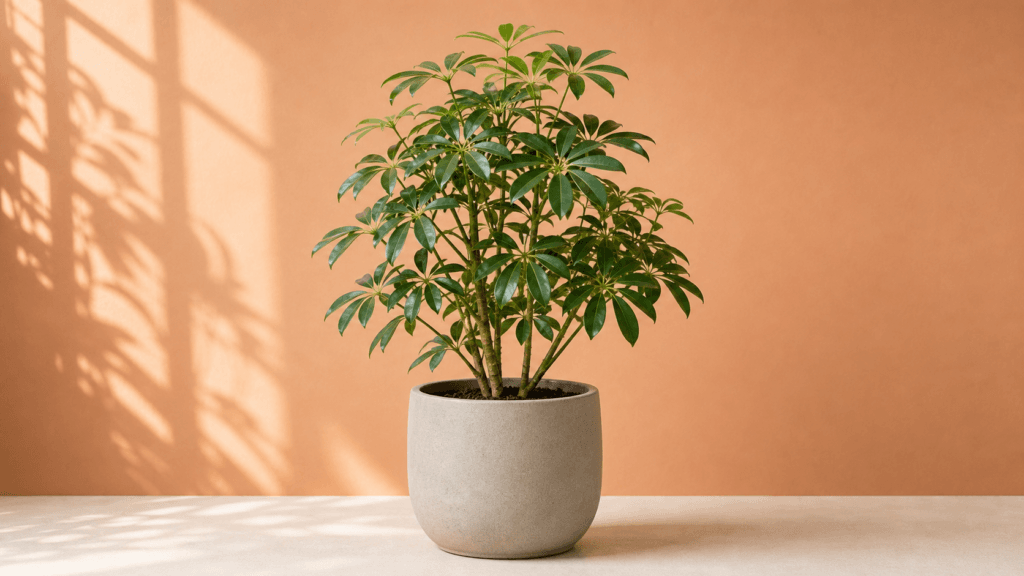
Umbrella Tree
Heptapleurum actinophyllum
A glossy tropical tree with spoke-like leaf clusters that needs filtered light, a draining root zone, stable warmth, and regular shaping indoors.
Watering frequency
Every 7-14 days
Ideal temperature
65-80°F / 18-27°C
Humidity
40-60%
Care difficulty
Medium
Air purifying
Yes
Growth rate
Moderate
Plant size
4-8 ft / 1.2-2.4 m
Soil type
Well-draining tropical mix
Fertilizer need
Every 4-6 weeks, spring-summer.
Care summary
- Light: Provide medium to bright indirect light and rotate for even growth.
- Water: Water after the upper mix dries, then empty all runoff.
- Soil: Use an aerated mix in a stable pot with unobstructed drainage.
- Shape: Pinch or prune healthy stems to manage height and branching.
- Safety: Toxic if chewed and not suitable within reach of pets.
Common problems
- Yellow leaves: Check wet soil, drainage, roots, and insufficient light.
- Leaf drop: Review abrupt relocation, cold, drought, saturation, and pests.
- Leggy growth: Increase useful light and prune during active growth.
- Brown patches: Check sun scorch, cold injury, salts, and roots.
- Pests: Inspect leaflet undersides and stems for scale, mites, and mealybugs.
Plant care guide
About Umbrella Tree
Umbrella Tree is the familiar consumer name for Heptapleurum actinophyllum, a tropical tree still sold almost everywhere under its synonym Schefflera actinophylla. Kew’s accepted botanical record places the species in Heptapleurum, gives its native range from southern New Guinea to northern Australia, and lists both Schefflera actinophylla and Brassaia actinophylla as synonyms.
Its compound leaves divide into glossy leaflets radiating from one point like umbrella spokes. Young plants may look like bushy foliage plants; mature outdoor specimens become substantial trees. Indoor pruning and container limits keep them smaller, but the page should not promise a permanently compact plant.
Why You’ll Like It
Umbrella Tree creates height and a clean tropical canopy without the enormous individual leaves of a Fiddle Leaf Fig. It accepts pruning, can branch below a cut, and works as a single-trunk accent or a multi-stem screen.
It is often confused with Dwarf Umbrella Tree, Heptapleurum arboricola. The dwarf species usually has smaller leaflets and is better suited to limited rooms. This record covers the larger H. actinophyllum.
Compare Money Tree for another palmate-leaved indoor tree with different pet-safety status, or Dragon Tree for a narrow upright silhouette.
What Kind of Plant Is It?
Each apparent “leaf cluster” is one compound leaf made of multiple leaflets. Pruning a leaflet does not cause stem branching; branching is managed at stem nodes and growing tips. Young stems are flexible, while older wood becomes firmer and carries a broader crown.
Outdoor plants in warm climates may produce large red inflorescences, but indoor flowering is uncommon and not a useful care target. Strong vegetative growth, balanced branching, and healthy roots are better measures of indoor success.
Related Umbrella Plants
- Dwarf Umbrella Tree (Heptapleurum arboricola): Smaller leaflets and a naturally more compact habit; formerly Schefflera arboricola.
- Variegated Dwarf Umbrella Tree: Usually a cultivar of H. arboricola, not a variegated form of this larger species unless verified.
- Australian Umbrella Tree: Another common name for H. actinophyllum.
- False Aralia (Plerandra elegantissima): A related houseplant with narrow toothed leaflets and different moisture sensitivity.
- Money Tree (Pachira aquatica): Similar spoke-like leaf arrangement but a different family, trunk, and toxicity profile.
Common-name overlap makes the Botanical Name field important before images or care content are reused.
Where It Works Best
Choose a bright living room, entryway with real daylight, or office near a broad window. The plant can tolerate medium light, but a dim lobby produces weak, stretched growth and slow soil drying. Rotate the pot gradually for a balanced canopy.
Keep it away from frequently opened winter doors, heating vents, and cold glass. Allow clearance for leaves and future branching. If summering it outdoors, acclimate it to brighter conditions and bring it inside before nights become cool.
In frost-free landscapes this species can escape cultivation and become invasive in some regions. Container owners should avoid discarding viable plant material outdoors and follow local guidance.
How to Care for Umbrella Tree
Light
Medium to bright indirect light is the practical indoor range. Gentle morning sun can strengthen growth, while sudden intense afternoon sun may scorch nursery-raised leaves. A grow light can supplement a deep room. Legginess is usually a light problem before it is a fertilizer problem.
Water
Allow the upper portion of the mix to dry, then water thoroughly and discard runoff. Adjust the 7–14-day starting range to actual conditions. The plant uses less water in dim, cool months and more when warm, rooted, and actively growing.
Do not respond to leaf drop by watering automatically. Both drought and saturated roots can cause it. Feel the mix, lift the pot, and inspect roots when symptoms persist.
Soil and container
Use a well-draining tropical mix amended with perlite, pumice, or fine bark. Choose a stable pot with drainage holes, only modestly larger than the roots. A tall tree in a lightweight nursery pot may need a heavy outer container for stability, but never let water collect unseen inside it.
Humidity and temperature
Average indoor humidity is acceptable, with moderate humidity supporting cleaner growth. Dry air combined with heat can favor spider mites. Maintain warmth without placing the plant in stagnant tropical humidity. A humidifier and airflow are more useful than routine misting.
Fertilizer
Feed lightly every four to six weeks from spring through early fall, while new leaves and shoots are forming; reduce or stop when growth slows in winter. Apply fertilizer to moist healthy roots, and flush accumulated salts periodically in a freely draining pot. Excess feeding can produce weak growth or root injury.
Pruning and shaping
Prune a healthy stem just above a node during active growth to control height and encourage shoots below the cut. Pinching young tips creates a bushier plant. Remove dead or diseased material at any time with clean tools.
Do not remove a large percentage of foliage from a stressed plant. After a major cut, maintain stable light and moisture rather than pushing fertilizer. Sap may irritate, so wear gloves and wash tools.
How to Propagate Umbrella Tree
Take a healthy stem cutting containing several nodes, remove the lowest leaves, and root it in a light medium under warm bright indirect light. Keep the medium evenly but lightly moist and maintain humidity around the cutting without sealing it in stagnant wet conditions.
Water rooting is possible, but the transfer to potting mix requires adjustment. Air layering can be useful on a tall woody stem: encourage roots on the stem before separating the top. A leaflet without stem and node tissue will not recreate the tree.
Named or variegated selections should be propagated vegetatively to maintain their traits. Seed-grown offspring are not guaranteed to match a parent cultivar.
When to Repot
Repot when roots crowd the pot, drainage slows because mix has collapsed, or water runs around a compacted root ball. Slow growth or leaning alone does not prove that a larger pot is needed. Move up one size, preserve healthy roots, and keep the previous stem depth.
Toxicity and Pet Safety
Umbrella Tree is not pet-safe. The ASPCA record for Australian Ivy Palm/Umbrella Tree uses the synonym Brassaia actinophylla and lists terpenoids, saponins, and insoluble oxalates. Reported signs include oral irritation, pain or swelling in the mouth, drooling, vomiting, and difficulty swallowing.
Keep the pot, fallen leaflets, sap, and prunings away from pets and children. Contact a veterinarian or poison-control professional after ingestion. Breathing or swallowing difficulty requires urgent care.
Air-Purifying Claims
The database’s legacy Air Purifying field is retained for compatibility, not as a medical promise. Sealed-chamber plant studies do not show that one Umbrella Tree meaningfully cleans an ordinary ventilated room. Use ventilation and a properly selected purifier for air-quality goals.
Common Problems and Practical Fixes
Sudden leaf drop
Review recent relocation, cold drafts, drought, saturated roots, and pests. A plant may react after a move even when the new position is reasonable. Stabilize conditions and avoid repeated relocations.
Yellow leaves
Check whether the mix stays wet too long, especially in lower light. Confirm drainage and inspect roots if yellowing spreads. An occasional old lower leaf can be normal.
Leggy stems
Increase useful light, then prune during active growth to encourage branching. Fertilizer without better light can make weak growth worse.
Brown or bleached patches
Consider sun scorch, cold contact, salt damage, or root stress. Match the pattern and recent history before cutting or watering.
Scale, mites, or mealybugs
Inspect stems, leaflet undersides, and nodes. Isolate the plant, remove visible pests, and use a labeled treatment. Repeat according to its instructions and monitor nearby plants.
Frequently Asked Questions
Is Umbrella Tree the same as Dwarf Umbrella Tree?
No. This page covers larger Heptapleurum actinophyllum. Dwarf Umbrella Tree is H. arboricola and generally suits smaller spaces.
Why does the label say Schefflera?
Schefflera actinophylla is a familiar synonym. Kew currently accepts Heptapleurum actinophyllum, but retail naming often lags taxonomy.
Can I cut the top off?
Yes, a healthy plant can be shortened above a node during active growth. The cut top may be propagated, and shoots may develop below the cut.
Can it grow in a dark entryway?
No. An entryway is suitable only if it receives useful daylight or strong supplemental light. Medium-light tolerance does not mean darkness.
Creating and Maintaining the Shape
Decide whether the plant should remain a single-trunk tree or a multi-stem screen. For a tree form, retain one strong leader and remove only competing shoots that disrupt the plan. For a bushier form, pinch several active tips so growth branches lower down. Make changes over time; removing too much foliage at once reduces photosynthesis and exposes previously shaded bark and leaves.
When shortening a tall plant, locate a healthy node below the desired height and cut just above it with a clean sharp tool. New shoots may appear below the cut, but their number and direction cannot be guaranteed. The removed top can become a cutting if it includes enough stem and nodes. Stake new growth loosely until it hardens.
Rotate the pot a small amount every week or two in a one-sided room. A sudden half-turn can twist tender shoots toward the window and expose shade-adapted leaves to stronger sun. If the canopy becomes too heavy, improve the base and container stability before cutting roots or adding soil.
Seasonal Care
Spring is suited to planned pruning, propagation, and repotting. As daylight increases, begin feeding only after active growth is visible. Check whether winter watering left salts or compacted mix, and clear drainage holes.
Summer warmth can produce rapid shoot extension. Monitor a plant beside west glass for heat and scorch, and check more often for mites. An outdoor holiday can be beneficial only after gradual shade-to-sun acclimation and with secure protection from wind.
In autumn, bring the plant indoors before cold nights, inspect it for hitchhiking pests, and reduce fertilizer. Drying slows with shorter days even if indoor temperature stays similar. Expect some adjustment after relocation, but investigate heavy leaf drop.
During winter, give the brightest safe position available and protect roots from cold floors. Extend the watering interval according to actual dry-down. Heated air may dry leaf edges while the center of the pot stays wet, so do not diagnose solely from the canopy.
Selecting and Acclimating a Healthy Plant
Check the scientific label to distinguish the larger species from Dwarf Umbrella Tree. Look for firm stems, evenly spaced healthy nodes, clean young leaflets, and a stable root ball. Inspect for scale as immobile brown bumps along stems and veins, mealybugs as cottony clusters, and mites as stippling or fine webbing.
Avoid plants sitting in a sleeve full of stale water or with a soft dark stem at soil level. A few old fallen leaflets may be harmless; widespread yellowing, sour odor, and saturated mix together suggest root trouble.
Quarantine the purchase before adding it to the collection. Give it stable light, record how quickly the nursery mix dries, and delay cosmetic repotting unless the root condition demands action. Several simultaneous changes make later leaf drop impossible to interpret.
Diagnosis Before Treatment
When symptoms appear, review the previous two weeks: watering, relocation, cold exposure, sun change, and pest contact. Check roots before fertilizer. A photo taken in the same position each week can reveal whether yellowing is advancing or simply an old leaf aging.
After correcting the most likely cause, hold the other variables steady. Existing dropped leaves will not return, so judge recovery by firm stems, stable remaining foliage, and healthy new shoots. Repeated watering, relocation, pruning, and feeding in quick succession can turn a simple acclimation response into lasting root stress.
Keep a simple care note through seasonal changes; it makes shifts in drying time, leaf drop, and light exposure much easier to interpret.
Final Thought
Umbrella Tree is a responsive indoor tree when given real filtered light, a correctly sized draining pot, and deliberate pruning. Confirm that you own the larger species, plan for its eventual canopy, and keep every part away from chewing pets.