
How to Increase Humidity for Houseplants: 7 Practical Methods
Your Calathea has brown tips. Your Boston Fern looks half-dried. Your Fittonia wilts every other day. You water correctly, the light is right, and yet something is still off.
The missing piece is likely humidity.
Most popular houseplants come from tropical and subtropical regions where humidity naturally stays between 50% and 80%. A typical home — especially in winter, with heating running, or in summer with air conditioning — often sits between 20% and 40% humidity. That is drier than the Sahara Desert.
This guide covers seven practical methods to increase humidity for your houseplants, ranked from easiest and free to most effective and expensive. You do not need to use all of them. The goal is to find the method that fits your space, your budget, and the plants you keep.
Why Humidity Matters for Houseplants
Plants lose moisture through their leaves in a process called transpiration. When the surrounding air is humid, moisture loss is slow and manageable. When the air is dry, moisture evaporates from the leaves faster than the roots can replace it through water uptake.
The result is stress that shows up as:
Brown, crispy leaf tips and edges — the most common sign
Curling or rolling leaves as the plant tries to reduce surface area
Slow or stalled growth despite proper light and watering
Flower buds dropping off before opening
Leaves feeling papery or thin instead of lush and firm
If your plants are showing these signs, low humidity is a likely cause.
What Is the Right Humidity Level for Houseplants?
Not every houseplant needs high humidity. The right level depends on the species.
General target for most tropical houseplants: 50% to 60% humidity.
Low-humidity tolerant plants (30% to 40% is fine): Snake Plant, ZZ Plant, Jade Plant, Ponytail Palm, Aloe Vera, and most succulents and cacti. These plants evolved in dry environments and have adaptations — thick cuticles, water-storing leaves — that protect them from moisture loss.
Moderate-humidity plants (40% to 50%): Pothos, Heartleaf Philodendron, Snake Plant, Peace Lily, Monstera, and Dracaena. These are adaptable and can tolerate average home humidity, though they will look healthier with slightly more.
High-humidity plants (50% to 70%+): Calathea, Maranta (Prayer Plant), Boston Fern, Fittonia, Peperomia, Areca Palm, and many tropical foliage plants. These plants struggle visibly in dry air and need active humidity management to thrive.
How to Measure Humidity
You do not need to guess. A small device called a hygrometer measures indoor humidity accurately and costs about $10 to $15. Place it near your plants and check it at different times of day. Humidity naturally drops at night when heating or AC cycles change, and it fluctuates with the seasons.
Once you know your baseline, you can choose the right method to raise it.
7 Methods to Increase Humidity
Method 1: Group Plants Together
Effort: Low | Cost: Free
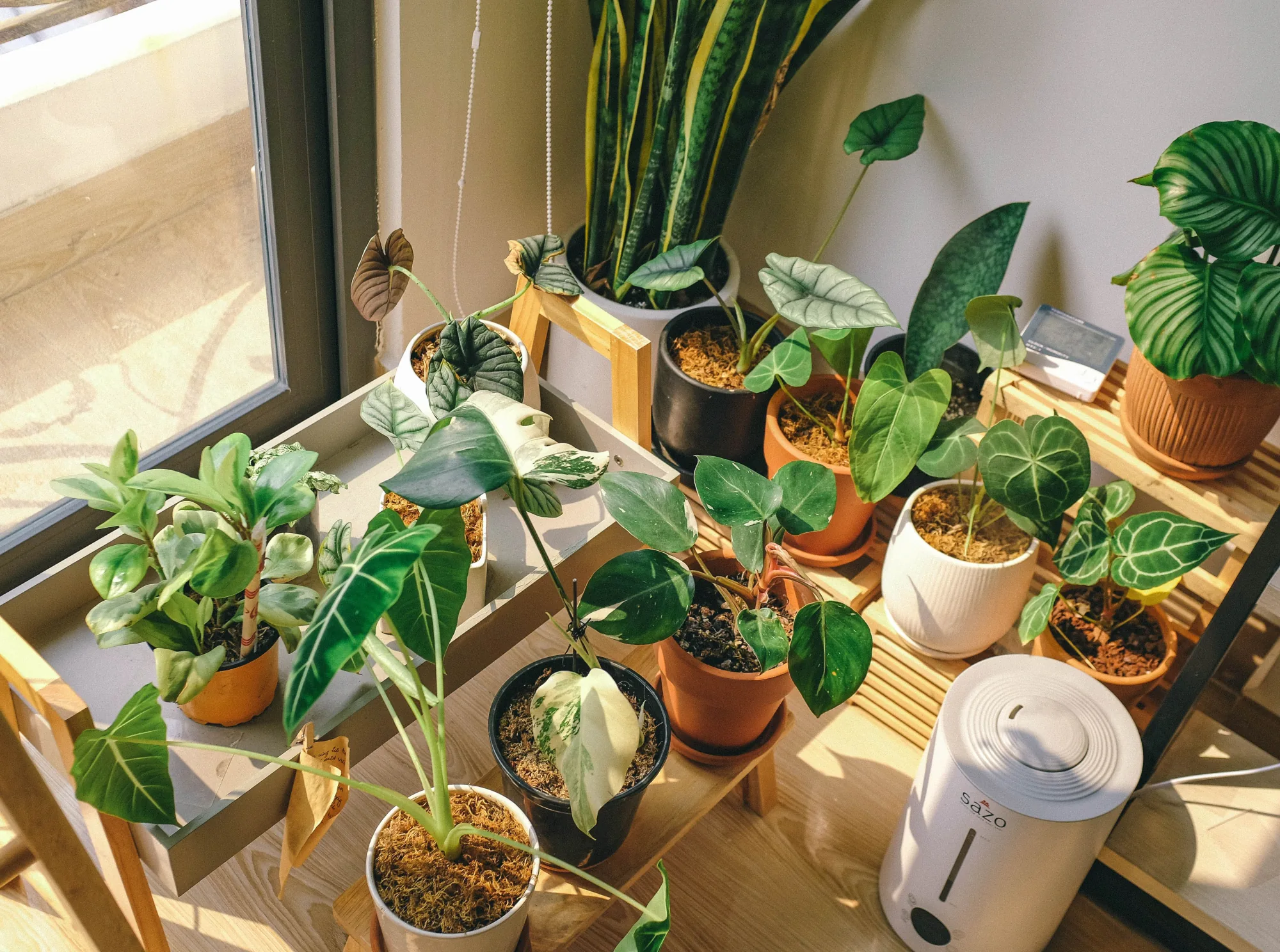
Plants release moisture into the air through transpiration. When you group several plants close together, they create a shared microclimate where the local humidity is higher than the surrounding room. This is the simplest and least expensive method available.
How to do it: Place 3 to 5 plants within a few inches of each other on a tray, shelf, or plant stand. Make sure their leaves are not touching, as this can encourage pest transfer and fungal issues. The closer the grouping, the more effective the humidity boost.
Best for: Any collection of multiple plants, especially moderate-humidity species that just need a small boost.
Limitations: Grouping typically raises local humidity by only 5% to 10%. It helps, but it is not enough for high-humidity plants like Calathea or Boston Fern in very dry homes.
Method 2: Pebble Tray
Effort: Low | Cost: $
A pebble tray is a shallow dish filled with pebbles and water, with the plant pot sitting on top of the pebbles. As the water evaporates, it creates a zone of higher humidity directly around the plant.
How to do it: Choose a tray or saucer wider than the plant’s pot. Fill it with a layer of pebbles or small stones. Add water until it reaches just below the top of the pebbles — the pot should sit on the stones, not in the water. Refill as the water evaporates, typically every few days.
Best for: Individual plants or small groups that need a moderate humidity boost. Works well for Peace Lily, Calathea, and Ferns.
Limitations: The humidity increase is localized — it only helps the plant directly above the tray. It will not raise the humidity of the entire room. The effect is also modest, adding roughly 5% to 15% locally depending on room conditions.
Method 3: Move Plants to Naturally Humid Rooms
Effort: Low | Cost: Free
Some rooms in your home naturally have higher humidity than others. Bathrooms and kitchens regularly produce steam from showers and cooking, which raises the ambient humidity. Moving humidity-loving plants to these rooms can solve the problem without any equipment.
How to do it: Identify which rooms in your home have the highest humidity — usually bathrooms with showers and kitchens near stoves. Check that the light in those rooms is sufficient for the plant’s needs, since understanding how much light your houseplants need matters just as much as humidity. Place humidity-loving plants where both conditions are met.
Best for: Plants that need moderate to high humidity and can tolerate medium or low light — Boston Fern, Peace Lily, Pothos, Spider Plant, and Philodendron.
Limitations: Bathroom light is often too low for many plants. A north-facing bathroom window may not provide enough light for a Calathea, even though the humidity is perfect. Also, not every bathroom has space for plants.
Method 4: Misting
Effort: Medium (requires daily repetition) | Cost: $
Misting involves spraying a fine mist of water directly onto the plant’s leaves using a spray bottle. It is one of the most commonly recommended humidity methods, and also one of the most misunderstood.
How to do it: Fill a clean spray bottle with room-temperature filtered or distilled water. Spray a fine mist over the leaves in the morning, so the water can evaporate during the day. Avoid soaking the leaves — a light mist is enough.
Honest truth: Misting provides only a very temporary humidity boost. The moisture on the leaves evaporates within minutes, and the local humidity returns to its previous level. Misting once a day does not meaningfully raise humidity for more than a few minutes. Think of it as a brief refresh, not a real solution.
Best for: A supplemental boost for plants that are already in adequate humidity. Not a primary solution for dry homes.
Limitations and risks: Misting can promote fungal and bacterial leaf diseases if leaves stay wet for extended periods, especially in poorly ventilated rooms. Do not mist plants with fuzzy leaves, such as African Violets and Begonias — water droplets on fuzzy leaf surfaces cause spotting and damage. Misting is also labor-intensive — it only works if done consistently, and even then, the effect is minimal.
Method 5: Terrarium or Glass Cloche
Effort: Medium | Cost: $$
A terrarium or glass cloche creates a fully enclosed environment where moisture from the plant and soil is trapped, creating natural humidity that stays consistently high — often 70% to 90%.
How to do it: Place a small plant in a glass container — either an open dish terrarium or a closed glass cloche. Use a thin layer of gravel at the bottom for drainage, topped with a layer of activated charcoal to prevent odors, then a layer of potting soil. The enclosed space naturally maintains high humidity through the water cycle of evaporation and condensation.
Best for: Small plants that thrive in high humidity and do not mind limited airflow — Fittonia, small ferns, moss, Peperomia, Baby Tears, and miniature Calathea. Not suitable for plants that grow large, need dry conditions, or require high airflow (succulents, cacti, Snake Plant).
Limitations: Only works for small plants. A terrarium cannot house a full-sized Boston Fern or a large Calathea. Closed terrariums also need occasional ventilation to prevent mold growth, and they require careful watering since there is no drainage.
Method 6: Humidifier
Effort: Medium (refilling and cleaning) | Cost: $$ to $$$
A humidifier is the most effective method for raising ambient humidity in a room. Unlike pebble trays or misting, a humidifier adds meaningful moisture to the air and can maintain a consistent humidity level across an entire room.
How to do it: Choose a cool-mist humidifier sized appropriately for your room. Place it near your plants but not so close that they are directly in the mist stream. Aim for a humidity level between 50% and 60%, and use a hygrometer to monitor. Run the humidifier during the driest parts of the day — typically overnight and early morning in heated homes.
Tips: Clean the humidifier regularly according to the manufacturer’s instructions to prevent mineral buildup and bacterial growth. Use filtered or distilled water if your tap water is hard, as minerals from tap water can leave white dust on surfaces. Refill daily for consistent results.
Best for: Plant rooms with five or more humidity-loving plants. If you have a shelf or corner dedicated to tropical plants, a humidifier is the single most effective investment you can make.
Limitations: Requires daily refilling and periodic cleaning. Cool-mist humidifiers can cool a room slightly, which may be unwelcome in winter. The cost ranges from $30 for a small desktop unit to $80-$150 for a room-sized model.
Method 7: Plant Cabinet or Greenhouse Shelf
Effort: High (setup and maintenance) | Cost: $$$
A plant cabinet — typically a glass-fronted shelving unit with doors — or a small indoor greenhouse shelf creates a semi-enclosed environment that can maintain 70% to 90% humidity consistently. This is the option for serious plant collectors with many tropical species.
How to do it: Purchase or repurpose a glass-fronted cabinet with adjustable shelves. Add a small humidifier or humidity tray inside, along with a small fan for air circulation. Install LED grow lights if the cabinet is not near a window. Monitor humidity with a hygrometer and adjust ventilation by opening or closing the cabinet doors.
Best for: Plant collectors with 10+ humidity-loving plants, people growing rare aroids or tropical species, and anyone who wants to maintain a dedicated plant environment without humidifying an entire room.
Limitations: Requires a significant investment of space and money. A quality plant cabinet costs $150 to $500 or more. Managing ventilation, humidity, and light inside a sealed environment requires regular attention. Not necessary for casual plant owners with a few common houseplants.
Quick Method Comparison
| Method | Humidity increase | Cost | Effort | Best for |
|---|---|---|---|---|
| Group plants | +5 to 10% | Free | Low | Any collection, quick win |
| Pebble tray | +5 to 15% (local) | $ | Low | Individual plants |
| Humid room (bathroom/kitchen) | Variable | Free | Low | Plants that also tolerate lower light |
| Misting | +5% (minutes only) | $ | Medium (daily) | Brief refresh, not a real solution |
| Terrarium / cloche | +70 to 90% (enclosed) | $$ | Medium | Small humidity-loving plants |
| Humidifier | +15 to 30% (room-wide) | $$ to $$$ | Medium (daily refill) | 5+ humidity-loving plants in one room |
| Plant cabinet | +70 to 90% (enclosed) | $$$ | High (setup + maintenance) | Serious collectors with many tropical plants |
What Not to Do
A few common approaches to humidity do more harm than good:
Do not place plants near heating vents or radiators. Hot, dry air blowing directly on a plant will desiccate the leaves faster than any humidity method can compensate for. If your plants are near a vent, move them or redirect the airflow.
Do not mist plants with fuzzy leaves. African Violets, Begonias, and Gloxinia have tiny hairs on their leaf surfaces that trap water droplets, causing brown spots and rot. Keep these plants dry and increase humidity through other methods.
Do not use a warm-mist humidifier too close to plants. Warm-mist units produce steam that can scorch nearby leaves. Cool-mist humidifiers are safer for plant rooms.
Do not assume one method is enough. In a very dry home (below 30% humidity), a single pebble tray or grouping will not bring a Calathea to 60%. Combine methods or invest in a humidifier.
Do not over-humidify. Sustained humidity above 70% in a poorly ventilated room can encourage mold growth on walls and furniture, and fungal diseases on plants. Aim for 50% to 60% for most homes.
FAQs About Humidity for Houseplants
Does misting really help houseplants?
Misting provides a very temporary humidity boost that lasts only a few minutes. It is better understood as a brief refresh than a meaningful humidity solution. For plants that genuinely need higher humidity, a humidifier, pebble tray, or terrarium is far more effective. Misting also carries a risk of fungal leaf diseases if leaves stay wet for extended periods.
What is the best humidity level for Calathea?
Calathea plants prefer 60% or higher humidity. They are among the most humidity-sensitive houseplants and will develop brown tips and curled edges in dry air. If your home humidity is below 50%, a humidifier is the most reliable way to keep Calathea healthy.
Can I use a diffuser as a plant humidifier?
Essential oil diffusers release too little moisture to meaningfully raise humidity, and the essential oils they disperse can coat leaf surfaces and potentially harm plants. Use a dedicated humidifier without any oils for plants.
Will a humidifier damage my furniture or walls?
If humidity stays below 65% and the humidifier is not pointed directly at walls or wooden furniture, the risk is minimal. Use a hygrometer to monitor levels and avoid exceeding 60% in living spaces. Clean the humidifier regularly to prevent mineral dust from settling on surfaces.
Which houseplants do not need extra humidity?
Snake Plant, ZZ Plant, Jade Plant, Ponytail Palm, Aloe Vera, and most succulents and cacti tolerate dry indoor air well. These plants evolved in arid environments and have thick, waxy leaves that prevent moisture loss. They do not need pebble trays, humidifiers, or misting.
Find Plants That Match Your Home
Not every home can support a Calathea or a Boston Fern — and that is perfectly fine. The best houseplant is one that naturally fits your home’s conditions. If your home is dry and you do not want to run a humidifier, there are dozens of beautiful plants that will thrive without extra humidity.
Use the House Plant Finder quiz to discover plants that match your actual light, humidity, and watering habits. Or browse the humidity-loving houseplants collection if you are ready to create the right environment for tropical species.