
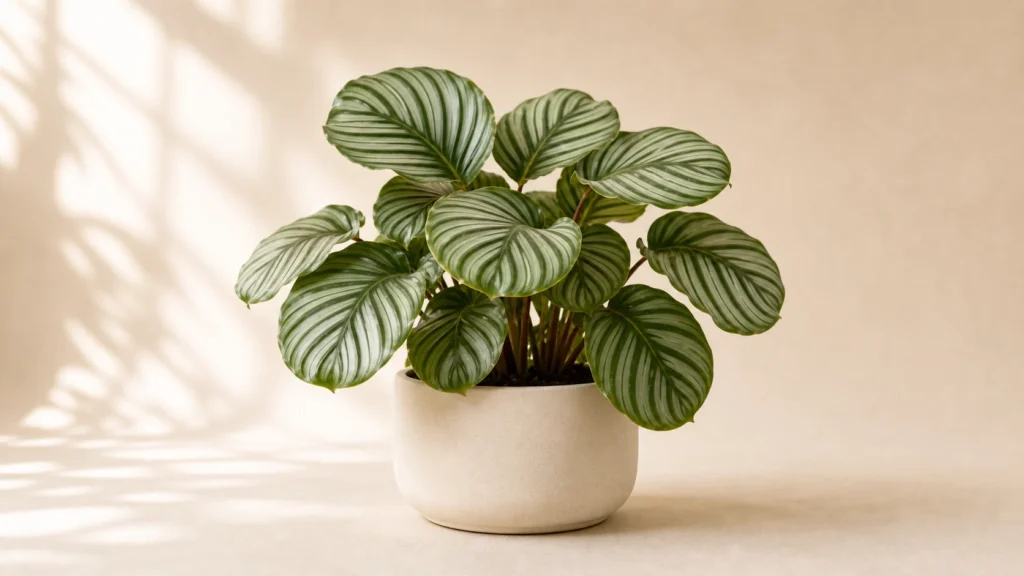
Calathea Orbifolia
Goeppertia orbifolia
A statement prayer plant with broad round leaves and soft silver-green bands, happiest with warm stable conditions and evenly moist, airy soil.
Watering frequency
Every 5-7 days
Ideal temperature
65-80°F / 18-27°C
Humidity
50-70%
Care difficulty
Hard
Air purifying
No/Not Known
Growth rate
Moderate
Plant size
1-3 ft / 0.3-0.9 m
Soil type
Airy, organic-rich mix that stays lightly moist
Fertilizer need
Lightly while growing.
Care summary
- Light: Bright indirect light; protect broad leaves from harsh direct sun.
- Water: Keep lightly and evenly moist, never saturated.
- Humidity: Consistent moderate-to-high humidity helps new leaves open cleanly.
- Water quality: Try lower-mineral water if browning persists after care is stabilized.
- Safety: ASPCA classifies Calathea species as non-toxic to cats and dogs.
Common problems
- Curling leaves: Check dry soil, low humidity, cold drafts, heat, and root stress.
- Crispy edges: Often linked to inconsistent moisture, dry air, salts, or damaged roots.
- Yellow lower leaves: May be normal aging, but widespread yellowing suggests wet soil or poor drainage.
- Faded or scorched patches: Light may be too intense.
- Spider mites: Inspect leaf undersides, especially in warm dry rooms.
- Decline after repotting: Oversized pots and root disturbance can keep the mix wet too long.
Plant care guide
About Calathea Orbifolia
Calathea Orbifolia is the name most plant shoppers recognize, so it remains the consumer-facing title even though the accepted botanical name is Goeppertia orbifolia. The older combination Calathea orbifolia remains common on nursery labels and in care searches. Kew Plants of the World Online accepts Goeppertia orbifolia, treats Calathea orbifolia as a synonym, and records the species as native to eastern Brazil's wet tropical biome.
It belongs to Marantaceae, the prayer plant family. Broad, almost round leaves rise on individual petioles from a clustered base, each blade marked with alternating bands of soft green and silver. The undersides are paler than those of many purple-backed prayer plants, giving Orbifolia a calmer, more architectural appearance.
Like its relatives, it can adjust leaf position between day and night. That movement is normal. A problem looks different: tightly rolled leaves that stay closed, scorched patches, widespread yellowing, or a plant that collapses while the potting mix remains wet.
Why You'll Like It
Orbifolia creates scale without looking heavy. One mature plant can fill the visual role of several smaller pots, and the rounded striped leaves work equally well in a quiet bedroom or a more formal living room. It offers pattern without the sharp color contrast of Croton or Caladium.
It is also classified as non-toxic to cats and dogs by the principal pet-safety source used for this project. That makes it worth considering where a broad-leaved aroid would be risky. Pet-safe does not mean chew-proof, but it changes the toxic-exposure concern.
The trade-off is consistency. Orbifolia is not a plant to water by calendar and forget beside a heating vent. It responds best when light, root-zone moisture, temperature, and humidity change gradually. If you prefer a slower plant that accepts more drying, Cast Iron Plant is easier. If you enjoy prayer plants, compare Calathea Makoyana, Prayer Plant, and Stromanthe 'Triostar'.
What Kind of Plant Is It?
Calathea Orbifolia is an evergreen, rhizomatous tropical perennial. Its rhizome is a horizontal underground stem that produces roots and new shoots. The plant therefore expands as a clump rather than extending along a vine.
Three traits explain most care problems:
- Large leaves lose water quickly. Warm dry air can pull moisture from the leaf faster than stressed roots replace it, producing curled blades and crisp margins.
- Fine roots need moisture and oxygen together. Letting the root ball become dust-dry damages roots, but keeping dense soil saturated damages them too. “Moist” and “waterlogged” are not the same condition.
- The foliage records past stress. A brown margin will not turn green again. Judge an improvement by healthy new leaves and a stable plant, not by waiting for damaged tissue to repair.
Related Prayer Plants
Retailers often place several Marantaceae plants together under “Calathea,” but the patterns and growth habits are distinct:
- Calathea Orbifolia has broad round leaves with wide silver-green bands and a substantial upright clump.
- Calathea Makoyana, or Peacock Plant, carries feathered markings on narrower oval leaves and usually stays smaller.
- Prayer Plant (Maranta leuconeura) grows lower and spreads more horizontally, with prominent colored veins in many cultivars.
- Stromanthe Triostar combines cream, green, and pink and usually needs stronger light to retain its color.
- Rattlesnake Plant has long narrow leaves with dark oval markings and purple undersides.
These plants share a preference for gentle light and an airy, moisture-retentive root zone, but they are not interchangeable. Leaf thickness, mature size, light response, and sensitivity vary.
Choosing a Healthy Plant
Look beyond one perfect display leaf. A good candidate has several firm petioles, an active central growth point, and a root ball that is moist but not sour or saturated. Minor dry edges are common and do not automatically indicate a failing plant; widespread yellowing, translucent patches near the base, or a loose crown deserves more caution.
Inspect both sides of every broad leaf for fine pale stippling, webbing, or clusters of pests. Orbifolia's large leaf area can hide an early spider-mite population until damage becomes obvious. Check the pot for standing water and ask when it was last watered before adding more at home.
After purchase, give the plant a stable quarantine position for a few weeks. Do not immediately repot, fertilize, divide, move it into direct sun, and change its water source all at once. The fewer simultaneous variables you introduce, the easier it is to interpret any curling or leaf loss.
Where It Works Best
Choose a warm room with bright indirect light and no frequent drafts. An east-facing window is often straightforward. Near south- or west-facing glass, filter strong sun or move the plant back far enough that leaves do not heat up. A north window can work if it is large and unobstructed, but growth may slow.
A bright bathroom is useful only when the window provides real plant light. A humid, windowless bathroom is still dark. In a living room or bedroom, place a humidifier nearby if winter heating repeatedly pushes the air very dry, while maintaining enough spacing for air movement.
Avoid the path of air-conditioning, radiators, fireplaces, and exterior doors. Repeated temperature swings can curl foliage even when watering looks correct. Keep the pot where pets cannot repeatedly shred the broad leaves; non-toxic plants can still cause vomiting if enough fibrous material is eaten.
How to Care for Calathea Orbifolia
Light: Provide bright indirect light. Gentle early sun may be tolerated, but intense midday or afternoon sun can bleach the pattern and leave dry patches. Too little light slows water use and growth, which increases the risk of keeping the pot wet by following an unchanged schedule.
Watering: Check the root zone regularly and water when the surface begins to dry while the mix below remains slightly moist. Water thoroughly and let excess drain. Do not give small sips that wet only the surface, and do not leave the pot standing in a cachepot of runoff.
If the plant becomes very dry, rehydrate evenly rather than flooding it repeatedly. Peat-heavy nursery mix can pull away from the pot when dry; slow watering in two passes may help the root ball absorb moisture.
Water quality: Browning has many causes, so do not blame tap water automatically. First stabilize watering, roots, humidity, and fertilizer. If new leaves still develop burned tips, try rainwater, distilled water, or another lower-mineral source for several growth cycles and compare the result. Letting water sit overnight does not remove all dissolved minerals.
Soil and container: Use an airy mix that retains moderate moisture—houseplant mix amended with fine bark, perlite, or pumice is a practical base. Drainage holes are essential. Avoid a sharply oversized pot, which surrounds a small root ball with wet unused soil.
Humidity: Aim for a stable 50-70% when practical. A humidifier is the most controllable method. A pebble tray changes humidity only in a very small area, and occasional misting is too brief to correct chronically dry air. Clean leaves with a damp cloth rather than relying on mist to remove dust.
Temperature: Keep roughly 65-80°F / 18-27°C and avoid prolonged temperatures below the plant's comfortable range. Use room-temperature water so a thirsty plant is not shocked with very cold irrigation.
Fertilizer: Feed lightly during active spring and summer growth with a diluted balanced fertilizer. Orbifolia is sensitive to accumulated salts, so more is not better. Pause when growth slows, never fertilize severely dry roots, and occasionally water deeply enough to flush soluble residue through the drainage hole.
Grooming: Trim a fully brown leaf at the base with clean scissors. For a small brown edge, follow the natural leaf outline and leave a narrow dry margin rather than cutting into healthy tissue. Clean broad leaves gently so dust does not hide mites.
Seasonal Adjustments
Longer spring days normally increase growth and water use. Begin feeding only when new leaves are actively opening, not simply because the calendar says March. In summer, watch plants close to glass for heat even when the light is filtered.
During autumn and winter, slower growth means the pot remains moist longer. Continue checking the soil, but expect wider intervals between waterings. Heating may lower humidity at the same time, creating the misleading combination of dry leaf edges and wet roots. Correct the air and root-zone problems separately: improve room humidity if needed, but do not keep the soil saturated to compensate.
How to Propagate Calathea Orbifolia
Division is the practical method. It cannot be propagated from an ordinary leaf cutting because a detached blade and petiole do not contain the rhizome and growth point needed to make a new plant.
Divide only a healthy, established clump with naturally separable sections. During repotting, ease the root ball apart so each division retains roots and at least one viable shoot cluster. Pot into appropriately small containers, keep the mix evenly moist, and provide warm, humid, indirect-light conditions while roots recover.
Division is stressful, and a small section may pause or sacrifice an older leaf. Avoid dividing a plant already suffering from rot, mites, cold damage, or chronic dryness merely to “save” it unless you are removing clearly diseased tissue.
When to Repot
Repot when roots and rhizomes have crowded the container, water no longer penetrates evenly, or old mix has collapsed and stays wet. Spring or early active growth is preferable. Move up one modest size and keep the crown at its previous level.
Some root density is normal. Slow growth alone is not proof that a larger pot is needed; first consider season, light, temperature, pests, and root health. After repotting, keep conditions stable and skip fertilizer until the plant resumes active growth.
Pet Safety
ASPCA classifies Calathea species as non-toxic to dogs, cats, and horses. Because Orbifolia is now classified in Goeppertia but remains part of the same familiar horticultural group, this is the project's best available genus-level pet reference.
Non-toxic does not mean edible. Chewing a large amount of any plant material can cause stomach upset, and pesticides or fertilizer residue create separate risks. Confirm the plant's identity and contact a veterinarian if a pet develops symptoms. The pet-safe houseplants guide offers other choices for habitual chewers.
Common Problems and Practical Fixes
- Curling leaves: Check actual soil moisture first, then humidity, heat, cold drafts, and roots. Do not assume every curl means “add water.”
- Crispy brown margins: Review inconsistent moisture, very dry air, fertilizer salts, water minerals, hot sun, and root damage together. Improvement appears on future growth.
- Yellow lower leaf: One old leaf may be normal. Several yellow leaves with wet soil point toward drainage or root problems.
- Pale scorched patch: Filter direct sun and move the plant gradually rather than changing from deep shade to a distant dark corner.
- Drooping in wet soil: Do not water again. Check temperature, oxygen in the mix, and roots for rot.
- Spider mites: Look for fine stippling, webbing, and tiny moving dots under the leaves. Isolate, rinse, and use a product labeled for indoor ornamental plants, repeating according to its directions.
- Fungus gnats: Persistent gnats suggest the surface stays wet. Improve drying and airflow without allowing the entire root ball to become bone-dry.
Frequently Asked Questions
Why is it still called Calathea Orbifolia?
That remains the dominant consumer and trade name. The accepted botanical name is Goeppertia orbifolia, while Calathea orbifolia is a recognized synonym.
Does it need distilled water?
Not automatically. Stabilize care first. If browning continues on new leaves, a lower-mineral water trial can help determine whether water quality contributes.
Can it live in low light?
It may survive, but growth and water use slow, and the plant becomes harder to maintain. Bright indirect light produces a fuller, more resilient specimen.
Why do leaves move during the day?
Daily position changes are normal in prayer plants. Persistent tight curling, collapse, or discoloration is the signal to investigate.
Can I root a leaf in water?
No. A viable division needs rhizome, roots, and a growth point; a leaf alone cannot rebuild the plant.
Final Thought
Calathea Orbifolia rewards stability more than constant intervention. Give it bright filtered light, an airy mix kept evenly—not excessively—moist, warm temperatures, and sustained moderate humidity. Then judge progress by the next healthy leaf rather than expecting old brown edges to disappear.