
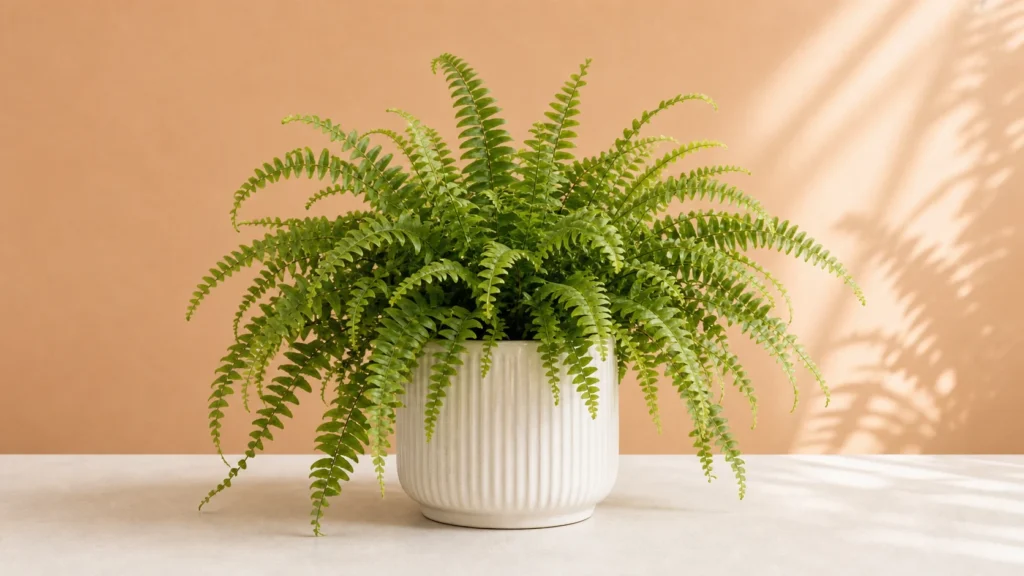
Boston Fern
Nephrolepis exaltata 'Bostoniensis'
A pet-compatible fern with long arching fronds that stays lush when moisture, humidity, filtered light, and cool-to-mild temperatures remain consistent.
Watering frequency
Every 3-7 days
Ideal temperature
60-75°F / 16-24°C
Humidity
50-80%
Care difficulty
Medium
Air purifying
No/Not Known
Growth rate
Moderate
Plant size
1-3 ft / 0.3-0.9 m
Soil type
Moist, organic-rich, well-draining mix
Fertilizer need
Every 4-6 weeks while growing.
Care summary
- Light: Medium to bright indirect light.
- Water: Keep evenly moist without standing water.
- Humidity: Stable humidity is essential for soft green fronds.
- Soil: Use an organic-rich mix that drains and resists compaction.
- Grooming: Remove dead fronds and expect some leaflet shedding.
Common problems
- Crispy fronds: dry air, dry roots, heat, or salts.
- Yellowing: saturated mix, poor drainage, or aging.
- Shedding: moisture swings, relocation, heat, or low light.
- Scorch: excessive direct sun.
- Pests: mites or scale, especially in dry air.
Plant care guide
About Boston Fern
Boston Fern is the classic cascading fern seen in hanging baskets, porch displays, bathrooms, and bright indoor rooms. Long arching fronds carry many small leaflets, creating a soft green silhouette that contrasts with the solid leaves of Bird’s-nest Fern and upright tropical plants.
The underlying species is Nephrolepis exaltata, native to tropical and subtropical parts of the Americas. Kew’s accepted record for Nephrolepis exaltata recognizes the species and its broad American distribution. The familiar Boston form is traditionally associated with ‘Bostoniensis’, a horticultural selection with broader drooping fronds. Retail plants may be other compact, ruffled, or golden cultivars, so preserve the cultivar label when one is supplied.
Boston Fern can be abundant outdoors in warm humid conditions yet demanding inside a heated home. The difference is environmental: containers dry quickly, HVAC systems remove humidity, and indoor light is weaker than it appears. The plant is not inherently fragile, but it reacts visibly to inconsistent moisture and dry air.
Why You’ll Like It
Few plants create the same sense of fullness. One healthy basket supplies hundreds of fine leaflets and softens shelves, stands, and hard architectural lines. It can become a substantial display without needing a moss pole or large woody trunk.
Boston Fern is considered pet-compatible, an important advantage for homes avoiding toxic foliage. It still benefits from being protected from chewing and digging; a cat can damage a basket long before the plant causes a toxic exposure.
The plant also provides clear seasonal feedback. New fiddleheads emerge from the crown, older fronds yellow gradually, and dry conditions show up quickly as shedding. That responsiveness helps an attentive owner adjust care, though it can frustrate someone seeking a plant that tolerates weeks of neglect.
What Kind of Fern Is It?
Nephrolepis exaltata is a perennial fern that can grow terrestrially or as an epiphyte. It forms short rhizomes and slender runners called stolons. New plants can develop along those runners, allowing the fern to spread in warm landscapes and to fill a container.
Each frond is divided into many pinnae—the individual leaflet-like segments arranged along the central rachis. Mature fertile fronds develop round brown sori on the undersides. These orderly spore structures are normal and should not be scraped off as pests.
The crown produces new fronds from the center. Unlike a Bird’s-nest Fern, Boston Fern can have multiple growing points and spreading runners, making division possible when the plant is large enough.
Popular Boston Fern Varieties
The NC State Extension Boston Fern profile records numerous cultivars with different size, texture, and color.
- ‘Bostoniensis’: The traditional broad, arching form associated with the Boston Fern name.
- ‘Compacta’: Shorter and more upright, useful where a full-size hanging basket is too broad.
- ‘Dallas’ or ‘Dallas Jewel’: A smaller fast-growing cultivar described as more tolerant of lower light and humidity, though it still needs fern-level moisture.
- ‘Fluffy Ruffles’: Compact, upright fronds with ruffled edges and dense texture.
- ‘Florida Ruffle’: Wider, more divided fronds that create a fuller, intricate appearance.
- ‘Tiger Stripe’: Variegated or gold-patterned foliage on dense arching growth.
- ‘Rita’s Gold’ and ‘Golden Boston’: Chartreuse or yellow-green selections that need sufficient filtered light to maintain color.
- ‘Whitmanii’, ‘Verona’, and ‘Suzi Wong’: Finely cut or lacy selections offering more intricate frond texture.
Names can be lost in mass-market production. A plant labeled only “Boston Fern” should remain at species level rather than being assigned the closest cultivar by appearance.
Where It Works Best
Provide medium to bright indirect light. An east window, bright north window, or filtered position near stronger glass often works. Direct midday sun can bleach and crisp fronds, while deep shade produces sparse growth and slows drying.
Bathrooms and kitchens can offer humidity, but only when they receive adequate light. A bright bedroom or living room with a humidifier may be better than a dark bathroom. Keep the basket away from heating vents, fireplaces, air conditioners, and frequently opened winter doors.
Boston Ferns often spend summer on a shaded porch. Acclimate the plant to outdoor light and wind, water more frequently, and protect it from intense afternoon sun. Before bringing it indoors, inspect for scale, mites, caterpillars, and other hitchhikers.
How to Water Boston Fern
Keep the mix evenly moist without leaving it waterlogged. Check every three to seven days during active growth and more often in a small hanging basket during hot weather. Water when the surface begins to dry, before the root ball becomes crisp and pulls from the pot.
Water thoroughly until excess drains, then empty the saucer or cachepot. If a very dry peat-based mix repels water, soak the pot briefly from below, remove it, and let it drain. Repeated tiny drinks do not rehydrate the center evenly.
In cooler, darker winter conditions, reduce frequency but continue checking. NC State notes that overwatering a slowed or dormant plant can lead to root rot. The goal remains even moisture adjusted to actual use, not a fixed summer or winter number.
If fronds wilt, feel the mix. Dry soil calls for water; wet soil with yellowing and collapse calls for root inspection. Do not add water automatically to a distressed wet fern.
Soil, Pot, and Repotting
Use an organic-rich mix that holds moisture but drains and stays aerated. A quality peat-free houseplant or fern mix amended with perlite or fine bark is suitable. Very coarse mixes dry too fast; dense garden soil suffocates container roots.
Hanging baskets dry rapidly because air circulates around the whole container. Plastic or glazed pots retain moisture longer than unglazed clay. Whatever the material, drainage holes are essential.
Repot when roots and rhizomes crowd the container, water runs through without wetting the mix, or the plant dries exceptionally fast. Move up only one size or divide the plant. Preserve the crown at its original level and avoid burying emerging fronds.
Humidity, Temperature, and Feeding
Humidity is central to good indoor appearance. Aim for 50–70% if practical. A room humidifier is more effective than misting, which briefly wets foliage and can contribute to spotting without raising room humidity for long. Grouping plants provides only a modest local effect.
Boston Fern prefers roughly 60–75°F (16–24°C) and often looks better in cooler rooms than beside a radiator. Avoid frost and cold drafts. Heat increases transpiration, so a warm dry room can brown fronds even when the surface seems moist.
Feed every four to six weeks during active growth with a balanced fertilizer at one-quarter to one-half strength. Apply to moist soil. Excess salts burn fine roots and leaf tips, so flush the pot occasionally and pause feeding when growth slows.
Grooming and Propagation
Remove completely brown fronds at the base with clean scissors. Trim scattered brown tips only for appearance; correcting moisture and humidity protects future growth. A badly declined but living plant can be cut back more substantially in spring, then given stable warmth, moisture, and filtered light while new fronds emerge.
Division is the easiest propagation method. Remove the plant, separate a section containing roots, rhizome, and healthy growing points, and pot it snugly. Small plantlets on runners may also be pinned onto moist mix until rooted before being detached.
Spore propagation is possible but slow and requires sterile, humid conditions through a tiny gametophyte stage. It will not necessarily reproduce a named cultivar true to type.
Buying and Acclimating a Boston Fern
Choose a basket with firm green fiddleheads emerging from several healthy points. Inspect deep inside the crown and under the fronds for webbing, scale, caterpillars, or gray mold. A few brown tips are manageable; a dry lightweight root ball combined with widespread crispy shedding suggests prolonged stress.
After purchase, quarantine the fern and place it in conditions close to the final location. Nursery baskets often come from much higher humidity than a home, so gradual acclimation and a humidifier may prevent severe shedding. Avoid repotting, strong fertilizer, direct sun, and a dramatic humidity drop all at once.
If the basket contains a decorative sleeve, remove it for watering and make sure it does not retain water around the roots. Check hanging hardware and the ceiling anchor at the plant’s fully watered weight, not its lighter dry weight.
Seasonal Indoor and Outdoor Care
Spring growth accelerates as light increases. This is a good time to divide, repot, remove dead winter fronds, and begin light feeding. During summer, a shaded porch may suit the fern, but wind and heat can dry a hanging basket in hours. Check it directly rather than assuming yesterday’s rain reached the root ball.
Before autumn nights become cold, inspect and move the fern indoors. Expect some adjustment as light and humidity fall. In winter, place it in the brightest indirect light available, keep it away from heat vents, reduce fertilizer, and water only as the pot begins to dry. The RHS guide to epiphytic ferns includes Boston Fern among common indoor epiphytic ferns and emphasizes warm humid air, indirect light, and an open moisture-retentive but fast-draining mix.
Pet Safety
The ASPCA Boston Fern profile lists it as non-toxic to dogs and cats. Correct identification matters: “fern” is a visual common name applied to unrelated plants, some of which may not share this status.
Non-toxic does not mean food. Large quantities of any plant can cause stomach upset, and pesticides or fertilizer add separate risks. Hang or place the fern securely if a pet chews fronds or pulls baskets down.
What About Air Purifying?
Boston Fern appears in discussions of plants and volatile organic compounds, but chamber performance does not show that one basket replaces ventilation or filtration in a home. Normal air exchange and ongoing pollution sources dominate real rooms. This candidate therefore treats meaningful room-scale air purification as not established.
Common Problems
- Crispy leaflets and heavy shedding: The root ball dried, humidity is low, the room is hot, or salts have accumulated. Correct the system rather than misting once.
- Yellow soft fronds: Check saturated soil, blocked drainage, and low-light winter watering.
- Brown round dots beneath fronds: Regular sori are normal. Scale insects are raised, irregular, and may produce sticky residue.
- Fine webbing and pale stippling: Spider mites thrive in dry air. Isolate the fern and use a labeled treatment that reaches frond undersides.
- Fronds bleach on one side: Reduce direct sun and rotate the pot after conditions are corrected.
- Center remains bare: Check whether the crown dried, rotted, or is shaded by dead material. Remove debris gently and wait for active-season growth.
- Fern declines after moving indoors: Light, humidity, temperature, and pest pressure changed at once. Stabilize conditions and avoid repotting or heavy fertilizer until it adjusts.
Frequently Asked Questions
How often should I water a Boston Fern? Check every few days and water when the surface starts to dry. Small baskets in summer may need frequent water; larger cool winter pots need less.
Why does it shed so much indoors? Dry roots, low humidity, heat, relocation, weak light, and older fronds all contribute. Sudden moisture swings are especially common after moving from a humid nursery.
Can it grow in low light? It tolerates shade better than sun, but a healthy indoor basket still needs medium to bright indirect light.
Are the brown dots spores? Regular patterned dots beneath mature fronds are sori. Inspect irregular bumps and sticky leaves for scale.
Is it safe for cats? ASPCA lists Boston Fern as non-toxic to cats and dogs, provided the plant is correctly identified as the Boston Fern form of Nephrolepis exaltata.
Final Thought
Boston Fern is not difficult because its needs are exotic; it is difficult because those needs must remain consistent. Give it filtered light, a root ball that stays evenly moist, humid air, and relief from indoor heat. In return, it produces the dense arching texture that has made it a classic for generations—and it does so without adding a known plant-toxicity concern for cats or dogs.