
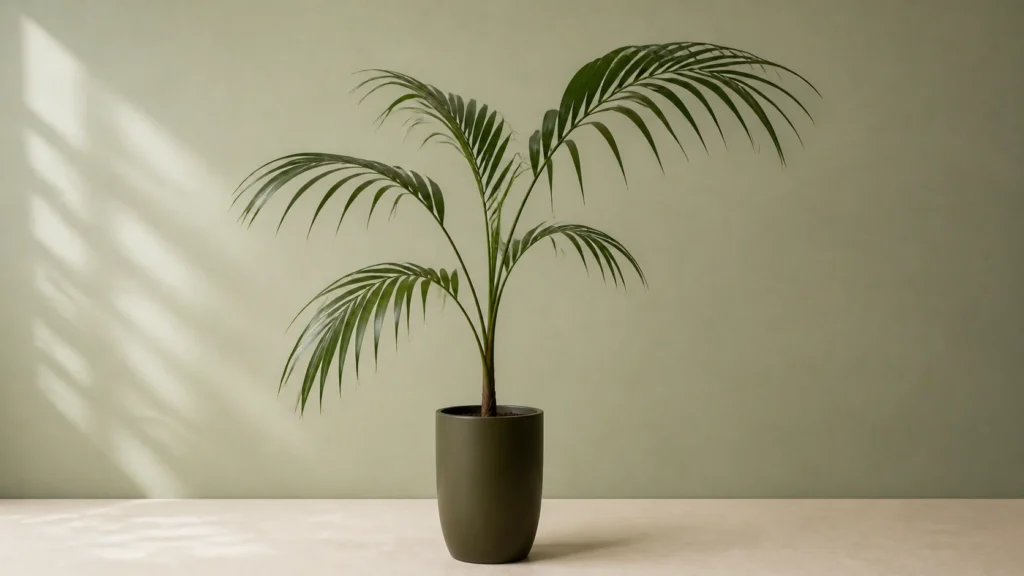
Kentia Palm
Howea forsteriana
A graceful slow-growing palm with arching feather-like fronds that adapts to indoor light when watering and drainage remain consistent.
Watering frequency
Every 7-14 days
Ideal temperature
65-85°F / 18-29°C
Humidity
40-60%
Care difficulty
Medium
Air purifying
Yes
Growth rate
Slow
Plant size
5-10 ft / 1.5-3 m
Soil type
Well-draining palm mix
Fertilizer need
Every 6-8 weeks, spring-summer.
Care summary
- Light: Medium to bright indirect light; avoid abrupt harsh sun.
- Water: Water after the surface dries while keeping the deeper root zone from extreme drought.
- Soil: Use a humus-rich, well-draining mix in a stable container.
- Pruning: Remove only fully brown fronds; never cut the central growing spear.
- Safety: ASPCA lists Kentia Palm as non-toxic to cats and dogs.
Common problems
- Yellow fronds: Check saturated soil, drainage, light, roots, and nutrition.
- Brown tips: Review drought, salts, dry air, cold, and root stress.
- Speckling or webbing: Inspect for spider mites.
- Sticky leaves: Look for scale or mealybugs.
- Weak new spear: Protect the crown and assess roots and deficiencies.
Plant care guide
About Kentia Palm
Kentia Palm (Howea forsteriana) is a single-stemmed feather palm endemic to Lord Howe Island, Australia. It develops long arching fronds with drooping dark-green leaflets and has been used as an indoor specimen since the Victorian era. Its ability to tolerate lower indoor light better than many palms explains its long popularity in homes, hotels, and public interiors.
NC State Extension's Kentia Palm profile documents its Lord Howe Island origin, single-stemmed habit, moderate indoor-light tolerance, slow growth, and common pest and nutrient problems. The source URL contains a “kenita” spelling, but the recognized consumer name is Kentia Palm.
Retail pots often contain several seedlings, creating a full clump. Kentia does not naturally branch or produce replacement shoots from a cut trunk. Each visible stem may be a separate palm with one growing point. This matters because ordinary tree-pruning advice can kill a palm.
Why You'll Like It
Kentia Palm brings height and movement without the rigid look of some fan palms. Mature fronds arch outward and downward, softening a large room while preserving open space beneath the canopy. Its growth is slow, so a correctly sized specimen does not immediately outgrow its position.
It also tolerates medium light and average indoor conditions better than many tropical palms, although “tolerates” does not mean “prefers darkness.” Strong filtered light produces better growth and helps the root zone dry predictably.
Compare it with Parlor Palm, a smaller clustering palm, or Areca Palm, which has many cane-like stems and generally needs more light. Correct identification prevents damaging assumptions about pruning and propagation.
What Kind of Plant Is It?
Kentia belongs to the Arecaceae family. Each trunk has one active growing point at the crown. New fronds emerge as upright spears, then open into pinnate—feather-like—leaves. Damage to the central spear can be permanent because the trunk cannot branch below it like a ficus.
The species is sometimes confused with Howea belmoreana, the Belmore Sentry Palm. Kentia generally has more relaxed arching fronds, while H. belmoreana has distinctly recurved foliage and is slower. Keep botanical labels when purchasing.
Seed is the normal propagation method. A multi-stem pot is usually several seedlings planted together, not one divisible clump connected by underground rhizomes.
Where It Works Best
Place Kentia Palm in a living room, entryway, or office with medium to bright filtered light and enough clearance for arching fronds. An east window is gentle; south and west exposures may need a sheer curtain or gradual acclimation.
Avoid tight corners where leaflets scrape walls, high-traffic paths, heater vents, and cold doors. Do not press the crown against the ceiling. Rotate the pot modestly for even exposure, handling fronds carefully because bent rachises do not straighten.
Kentia can spend warm months outdoors in deep shade or filtered light after gradual acclimation. Protect it from strong wind and direct midday sun. Inspect for pests before returning inside.
How to Care for Kentia Palm
Light
Medium light is tolerated, but bright indirect light is ideal. Low light slows already modest growth and lengthens soil drying. Sparse leaning growth and long periods without a healthy spear can signal inadequate light, though palms naturally produce few fronds per year indoors.
Harsh direct sun can bleach leaflets. Increase exposure gradually and judge by new growth rather than moving the palm repeatedly.
Watering
Water when the top one or two inches of mix dry, while avoiding complete prolonged desiccation of the entire root ball. Apply water evenly until excess drains, then empty the saucer or cachepot.
Seven to fourteen days is only a starting estimate. Large nursery pots can remain wet deep inside even when the surface looks dry. Check with a skewer, moisture feel, and pot weight. Winter or low-light conditions may require much longer.
Both chronic saturation and severe drought cause brown or yellow foliage. A wilted or declining palm in wet soil should not receive more water automatically; inspect roots and drainage.
Soil and Container
Use a humus-rich but well-draining palm or indoor-tree mix, amended with perlite, pumice, or fine bark as needed. The pot must have drainage holes. Keep the trunk bases at their original depth.
Kentia dislikes unnecessary root disturbance. Choose a stable container only modestly larger when repotting. For physical weight, place the correctly sized draining pot inside a heavy cachepot rather than using excessive wet soil.
Humidity and Temperature
Average household humidity around 40–60 percent is workable. Dry heated air can encourage mites and brown tips, but salts, drought, cold, and damaged roots are also common causes. A humidifier is more effective than misting.
Maintain 65–85°F (18–29°C) and avoid cold drafts. Do not place the palm directly against winter glass or in hot forced air.
Fertilizer
Feed lightly every six to eight weeks from spring through early fall, when the palm is making new fronds, with a palm-appropriate or balanced fertilizer used according to its label. Reduce or pause feeding in winter when growth slows. Palms can develop potassium, magnesium, manganese, or boron problems, but blind supplementation can create new imbalances.
Persistent patterned discoloration should be assessed carefully. Do not remove symptomatic older fronds too early because palms can redistribute mobile nutrients from them. When deficiencies are suspected, use a properly formulated palm fertilizer or seek local horticultural advice.
Cleaning and Pruning
Wipe or gently shower foliage to remove dust, allowing it to dry with airflow. Support fronds during cleaning. Inspect undersides for mites and scale.
Remove a frond only when it is fully brown and dry, cutting near—but not into—the trunk. Do not cut green fronds merely to reduce size, and never cut the central spear or top the trunk. Brown tips may be trimmed cosmetically while leaving a narrow dry margin.
Propagation and Multi-Stem Pots
Kentia Palm is propagated from seed, a slow specialist process. Home stem cuttings do not work because a cut frond or trunk section lacks a new growing point. Air layering and ordinary branch cuttings are also inappropriate.
Separating a nursery pot is risky because individual seedling roots become intertwined. If one stem dies, remove only loose dead material; do not tear the entire root ball apart unless there is a compelling reason and suitable recovery conditions.
When buying, count trunks and inspect every central spear. A full pot with many healthy seedlings offers immediate volume, while a single palm may grow more efficiently with less root competition. Neither format is a separate cultivar.
When to Repot
Repot when roots severely crowd the container, the mix has collapsed, drainage fails, or the pot is unstable. This may be only every few years. Spring or early summer provides better recovery light.
Slide the root ball out intact, move it into one modestly larger pot, and fill around it without burying trunks. Avoid aggressive root pruning. Resume feeding only after the palm is stable and growing.
Seasonal Care
In spring and summer, stronger light supports new spears and greater water use. Check more often and feed lightly. Outdoor placement must begin in shade and remain protected from wind.
In winter, maximize filtered light, extend the watering interval, and pause or reduce fertilizer. Heated indoor air raises mite pressure, so inspect leaflets with a bright light.
Buying and Acclimating a Kentia Palm
Kentia Palms are slow and often expensive, so inspection before purchase matters. Check every central spear: it should be firm, upright, and free of gray mold or collapse. Look along the underside of leaflets for mite stippling and at trunk bases for scale or mealybugs. Soil should smell fresh and drain, not remain swampy in a decorative sleeve.
Count the trunks and recognize that each is probably a separate seedling. A pot with many stems looks full immediately but has more crowded roots and several crowns to monitor. A sparser pot may grow more evenly over the long term. Neither arrangement guarantees better health; choose firm crowns and clean roots.
After transport, quarantine the palm and place it in its intended filtered light. Do not immediately repot, divide, fertilize, and move it outdoors. Kentia responds slowly, so excessive correction can create more damage before the original issue is understood. Learn the deep-soil drying pattern first.
If brown tips were already present at purchase, mark or photograph them. Existing damage will not reverse, and a baseline prevents blaming the new home for every old mark. Assess the next spear and newly expanding leaflets instead.
Long-Term Size and Room Planning
Measure the available height and width before buying. A frond can arc well beyond the pot, and cutting green leaves to fit a narrow hallway weakens the palm. Select a plant whose current canopy has room to expand for several years.
Because the trunk cannot branch after topping, height cannot be reset like a ficus. If a healthy Kentia eventually reaches the ceiling, relocation to a taller interior is safer than cutting the crown. Small palms are easier to plan around but take years to build the same presence.
Use a wheeled plant caddy rated for the pot's weight if seasonal repositioning is necessary. Lock the wheels and protect floors from runoff. Moving equipment should support the container, never pull on trunks or fronds.
Toxicity and Pet Safety
ASPCA identifies Kentia Palm, Howea forsteriana, as non-toxic to cats and dogs in its toxic and non-toxic plant database. This supports the Pet safe classification.
Non-toxic does not mean suitable food. Fibrous leaflets can still cause individual stomach upset, and a large top-heavy pot can injure a pet if pulled over. Contact a veterinarian if symptoms develop after chewing and provide the botanical name.
Common Problems and Practical Fixes
Brown tips
Review drought, fertilizer salts, hard water, dry air, cold exposure, and roots. Old damage remains. Adjust care and judge the newest leaflets.
Widespread yellowing
Check deep soil moisture and drainage. Persistent wetness suggests root stress; patterned yellowing can involve nutrients. Do not add water and fertilizer simultaneously without diagnosis.
New spear does not open
Some delay is normal. Check temperature, humidity, pests, roots, and whether the spear is firm. A soft or easily pulled spear suggests serious crown or root rot and needs prompt assessment.
Speckled leaves and fine webbing
Spider mites are common in dry indoor air. Isolate the palm, rinse both leaf surfaces where practical, and use a labeled control repeatedly as directed.
Sticky leaflets or bumps
Scale or mealybugs may be feeding on the palm. Inspect stems and leaflet bases, clean accessible pests, and follow with a treatment labeled for indoor palms.
Frequently Asked Questions
Can Kentia Palm grow in low light?
It tolerates medium and relatively low light better than many palms, but growth is healthier in bright indirect light. A windowless room needs a grow light.
Can I cut the top if it is too tall?
No. Cutting the single growing point kills that trunk. Choose the correct size and control placement rather than topping it.
Why are there several trunks?
Commercial growers often plant multiple seedlings in one pot. Kentia itself is not a suckering palm.
Can I divide the pot?
Separation can severely damage intertwined roots and is not routine care. Keep the group intact unless there is a clear horticultural reason.
Is it safe for pets?
ASPCA lists Howea forsteriana as non-toxic, though chewing and pot instability should still be prevented.
Should I cut brown tips off?
You may follow the natural leaflet shape for appearance, leaving a narrow brown edge. Do not cut into broad areas of healthy green tissue or remove an otherwise functioning frond.
Why has it produced no new leaf for months?
Kentia is naturally slow, especially in winter or medium light. Confirm that the central spear remains firm and check light, temperature, roots, and pests before adding fertilizer.
Final Thought
Kentia Palm rewards gentle consistency rather than frequent intervention. Give it filtered light, evenly managed moisture, a stable root ball, and very restrained pruning. Protect the crown and respect its slow pace; a healthy frond is more valuable than a quickly reshaped silhouette.