
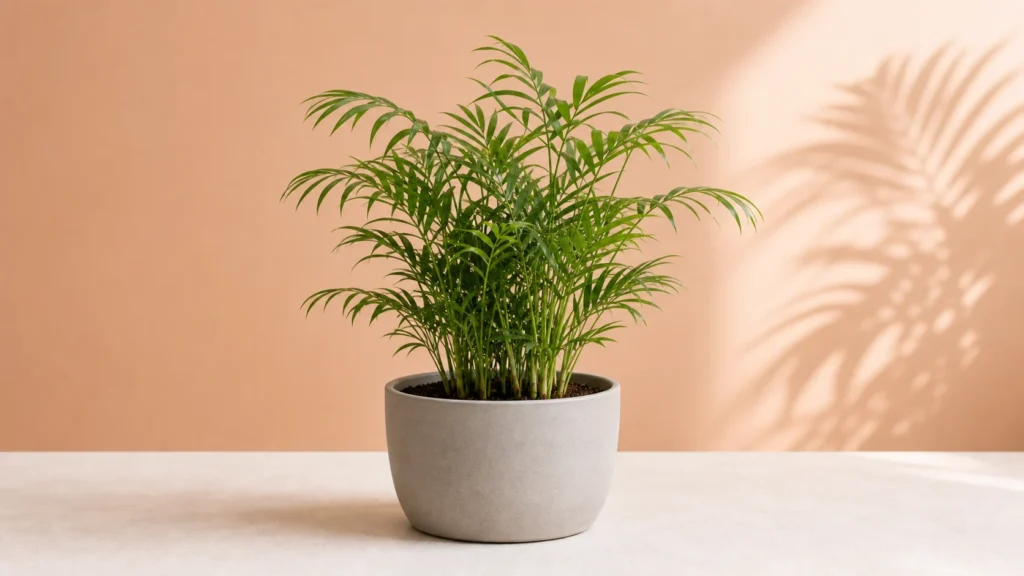
Parlor Palm
Chamaedorea elegans
A compact understory palm with softly arching fronds, exceptional indoor history, and verified non-toxic status for cats and dogs.
Watering frequency
Every 7-14 days
Ideal temperature
65-80°F / 18-27°C
Humidity
40-60%
Care difficulty
Easy
Air purifying
Yes
Growth rate
Slow
Plant size
2-4 ft / 0.6-1.2 m
Soil type
Well-draining palm mix
Fertilizer need
Every 6-8 weeks, spring-summer.
Care summary
- Light: Give medium to bright indirect light; avoid harsh sun.
- Water: Let the surface dry slightly, then soak and drain.
- Soil: Use a moisture-retentive but aerated mix with drainage.
- Pruning: Remove only fully brown fronds at the base.
- Safety: ASPCA lists Parlor Palm as non-toxic to cats and dogs.
Common problems
- Brown tips: Check drought, dry airflow, salts, and root health.
- Yellow fronds: Review wet soil, drainage, light, and natural aging.
- Pale growth: Check excessive sun, depleted mix, and pests.
- No new fronds: Slow growth may be normal; verify roots and light.
- Pests: Inspect closely for spider mites and scale.
Plant care guide
About Parlor Palm
Parlor Palm (Chamaedorea elegans) is a small understory palm native to southern Mexico and northern Central America. Its fine-textured, arching fronds and tolerance of indoor conditions made it a fashionable room plant long before today's houseplant boom. NC State Extension's Parlor Palm profile describes it as a slow-growing palm that prefers filtered light and well-drained soil.
One retail pot usually contains several seedlings planted together for a fuller appearance. That arrangement creates a clump, but each slender stem is an individual palm. A stem that loses its growing tip cannot branch from the cut like a dracaena or ficus. This is why topping a palm to control height is not an appropriate pruning method.
Parlor Palm is sometimes confused with bamboo-like palms in the same genus or with much larger feather palms. Its compact scale, thin green stems, and narrow leaflets suit shelves and small floor pots better than most palms. It grows slowly enough that a healthy specimen can remain in the same room position for years.
Why You'll Like It
This is one of the few true palms that tolerates medium indoor light without rapidly collapsing. “Tolerates” does not mean it prefers a windowless corner, but it gives owners more placement flexibility than Majesty Palm or Areca Palm. The feathery silhouette softens hard furniture lines without dominating the room.
It is also a strong choice for pet households. ASPCA's Parlor Palm record lists Chamaedorea elegans as non-toxic to cats and dogs. Non-toxic does not make leaves a snack—chewed plant material can still cause mechanical irritation or stomach upset—but the species lacks the specific toxic classification carried by many common aroids.
Compare Kentia Palm for a taller, more architectural palm, Areca Palm for a denser cane-like screen, or Majesty Palm if you can provide substantially brighter light and more demanding care.
What Kind of Plant Is It?
Parlor Palm is a solitary-stemmed palm in nature. Its growing point sits at the top of each stem and produces one frond at a time. A new frond first appears as a narrow spear, then slowly unfolds. Do not pull an emerging spear or repeatedly handle it; damage to the growth point can permanently end that stem.
The root system is relatively fine and dislikes both prolonged saturation and severe repeated drought. Palms also respond slowly to a correction. A brown tip will remain brown, and an improvement may become visible only in later fronds. Patient observation is more useful than frequently changing the routine.
Small yellow flower clusters can appear on mature indoor plants. Male and female flowers occur on separate plants, so fruit is unlikely in a typical mixed nursery pot. Flowering is optional and does not mean the palm has reached the end of its life.
Parlor Palm Forms and Related Palms
Named Parlor Palm cultivars are less prominent in ordinary retail trade than the confusing range of plants sold as “indoor palms.” Use botanical names when comparing them.
- Parlor Palm (Chamaedorea elegans): Compact, slow, and especially tolerant of moderate indoor light.
- Bamboo Palm (Chamaedorea seifrizii): A related species with taller cane-like stems and a denser screening habit.
- Cat Palm (Chamaedorea cataractarum): A different, more moisture-demanding species that forms a fuller fountain of foliage.
- Kentia Palm (Howea forsteriana): Larger and more expensive, with broad, gracefully drooping fronds.
- Areca Palm (Dypsis lutescens): A fast, multi-cane-looking palm that generally needs brighter light.
- Majesty Palm (Ravenea rivularis): Often inexpensive at retail but difficult to keep dense indoors without excellent light, moisture management, and pest control.
These are not interchangeable cultivars. Their ultimate sizes, root needs, and light tolerances differ, so the familiar common word “palm” is not enough to set a care plan.
Where It Works Best
A position near an east or north window is often ideal. Filtered light from a brighter south or west exposure can also work. Parlor Palm can endure lower light, but very low light slows water use and new growth, increasing the risk of keeping the mix wet too long.
The soft fronds are vulnerable to traffic. Keep the plant away from doorways, chair backs, and places where people brush past it. Avoid direct heating or air-conditioning vents, which accelerate tip browning and encourage spider mites. A bedroom, office, or quiet living-room corner with a nearby window suits its pace.
If moving a plant outdoors for summer, use deep shade or filtered light and acclimate it gradually. Indoor-grown leaves can scorch quickly in direct sun. Bring the palm inside before nights become cool and inspect it thoroughly for pests first.
How to Care for Parlor Palm
Light
Medium to bright indirect light supports the best balance of growth and manageable watering. Gentle early sun may be tolerated after acclimation, but strong direct sun can bleach leaflets or create crisp patches. If the whole plant leans, rotate it periodically. Do not compensate for a dark location with extra fertilizer.
A palm that receives enough light may still grow slowly. Look for a healthy new spear and firm green stems rather than expecting frequent fronds. Seasonal winter slowdown is normal.
Water
Treat seven to fourteen days as a reminder to inspect, not a command. Let the surface inch or so dry, then check below it. Water thoroughly when the upper mix is partly dry but before the entire root ball becomes bone-dry. Allow excess water to leave the pot and empty the saucer.
The plant's water use falls in cooler, darker periods. A pot that needed weekly water in summer may stay moist much longer in winter. Conversely, a small root-filled nursery pot near a bright window can dry quickly. Learn the weight of the pot and combine that clue with a finger or wooden-skewer check.
Soil and Container
Use a fine but aerated houseplant or palm mix. Quality potting mix amended with pumice, perlite, or fine bark can hold even moisture without remaining airless. Avoid dense garden soil. A drainage hole is essential because roots should never stand in collected water.
Do not rush to separate a full nursery cluster. Fine roots can be tightly intertwined, and division may produce several sparse, stressed pots. If separation is necessary, work during active growth and preserve as many roots as possible.
Humidity and Temperature
Parlor Palm adapts to average household humidity around 40–60 percent. Higher stable humidity can reduce moisture stress, but brown tips can also come from salts, inconsistent watering, root damage, or hot airflow. Diagnose all of those before buying a humidifier.
Keep it around 65–80°F (18–27°C) and away from cold glass and drafts. The plant can tolerate ordinary indoor temperature variation, but prolonged chill combined with wet soil is especially risky.
Fertilizer
Palms are sensitive to accumulated salts. Feed lightly—about every six to eight weeks at a diluted label rate—from spring through early fall, while healthy new fronds are forming; reduce or pause in winter. Do not fertilize a dry, badly stressed, or recently repotted root system. Periodically water deeply enough for surplus minerals to drain away.
If a new frond is unusually pale, first check light, roots, pests, and water quality. Micronutrient problems are possible, but adding multiple products without a diagnosis can worsen root stress.
Grooming and Pruning
Trim fully brown fronds near their base with clean scissors. A frond that retains substantial green tissue is still contributing energy. You may trim a crisp tip cosmetically, following the natural leaflet shape and leaving a narrow brown margin so the cut does not advance into green tissue.
Never cut the top from a stem to make it shorter. Palms do not branch below a topping cut. If one stem dies, remove that stem at soil level and allow the remaining seedlings to fill the pot visually.
Clean dust by gently showering foliage or wiping with a soft damp cloth. Support the frond so thin leaflets do not tear. Skip leaf-shine products.
Propagation
Parlor Palm is naturally propagated from seed. A retail cluster can be divided because it contains multiple seedlings, but an individual palm stem cannot be rooted from a normal stem cutting. Removing a frond and placing it in water will not create a new palm.
Division is best treated as a rescue or design choice, not routine maintenance:
- Water the plant lightly a day before working so roots are flexible.
- Slide the root ball out and identify natural groups of stems with their own roots.
- Tease groups apart slowly; avoid stripping every particle of old mix.
- Pot each division at its original depth in a snug draining container.
- Return divisions to stable indirect light and keep the mix evenly, not constantly, moist while roots recover.
Some frond loss after division is possible. Do not fertilize heavily to force recovery; the plant must rebuild roots first.
When to Repot
Repot when roots have densely occupied the pot, the mix has collapsed, drainage has become unreliable, or the plant dries much faster than before. Parlor Palm does not need annual disturbance and often performs well slightly root-bound.
Choose a container only one practical size larger. Keep all stems at the previous soil line and handle the root ball gently. If the palm is tall relative to its pot, a heavier outer container can provide stability, but ensure drainage water cannot remain trapped inside it.
Pet Safety
ASPCA classifies Parlor Palm as non-toxic to cats and dogs. This verified status is a useful distinction from Sago Palm, which is not a true palm and is dangerously toxic. Confirm the botanical identity before relying on a common-name safety label.
Place the pot securely, discourage chewing, and contact a veterinarian if a pet eats enough material to become unwell. Soil amendments, systemic pesticides, fertilizer, and decorative top dressings can pose separate risks even when the plant itself is non-toxic.
Common Problems and Practical Fixes
Brown tips
Check whether the root ball has repeatedly dried hard, whether a vent blows on the plant, and whether fertilizer or hard-water salts have accumulated. Flush the mix with suitable water and correct the routine. The existing tip will not green again; evaluate improvement in new fronds.
Yellow fronds
An old bottom frond naturally yellows before it dies. Several yellowing fronds, soft stem bases, or sour-smelling wet mix point toward poor drainage or root trouble. Yellowing plus an extremely dry root ball suggests the opposite stress. Inspect before watering.
Brown patches or bleached leaflets
Sun scorch usually follows a sudden increase in direct light and appears on the exposed side. Move the plant back to filtered light and acclimate more slowly. Cold contact and chemical sprays applied in bright light can create similar damage.
Spider mites
Fine pale stippling, dull foliage, and delicate webbing are common clues. Inspect leaflet undersides with a flashlight. Isolate the palm, rinse thoroughly, and use an indoor product labeled for mites, repeating exactly as directed. Improving humidity can reduce stress but will not eliminate an established infestation.
Scale or mealybugs
Look along stems, rachises, and leaflet bases for attached bumps or cottony deposits. Confirm the pest before treatment. Dense multi-seedling pots require careful coverage, and repeated treatment may be necessary.
No visible growth
Slow growth is normal, especially in winter or low light. Verify that the central spear is firm, roots smell healthy, and the plant receives useful indirect light. Do not repot or fertilize repeatedly solely because it has paused.
Frequently Asked Questions
Can Parlor Palm live in a windowless room?
Not indefinitely without supplemental light. It tolerates lower light than many palms, but it still needs enough light for photosynthesis. A bright room position or grow light is more sustainable.
Why are there many trunks in one pot?
Nurseries commonly plant several individual seedlings together to create fullness. Parlor Palm is not responding to pruning by branching from one trunk.
Can I cut it shorter?
You can remove a complete unwanted stem at soil level, but you cannot shorten a stem by topping it and expect regrowth. The growing point is at the top.
Should I mist it?
Misting provides only a brief humidity change. Stable room humidity, consistent root moisture, and distance from vents matter more. Wet foliage without airflow can also encourage spotting.
Is it an air purifier?
The database retains an air-purifying category, but a few potted palms do not replace ventilation or mechanical filtration in an ordinary room. Choose it for its graceful foliage, pet classification, and adaptability.
Final Thought
Parlor Palm succeeds through restraint: gentle useful light, thorough watering after a partial dry-down, light feeding, and minimal root disturbance. Respect the growing point of each individual stem and diagnose brown tips instead of chasing them with one universal remedy. Its slow pace is part of its value—a well-placed plant can remain an elegant, manageable companion for years.