
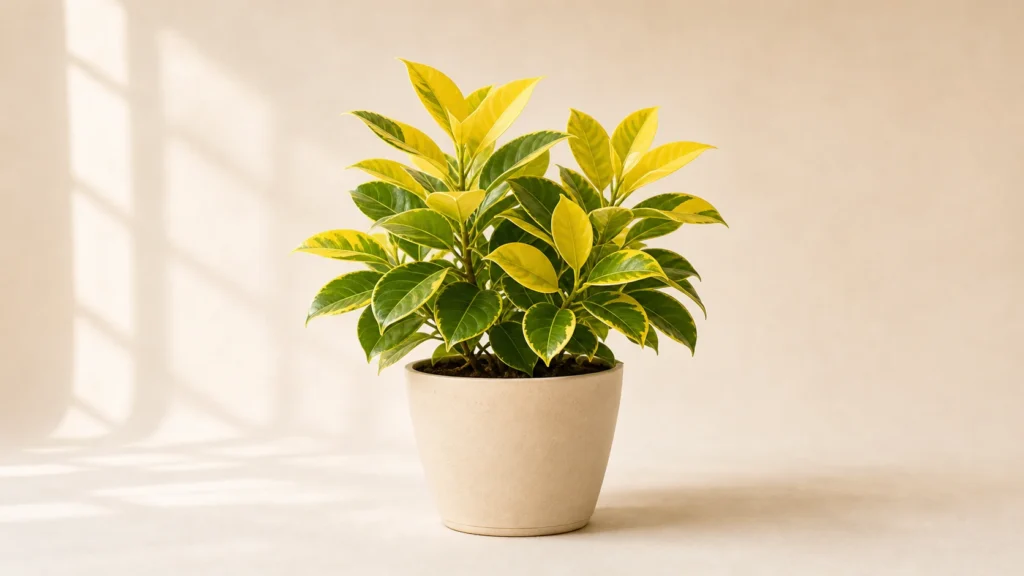
Golden Leaves Ficus
Ficus microcarpa 'Golden Leaves'
A golden-leaved Chinese Banyan cultivar that needs strong light, warmth, careful watering, and a stable indoor position.
Watering frequency
Every 7-14 days
Ideal temperature
65-85°F / 18-29°C
Humidity
40-60%
Care difficulty
Medium
Air purifying
Yes
Growth rate
Moderate
Plant size
3-8 ft / 0.9-2.4 m
Soil type
Well-draining mix
Fertilizer need
Monthly, spring-summer.
Care summary
- Light: Give very bright filtered light to support golden foliage.
- Water: Water after the upper mix dries, then drain completely.
- Stability: Avoid cold drafts and frequent moves.
- Shape: Prune above nodes during active growth to encourage branching.
- Safety: Ficus latex and plant material are not pet-safe.
Common problems
- Leaf drop: Review relocation, cold drafts, light changes, pests, and moisture.
- Green new growth: Increase usable light and verify cultivar identity.
- Yellow leaves: Check saturated soil and damaged roots before watering again.
- Brown edges: Review drought, heat, salts, and root crowding.
- Pests: Inspect for mites, scale, mealybugs, thrips, and fig pests.
Plant care guide
About Golden Leaves Ficus
Golden Leaves Ficus is a yellow-green foliage cultivar of Ficus microcarpa, the tree commonly called Chinese Banyan, Indian Laurel, or Laurel Fig. The former database record called it simply Golden Ficus but incorrectly listed Moraceae—the fig family—as its botanical name. The original supporting image shows the bright new foliage associated with F. microcarpa 'Golden Leaves', so this draft uses the verified cultivar identity rather than leaving “golden” as an unsupported adjective.
Hong Kong's official Greening tree record gives the scientific name Ficus microcarpa 'Golden Leaves' and explains that its golden-green foliage distinguishes it from wild Chinese Banyan. The familiar short name Golden Ficus can remain in search copy and conversation, while Golden Leaves Ficus gives consumers a clearer name tied to a documented cultivar.
Kew recognizes Ficus microcarpa as an accepted species native across tropical and subtropical Asia into the western Pacific. Outdoors in warm climates, the species becomes a substantial banyan tree. A container, indoor light, and pruning keep the cultivar much smaller, but it is still a woody tree rather than a naturally miniature desk plant.
Why You'll Like It
The cultivar brings warmer color to the small, glossy leaves of Chinese Banyan. New growth can emerge vivid yellow or chartreuse and then deepen with age, creating several tones in one canopy. Its compact leaf scale also makes it suitable for pruning, topiary-style shaping, or bonsai training.
It offers a different look from the large leaves of Fiddle Leaf Fig and Rubber Plant. A standard green Ficus microcarpa may handle imperfect light with less obvious color loss, but 'Golden Leaves' is chosen specifically for bright foliage and deserves a bright position.
This is not a low-maintenance solution for a dark entryway. Ficus responds to environmental changes by adjusting or dropping leaves. Once the plant has enough light and a stable watering rhythm, however, its woody structure is straightforward to maintain.
What Kind of Plant Is It?
Golden Leaves Ficus is a broadleaf evergreen tree in the Moraceae family. Its stems and leaves contain white latex, and the species can form aerial roots in warm, humid conditions. Indoor flowers are hidden inside small fig structures and are rarely a meaningful ornamental feature.
NC State Extension's Chinese Banyan profile documents F. microcarpa as an indoor tree and bonsai subject with smooth bark, dense crown, milky sap, and susceptibility to mites, scale, mealybugs, root rot, and leaf problems. Cultivar color does not change those basic species traits.
Every leaf attaches at a node that can support a dormant bud. Pruning above a healthy node can redirect growth into side branches. A detached leaf without stem and bud tissue cannot reproduce a complete tree.
Golden Ficus Names You May Encounter
“Golden Ficus” is ambiguous in retail use. It may refer to several unrelated products:
- Ficus microcarpa 'Golden Leaves' has golden new foliage and is the plant documented by this page and its supporting image.
- Ficus benjamina 'Golden King' is a weeping fig cultivar with cream-to-yellow leaf margins.
- Ficus altissima 'Yellow Gem' is a larger-leaved species with green and yellow variegation.
- Golden Gate Ficus is a bonsai trade name commonly associated with small-leaved Ficus microcarpa types; it does not necessarily mean 'Golden Leaves'.
These plants should not share one botanical record merely because “golden” appears in the name. Compare the leaf size, growth habit, pattern, and nursery label before applying this guide.
Where It Works Best
Place Golden Leaves Ficus near a large east, south, or west window. Bright indirect light is the safest baseline, and a gradually acclimated plant can accept gentle sun. Light sustains compact growth and the cultivar's yellow-green color.
Avoid cold doors, air conditioners, heaters, and repeated moves. A stable bright living room is better than rotating the tree among several decorative but dim positions. Keep leaves from touching cold or hot glass.
It can spend summer outdoors in a sheltered warm position. Start in shade, gradually increase light, check water more frequently, and inspect for pests before bringing it back inside. In frost-free regions, planting F. microcarpa outdoors requires local invasive-species and root-damage awareness; a houseplant guide should not encourage landscape escape.
How to Care for Golden Leaves Ficus
Light
Give very bright filtered light. If new leaves become greener, shoots stretch, and lower foliage thins, usable light may be inadequate. Move closer to a window or add a suitable overhead grow light.
Some mature leaves naturally darken, so color change is not automatically reversion. True reversion means a shoot repeatedly produces growth inconsistent with the cultivar. Confirm light first; if a vigorous all-green branch persists and begins outgrowing colored sections, prune it back to the last correctly colored node.
Acclimate to direct sun. Bleached, crisp patches on the exposed side after a move indicate too much intensity too quickly.
Watering
Allow the upper inch or two—or an appropriate upper portion in a large pot—to dry before watering thoroughly. Saturate the root ball evenly and let excess drain. Never leave the nursery pot standing in runoff inside a cachepot.
Seven to fourteen days is an estimate, not a rule. Light, season, temperature, roots, mix, and pot material determine how fast the plant dries. Low winter light can double the interval; a small root-filled pot outdoors may need much closer checking.
Ficus leaf drop can result from both drought and saturated roots. Feel the mix before responding. Wet heavy soil with yellowing suggests excess moisture. Very dry contracted soil and a light pot suggest drought.
Soil and Container
Use a well-draining indoor potting mix amended with perlite, pumice, or fine bark. The mix should retain some moisture but recover air after watering. Drainage holes are essential.
Choose a container only slightly larger than the root ball. Bonsai specimens in shallow pots need far more frequent monitoring than a standard nursery pot and cannot follow the same watering estimate. Heavy outer pots can stabilize a tall plant without oversizing the wet root zone.
Humidity and Temperature
Normal home humidity around 40–60 percent is generally workable. Higher humidity may encourage aerial roots, but it does not substitute for drainage or light. Use a humidifier rather than constant misting if heated air is extremely dry.
Maintain 65–85°F (18–29°C), avoiding cold drafts and sharp temperature drops. Warm roots and strong light support recovery after pruning or repotting.
Fertilizer and Leaf Care
Feed monthly at a diluted label rate while new leaves are emerging in spring and summer. Reduce or stop in winter. Excess nitrogen cannot restore cultivar color in low light, and fertilizer salts can damage roots.
Wipe leaves with a damp cloth and inspect their undersides. Small glossy leaves can hide scale along veins and stems. Avoid leaf-shine oils.
Pruning and Training
Prune just above a node during active growth. Wear gloves because sap can irritate. Shortening vigorous tips encourages branching and maintains a compact canopy. Remove dead, crossing, or persistently reverted growth, but keep enough foliage for recovery.
Wire used for bonsai can cut rapidly into expanding bark. Inspect it often and remove before scarring. Ordinary houseplant owners can shape with directional pruning and soft ties instead of advanced bonsai techniques.
How to Propagate Golden Leaves Ficus
Stem cuttings preserve a cultivar more reliably than seed. Take a healthy correctly colored tip with several nodes, protect yourself from latex, and insert a lower node into water or an airy propagation medium. Provide warmth, bright filtered light, and moderate humidity with airflow.
Rooting time varies. Wait for a branching root system and stable new growth before potting into a small container. A single leaf may root but lacks the stem bud needed to create a full tree.
Air layering works well for a taller woody stem. Root the upper section while it remains attached, then cut below the developed root mass. This both shortens the parent and creates a larger new plant.
When to Repot
Repot when roots densely circle, drainage fails, the mix has collapsed, or the plant dries unmanageably fast. Spring or early summer is best. Move up one modest size and keep the trunk at the original depth.
Do not repot solely because leaves drop after relocation. Stabilize light, temperature, and moisture first. If soil is sour and roots are soft, then repotting becomes a root-health intervention rather than routine maintenance.
Buying and Acclimating Golden Leaves Ficus
Buy only when the label, foliage, and seller description support Ficus microcarpa 'Golden Leaves'. The newest foliage should be yellow to chartreuse, while older leaves may deepen toward green. Avoid assigning the cultivar from a generic “Golden Ficus” tag alone because that name is used for several species.
Inspect leaf undersides, branch junctions, and the trunk for scale, mites, or sticky residue. A firm trunk and evenly moist, fresh-smelling mix are better signs than a flawless canopy recently treated with leaf shine. Quarantine the plant at home and give it its intended bright position.
Some leaf drop after transport can reflect adjustment. Do not immediately combine repotting, heavy pruning, fertilizer, and a second relocation. Establish moisture and light first. If the plant was purchased in deep shade, increase sun gradually so pale cultivar tissue is not scorched.
Toxicity and Pet Safety
Golden Leaves Ficus is not pet-safe. The ASPCA's Ficus toxicity record lists figs as toxic to cats and dogs and identifies ficin and ficusin as toxic principles. Milky sap can also irritate human skin.
Keep leaves, cuttings, and pruning debris away from pets and children. If ingestion occurs, contact a veterinarian or animal poison-control service and provide Ficus microcarpa 'Golden Leaves'. For human exposure or eye contact, seek appropriate poison-control or medical guidance. Do not induce vomiting unless instructed.
Common Problems and Practical Fixes
Sudden leaf drop
Review recent moves, cold, light loss, drought, saturated soil, and pests. Choose a suitable position and stabilize care. Do not move the plant daily while trying to find a perfect spot.
New leaves are mostly green
Increase light gradually and verify that leaves are not simply maturing darker. Persistent all-green shoots may be reversion; prune them only after light is adequate and identity is confirmed.
Yellow leaves and wet mix
Stop watering, empty standing water, and improve drainage. Inspect roots if decline continues. Remove rotten tissue with clean tools and retain healthy tips as insurance.
Brown margins
Check drought, salts, hot glass, low humidity, and damaged roots. Flush healthy mix occasionally and adjust the underlying cause. Old tissue will not recover.
Scale, mites, or mealybugs
Isolate the plant, identify the pest, clean accessible insects, and apply a product labeled for that pest and indoor use. Repeat inspection because eggs and hidden stages may remain.
Frequently Asked Questions
Is Golden Leaves Ficus the same as Golden Gate Ficus?
No. Golden Gate is a bonsai trade name, while this page is specifically Ficus microcarpa 'Golden Leaves'.
Why was the botanical name changed from Moraceae?
Moraceae is the plant family, not a species. The verified cultivar identity is Ficus microcarpa 'Golden Leaves'.
Can it grow in low light?
It may survive, but the golden color and compact form decline. It is a bright-light ficus.
Can I prune it into a small tree?
Yes. Prune healthy growth above nodes during the growing season and shape gradually over several cycles.
Will every new leaf stay bright yellow?
No. New leaves may emerge brightest and become greener with maturity. Evaluate the overall cultivar pattern and successive growth, not one leaf. Insufficient light can further reduce the golden effect.
Is the current featured image exact?
The supporting image matches golden new foliage well. The generated featured image also shows stronger yellow edging, so it should receive a final cultivar-accuracy review before publication.
Final Thought
Golden Leaves Ficus is useful only when its identity is clear. Treat it as the named Ficus microcarpa cultivar: give it strong light for color, stable warmth, a draining root zone, and deliberate pruning. This correction makes the page safer for future internal links and prevents several different “golden” figs from being merged into one record.