
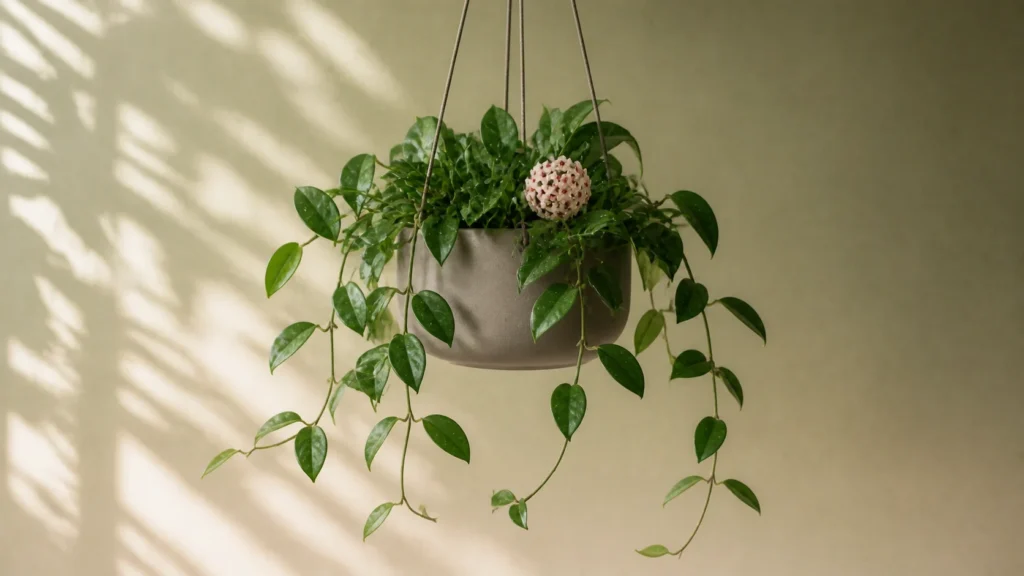
Hoya Carnosa
Hoya carnosa
A pet-safe waxy-leaved vine that grows in an airy mix and can produce fragrant clusters of star-shaped flowers in strong light.
Watering frequency
Every 10-14 days
Ideal temperature
60-80°F / 16-27°C
Humidity
40-60%
Care difficulty
Easy
Air purifying
No/Not Known
Growth rate
Slow
Plant size
2-4 ft trailing / 0.6-1.2 m
Soil type
Light, well-draining mix with orchid bark
Fertilizer need
Every 4-6 weeks while growing.
Care summary
- Light: Give bright indirect light with some gentle acclimated sun.
- Water: Let much of the mix dry, then soak and drain thoroughly.
- Soil: Use a coarse, airy mix in a small pot with drainage.
- Flowers: Preserve old peduncles because they can bloom again.
- Safety: ASPCA lists Hoya carnosa as non-toxic to cats and dogs.
Common problems
- Yellow leaves: Check saturated soil, damaged roots, cold, and recent change.
- Wrinkled leaves: Inspect both soil dryness and root health before watering.
- Bud drop: Review relocation, drought, temperature swings, and pests.
- No flowers: Increase usable light and preserve old flower peduncles.
- Pests: Inspect nodes and peduncles for mealybugs, scale, aphids, and mites.
Plant care guide
About Hoya Carnosa
Hoya Carnosa (Hoya carnosa) is an evergreen climbing or trailing vine with thick waxy leaves and rounded clusters of star-shaped flowers. Wax Plant, Porcelain Flower, and Honey Plant are established common names, but Hoya Carnosa is widely recognized by houseplant buyers and clearly defines the species, so it remains the consumer-facing title.
NC State Extension's Hoya carnosa profile describes it as an epiphytic vine native from parts of East and Southeast Asia, with bright-light, free-draining care and persistent flower structures. Epiphytic means that the plant can grow on trees for physical support rather than rooting in dense ground soil. Indoors, that translates into an airy root zone, not an assumption that the plant needs no water.
Its flowers form in umbels—rounded clusters—on short specialized stalks called peduncles. A peduncle can flower again, so it should not be removed after the old blooms fall. This one detail distinguishes thoughtful Hoya pruning from ordinary vine trimming.
Why You'll Like It
Hoya Carnosa combines durable foliage, flexible styling, flowers, and pet-friendly status. It can cascade from a shelf, circle a hoop, or climb a trellis. The leaves remain attractive between blooms, so flowering is a reward rather than the only reason to own the plant.
It also tolerates some delay between waterings because its leaves store moisture. That makes it easier than a thin-leaved tropical vine, although chronic neglect still damages roots and foliage. Once established in sufficient light, it can remain in the same modest pot for years.
For patterned foliage within the same species, compare Hoya 'Krimson Queen'. Other Hoya species may have different moisture, temperature, and flowering behavior, so this page should not be used as a universal guide for the whole genus.
What Kind of Plant Is It?
Hoya Carnosa belongs to the dogbane family, Apocynaceae. Opposite leaves grow along flexible vines, and nodes can form roots and new shoots. A propagation cutting therefore needs at least one viable node.
Young vines sometimes extend a long bare “runner” before producing leaves. Do not automatically cut it off. Give it support and time; nodes along the runner may leaf out. If space is limited, prune above a node during active growth and use the removed section for propagation.
The plant produces white latex when cut. Although the species is listed as non-toxic to cats and dogs, sap can still irritate sensitive skin, and eating any fibrous plant material may cause individual gastrointestinal upset. Pet-safe does not mean edible.
Popular Hoya Carnosa Varieties
- Green Hoya Carnosa is the solid-green species form covered by this page.
- 'Krimson Queen', also sold as 'Tricolor', has cream or pink outer leaf margins. It already has a separate project record.
- 'Krimson Princess' has lighter variegation concentrated toward the center of the leaf. It should not be confused with 'Krimson Queen'.
- 'Compacta', commonly Hindu Rope, has tightly curled leaves and dense folds that hide mealybugs.
- 'Chelsea' is a named selection with rounded, often cupped leaves; verify provenance before applying the cultivar name.
- 'Krinkle 8' is associated with characteristically indented leaves and is distinct from any randomly puckered plant.
“Splash” usually describes silver flecking rather than proving a cultivar. Light, age, and individual leaves change the amount of flecking, so avoid inventing a variety identity from this trait alone.
Where It Works Best
Place Hoya Carnosa at a bright east, south, or west window with filtered light. Gentle morning or late-afternoon sun can support flowering after acclimation. Deep shade may keep the vine alive but usually reduces growth and flowers.
It suits a bright windowsill, hanging position, wall hoop, or trellis. Ensure the pot remains accessible for moisture checks and drainage. A bathroom works only when it also has strong natural or artificial plant light; humidity by itself is not sufficient.
Avoid cold glass, heater blasts, and a position where opening doors create sharp temperature swings. Once buds form, maintaining orientation and conditions reduces stress, but it is not necessary to treat the plant as permanently immovable when no buds are present.
How to Care for Hoya Carnosa
Light
Bright indirect light is the most important flowering input. Some soft direct sun can help, but acclimate gradually to prevent pale scorch patches. Dark green healthy leaves with no flowers may still indicate that light is adequate for survival but not reproduction.
Increase light before changing fertilizer. An overhead grow light can supplement winter conditions and promotes more even growth than a weak side lamp.
Watering
Allow much of the potting mix to dry, then water thoroughly and drain. Do not wait automatically for every leaf to wrinkle; by then fine roots may have been dry for too long. Check the pot's weight and moisture within the mix.
Ten to fourteen days is a starting estimate. A small bark-heavy pot in summer may dry faster; a cool winter plant may take much longer. Thick leaves reduce water loss, but roots still need a complete wetting when watering is due.
Wrinkled or soft leaves are not always thirst. If the mix is wet, damaged roots may be unable to supply water. Adding more water worsens that situation. Inspect roots when symptoms and soil moisture disagree.
Soil and Container
Use a coarse, fast-draining organic mix. Fine bark, perlite or pumice, coco chips, and a smaller portion of indoor potting mix can create a workable structure. Adjust ingredients to the room; a very dry home needs slightly more moisture retention than a humid greenhouse.
Drainage holes are essential. Hoyas often grow well in a relatively small pot, but “likes being root-bound” should not justify compacted soil or a cracked container. Move up only one modest size when needed.
Transparent nursery pots can make root and moisture checks easier, though they are optional. Place one inside a decorative cachepot and remove it for watering so runoff never remains trapped.
Humidity and Temperature
Average room humidity of 40–60 percent is generally adequate. Higher humidity can support new roots and growth when airflow is good. Constant misting is not required and wet flowers may spot or decay.
Maintain roughly 60–80°F (16–27°C), protecting the plant from frost and cold drafts. Room-temperature water avoids a sudden chill to warm roots. Growth slows in winter, so extend dry-down and reduce feeding.
Fertilizer
Feed every four to six weeks at a diluted label rate from spring through early fall, while new leaves or vines are forming; reduce or pause in winter if growth stops. A balanced fertilizer is adequate; flowering depends on plant maturity, light, roots, and stable care, not on a single “bloom booster.” Excess fertilizer can burn roots and will not force an immature or shaded plant to flower.
Training and Pruning
Guide vines around a hoop or trellis with loose soft ties. Do not constrict expanding stems or reverse them sharply. Hoya vines often prefer to climb before hanging under their own weight.
Prune above a node to control size or encourage branching. Preserve peduncles, which look like short bare spurs, even after flowers fall. Remove only dead, damaged, or unwanted vines and clean tools between plants.
How to Encourage Flowers
Start with strong filtered light and an established root system. Allow the plant to experience normal drying without severe drought, feed lightly during growth, and avoid repeated relocation while buds develop. Mature plants are more likely to bloom, but there is no universal age or calendar.
Do not cut old peduncles. New flower clusters may emerge from the same spur over multiple cycles. Nectar droplets on flowers are normal but can mark furniture; protect the surface below without spraying the blooms.
Bud drop may follow drought, saturated roots, abrupt cold, relocation, or pest activity. Review conditions rather than assuming the plant needs phosphorus.
How to Propagate Hoya Carnosa
Take a healthy stem cutting with one or more nodes and at least one leaf pair. Root the node in water, sphagnum, perlite, or an airy potting mix. Give warmth, bright indirect light, and moderate humidity with airflow.
Keep the chosen medium appropriately moist but never stagnant. Pot the cutting when roots have branched and the plant begins stable growth. Several cuttings can share a small pot for fullness.
A single Hoya leaf may root and remain alive for a long time, but without attached stem and a viable node it usually cannot produce a vine. Heart-shaped single-leaf novelty pots demonstrate the same limitation in other Hoya species.
Layering is also simple: pin a node from an attached vine onto moist medium in a second pot. After roots establish, cut the connection to the parent.
When to Repot
Repot when roots and mix form an impenetrable mass, drainage deteriorates, the container breaks, or the plant dries so rapidly that care becomes difficult. Avoid repotting while buds or flowers are developing unless root health is at risk.
Choose a pot no more than modestly larger, retain healthy roots, and keep the crown at the original depth. Wait for renewed growth before returning to regular feeding.
Seasonal Care
Spring and summer bring stronger growth and may support flowering, pruning, propagation, and feeding. Check small airy pots more often. A protected outdoor stay is possible after gradual acclimation and while nights remain warm.
In fall, inspect carefully before bringing the plant indoors. In winter, provide the strongest available light, reduce water and fertilizer, and protect from cold windows. Slow growth is normal; soggy soil is not.
Toxicity and Pet Safety
ASPCA's species-specific Honey Plant record lists Hoya carnosa as non-toxic to cats and dogs. This supports the Pet safe taxonomy used here.
Still place long vines and heavy pots safely. Pets may pull a hanging plant down, and any chewed material can cause an individual stomach reaction. If a pet develops symptoms after eating it, contact a veterinarian and provide the botanical name rather than assuming every reaction is harmless.
Common Problems and Practical Fixes
Yellow leaves
Check wet soil, cold, damaged roots, and recent environmental change. One old leaf may age naturally; several soft yellow leaves often point to prolonged moisture.
Wrinkled leaves
If the mix is dry and roots are healthy, water thoroughly. If the mix is wet, inspect for rot. Wrinkles do not prove that more water is safe.
No flowers
Increase usable light, preserve peduncles, and allow maturity. Confirm that fertilizer and potting mix are not excessively rich while light remains weak.
Buds fall
Review movement, drought, waterlogged roots, temperature swings, and pests around peduncles. Stabilize care rather than making several corrections at once.
Mealybugs, scale, aphids, or mites
Inspect nodes, leaf undersides, and flower spurs. Isolate the plant, identify the pest, clean accessible insects, and use an indoor treatment labeled for that pest. Curled cultivars require especially careful inspection.
Black or soft roots
Remove saturated mix and dead roots, preserve firm stem cuttings, and restart in a smaller airy pot. Do not fertilize until healthy new growth appears.
Frequently Asked Questions
Should I remove old flower stems?
No. Preserve the short peduncles because they can produce another umbel.
Can Hoya Carnosa live in low light?
It may survive, but growth and flowering decline. Give it bright filtered light.
Does it need a humidifier?
Usually not in a typical home. Stable watering, airy roots, and good light matter more; a humidifier helps only when air is persistently very dry.
Why is it growing a bare vine?
Runners often extend before leaves develop. Guide the vine onto support and wait unless its size creates a practical problem.
Is it safe for pets?
ASPCA lists the species as non-toxic to cats and dogs, but it should not be treated as pet food and the pot must be physically secure.
Final Thought
Hoya Carnosa responds best to a light hand grounded in observation. Give it bright light, a small airy root zone, a real wet-and-dry cycle, and stable warmth. Preserve its peduncles and let maturity do the rest. It may not flower on demand, but its waxy foliage remains worthwhile while you wait.