
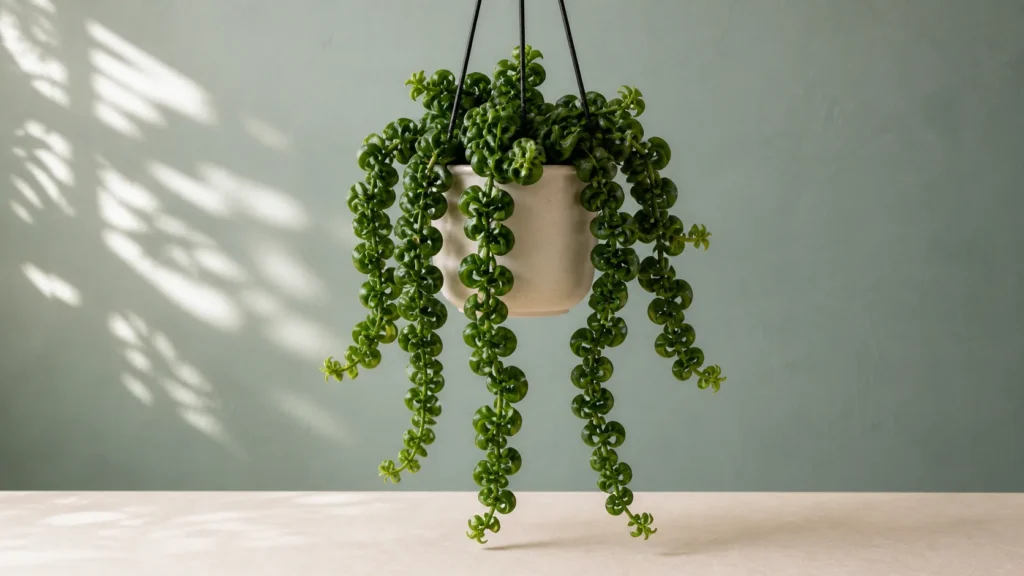
Hindu Rope Plant
Hoya carnosa 'Compacta'
A slow-growing Hoya carnosa cultivar with tightly curled waxy leaves, trailing rope-like stems, fragrant flower clusters, and pet-safe species evidence.
Watering frequency
Every 10-18 days
Ideal temperature
60-80°F / 16-27°C
Humidity
40-65%
Care difficulty
Medium
Air purifying
No/Not Known
Growth rate
Slow
Plant size
1-3 ft trailing / 0.3-0.9 m
Soil type
Chunky, fast-draining Hoya mix with bark and perlite
Fertilizer need
Monthly, spring-summer.
Care summary
- Light: Give bright indirect light with optional gentle acclimated sun.
- Water: Let much of the mix dry, then soak fully and drain.
- Soil: Use a coarse epiphytic mix in a snug pot with drainage.
- Flowers: Keep old peduncles because they can bloom again.
- Safety: ASPCA lists the parent species Hoya carnosa as non-toxic to cats and dogs.
Common problems
- Yellow or soft leaves: Check wet mix, poor drainage, and damaged roots.
- Wrinkled leaves: Inspect root health as well as soil dryness before watering.
- No flowers: Increase usable light, keep the plant stable, and preserve old peduncles.
- Bare or stalled vines: Review light, season, roots, and pest pressure.
- Pests: Inspect curled leaves closely for hidden mealybugs, scale, aphids, and mites.
Plant care guide
About Hindu Rope Plant
Hindu Rope Plant is the common retail name for Hoya carnosa ‘Compacta’, a slow-growing cultivar whose thick leaves fold, twist, and crowd tightly along trailing stems. The overlapping foliage hides much of the vine and creates the braided or rope-like appearance behind its common names.
RHS accepts Hoya carnosa ‘Compacta’ and records Hoya carnosa var. compacta and Hoya compacta as synonyms. NC State Extension also lists ‘Compacta’, or Krinkle Kurl, among cultivars of Hoya Carnosa. This makes Hindu Rope Plant a cultivar of the existing species profile, not a separate wild species.
That distinction is useful because its basic care and flowers follow Hoya carnosa, while the tightly curled foliage changes the practical experience. Water evaporates slowly from a dense pot, pests hide deep in the folds, and growth is much slower than on a flat-leaved Wax Plant. A care guide needs to account for those differences rather than copying generic Hoya advice word for word.
Why You’ll Like It
Few houseplants create such a sculptural texture without pruning or training. A mature stem looks like a green rope, and an older hanging plant can develop multiple heavy strands. The foliage is decorative before the plant ever flowers.
When mature and well lit, it can produce rounded umbels of waxy, star-shaped flowers. The blooms may be pale pink to white with contrasting centers and can be fragrant. They emerge from persistent flower stalks called peduncles, which may bloom again in later cycles.
The plant also has a useful pet-safety basis. ASPCA lists Hoya carnosa as non-toxic to cats and dogs. Because ‘Compacta’ is a cultivar of that exact species, this database applies the species-level record to the cultivar while still discouraging chewing.
What Kind of Plant Is It?
Hindu Rope Plant is a semi-succulent evergreen vine in the dogbane family, Apocynaceae. “Semi-succulent” describes its thick water-buffering leaves; it does not mean the roots should remain bone-dry for months. In nature, Hoyas often grow as epiphytes on tree branches, where roots receive air, intermittent moisture, and organic debris rather than dense garden soil.
RHS describes ‘Compacta’ as a trailing or climbing Hoya with rigid puckered leaves and slow growth. The curled leaf shape is stable cultivar behavior, not damage. New leaves may look smaller or less tightly folded while expanding, then harden into the familiar contorted form.
Vines grow from nodes, and roots can form near nodes during propagation. Flowers grow from separate short spurs or peduncles. Knowing the difference prevents two common mistakes: trying to propagate a detached leaf without a node and cutting off old peduncles during cleanup.
History and Naming
The cultivar is widely sold as Hindu Rope, Krinkle Kurl, Rope Plant, Curly Wax Plant, and Hoya Compacta. “Hindu Rope Plant” is the most recognizable consumer name in many English-speaking markets, while Hoya carnosa ‘Compacta’ preserves its exact horticultural identity.
The older combinations Hoya compacta and Hoya carnosa var. compacta still appear in catalogs and collections. They refer to the same curled form rather than proving that the plant is a separate Hoya species.
There are also variegated compact forms. ‘Compacta Marginalis’ and other curled, cream-edged plants should not automatically be labeled as the all-green ‘Compacta’. Variegation affects appearance, growth rate, and light sensitivity, so retain the nursery cultivar label when it is reliable.
Hindu Rope Plant and Related Hoyas
- Hoya Carnosa: The flat-leaved parent species, usually faster and easier to inspect for pests.
- Hoya Krimson Queen: A Hoya carnosa cultivar with cream or white leaf margins and pink new growth.
- Sweetheart Hoya: Sweetheart Hoya is Hoya kerrii, a different species with heart-shaped leaves.
- Variegated Hindu Rope: A curled Hoya carnosa selection with cream patterning; growth can be slower than the green form.
These plants share broad Hoya habits, but leaf thickness, growth speed, preferred warmth, and flowering behavior vary. Do not use one watering schedule for every Hoya in a collection.
Where Hindu Rope Plant Works Best
Use a hanging basket, high shelf, or compact trellis where the dense vines have room to develop without being handled constantly. Bright natural light is more important than humidity gadgets. An east-facing window or a bright position near a south- or west-facing window usually provides a useful starting point.
Because the parent species is listed as non-toxic by ASPCA, Hindu Rope Plant can be considered alongside other Pet-Friendly Houseplants. Pet-safe does not mean chew-proof: the stems, potting mix, fertilizer, hanging hardware, and any pesticide treatment remain separate risks.
Avoid positioning the plant directly above fabric, electronics, or valuable furniture once it flowers. Hoya blooms can release sticky nectar. A washable surface or drip protection makes flowering easier to enjoy.
Hindu Rope Plant Care
Light
Give bright indirect light for compact growth and the best chance of flowering. Gentle morning or late-afternoon sun can help after acclimation, but hot sun through glass can bleach or scorch exposed leaves.
Low light may keep the plant alive while producing little visible growth. The natural slowness of ‘Compacta’ makes this hard to diagnose, so compare new nodes over a season rather than expecting weekly change. If a plant is healthy but motionless, improve usable light before adding fertilizer.
Once buds form, avoid repeatedly moving or rotating the plant. A sudden change in light direction, temperature, or moisture can contribute to bud drop.
Watering
Let much of the potting mix dry, then water thoroughly and allow all excess water to escape. A starting interval of 10–18 days may work in active growth, but the actual timing changes with pot size, root density, light, temperature, and season.
Do not judge moisture only by squeezing curled leaves. Thick leaves may remain firm while the center of the pot is still wet, and wrinkled leaves may result from root loss rather than simple thirst. Check the mix with a wooden skewer, pot weight, or a finger near the root zone.
Water less often in winter or during stalled growth, but do not leave the roots desiccated indefinitely. The goal is a substantial dry-down, not prolonged abandonment.
Soil and Container
Use a chunky, airy mix based on fine orchid bark, coarse perlite or pumice, and a modest amount of moisture-retentive houseplant mix or coco material. The exact recipe matters less than the resulting structure: water should pass through while roots retain access to both moisture and air.
Choose a small pot with drainage. Hoyas often perform well when somewhat root-bound, and RHS notes that they can remain in the same pot for years. An oversized pot adds wet volume without making the vine grow faster.
A hanging pot needs the same drainage standard as a tabletop pot. Empty the saucer or outer cachepot after watering rather than letting the root ball sit in runoff.
Humidity
Average indoor humidity is acceptable, while moderately higher humidity can support active growth. Do not sacrifice airflow to raise humidity. Dense curled leaves already create protected pockets where pests and moisture can remain hidden.
Avoid routine misting into the leaf folds. It does not provide stable room humidity and may keep sheltered surfaces wet. A humidifier used for the room is more predictable if the air is exceptionally dry.
Temperature
Aim for 60–80°F / 16–27°C and protect the plant from cold drafts. Hoya carnosa can tolerate cooler winter nights than some tropical Hoyas, but cold wet roots remain risky. Keep the pot away from heating vents as well, because hot dry air can desiccate exposed vines and buds.
Fertilizer
Feed monthly from spring through early fall, while new vines or leaves are forming, with a balanced liquid fertilizer at a diluted label rate; stop or reduce feeding when growth pauses in winter. Heavy feeding can create salt buildup and soft growth without solving insufficient light.
For flowering, consistency and light matter more than a high-phosphorus “bloom booster.” Flush the mix occasionally with plain water if your water and fertilizer leave visible mineral crusts.
Pruning and Training
Trim only to control size, remove dead tissue, or make a propagation cutting. Do not remove the short woody peduncles left after flowers drop; they can rebloom.
Support climbing stems gently or let them trail. The dense ropes become heavier as they grow, so use secure hooks and avoid thin wire that cuts into stems.
Propagating Hindu Rope Plant
Stem cuttings are the reliable method. Take a healthy section with at least one or two nodes, remove foliage only where needed, and place a node into a light propagation mix, sphagnum, or water. Warmth, bright indirect light, and moderate moisture support rooting.
Iowa State Extension’s Hoya guidance emphasizes that stem cuttings require nodes. A detached leaf may root but cannot reliably build a new vine without a growth point. Curled leaves make nodes harder to see, so identify the actual stem before cutting.
Growth after rooting can be slow. Do not keep increasing water because the cutting has not produced a new leaf. Check for resistance, healthy roots, and firm tissue, then allow time.
Layering is another low-risk method: pin a node from an attached vine onto moist airy mix in a second small pot. Once roots form, cut the connection to the parent.
Repotting Hindu Rope Plant
Repot only when drainage has failed, roots are severely crowded, the mix has decomposed, or the pot is no longer stable. Choose one size larger and work carefully around brittle curled stems.
If the plant is budding or flowering, delay non-urgent repotting. Changing root conditions and position can cause bud loss. After repotting, return the plant to similar light and resume watering based on root-zone dryness rather than a fixed schedule.
Flowering
Strong light, maturity, stable care, and intact peduncles improve the chance of flowers. A plant may still take years to bloom, especially from a small cutting. Lack of flowers is not evidence that it needs a larger pot.
When flowers fade, let them drop or remove only the spent individual blooms. Preserve the peduncle. Expect possible fragrance and sticky nectar, and inspect flowers for aphids or mealybugs.
Toxicity and Pet Safety
Hindu Rope Plant is classified as Pet safe under the project rule because ASPCA lists Hoya carnosa—the exact parent species—as non-toxic to cats and dogs. ‘Compacta’ is a named cultivar of that species, so this is species-level evidence applied to a cultivar rather than a guess based only on family.
Pet-safe plants can still cause mild mechanical stomach upset when chewed, and treatments applied to the plant may be harmful. Keep the pot out of reach of persistent chewers and contact a veterinarian if an animal develops symptoms after eating any plant material.
Common Problems and Practical Fixes
Yellow, soft, or dropping leaves
Check the center of the pot for prolonged moisture and inspect roots. Improve drainage, remove standing water, and correct the watering interval. Cold can compound wet-soil damage.
Wrinkled leaves
The plant may be dry, but damaged roots can create the same symptom. Check soil moisture and root condition before watering repeatedly.
No visible growth
Consider season and natural cultivar speed first. Then review light, roots, pests, and temperature. Fertilizer is not the first diagnostic tool.
No flowers
Increase useful light gradually, preserve peduncles, avoid frequent relocation, and let the plant mature. Do not overpot in an attempt to force flowering.
Mealybugs hidden in leaf folds
Isolate the plant and inspect each rope under strong light. Remove visible insects carefully and repeat treatment. One pass rarely reaches every fold.
Black patches or stem collapse
Check for cold damage, persistent moisture, or rot. Remove affected tissue with sterile tools and propagate healthy sections if the root system is failing.
Frequently Asked Questions
Is Hindu Rope Plant the same as Hoya Compacta?
Yes. Hindu Rope Plant is the common name for Hoya carnosa ‘Compacta’.
Why are the leaves curled?
The folded, contorted leaves are the cultivar’s normal trait. Curling alone is not a watering symptom on this plant.
How fast does it grow?
Slowly. Light, warmth, root health, season, and maturity all affect the pace.
Can I propagate one leaf?
A leaf without a stem node is not a reliable way to create a new vine. Use a node-bearing stem cutting.
Should I cut off old flower stalks?
No. Preserve the peduncles because they can produce flowers again.
Is Hindu Rope Plant safe for cats and dogs?
It is classified as pet safe because ASPCA lists its parent species, Hoya carnosa, as non-toxic to cats and dogs.
Final Thought
Hindu Rope Plant rewards the owner who can separate “slow” from “struggling.” Its curled foliage naturally hides the stem, develops at an unhurried pace, and stores enough moisture to tolerate a careful dry-down. Give it bright light, a small airy pot, patient watering, and regular pest inspection. Preserve the peduncles, and the same plant valued for its rope-like leaves may eventually add fragrant waxy flowers.