
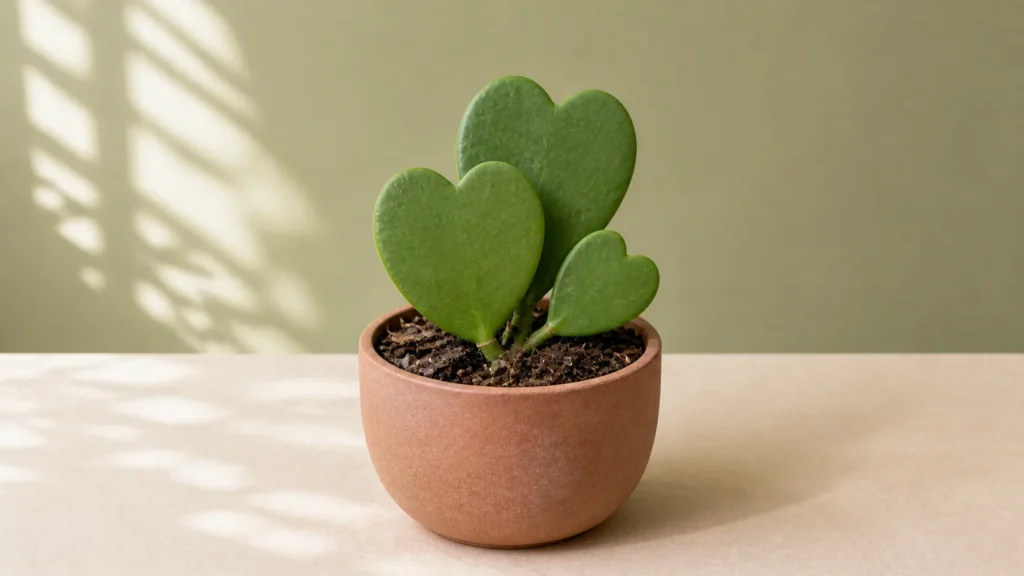
Sweetheart Hoya
Hoya kerrii
A slow-growing tropical Hoya with thick heart-shaped leaves, climbing vines, waxy flowers, and genus-level pet-safety evidence.
Watering frequency
Every 10-18 days
Ideal temperature
65-85°F / 18-29°C
Humidity
40-65%
Care difficulty
Medium
Air purifying
No/Not Known
Growth rate
Slow
Plant size
3-10 ft climbing or trailing / 0.9-3 m
Soil type
Chunky, fast-draining Hoya or epiphyte mix
Fertilizer need
Monthly, spring-summer.
Care summary
- Light: Give bright indirect light with optional gentle acclimated sun.
- Water: Let much of the mix dry, then soak fully and drain.
- Soil: Use a coarse airy mix in a small pot with drainage.
- Buying: Choose a rooted vine with a visible node if you want future climbing growth.
- Safety: Pet-safe status is inferred from an authoritative Hoya carnosa record, not an exact H. kerrii listing.
Common problems
- Yellow or soft leaves: Check for prolonged wet soil and damaged roots.
- Wrinkled leaves: Confirm both soil moisture and root health before watering again.
- One leaf never vines: It may be a rooted leaf without a stem node.
- Long bare vine or no flowers: Review usable light, maturity, and seasonal growth.
- Pests: Inspect leaf joints and new growth for mealybugs, scale, mites, and aphids.
Plant care guide
About Sweetheart Hoya
Sweetheart Hoya is the consumer-friendly name for Hoya kerrii, a tropical climbing plant recognized by its thick, symmetrical heart-shaped leaves. It is heavily marketed around Valentine’s Day as Lucky Heart Plant, Valentine Hoya, Sweetheart Plant, Wax Hearts, Heart Leaf Hoya, or simply Hoya Heart. A mature plant is a vine, not a permanent one-leaf novelty.
Kew Plants of the World Online accepts Hoya kerrii and records a native range from Indo-China to western Malesia. It grows as an epiphyte or lithophyte, using trees or rock surfaces for support while rooting into small accumulations of organic material. That natural habit helps explain its preference for air around the roots.
RHS describes Sweetheart Hoya as a slow-growing evergreen climber with fleshy heart-shaped leaves and clusters of waxy flowers. The accepted identity separates it from ordinary Hoya carnosa, even though the two share broad Hoya care habits.
Why You’ll Like It
The leaf shape is distinctive without depending on artificial training or pruning. A young vine can be compact, while a mature specimen develops long flexible stems that climb a hoop, trellis, or moss-covered support. Leaves become a repeating series of green hearts rather than one seasonal gift.
Mature plants may produce rounded umbels of star-shaped flowers. The flowers are typically pale with contrasting centers and may be fragrant or produce sticky nectar. Old flower spurs, called peduncles, can bloom again, adding a long-term reward for stable care.
Sweetheart Hoya is drought-buffered by thick leaves and does not need a constantly wet root zone. Its slow pace, however, rewards patience and careful buying.
What Kind of Plant Is It?
Hoya kerrii belongs to Apocynaceae, the dogbane family. It is a semi-succulent vine: its leaves store water, while its tropical epiphytic roots still benefit from intermittent moisture, warmth, and airflow. It should not be treated exactly like a cactus or planted in dense water-retentive soil.
The vine grows from nodes, which are points on a stem capable of producing leaves, roots, and new shoots. A leaf blade and petiole can form roots without containing a viable stem node. This anatomical detail is the reason some single-leaf Valentine plants remain one leaf for years.
New vines may initially travel bare before producing leaves, particularly when a plant is establishing or searching for support. Do not cut every leafless extension immediately. Watch for healthy green tissue and emerging nodes before deciding it has failed.
History and Naming
The species name honors Irish physician and botanist Arthur Francis George Kerr, who collected extensively in Southeast Asia. The older botanical combination Hoya obovata var. kerrii appears as a synonym in Kew’s taxonomic record, but the accepted name for this profile is Hoya kerrii.
The plant’s modern Valentine trade is based on individual heart-shaped leaves rooted upright in tiny pots. That format made Hoya Heart and Lucky Heart Plant recognizable retail names, but it also separated the attractive leaf from the mature growth habit buyers may expect.
NC State Extension’s Hoya kerrii profile warns that a single rooted leaf needs stem tissue to develop into a vine. Iowa State Extension’s Hoya guide makes the same practical distinction: a leaf without a node may stay alive but usually cannot produce a new shoot. A one-leaf pot is not necessarily unhealthy; it may simply lack the anatomy required for future vining.
How to Buy the Plant You Want
If you want a living heart-shaped desk ornament, a firm rooted leaf can serve that purpose for a long time. Check that it is securely rooted, free of soft spots, and planted in a draining pot. Do not assume slow or absent top growth can be fixed with fertilizer.
If you want a climbing Sweetheart Hoya, buy a plant with a visible stem section, at least one node, and ideally more than one leaf. Ask whether the item is a rooted leaf or a rooted cutting. A nursery label showing Hoya kerrii is more useful than a generic “Hoya heart” tag.
Variegated Hoya kerrii plants exist, but retain their exact nursery or cultivar identification rather than treating “variegated” as a complete name. Cream-edged or centrally patterned plants grow more slowly and may be more sensitive to abrupt intense sun.
Sweetheart Hoya and Related Hoyas
- Hoya Carnosa: Hoya Carnosa has oval waxy leaves and is generally faster and more widely available.
- Hindu Rope Plant: Hindu Rope Plant is Hoya carnosa ‘Compacta’, with tightly folded leaves crowded along rope-like stems.
- Hoya obovata: Often has rounded or oval leaves rather than the sharply heart-shaped outline of H. kerrii.
- Variegated Sweetheart Hoya: A patterned H. kerrii selection that requires enough light to maintain useful growth while avoiding scorch.
These plants share epiphytic habits, but their leaf form, growth speed, cold tolerance, and flowering response are not identical. Keep each profile’s botanical identity attached to its care advice.
Where Sweetheart Hoya Works Best
Use a small trellis, hoop, shelf edge, or hanging basket in a bright room. An east-facing window can provide gentle sun. Near a south- or west-facing exposure, move it back from hot glass or use a sheer curtain until the plant is acclimated.
A mature vine becomes heavier than the one-leaf gift pot suggests. Secure supports before stems lengthen, and leave room for exploratory vines. Avoid moving a budding plant repeatedly because major changes in orientation, temperature, or moisture can contribute to bud drop.
The plant can suit a pet-conscious home under the project’s genus-evidence rule, but place it based on light first. A dark high shelf may prevent chewing while also preventing healthy growth. Potting mix, fertilizer, wire supports, and pesticide treatments are separate hazards even when foliage is classified pet safe.
Sweetheart Hoya Care
Light
Give bright indirect light for steady growth and the best chance of flowering. Gentle morning or late-afternoon sun is useful after acclimation. Hot direct midday sun through glass can bleach or scorch the thick leaves.
Low light may allow a leaf to persist without supporting meaningful vine growth. If a healthy plant stalls, improve usable light before increasing water or fertilizer. A grow light can help in dark seasons if it provides broad coverage without heating the leaves.
Rotate a non-flowering plant periodically for balanced growth. Once buds form, minimize major changes in position.
Watering
Let much of the potting mix dry, then water thoroughly until excess drains. A 10–18 day interval is only a starting range; the true interval changes with pot size, root density, light, temperature, and season.
Test the root zone by pot weight, a wooden skewer, or a finger rather than squeezing one leaf. A thick leaf can remain firm while the center is wet. Wrinkling may signal thirst, but root rot can prevent water uptake and create the same appearance.
Reduce watering when growth slows, especially in cool low-light winters. Do not leave the plant completely dry for months. The goal is a substantial dry-down followed by full drainage.
Soil and Container
Use a chunky mix that balances fast drainage with modest moisture retention. Fine orchid bark, perlite or pumice, and a smaller portion of quality houseplant mix or coco material make a practical starting blend.
Choose a snug pot with drainage. RHS notes that Hoyas resent frequent repotting, and an oversized pot adds wet soil around a small root system. A heavy outer container can stabilize a trellis, but do not let the nursery pot stand in runoff.
Tie vines with soft plant tape or clips. Avoid sharp wire against growing stems.
Humidity
Average household humidity is workable, while roughly 40–65% can support active growth. Warmth and adequate light matter as much as humidity. A dark closed cabinet is not automatically a better environment.
Use a room humidifier if necessary and maintain airflow. Routine misting does not create stable humidity and can leave water sitting around new growth.
Temperature
Aim for 65–85°F / 18–29°C. Protect the plant from cold drafts, chilly window glass, and air-conditioning vents. Cold combined with wet mix is more damaging than either factor alone.
Avoid sudden heat from radiators. Warm dry air can shrivel tender growth and increase pest pressure.
Fertilizer
Feed monthly at a diluted label rate during active spring and summer growth. Pause when the plant is dormant or stressed. Fertilizer cannot supply missing light or repair rotten roots.
A balanced fertilizer supports foliage and roots. Flowering depends more on maturity, usable light, stable care, and intact peduncles than on an aggressive bloom-booster formula.
Pruning and Training
Prune to remove dead tissue, control size, or create a stem cutting. Do not cut off old peduncles after flowers fade; the same spur may bloom again.
Train flexible vines loosely around a support. If a green leafless runner is healthy, give it time to find the support before trimming it. Remove truly dry or collapsed stems with clean tools.
Propagating Sweetheart Hoya
Use a stem cutting with at least one viable node. A two-node cutting gives more options: remove the lowest leaf if needed, place a node in an airy propagation medium, and keep the cutting warm in bright indirect light.
Water, sphagnum, perlite, or a light Hoya mix can work when moisture and oxygen are balanced. Do not submerge the leaves. Once roots are established, transfer gently and expect slow new top growth.
Layering is lower risk for a valuable vine. Pin an attached node onto moist airy mix in a second small pot, wait for roots, and cut it free only after establishment.
A detached leaf may root and remain attractive, but without stem tissue and a growth point it is unlikely to become a vine. Propagating a leaf is therefore not equivalent to propagating the whole plant.
Repotting Sweetheart Hoya
Repot when the mix has broken down, roots are severely crowded, drainage has failed, or the plant and support are unstable. Choose one size larger and keep the crown at the same level.
Delay optional repotting while buds are forming. After the move, restore similar light and temperature, and reassess drying time because fresh mix and a larger pot retain water differently.
Flowering
Maturity, strong filtered light, warm active growth, and stable conditions improve flowering. A one-leaf pot cannot flower without growing a vine. Even a healthy rooted vine may need years to reach flowering size.
Flowers form on persistent peduncles. Preserve them after bloom, expect possible fragrance and sticky nectar, and protect nearby surfaces. Do not overpot or overfeed in an attempt to force blooms.
Toxicity and Pet Safety
Sweetheart Hoya is classified as Pet safe according to the project’s genus-evidence rule. No exact ASPCA Hoya kerrii record was found during this review. ASPCA does list Honey Plant, Hoya carnosa, as non-toxic to cats and dogs. That authoritative same-genus record, combined with no reliable contrary evidence found for H. kerrii, provides the basis for the status.
This is genus-level inference, not an exact species toxicity test. The dogbane family contains plants with materially different chemistry, so the classification is not based on a blanket family assumption. Discourage chewing, keep treated plants and potting materials out of reach, and contact a veterinarian if an animal develops symptoms.
Common Problems and Practical Fixes
One leaf never grows a vine
The leaf may lack a stem node. Maintain it as a rooted leaf if healthy, or buy a verified multi-node cutting when vining growth is the goal.
Yellow or soft leaves
Check the center of the pot for persistent moisture and inspect roots. Improve drainage and watering practice before adding fertilizer.
Wrinkled leaves
Test soil and roots. Water a genuinely dry healthy root ball, but do not repeatedly soak a plant whose roots are failing.
Long bare vines
Some exploratory growth is normal. Provide bright light and support, then wait for nodes to activate. Persistent weak stretched growth suggests inadequate light.
No flowers
Allow the vine to mature, increase useful light gradually, preserve old peduncles, and avoid repeated relocation. A larger pot is not a flowering shortcut.
Mealybugs or scale
Inspect nodes, leaf undersides, and supports. Isolate the plant and repeat treatment according to the label because waxy foliage can shelter pests.
Frequently Asked Questions
Will a single Hoya heart grow into a plant?
Only if the cutting includes viable stem tissue and a node. A leaf without a node may root and live but usually cannot form a vine.
Is Sweetheart Hoya the same as Hoya carnosa?
No. Sweetheart Hoya is Hoya kerrii. Hoya carnosa is a related species with different leaf form and several familiar cultivars.
How fast does it grow?
It is naturally slow, especially from a small cutting. Light, warmth, roots, season, and maturity all affect visible progress.
Can it take direct sun?
Gentle sun after acclimation can be beneficial. Protect it from abrupt hot midday sun through glass.
Why should old flower stalks stay?
Hoya peduncles can bloom again in later cycles. Remove spent individual flowers, not the persistent spur.
Final Thought
Choose Sweetheart Hoya in the form that matches your expectation: a rooted heart for a small novelty display or a visible multi-node vine for long-term climbing growth. Bright filtered light, a snug airy root zone, careful dry-down watering, warmth, and intact peduncles give the full plant its best path from one heart to many.