
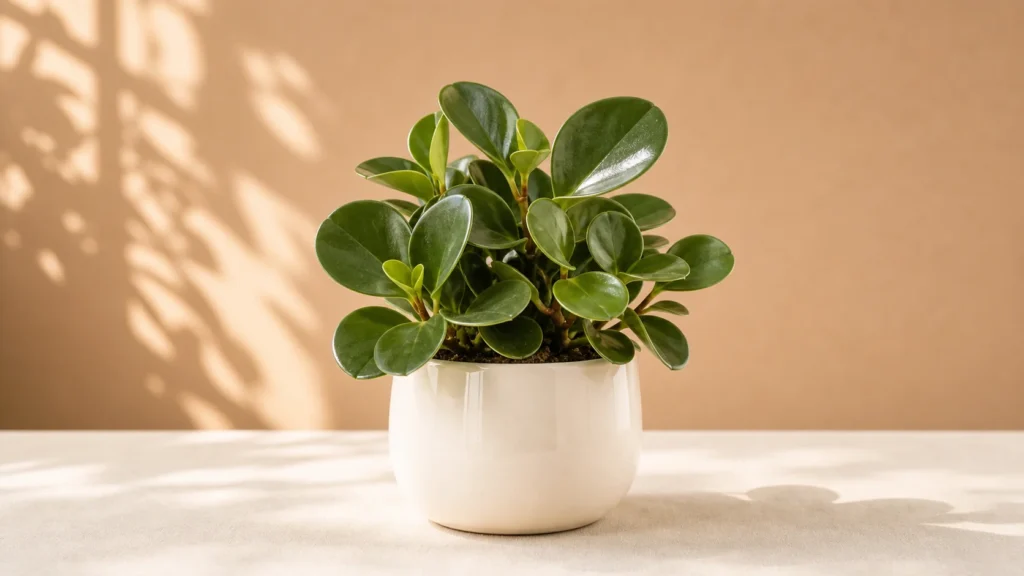
Baby Rubber Plant
Peperomia obtusifolia
A compact Baby Rubber Plant with thick glossy leaves, a forgiving growth habit, and verified non-toxic status for cats and dogs.
Watering frequency
Every 10-14 days
Ideal temperature
65-80°F / 18-27°C
Humidity
40-60%
Care difficulty
Easy
Air purifying
No/Not Known
Growth rate
Moderate
Plant size
6-12 in / 15-30 cm
Soil type
Well-draining mix
Fertilizer need
Every 6-8 weeks, spring-summer.
Care summary
- Light: Give medium to bright indirect light for compact growth.
- Water: Let the upper mix dry substantially, then soak and drain.
- Soil: Use a fine, airy mix in a snug pot with drainage.
- Pruning: Cut above nodes to encourage branching and make cuttings.
- Safety: ASPCA lists this species as non-toxic to cats and dogs.
Common problems
- Soft stems or yellow leaves: Check saturated mix and root health.
- Wrinkled leaves: Review prolonged drought and damaged roots.
- Leaf drop: Check cold, watering swings, low light, and pests.
- Scorched patches: Reduce harsh direct sun and acclimate gradually.
- Pests: Inspect nodes and leaf undersides for mites and mealybugs.
Plant care guide
About Baby Rubber Plant
Baby Rubber Plant (Peperomia obtusifolia) is also sold as Blunt-leaf Peperomia, American Rubber Plant, Pepper Face, and Oval Leaf Peperomia. It is a compact tropical member of the pepper family, Piperaceae. NC State Extension's species profile records the established Baby Rubber Plant common name and describes its thick, glossy, rounded leaves.
Despite the similar retail name, Baby Rubber Plant is completely different from Rubber Plant. Baby Rubber Plant is Peperomia obtusifolia in Piperaceae; Rubber Plant is Ficus elastica in Moraceae. They are not the same genus, family, growth form, or plant type. Baby Rubber Plant is a compact, fleshy-stemmed herb, while Rubber Plant develops into a woody latex-bearing tree. Their care, mature size, propagation behavior, sap, and pet-safety profiles must not be treated as interchangeable.
The leaves are fleshy rather than truly succulent in the desert-plant sense. They buffer short dry periods, but the roots still need a moderately moisture-retentive tropical mix. Treating the plant like a cactus and leaving it dry for months is as unhelpful as keeping it constantly wet.
Why You'll Like It
Baby Rubber Plant suits desks, bookcases, kitchen shelves, and small apartments because it usually remains around 6–12 inches tall indoors. The upright stems branch after pruning and create a rounded silhouette without a support pole. Its leaf surfaces are easy to inspect and clean.
It tolerates ordinary household humidity and a missed watering better than many thin-leaved tropicals. It is also suitable for homes seeking lower-risk plant choices: ASPCA lists this species as non-toxic to cats and dogs. For a different leaf pattern in the same broad group, compare Watermelon Peperomia. Compare Rubber Plant when clarifying the similar common name, and Pilea Peperomioides for another compact pet-safe tabletop plant with very different round leaves.
What Kind of Plant Is It?
This is an evergreen epiphytic or rock-associated tropical herb with nodes along its fleshy stems. A node is the joint where a leaf and dormant bud attach. New branches and roots can develop there, which makes stem cuttings practical.
Leaves are alternately arranged, often cupped slightly, and may be deep green or patterned in named cultivated forms. Upright flower spikes resemble thin pale rat tails rather than conventional petals. They are normal and can be left in place or removed if you prefer the plant to direct energy toward foliage.
Growth is moderate in warmth and useful light, then slows substantially in winter. A compact plant is not necessarily stalled. The distance between nodes and the firmness of new leaves provide more information than height alone.
Popular Baby Rubber Plant Varieties
Use verified cultivar names when available instead of treating every patterned plant as simply “variegated.”
- Standard green Peperomia obtusifolia: The most vigorous, with solid glossy green leaves.
- 'Variegata': A recognized cultivated form with cream and green patterning, sometimes with pink on fresh growth.
- 'Alba': A pale-leaved selection in which new foliage can emerge light before developing more green.
- 'Gold Tip': A selected form associated with golden or cream marking toward leaf ends.
- 'Minima': A more compact selection useful for small containers.
- 'Obtipan Green': A named green commercial selection with an especially tidy habit.
Patterned plants need enough light to maintain compact growth, but pale tissue can scorch if abruptly exposed to strong sun. A green shoot on a patterned plant may grow faster; prune it selectively only after confirming it is changing the plant's balance.
Where It Works Best
Place it close to an east or north window or set it behind a sheer curtain at a stronger exposure. Medium indirect light is adequate; bright indirect light usually produces firmer, closer-spaced growth. It can tolerate lower light for a period, but prolonged dimness increases stretching and slows soil dry-down.
Because it is small, it can fit on a windowsill, but protect leaves from cold glass and intense afternoon heat. A kitchen or bathroom works only if the room also provides light and airflow. Keep it away from heating vents and exterior-door drafts.
A heavier decorative outer pot can stop a top-heavy plant from tipping. Always remove collected drainage water. Pet-safe status does not eliminate the risk of a falling pot or ingestion of fertilizer and soil amendments.
How to Care for Baby Rubber Plant
Light
Aim for medium to bright indirect light. Gentle morning sun can deepen growth after gradual acclimation. Harsh direct afternoon sun may create bleached tan patches, particularly on cream-patterned leaves.
Long gaps between leaves, thin new growth, and a pronounced lean indicate the plant needs more useful light. Rotate periodically or prune and move it gradually. Do not fertilize a stretched plant in a dark location; that can produce weaker growth and leave wet soil unused.
Water
Use ten to fourteen days only as a starting inspection interval. Let the upper portion of the mix dry substantially, then water the entire root ball and drain. The fleshy leaves make moderate dry-down safer than perpetual moisture.
Learn the pot's weight and insert a wooden skewer to check below the surface. A decorative top dressing can hide moisture and should not replace a root-zone check. In winter, low light and cool temperatures may extend the interval greatly.
If leaves wrinkle while the soil is wet, do not assume thirst. Damaged roots cannot supply water even when surrounded by it. Inspect for soft dark roots, a sour smell, and a soft stem base.
Soil and Container
Use a well-draining but not extremely coarse mix. Quality houseplant mix amended with perlite, pumice, or fine bark works well. The fine roots benefit from a snug pot; an oversized container stays wet around them for too long.
Drainage holes are essential. Terracotta can accelerate drying in a humid or low-light home, while plastic retains moisture longer. Neither material is universally superior—match watering and mix to the container.
Humidity and Temperature
Average indoor humidity around 40–60 percent is usually adequate. Avoid placing the plant directly under a hot vent. High humidity with stagnant air and wet soil can encourage stem and leaf disease, so humidity should not be pursued independently of airflow.
Keep temperatures around 65–80°F (18–27°C). Cold, especially combined with wet mix, can cause sudden leaf drop or translucent damage. Growth slows naturally as days shorten.
Fertilizer
Feed lightly every six to eight weeks during active spring and summer growth, using a balanced fertilizer at a diluted label rate. Peperomia is not a heavy feeder. Pause when the plant is stressed, newly repotted, or not growing.
Salt buildup can damage fine roots and create pale crust or brown edges. Water thoroughly enough to flush the pot occasionally, and never apply concentrated fertilizer to dry roots.
Pruning and Grooming
Cut an overlong healthy stem just above a node on the mother plant to encourage buds below the cut. Pinching soft tips can maintain a rounded shape. Use removed healthy pieces as cuttings.
Remove yellow, mushy, or badly damaged tissue with clean tools. Wipe glossy leaves gently and inspect nodes for pests. Avoid oily leaf-shine products.
How to Propagate Baby Rubber Plant
Stem cuttings are the most dependable household method because they include nodes and buds.
- Take a healthy stem section with at least one or two nodes.
- Remove the lowest leaf so a node can contact water or medium.
- Root it in clean water or a lightly moist airy propagation mix.
- Keep it warm in bright indirect light and avoid sealing it in stagnant wet conditions.
- Pot water-rooted cuttings after a branching root system develops.
Leaf cuttings can sometimes produce plantlets, but they are slower and cultivar pattern may not always reproduce predictably. A stem cutting preserves a growing point and is easier for most owners. Several rooted cuttings can be planted together for a fuller pot.
Do not promise a fixed rooting date. Temperature, season, cutting health, and medium all change the pace. Discard a cutting that becomes translucent, foul-smelling, or mushy rather than transferring decay into the new pot.
When to Repot
Repot when roots densely occupy the container, the mix has broken down, water penetration becomes uneven, or the plant repeatedly wilts despite an appropriate routine. Peperomia often prefers a relatively snug pot and does not need an annual size increase.
Move up one small size and keep stems at their previous depth. If a mature plant has become bare or woody, propagation and renewal may create a better display than placing the old root ball in an unnecessarily large pot.
Pet Safety
ASPCA's Blunt-leaf Peperomia record lists Peperomia obtusifolia as non-toxic to cats and dogs. This applies to the correctly identified Peperomia, not to every plant called Rubber Plant.
Non-toxic does not mean edible. Chewed foliage may still cause minor digestive upset, and potting materials or pesticides can have their own hazards. Secure the pot and contact a veterinarian if a pet eats plant material and develops symptoms.
Common Problems and Practical Fixes
Soft stems and yellow leaves
These are classic warnings of prolonged saturation, especially when the mix smells sour. Remove the plant, inspect roots and the stem base, cut away rotten tissue with a clean tool, and restart healthy tops as cuttings if necessary. Fix drainage and light before returning to a routine.
Wrinkled or curling leaves
Dry mix suggests prolonged drought; wet mix suggests roots are failing to supply water. Heat, cold, and pests can also distort leaves. Check the entire system instead of responding to texture alone.
Leaf drop
Sudden cold, a major relocation, repeated wet-dry extremes, or root damage may cause shedding. Stabilize warmth and light, inspect soil, and wait for new growth before making another major change.
Scorched or pale patches
Damage on the window-facing side often follows abrupt direct sun. Move the plant to filtered light and acclimate slowly. Existing scars will remain, but new leaves should emerge healthy.
Leggy growth
Increase useful indirect light and prune healthy stems above nodes. Root the cuttings and return them to the pot for fullness. A bigger pot will not correct insufficient light.
Pests
Mealybugs hide at nodes and leaf bases; mites create fine stippling; scale can attach along stems. Isolate the plant, identify the pest, clean the foliage, and follow an indoor treatment label through repeated applications if required.
Frequently Asked Questions
Is Baby Rubber Plant the same as Rubber Plant?
No. Baby Rubber Plant is Peperomia obtusifolia in Piperaceae. Rubber Plant is Ficus elastica in Moraceae. They differ in size, sap, propagation, and pet safety.
Can it live in low light?
It may tolerate lower light, but growth becomes slower and looser and the pot remains wet longer. Medium to bright indirect light is the better long-term target.
If a lower-light placement is unavoidable, use a smaller well-draining pot, check moisture less often rather than watering automatically, and watch the spacing of new leaves. Moving the plant briefly to a bright location on watering day does not replace consistent daily light. A modest, properly positioned grow light is more useful than repeated changes of location.
Why is it flowering?
The narrow pale spikes are normal Peperomia inflorescences. Leave them or remove them for appearance; neither choice signals a care emergency.
Can I grow it from one leaf?
Leaf propagation can work, but a stem cutting with a node is faster and more reliable. It also better preserves the growth habit of a selected cultivar.
How often should I water?
Inspect around every ten to fourteen days as a starting point, then water according to actual dry-down. A small bright pot may need water sooner; a cool low-light pot may need much longer.
Watering from below is acceptable occasionally if the pot is allowed to absorb moisture and then drain completely, but top watering makes it easier to flush accumulated salts. Whichever method you use, never leave the container standing in water for the rest of the day.
Final Thought
Baby Rubber Plant is forgiving when its compact root system can breathe. Give it useful filtered light, let much of the upper mix dry, then water thoroughly rather than frequently. Preserve its verified identity—Peperomia obtusifolia, not Rubber Plant—and it becomes an adaptable, pet-safer tabletop plant that is easy to prune, propagate, and keep within bounds.