
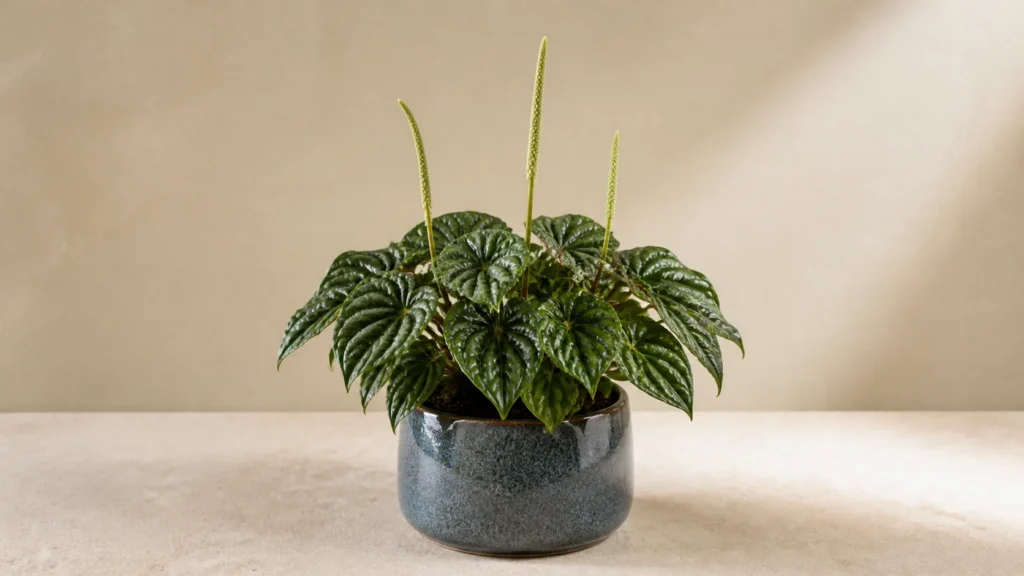
Emerald Ripple Peperomia
Peperomia caperata
A compact, easy-care peperomia with deeply wrinkled, heart-shaped emerald-green leaves and slender flower spikes, tolerating medium light, average humidity, and infrequent watering.
Watering frequency
Every 10-14 days (allow top 1-2 inches of soil to dry)
Ideal temperature
60-80°F / 15-27°C
Humidity
40-50%
Care difficulty
Easy
Air purifying
No/Not Known
Growth rate
Slow
Plant size
6-12 in / 15-30 cm tall and wide
Soil type
Well-draining peat-based mix with perlite or orchid bark
Fertilizer need
Monthly, spring-summer.
Care summary
- Light: Give medium to bright indirect light; tolerates lower light than many houseplants, but avoid direct sun.
- Water: Allow the top 1-2 inches of soil to dry between waterings; overwatering is the main risk.
- Humidity: Average household humidity (40-50%) is fine; no special humidity needs.
- Temperature: Keep above 60°F (15°C); protect from cold drafts and sudden temperature changes.
- Soil: Use a light, well-draining mix; dense soil causes root rot.
- Safety: Peperomia is non-toxic to cats, dogs, and horses, making it a good choice for pet households.
Common problems
- Yellow, mushy leaves or stems: Usually overwatering or root rot; let soil dry and check roots.
- Drooping or wilting despite wet soil: Check root rot from overwatering or compacted soil.
- Brown crispy leaf edges or tips: Review underwatering, low humidity, or cold dry air.
- Leggy growth with small leaves: Confirm insufficient light; move to brighter indirect light.
- Pests: Inspect leaf undersides and stems for mealybugs, spider mites, and fungus gnats.
Plant care guide
About Emerald Ripple Peperomia
Emerald Ripple Peperomia (Peperomia caperata) is a compact, tropical houseplant grown for its deeply textured, heart-shaped leaves with a distinctive rippled or crinkled surface. Native to Brazil, Peperomia caperata is one of the most popular peperomia species, with dozens of cultivars offering leaf colors ranging from deep emerald green to burgundy, silver, and variegated patterns. The leaves grow in dense rosettes on short, reddish stems, creating a low, mounding plant typically 6–12 inches tall and wide.
Why You'll Like It
Emerald Ripple Peperomia is a delightful, low-maintenance houseplant that packs a lot of visual interest into a small package. Its deeply textured, rippled leaves catch the light and create subtle shadows, giving the plant a rich, dimensional appearance that changes throughout the day. The compact size (6–12 inches) makes it perfect for desks, shelves, windowsills, and small spaces where larger plants would be overwhelming.
What Kind of Plant Is It?
Emerald Ripple Peperomia (Peperomia caperata) is a compact, evergreen perennial in the Piperaceae (pepper) family, grown primarily for its ornamental foliage. Leaves are the main attraction — they are heart-shaped, thick, and succulent-like, with a deeply corrugated or rippled surface that gives the species its name (caperata means "wrinkled"). The leaves grow in dense rosettes on short, fleshy, reddish stems, and their color varies by cultivar: deep emerald green (the species), burgundy or purple-red, silver-gray, or variegated with cream or pink margins.
History and Naming
The genus Peperomia was established by Spanish botanists Hipólito Ruiz López and José Antonio Pavón Jiménez in 1794, during their botanical expedition to Peru and Chile. The name Peperomia derives from Greek peperi (pepper) and homoios (resembling), referring to the plants' resemblance to and close relationship with the true pepper genus Piper (which includes black pepper, Piper nigrum). Peperomia caperata was first described in 1866 by English botanist John Gilbert Baker, based on material from Brazil.
Emerald Ripple Peperomia and Related Plants
- Baby Rubber Plant (Peperomia obtusifolia): A popular peperomia with thick, glossy, oval leaves (often variegated), growing upright to 12–18 inches. It shares the same easy-care nature and pet-safe status but has smooth rather than rippled leaves and a more upright growth habit.
- Watermelon Peperomia (Peperomia argyreia): A striking peperomia with round, silver-striped leaves resembling watermelon rind, on long reddish petioles. It has similar care requirements but a very different leaf appearance, and is prized for its bold pattern.
- String of Turtles (Peperomia prostrata): A trailing peperomia with small, round, turtle-shell-patterned leaves on cascading stems. It shares the peperomia family's easy care and pet-safe status but has a trailing rather than mounding growth habit, making it ideal for hanging baskets.
Other popular Peperomia caperata cultivars include 'Rosso' (deep burgundy-red leaves), 'Luna Red' (dark purple-red rippled leaves), 'Silver Ripple' (silver-gray rippled leaves), 'Variegata' (green leaves with cream/pink variegation), and 'Emerald Ripple' (the classic deep green form). Each cultivar offers a different foliage color while sharing the same rippled texture and compact growth habit.
Where Emerald Ripple Peperomia Works Best
Choose a position with bright indirect light — an east or north-facing window is ideal; a west window with a sheer curtain works well; a south window should be filtered or set back to avoid direct sun, which can scorch the leaves. Emerald Ripple Peperomia is an excellent desk, shelf, or tabletop plant — its compact size and low-maintenance nature make it perfect for offices, bedrooms, and small living spaces. It also does well in bathrooms with a window, as the moderate humidity benefits the plant.
Emerald Ripple Peperomia Care
Light
Provide bright indirect light — Emerald Ripple Peperomia needs good light to maintain its compact growth and rich foliage color, but direct sun scorches its leaves. An east or north-facing window is ideal; a west window with a sheer curtain works; a south window should be filtered or set back.
Watering
Allow the top inch of soil to dry out between waterings — Emerald Ripple Peperomia has succulent-like leaves that store water, making it more drought-tolerant than many tropical houseplants. Water thoroughly when the top inch feels dry, typically every 7–10 days in warm weather, every 10–14 days in cooler conditions.
Potting Medium and Container
Use a light, well-draining potting mix — a good blend is 2 parts peat moss or coco coir + 1 part perlite + 1 part vermiculite, or a high-quality African violet mix, or a regular houseplant mix amended with extra perlite for drainage. The medium should retain some moisture while allowing excess water to drain freely and air to reach the roots.
Humidity
Emerald Ripple Peperomia prefers moderate humidity — ideally 40–60%, which is typical of most indoor environments. It is more tolerant of average household humidity than many tropical houseplants, thanks to its succulent-like leaves that store moisture.
Temperature
Emerald Ripple Peperomia prefers warm, stable temperatures — ideally 65–75°F (18–24°C). It can tolerate temperatures down to 60°F (15°C) and up to 85°F (29°C) for short periods, but prolonged exposure outside this range stresses the plant.
Fertilizer
Fertilize lightly during the growing season (spring and summer) with a balanced, water-soluble houseplant fertilizer at half the label strength, applied every 4–6 weeks. Emerald Ripple Peperomia is not a heavy feeder, and over-fertilization causes leaf tip burn, salt buildup in the soil, and can damage the shallow root system.
Pruning and Grooming
Emerald Ripple Peperomia requires minimal pruning but benefits from regular grooming to maintain its appearance and health. Remove yellowed, damaged, or dead leaves by gently twisting them off at the base or cutting the petiole with sterile scissors.
Propagating Emerald Ripple Peperomia
The most common and reliable home propagation method is leaf cuttings. Emerald Ripple Peperomia is easy to propagate from leaves, and a single leaf can produce one or more new plants. To propagate by leaf cutting: select a healthy, mature leaf from the parent plant; cut the leaf from the plant with a sterile knife or scissors, leaving about 1 inch of petiole (leaf stem) attached; allow the cut end to callus over for a few hours or overnight (this helps prevent rot); insert the petiole into a moist, well-draining propagation medium (such as peat moss + perlite, or sphagnum moss), with the leaf blade resting on the surface; keep the medium moist but not soggy, and enclose the cutting in a plastic bag or propagation dome to maintain high humidity; place in bright indirect light at 70–75°F (21–24°C); roots and a new plantlet will emerge from the base of the petiole in 4–8 weeks; once the plantlet has developed several leaves and roots, gently separate it and pot it up in a small pot with regular potting medium.
Repotting Emerald Ripple Peperomia
Repot every 2–3 years in spring, or sooner if the plant becomes root-bound (roots growing through drainage holes, water draining very quickly, plant lifting out of the pot), the medium breaks down (becomes dense, compacted, or foul-smelling), or the plant has outgrown its pot. Best time is when new growth emerges in spring. Emerald Ripple Peperomia has shallow root systems and prefers relatively small pots — it actually blooms more profusely when slightly root-bound.
Toxicity and Pet Safety
Emerald Ripple Peperomia (Peperomia caperata) is classified as Pet safe. The ASPCA lists peperomias as non-toxic to cats and dogs. Peperomia species are not known to contain toxic compounds that pose a significant risk to pets, and the plant is generally considered safe for households with cats and dogs.
Common Problems and Practical Fixes
Yellowing leaves are usually caused by overwatering or root rot. If leaves are yellow and mushy or falling off easily, check the soil moisture — if it is constantly wet, the plant is likely overwatered. Brown leaf tips or edges are usually caused by low humidity, underwatering, or excessive fertilizer. If humidity is below 30%, increase it with a humidifier, pebble tray, or by grouping with other plants. Root rot or stem rot is a serious problem caused by overwatering, poor drainage, or dense soil. Symptoms include yellowing leaves, mushy stems at the base, foul smell from soil, and leaves falling off easily. Leggy growth is usually from insufficient light. Emerald Ripple Peperomia needs bright indirect light to maintain compact growth — in dim conditions, the stems elongate, leaves become larger and paler, and the plant loses its dense, mounding shape.
Frequently Asked Questions
How often should I water my Emerald Ripple Peperomia?
Allow the top inch of soil to dry out between waterings, typically every 7–10 days in warm weather and every 10–14 days in cooler conditions. Water thoroughly until water drains from the bottom, then empty the saucer.
Why is my Emerald Ripple Peperomia dropping leaves?
Leaf drop is usually caused by overwatering, cold stress, or sudden environmental changes. If the soil is constantly wet, overwatering and root rot are likely — reduce watering and check roots.
Does Emerald Ripple Peperomia flower?
Yes. Peperomia caperata produces slender, upright, spike-like flower spikes (inflorescences) that rise above the foliage, typically in spring and summer.
Final Thought
Emerald Ripple Peperomia is a charming, low-maintenance houseplant that brings textured, dimensional foliage to small spaces without demanding much in return. Its key needs are simple: bright indirect light to maintain compact growth and rich foliage color, well-draining soil allowed to dry slightly between waterings (never waterlogged), moderate humidity, and warm stable temperatures. The most common mistake — overwatering — is easy to avoid by letting the top inch of soil dry before watering and ensuring the pot has drainage.
Read the leaves for cues: compact, richly colored leaves mean the plant is happy; leggy growth or pale leaves signal insufficient light; yellow mushy leaves indicate overwatering. With proper care, an Emerald Ripple Peperomia can be a long-lived companion on your desk or shelf, and its ease of propagation from leaf cuttings means you can share its textured beauty with friends.