
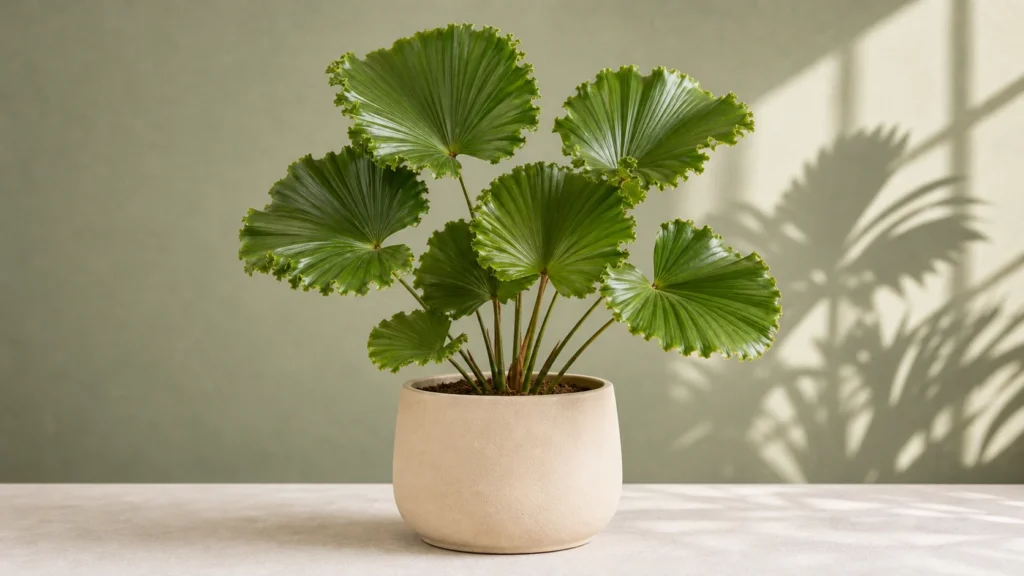
Ruffled Fan Palm
Licuala grandis
A wet-tropical Vanuatu fan palm with nearly round pleated leaves that requires warmth, filtered light, even moisture, humidity, and careful handling.
Watering frequency
Every 5-10 days
Ideal temperature
65-85°F / 18-29°C
Humidity
60-80%
Care difficulty
Hard
Air purifying
No/Not Known
Growth rate
Slow
Plant size
3-6 ft / 0.9-1.8 m
Soil type
Moist, aerated palm mix
Fertilizer need
Every 6-8 weeks, spring-summer.
Care summary
- Light: Give medium to bright filtered light without harsh sun.
- Water: Keep evenly moist, allowing the surface to begin drying.
- Humidity: Maintain stable high humidity with gentle airflow.
- Pruning: Retain green fronds and never cut the central spear.
- Safety: Species-specific veterinary evidence remains insufficient.
Common problems
- Brown edges: Check drought, dry airflow, mineral salts, cold, and roots.
- Yellow fronds: Review wet soil, drainage, low light, and natural aging.
- Loose central spear: Treat as possible crown or root rot immediately.
- Torn fans: Protect unfolding leaves from traffic, wind, and low humidity.
- Pests: Inspect pleats and petiole bases for mites, scale, and mealybugs.
Plant care guide
About Ruffled Fan Palm
Ruffled Fan Palm (Licuala grandis) is a true palm valued for broad, nearly circular leaves folded into deep pleats. The fans often remain partly divided only near their edges, creating a much more solid silhouette than the feather-like fronds of Parlor Palm or Kentia Palm.
Kew's accepted botanical record places the native range from the Santa Cruz Islands to Vanuatu and describes it as a wet-tropical shrub or tree. Vanuatu Fan Palm is therefore another useful common name. The familiar “Ruffled” label refers to the corrugated leaf surface rather than a named cultivar.
University of Florida's ornamental-palm guide identifies Licuala grandis as a single-stem fan palm with round leaves, spiny petioles, low salt-spray tolerance, and a preference for shade. Those landscape traits reinforce the indoor need for filtered rather than harsh light and careful handling of the leaf stalks.
This palm can be grown indoors, but it is not an easy generic office palm. It evolved in warmth and atmospheric moisture, uses a relatively steady root-water supply, and damages easily when its fans unfold in dry air or rub against furniture. Slow growth means every healthy green leaf is valuable.
Why You'll Like It
Few indoor palms look as architectural. Each pleated fan reads as one bold surface, making the plant visually effective without a dense mass of fronds. A carefully placed specimen can anchor a bright living room or conservatory.
The slow pace limits frequent pruning and repotting, but it also means damage remains visible for a long time. Ruffled Fan Palm suits an owner willing to monitor humidity, water quality, root moisture, pests, and temperature rather than relying on a weekly routine.
Compare Parlor Palm for a smaller, easier and ASPCA-verified pet-safe palm, Kentia Palm for a larger feather-leaved statement plant, or Areca Palm for a denser screen. These true palms have different root and humidity tolerances.
What Kind of Plant Is It?
Ruffled Fan Palm grows from one central apical bud. Each new leaf first appears as a folded spear, then opens gradually into a pleated fan. The spear is the plant's only active growing point; cutting or damaging it can kill the stem.
An individual palm does not branch after topping. Nurseries may group seedlings for fullness, but a genuine single plant retains one trunk. Indoor specimens remain far smaller than mature tropical landscape trees and rarely flower or fruit.
The petioles—the stalks supporting each fan—may carry small teeth or sharp margins, so handle them carefully. Torn green leaf tissue still photosynthesizes. Cosmetic damage is not a reason to remove an entire functioning frond.
Ruffled Fan Palm and Related Fan Palms
- Ruffled Fan Palm (Licuala grandis): Broad, strongly pleated, almost complete circular blades and a wet-tropical origin.
- Lady Palm (Rhapis excelsa): A clustering fan palm with multiple cane-like stems and divided leaf segments.
- Chinese Fan Palm (Livistona chinensis): A larger palm whose segments droop at the ends; it becomes less suitable for ordinary rooms with age.
- European Fan Palm (Chamaerops humilis): A more sun- and drought-adapted clustering palm with very different indoor moisture needs.
- Fishtail Palm (Caryota spp.): A feather palm whose leaflets resemble fish tails rather than one round fan.
- Sago Palm (Cycas revoluta): Not a true palm and severely toxic to pets; a reminder that common names do not establish botanical identity or safety.
Do not transfer a universal “palm care” recipe between these plants. Native habitat and root structure materially change light, water, and temperature requirements.
Where It Works Best
Use a bright room with filtered light, stable warmth, and enough clearance that fans do not touch walls or traffic. An east window or a position behind a sheer curtain at a stronger exposure is suitable. Harsh direct afternoon sun can bleach broad blades, while deep shade slows growth and water use.
A conservatory or bright humid bathroom can work if air circulates and nights remain warm. A windowless bathroom does not provide photosynthetic light. Keep the palm away from cold doors, heating vents, air conditioners, and frequently opened windows in winter.
Outdoor summer placement is possible in warm climates, but use deep shade or filtered light initially and protect the fans from wind. Inspect thoroughly for mites, scale, and mealybugs before bringing it inside.
How to Care for Ruffled Fan Palm
Light
Provide medium to bright indirect light. Gentle early sun may be accepted after acclimation, but the broad fans overheat easily behind glass. Pale bleached patches on the exposed face suggest scorch; slow weak spears and soil that never dries suggest insufficient light.
Rotate the pot gently for balanced growth, but avoid repeatedly brushing or bending the emerging leaf. A grow light may support winter conditions if it is strong enough, close enough, and used consistently.
Water
Treat five to ten days as a cue to inspect. Let the surface begin to dry, then check below it; the root ball should remain evenly moist rather than cycling from swampy to bone-dry. Water thoroughly across the pot and empty all runoff.
Hot bright weather, a root-filled pot, and high airflow accelerate use. Cool low light slows it. A moisture meter alone can misread chunky or salty media, so combine pot weight, a finger or wooden skewer, and plant response.
If the palm wilts in wet soil, do not add water. Oxygen-starved roots cannot supply the leaves. Inspect drainage, temperature, odor, and root firmness.
Water Quality
Broad pleated margins can show accumulated salt stress. If brown edges persist after moisture and humidity are stable, consider filtered, distilled, or safely collected rainwater and flush the medium periodically. Do not soften water with sodium-based household systems for plant use.
Water quality is one factor, not a universal diagnosis. Drought, cold, hot vents, fertilizer, root damage, and physical tears can create similar browning.
Soil and Container
Use a humus-rich but aerated palm or houseplant mix amended with perlite, pumice, or fine bark. It should hold even moisture while allowing rapid drainage. Dense garden soil becomes airless; an extremely coarse mix can create dry pockets.
Choose a pot with open drainage only modestly larger than the root mass. A plastic nursery pot inside a heavy cachepot provides moisture stability and physical support, provided the outer pot is emptied after watering.
Keep the trunk and growing point at their original depth. Burying the stem base invites decay.
Humidity and Airflow
Aim for 60–80 percent humidity when practical. A humidifier with a hygrometer provides more stable conditions than misting. At high humidity, gentle airflow becomes especially important so the crown and folds do not remain wet.
Do not place the pot on a pebble tray and assume the entire room has changed. Measure conditions near the foliage. Brown edges can continue after humidity improves because existing tissue cannot repair itself.
Temperature
Keep the plant around 65–85°F (18–29°C), with minimal cold drafts. Wet roots combined with temperatures below the comfort range can lead to crown and root problems. Protect leaves from cold glass and avoid abrupt relocation.
Fertilizer
Feed lightly every six to eight weeks during active spring and summer growth using a complete palm or balanced fertilizer at a diluted label rate. Palms need micronutrients, but indiscriminate extra feeding can burn fine roots.
Pause when growth slows, roots are damaged, or salts have accumulated. Correct drainage and pH-related availability before assuming every pale leaf needs more nitrogen.
Grooming and Pruning
Remove only fully brown fronds near the base with clean tools. A green leaf with torn edges still contributes energy. Never cut the central spear or trim a fan into a shape that removes substantial living surface.
Dust can be removed with a gentle shower or soft damp cloth. Support each fan while cleaning and avoid forcing open a new folded leaf. Skip oily shine products.
Propagation
Ruffled Fan Palm is propagated from seed. It cannot be grown from a detached frond or ordinary trunk cutting, and a single stem cannot be divided.
Seed propagation requires fresh viable seed, sustained warmth, clean porous medium, and patience. Germination can be slow and uneven, and seedlings remain small for a long time. For most household growers, buying a nursery-propagated plant is more practical and reduces pressure on wild populations.
If a retail pot contains multiple seedlings, they can theoretically be separated, but the roots may be intertwined and each division will look sparse. Disturb only for a clear horticultural reason.
When to Repot
Repot when roots densely fill the pot, medium has collapsed, drainage is unreliable, or the plant has become unstable. Slow growth and one root at a drainage hole are not emergencies. Palms generally dislike unnecessary root disturbance.
Move up one modest size during warm active growth. Keep the root ball intact, preserve fine roots, and maintain the original planting depth. Return the palm to stable filtered light and humidity rather than exposing it to additional changes.
Pet and Household Safety
The canonical record labeled Ruffled Fan Palm not pet-friendly. This review found no direct Licuala grandis entry from ASPCA or an equivalent species-specific veterinary toxicology authority. It would therefore be equally unsupported to reverse the field and promise that all true palms are safe.
The draft retains the conservative Not pet safe classification pending reliable evidence. This means “do not promise safety,” not “a toxin has been confirmed.” Prevent chewing and contact a veterinarian or animal poison-control service after an ingestion or if symptoms appear. Sharp petiole edges and contaminated potting products are separate physical and chemical risks.
Common Problems and Practical Fixes
Brown tips and margins
Check dry-down, humidity, hot airflow, mineral salts, cold injury, and roots. Do not remove an entire green fan for a narrow brown edge. Correct the cause and evaluate later leaves.
Yellow fronds
One oldest lower frond may age naturally. Several yellowing leaves with wet mix suggest root stress; yellowing in deep shade may accompany chronically slow water use. Inspect before watering or feeding.
Loose central spear
A spear that pulls free with a soft or foul base signals severe crown or root decay. Isolate the plant, inspect immediately, remove stagnant water, and improve warmth and airflow. Damage to the only growing point can be fatal.
Torn or stuck fans
Low humidity, physical handling, wind, or pest damage can keep segments from unfolding cleanly. Do not pull the leaf open. Improve stable humidity and protect the next spear; torn tissue will not knit together.
Pale patches
Large bleached areas on the light-facing side suggest sunburn. Move to filtered light and acclimate more slowly. Fine overall stippling instead suggests mites.
Pests
Spider mites hide in pleats and cause stippling; scale attaches along petioles; mealybugs collect at protected bases. Isolate, identify, rinse carefully, and use a product labeled for indoor palms and the confirmed pest. Repeat as directed.
Frequently Asked Questions
Is Ruffled Fan Palm difficult indoors?
Yes, relative to Parlor Palm. It needs brighter filtered light, steadier warmth and moisture, higher humidity, and protection from handling and pests.
Should I cut brown edges off?
You may trim a narrow dead edge for appearance, leaving a small brown margin. Retain the green fan because replacement is slow.
Can it live in low light?
Deep shade produces slower, weaker growth and keeps soil wet too long. Medium to bright filtered light is the realistic indoor range.
Can I propagate a frond?
No. Palms grow from seed and a frond cutting has no growing point. A single stem also cannot be divided.
Is it safe for cats and dogs?
Species-specific veterinary evidence was not found, so this page does not promise safety. Keep it away from pets that chew plants pending better evidence.
Why is the new leaf not opening?
New fans unfold slowly. Maintain warmth, humidity, even root moisture, and pest control, but do not force the spear apart. A soft or loose spear requires urgent root and crown inspection.
Final Thought
Ruffled Fan Palm is living sculpture with a narrow indoor comfort zone. Protect the central spear, provide filtered light, warm aerated roots with even moisture, high stable humidity, and room for every fan to open untouched. Its slow pace makes prevention far more valuable than cosmetic correction—and makes each intact new leaf an achievement.