
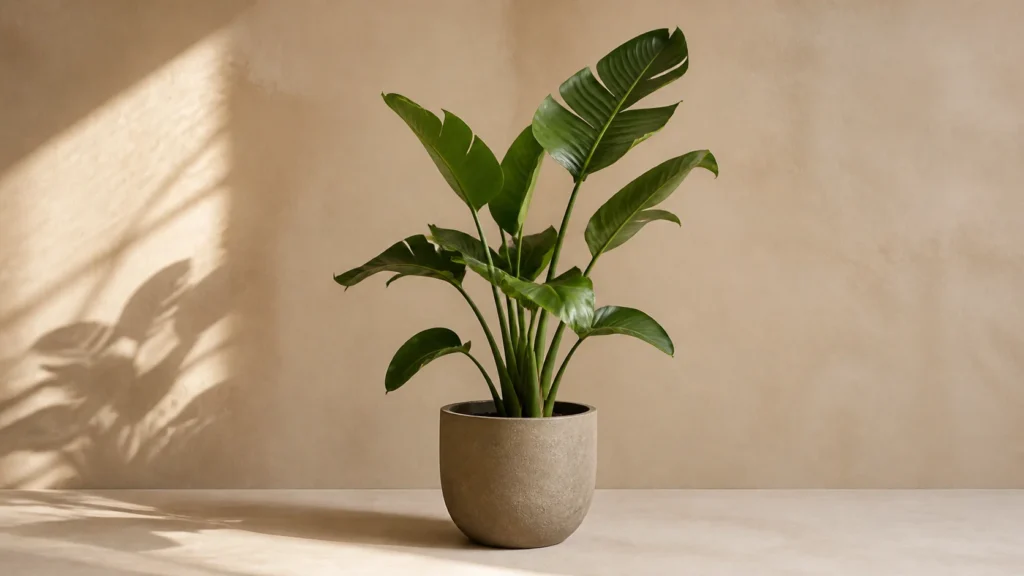
Bird of Paradise
Strelitzia nicolai
A large tropical statement plant with upright stalks and broad paddle-shaped leaves that needs very bright indoor light and generous space.
Watering frequency
Every 7-10 days
Ideal temperature
65-80°F / 18-27°C
Humidity
40-60%
Care difficulty
Medium
Air purifying
No/Not Known
Growth rate
Moderate
Plant size
5-8 ft / 1.5-2.4 m indoors
Soil type
Rich, well-draining potting mix
Fertilizer need
Monthly, spring-summer.
Care summary
- Light: Very bright indirect light with acclimated direct sun.
- Water: Let the upper 1-2 inches dry, then soak and drain.
- Soil: Use a rich but airy mix in a stable pot with drainage.
- Space: Allow substantial width and ceiling height.
- Safety: Keep away from pets and children who may chew it.
Common problems
- Leaf splitting: natural, but increased by wind and contact.
- Yellow leaves: wet roots, poor drainage, or aging.
- Brown edges: moisture swings, dry drafts, or salts.
- Curling leaves: thirst, heat, cold, or root stress.
- Leaning growth: one-sided or insufficient light.
- Pests: spider mites, scale, mealybugs, or aphids.
Plant care guide
About Bird of Paradise
The Bird of Paradise in this database is Strelitzia nicolai, commonly called White Bird of Paradise or Giant Bird of Paradise. It produces broad banana-like leaves on long upright stalks and gradually forms a clump with a trunk-like base. In a bright interior, even a young plant can become a major architectural feature; outdoors in a suitable subtropical climate, the species grows into a much larger tree-like perennial.
Kew’s accepted botanical record for Strelitzia nicolai places its native range from eastern Zimbabwe and Botswana through Mozambique to KwaZulu-Natal. Kew classifies it as a tree of subtropical environments. The household plant is therefore not naturally a compact floor accent. Its size is temporarily constrained by container, light, and indoor conditions, but buyers should plan for increasing height, width, weight, and leaf spread.
The white-and-blue flowers are dramatic, yet indoor specimens rarely bloom because flowering requires maturity, strong light, and space. Do not judge an indoor plant as unhealthy simply because it remains foliage-only. The leaves are the practical indoor display.
Why You’ll Like It
Few houseplants create as much visual structure with so few leaves. Each new paddle adds height and a bold plane of green, making the plant effective in a large living room, open office, conservatory, or bright entrance. It pairs well with smaller foliage plants without looking busy.
White Bird of Paradise also gives visible feedback. In adequate light, new leaves emerge upright and the clump thickens. Dust is easy to see and remove. Root crowding, leaning, dry edges, and pest stippling can be recognized before the plant collapses if the large leaves are inspected regularly.
Its challenges are physical as much as horticultural. A mature pot can be heavy, top-heavy, difficult to rotate, and too wide for a walkway. Split leaves are normal rather than evidence that the purchase is defective. This is a good plant for someone with bright light and space—not a universal solution for an empty dark corner.
What Kind of Plant Is It?
Strelitzia nicolai is a clump-forming evergreen perennial in the Strelitziaceae family. New shoots rise from underground rhizomes, which are modified stems that store energy and produce roots and growth points. What looks like a trunk develops from tightly layered leaf bases and older woody stems.
Leaves emerge rolled and gradually unfurl. Their broad blades naturally tear along parallel veins. In the wild, splitting reduces resistance to wind; indoors, fans, narrow passageways, pets, handling, and dry unfurling increase damage. A split does not fuse again, and taping it is unnecessary.
The species is often confused with bananas because both belong to the order Zingiberales and share a paddle-leaf silhouette. Bananas belong to Musa, while Bird of Paradise has a different flower structure, growth pattern, and family.
Popular Bird of Paradise Species
“Bird of paradise” is used for several Strelitzia species and also for unrelated flowering shrubs. Correct identification changes expected size and flower color.
- White or Giant Bird of Paradise (Strelitzia nicolai): The large species covered here, with white-and-blue flowers and a potentially tree-like outdoor habit.
- Orange Bird of Paradise (Strelitzia reginae): A smaller clumping species with familiar orange-and-blue flowers. It is more realistic for long-term container flowering under excellent light.
- Narrow-leaved Bird of Paradise (Strelitzia juncea): Develops rush-like cylindrical or very narrow mature leaves and orange-blue flowers.
- White Bird of Paradise (Strelitzia alba): A separate large white-flowered species that can be confused with S. nicolai in commerce.
- Mountain Strelitzia (Strelitzia caudata): Another large southern African species, uncommon as a mainstream houseplant.
Red or yellow “bird of paradise” shrubs sold under Caesalpinia are legumes, not Strelitzia. Do not transfer this care guide or toxicity information to them.
Where It Works Best
Provide the brightest indoor location available. A large unobstructed south-, west-, or east-facing window can work, depending on hemisphere, season, and exterior shade. Several hours of acclimated direct sun support stronger growth. A plant raised in a dim store must be introduced to intense sun gradually to prevent bleaching and scorch.
Position the entire canopy near the light, not merely the bottom of the pot. A tall plant placed beside a narrow window may lean because only part of the foliage receives light. Rotate a manageable pot a quarter turn every few weeks; once it is too heavy, use casters or a stable plant caddy rated for the load.
Avoid low ceilings, ceiling fans, heating vents, and busy walkways. A bright sheltered patio can be useful in warm months, but acclimate the foliage to sun and wind and bring the plant inside before temperatures become cold. Inspect for pests before reentry.
How to Water Bird of Paradise
Water when the upper 1–2 inches (2–5 cm) of mix have dried and the pot feels lighter. Apply water slowly across the surface until the full root ball is moist and excess exits the holes. Empty the saucer or cachepot. Every 7–10 days may be a warm-season checking rhythm, but a large cool pot may take much longer.
Do not rely on leaf curl alone. Curling can reflect dryness, heat, cold, intense sun, damaged roots, or a newly unfurling leaf. Test the root zone. Repeated small drinks wet only part of a large pot, while watering an already heavy pot promotes oxygen-starved roots.
In winter or reduced light, growth and water use slow. Let more of the upper mix dry, but do not impose a severe drought on an actively growing plant. Room-temperature water avoids chilling warm roots. If mineral crust accumulates, flush the mix thoroughly and review fertilizer and water quality.
Soil, Pot, and Repotting
Use a rich but open houseplant mix. Quality potting mix amended with perlite, pumice, or fine bark provides both moisture retention and air. Dense garden soil is unsuitable in a container. The pot must have unobstructed drainage holes and enough weight or breadth to stabilize the canopy.
Repot when roots densely circle, lift the plant, block drainage, or cause the mix to dry extremely fast. Move up only one container size. A decorative oversized pot filled with unused wet mix increases rot risk. Large specimens can be top-dressed or root-pruned by an experienced grower when moving to an even larger pot is impractical.
Keep the base at its previous depth and do not bury leaf stalks. Spring or early summer is convenient because stronger light supports recovery. A recently repotted plant may pause before producing another leaf.
Temperature, Humidity, and Feeding
Aim for 65–80°F (18–27°C). The NC State Extension profile for White Bird of Paradise recommends warmth, bright indirect light, moist well-drained soil, and protection below 50°F (10°C). Avoid cold glass, exterior-door drafts, and sudden moves between temperature extremes.
Average household humidity around 40–60% is usually workable. Higher stable humidity may help new leaves unfurl with less tearing, but it cannot compensate for weak light or saturated soil. Use a humidifier rather than repeatedly misting an enormous leaf surface.
Feed monthly during active spring and summer growth with a balanced fertilizer at reduced to label strength according to the product. Apply to moist soil. Pause when growth slows, and flush salts if leaf margins brown or a white crust appears.
Leaf Care, Pruning, and Propagation
Wipe leaves with a soft damp cloth, supporting the blade from beneath. Avoid leaf-shine products. Remove a fully yellow or badly damaged leaf by cutting its stalk near the base with a clean tool. Cosmetic splitting alone is not a reason to remove a functioning green leaf.
Propagation by division is faster and more predictable than seed. A division needs a separate shoot, viable rhizome section, and roots. Large plants may require two people and substantial tools; forcing an immature shoot away without roots can kill it.
Seeds can germinate when fresh and correctly prepared, but seedlings take years to become substantial plants and may not match a named selection. A detached leaf cannot produce a new Bird of Paradise because it lacks a rhizome growth point.
Buying and Acclimating a Large Specimen
Inspect the newest rolled leaf, stalk bases, and leaf undersides before purchase. Fine pale stippling, webbing, sticky residue, or fixed brown bumps can signal mites or scale. Check that the root ball is moist but not sour or saturated and that the pot stands upright without a cracked base.
Measure doors, elevators, vehicle space, final ceiling height, and canopy width before buying. A nursery leaf can be damaged simply by forcing it through a narrow doorway. Once home, quarantine the plant and give it stable bright light. Acclimate it gradually to direct sun; do not combine a dramatic light increase with repotting and heavy fertilizer. Older leaves may remain angled toward the nursery light, while new growth shows whether the new position works.
The RHS Strelitzia growing guide provides additional genus-level guidance on light, seasonal watering, feeding, repotting, and flowering. Apply it with the expected scale of S. nicolai in mind rather than assuming every Strelitzia remains the size of S. reginae.
Pet and Human Safety
Bird of Paradise is not pet-safe. NC State classifies S. nicolai as having low-severity poison characteristics and reports gastrointestinal symptoms such as nausea, vomiting, diarrhea, or drowsiness after ingestion, with fruits and seeds of particular concern. Skin irritation can also occur in sensitive people.
Keep leaves, flowers, seeds, and divisions away from pets and children. If ingestion occurs, contact a veterinarian, poison-control service, or medical professional as appropriate. Do not induce vomiting unless instructed. Remember that a floor plant is directly accessible to many dogs and cats.
What About Air Purifying?
There is no good basis for promising that one large Bird of Paradise cleans a room. Chamber experiments with plants do not translate directly to normal occupied buildings with ventilation and continuing pollutant sources. Grow it for scale, foliage, and visual atmosphere; use ventilation, filtration, and source control for indoor air quality.
Common Problems
- Split leaves: Normal, but worsened by contact, fans, wind, and dry unfurling. Protect new leaves rather than repairing old splits.
- Several yellow lower leaves: Check saturated soil and drainage. One oldest leaf yellowing can be normal turnover.
- Brown margins: Review drying, hot or cold drafts, fertilizer salts, and humidity.
- Plant leans strongly: Increase and balance light. A heavy mature stem may not straighten completely.
- New leaf will not unfurl: Improve stable humidity and watering, but do not force or peel the leaf; inspect for pests in the fold.
- Fine pale stippling and webbing: Spider mites favor dry stressed foliage. Isolate and treat promptly.
- Brown fixed bumps or sticky residue: Inspect for scale. Clean accessible insects and use an indoor-plant product labeled for scale.
- Soft base and sour soil: Suspect root or rhizome rot. Remove damaged tissue and correct the oversized pot, dense mix, or watering routine.
Frequently Asked Questions
Can Bird of Paradise grow in low light? It may survive for a time, but growth becomes weak, sparse, and leaning. S. nicolai is a high-light houseplant.
Will it flower indoors? Possibly, but rarely. Maturity, extremely strong light, stable care, and space are required. Buy it primarily for foliage.
Why are the leaves splitting? Splitting along the veins is a normal adaptation. Indoor contact, fans, and dry conditions increase it.
How tall will it become? Many indoor plants reach 5–8 feet and can exceed that under excellent conditions. Outdoors in suitable climates the species becomes far larger.
Is this the orange Bird of Paradise? No. This record is Strelitzia nicolai, the White or Giant Bird of Paradise. The orange-flowered smaller species is S. reginae.
Final Thought
White Bird of Paradise earns its place by giving a room genuine scale, but it needs a home that can support that scale. Put it in very bright light, water the actual root zone rather than the calendar, and plan for a heavier, wider plant. Accept split leaves as part of its character. With sufficient light and space, it becomes a long-term architectural specimen rather than a temporary dark-corner decoration.