
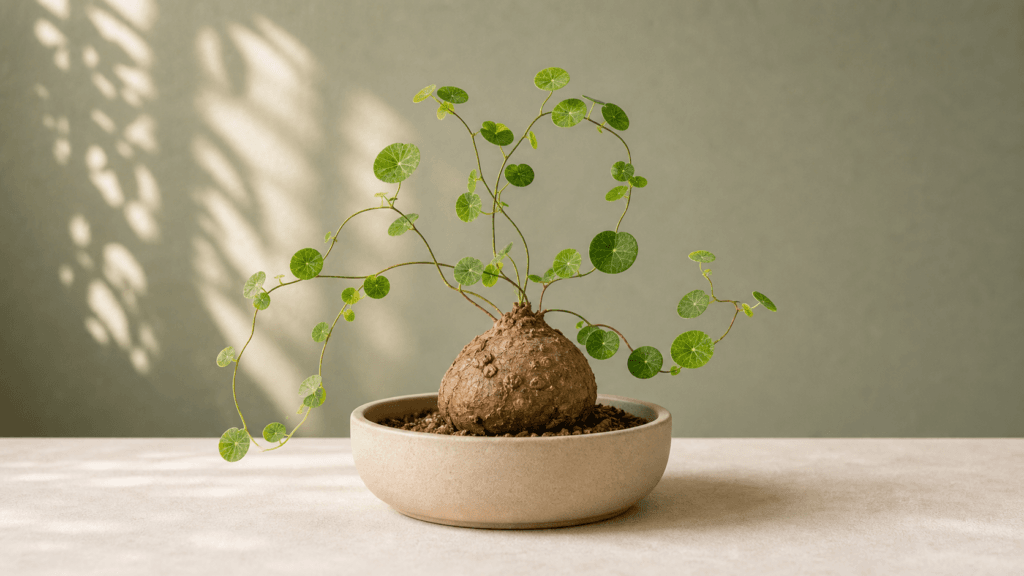
Stephania erecta
Stephania pierrei
A Southeast Asian caudex vine sold as Stephania erecta, with round peltate leaves, seasonal growth, and a high need for careful watering and drainage.
Watering frequency
Every 2-4 weeks
Ideal temperature
65-80°F / 18-27°C
Humidity
40-60%
Care difficulty
Medium
Air purifying
No/Not Known
Growth rate
Slow
Plant size
6-24 in / 15-60 cm
Soil type
Gritty, fast-draining mix
Fertilizer need
Every 6-8 weeks while the vine grows.
Care summary
- Light: Give bright filtered light while protecting an unsprouted caudex.
- Water: Water rooted active plants after substantial dry-down; keep dormancy drier.
- Soil: Use a shallow gritty mix and keep much of the caudex exposed.
- Dormancy: Reduce water after vine dieback and wait for clear growth signals.
- Safety: Species-specific veterinary evidence is insufficient; prevent chewing.
Common problems
- Soft caudex or musty odor: Treat as possible rot and inspect immediately.
- Wrinkled caudex: Check dormancy, root status, heat, and actual moisture.
- No sprout: Review viability, warmth, season, moisture, and orientation.
- Weak vine: Check useful light, roots, active season, and pests.
- Pests: Inspect thin vines and leaf undersides for mites and scale.
Plant care guide
About Stephania erecta
Stephania erecta is the consumer and trade name for a caudex-forming vine now accepted botanically as Stephania pierrei. Kew's accepted record lists Stephania erecta as a synonym, places the species across Cambodia, Laos, Thailand, and Vietnam, and describes it as a climbing caudex geophyte of the wet tropics.
The display name remains Stephania erecta because that is how collectors and retailers recognize the plant. The accepted name belongs in Botanical Name, while the opening explains the synonym. This follows the database rule of prioritizing consumer recognition without storing outdated taxonomy as if it were current.
The rounded exposed caudex stores resources and sends up slender vines with round peltate leaves—the leaf stalk attaches inward from the edge. Seasonal dieback and regrowth are normal, but internet advice often oversimplifies dormancy into a fixed calendar. The plant's origin, shipping history, root condition, and home environment all affect its cycle.
Why You'll Like It
Stephania erecta looks sculptural before it even sprouts. During active growth, the contrast between a heavy stone-like caudex and delicate climbing vine creates a minimalist display suited to a small trellis.
It rewards owners who enjoy observing seasonal transitions and root-zone signals. It is not ideal for someone who waters every plant weekly or expects continuous foliage. Imported bare caudices may take a long time to establish, and some never do if they arrive nonviable or damaged.
Compare Ponytail Palm for a brighter, drought-adapted caudex tree with ASPCA-verified pet safety, ZZ Plant for an underground storage system and easier indoor dormancy behavior, or String of Pearls for another sculptural trailing plant with different toxicity and watering.
What Kind of Plant Is It?
This is a geophytic vine. The caudex is a swollen underground or partly exposed storage organ adapted to survive unfavorable periods. In display culture, much of it is kept above the mix to reduce rot risk and show its form, while the root-producing underside contacts the medium.
Thin vines require support and can grow rapidly once activated. Leaves may yellow and the vine die back at the end of a growth cycle. A dormant caudex without leaves uses far less water than an actively rooted plant supporting a canopy.
The caudex itself is not a reliable water meter. Mild wrinkling can reflect reserve use, but a soft dark spot or musty odor suggests decay. An unrooted caudex in moist mix cannot take up water effectively and is especially vulnerable to rot.
Stephania Names and Related Caudex Plants
- Stephania erecta: The dominant trade name and a botanical synonym.
- Stephania pierrei: Kew's accepted scientific name for this page's plant.
- Stephania suberosa: A different accepted species sometimes confused in trade, with different caudex and vine characteristics.
- Stephania rotunda: Another distinct species name that should not be substituted because the leaves look round.
- Dioscorea elephantipes: Elephant's Foot, a caudex vine in a different family with a strongly fissured surface and different seasonal cycle.
- Ponytail Palm: A caudex tree, not a vine, and not closely related.
Collector plants are frequently mislabeled from caudex appearance alone. Keep provenance and nursery documentation rather than relying on an image search.
Where It Works Best
Place an actively growing plant near an east window or behind a sheer curtain at a stronger exposure. Bright indirect light supports short internodes and fuller leaves. Harsh hot sun can scorch thin leaves and overheat a small pot.
An unsprouted caudex needs warmth and bright ambient light but little transpiration-based water use. Do not bake it against glass in an attempt to force growth. Bottom warmth can be useful only when controlled and paired with a clean, lightly moist—not wet—medium.
Provide a small hoop or trellis as soon as the vine emerges. Keep the caudex away from cold drafts, humid sealed jars, and decorative containers that trap runoff.
How to Care for Stephania erecta
Light
Give bright filtered light during active growth. Weak light produces a thin stretched vine and small widely spaced leaves. Direct sun is safest only after gradual acclimation and with protection from midday heat.
During dormancy, maintain a bright warm position so the caudex receives seasonal cues without remaining cold and wet. A grow light can support an active vine when positioned appropriately.
Water During Active Growth
Water only after roots and a vine are clearly active. Let the gritty mix dry substantially, then water the root zone thoroughly enough to wet it and allow all excess to escape. Do not pour water repeatedly over the top of the exposed caudex.
Two to four weeks is a broad inspection interval, not a schedule. A small warm mineral-rich pot may dry faster; a cool organic mix may stay wet much longer. Check below the surface and learn the container's dry weight.
Water During Dormancy
When the vine yellows and dies back, reduce water sharply. A rooted caudex may receive a very small amount only when the mix is fully dry and excessive shriveling develops; a cool dormant plant is safer drier than wet.
Do not try to “wake” dormancy with repeated soaking. Growth resumes according to internal reserves, temperature, season, and viability. Water increases only after roots and a new shoot can use it.
Starting a Bare Caudex
Inspect on arrival. A viable caudex should feel firm for its type, without spreading softness, black wet tissue, or sour odor. Identify the flatter root side and the top bud scar; do not bury it upside down.
Set the lower portion shallowly into a clean gritty mix, leaving most of the caudex exposed. Keep warm with airflow and bright indirect light. Use minimal moisture around the root zone rather than soaking the whole container. Patience is safer than escalating water every week.
Soil and Container
Use a highly aerated mineral-rich mix, such as pumice, lava, coarse perlite, grit, and a smaller organic fraction. The exact blend depends on climate, but water must move through immediately and the mix must not remain cold and muddy.
A shallow pot with generous drainage matches the limited root zone and keeps moisture observable. Use a container only slightly larger than the roots. Top dressing should not hide the stem-root junction.
Humidity and Temperature
Normal household humidity around 40–60 percent is sufficient once rooted. Moderate humidity can protect delicate new leaves, but sealing a caudex in stagnant humid air promotes fungus and rot.
Keep it around 65–80°F (18–27°C), warmer during sprouting without extreme heat. Cold and wet conditions are particularly dangerous. Airflow matters at every humidity level.
Fertilizer
Feed sparingly every six to eight weeks only while an established rooted vine is actively growing, usually from spring into early fall; stop as the vine yellows or dormancy begins. Use a balanced fertilizer at a diluted label rate. Do not fertilize an unrooted caudex, dormant plant, or damaged root system.
Excess nitrogen can create weak stretched growth and salts can burn the small root system. Light and root health come first.
Training and Pruning
Guide the vine around a hoop or trellis without sharp bends. Use loose ties and allow the petiole-attached round leaves to face light. A long active vine can be pinched to encourage side growth, although branching is not guaranteed.
Remove a fully dead seasonal vine cleanly after it dries. Do not cut a healthy vine merely because the caudex looks more sculptural without it; leaves replenish stored reserves.
Propagation
Commercial propagation is primarily by seed. Ordinary vine cuttings are not a reliable route to producing the characteristic caudex, and a detached leaf cannot create a mature storage organ.
Seeds require freshness, warmth, humidity with airflow, and a clean draining medium. Seedlings develop slowly and should not be forced into adult dry-down before their roots and storage tissue establish. For most owners, purchasing legally propagated nursery stock is more practical.
Origin matters. Caudex plants have faced collection pressure and confusing international trade. Prefer sellers that can document cultivated propagation and avoid specimens represented as wild-collected.
When to Repot
Repot when roots have filled the shallow container, the mix has compacted, drainage fails, or rot inspection is necessary. Do not disturb a newly sprouting unrooted caudex just to change the decorative pot.
Work during warm active growth when possible. Preserve healthy roots, replace degraded medium, and reset the lower caudex at the same shallow depth. Resume watering cautiously after damaged roots have had time to settle.
Buying a Viable Caudex
Choose a documented nursery-propagated plant with a firm caudex, clear top and root side, and preferably active roots or a visible bud. Avoid specimens with wet black scars, a sour smell, or unexplained drilled and sealed areas. A completely dry dormant caudex may be viable, but the buyer accepts more uncertainty than with an established plant.
Ask whether it is rooted and how long it has been in the current pot. A newly placed imported caudex can look established while having no functional roots. That distinction determines whether ordinary active-growth watering is safe.
Preserve labels and purchase information. Stephania species can be difficult to distinguish without provenance, and legality and sustainability matter for caudex plants in international trade.
Pet and Household Safety
The existing record marked Stephania erecta not pet-safe. This review did not find a direct species-specific ASPCA, Pet Poison Helpline, or equivalent veterinary classification for Stephania pierrei. Some members of Menispermaceae contain biologically active alkaloids, but family-level chemistry is not enough to invent a specific clinical claim for this species.
The conservative Not pet safe value is retained, meaning safety is not established. Prevent chewing and contact a veterinarian or animal poison-control service after ingestion or symptoms. Wash after handling damaged tissue and keep care chemicals inaccessible.
Common Problems and Practical Fixes
Soft caudex or musty smell
Treat this as possible rot. Stop watering, remove the plant, inspect roots and tissue, and cut only when a healthy boundary can be identified with sterile tools. Advanced internal rot may not be recoverable.
Wrinkled caudex
Check whether the plant is rooted, active, dormant, overheated, or rotting. A dry rooted active plant may need water; an unrooted caudex in wet mix cannot absorb it. Do not use appearance alone.
No sprout
Review viability, orientation, warmth, season, and rot. Waiting several weeks or months can be normal after shipping. Repeated soaking is not a safe test of life.
Weak stretched vine
Increase useful filtered light gradually, provide support, and verify roots. Dormancy onset can also weaken growth. Fertilizer is not the first fix.
Yellow leaves and vine dieback
This may be normal seasonal dormancy or stress from roots, cold, drought, pests, or relocation. Check the caudex and soil before deciding. Reduce water after confirmed natural dieback.
Pests
Mites stipple leaves; scale attaches to thin stems; mealybugs hide at nodes. Isolate, identify, and use a labeled indoor treatment cautiously. An exposed caudex should not remain wet with spray.
Frequently Asked Questions
Is Stephania erecta the correct botanical name?
It is a recognized synonym and dominant trade name. Kew currently accepts Stephania pierrei for the same species.
Should the caudex be buried?
Only the lower root-producing portion should contact the mix. Keeping most of it exposed improves observation and reduces wet surface area.
How do I wake it from dormancy?
Provide warmth, bright indirect light, and minimal root-zone moisture, then wait for a shoot. Repeated soaking does not safely force growth.
How often should I water?
Water a rooted active plant after substantial dry-down; keep a dormant or unrooted caudex much drier. The two-to-four-week field is only an inspection range.
Can I propagate the vine?
Vine or leaf cuttings are not a dependable way to reproduce the characteristic plant. Seed is the standard propagation route.
Is it pet-safe?
Species-specific veterinary evidence is insufficient, so the page does not promise safety. Keep it away from animals that chew plants.
Should I use a humidity dome?
Only with great caution. A dome can reduce leaf water loss around a new shoot, but stagnant saturated air encourages caudex and stem rot. Ventilation, warmth, and minimal root-zone moisture are essential.
Final Thought
Stephania erecta is best treated as a seasonal caudex vine rather than a permanently leafy succulent. Preserve the consumer name, store the accepted Stephania pierrei identity, keep the root zone shallow and fast-draining, and let actual growth determine water. Patience—especially before roots or after dieback—is the most important care tool.