
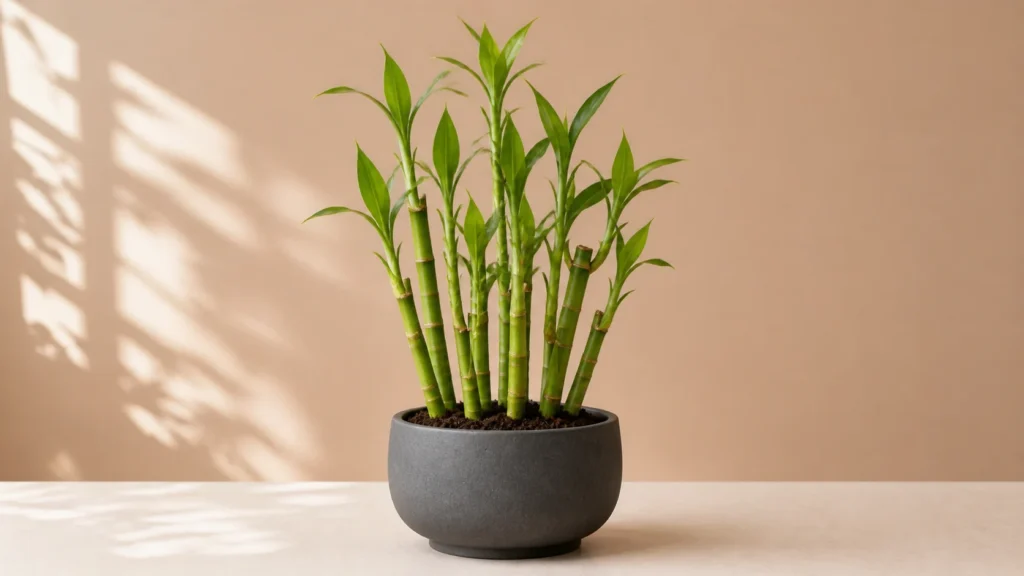
Lucky Bamboo
Dracaena sanderiana
A cane-form Dracaena often displayed in water and pebbles that needs filtered light, clean low-mineral water, warmth, and careful rot prevention.
Watering frequency
Every 7-10 days (soil) / change water weekly
Ideal temperature
60-80°F / 16-27°C
Humidity
40-60%
Care difficulty
Easy
Air purifying
No/Not Known
Growth rate
Slow
Plant size
1-5 ft / 0.3-1.5 m
Soil type
Well-draining mix
Fertilizer need
Every 4-8 weeks while growing.
Care summary
- Light: Give medium to bright indirect light; avoid harsh sun.
- Water culture: Cover roots, not the whole cane, and replace water weekly.
- Soil culture: Keep lightly moist but drained; do not leave the pot standing in water.
- Water quality: Low-mineral, chlorine-free water can reduce tip burn.
- Safety: Dracaena saponins make it toxic to cats and dogs.
Common problems
- Yellow cane: Check for rot, old water, cold, or severe root damage.
- Brown tips: Review chlorine, fluoride, mineral salts, fertilizer, and dry air.
- Pale stretched growth: Increase usable filtered light.
- Algae or odor: Clean the vessel and pebbles and replace water.
- Pests: Inspect shoots for mealybugs, scale, and mites.
Plant care guide
About Lucky Bamboo
Lucky Bamboo (Dracaena sanderiana) is not bamboo. It is a tropical African shrub in the asparagus family, related to Dragon Tree and other Dracaenas. Commercial growers cut its flexible green canes into sections, root them in water or soil, and train new shoots into spirals, hearts, braids, and tiered arrangements.
Kew's accepted botanical record places Dracaena sanderiana from west-central tropical Africa to northeastern Angola. Older tags may use Dracaena braunii or Pleomele sanderiana. The established trade name Lucky Bamboo should remain the consumer-facing title, while the accepted species name prevents confusion with true bamboos.
Its reputation as a plant that “grows in water” is partly true. Rooted canes can remain in a clean water culture for years, but stagnant water, submerged cane tissue, mineral buildup, and heavy fertilizer cause decline. Soil-grown plants often develop stronger long-term root systems, provided the mix remains aerated.
Why You'll Like It
Lucky Bamboo fits small spaces and decorative containers. Its vertical canes create height without a broad canopy, and the plant tolerates medium indoor light better than many flowering plants. It is also easy to propagate from healthy cane sections.
The shaped stems carry strong cultural associations with luck and prosperity, which adds meaning to a gift. Those shapes are created by controlled directional growth before sale; they do not continue curling automatically at home.
For a larger Dracaena silhouette, compare Dragon Tree. For a truly bamboo-like houseplant, verify the species carefully; care and toxicity can differ from D. sanderiana.
What Kind of Plant Is It?
Lucky Bamboo is a cane-form evergreen shrub. Rings along the cane are nodes where leaves or roots can emerge. A healthy cane is firm and green. Yellowing or softening of the cane itself is more serious than one yellow leaf because damaged cane tissue does not reliably recover.
NC State Extension's Lucky Bamboo profile documents its Dracaena identity, bright filtered-light care, water-culture option, weekly water changes, West African origin, and saponin-related toxicity.
New shoots grow toward light. Commercial spirals are produced by repeatedly changing the direction of light or using shaped training systems over time. Home growers can influence a new shoot gradually, but rotating the entire arrangement casually will not produce a neat spiral.
Common Lucky Bamboo Forms
- Straight canes are the simplest and often the healthiest format because they have fewer tight ties and bends.
- Spiral canes were trained before sale; new shoots from them grow normally unless training continues.
- Tiered arrangements combine canes of different lengths, usually held together with ribbon or wire.
- Braided forms combine flexible young stems; ties must be checked as tissue expands.
- Variegated selections may have pale striped leaves, but use a verified cultivar or trade label rather than inventing a variety name.
The number of canes may carry symbolic meaning in gift traditions, but it does not change botanical care. More canes in one vessel use oxygen and space faster and require especially clean water.
Choosing Between Water and Soil
Water culture is decorative and makes roots visible. Use a stable vessel, clean pebbles, and enough water to cover the roots. Do not submerge most of the cane, because permanently wet stem tissue can rot. Replace the water weekly and clean the vessel when algae or film appears.
Soil culture is better for growers who want more conventional long-term growth. Use a draining pot and loose mix, keep it lightly moist rather than saturated, and empty runoff. A plant moved from water to soil needs a transition period because water roots and soil roots function differently.
Do not move a failing rotten cane into soil and assume the medium alone will cure it. Remove damaged tissue and root a healthy section above the problem.
Where It Works Best
Place Lucky Bamboo in medium to bright indirect light. An east-facing window or a position near a filtered south or west window works. Harsh direct sun can bleach leaves and yellow exposed canes.
Keep the plant warm and away from cold doors, air conditioners, and heater vents. A bathroom is suitable only if it also has usable light. Water-filled glass near direct sun often develops algae quickly, so use an opaque outer container or move just outside the sunbeam.
Place arrangements where pets cannot drink from the vessel or chew the leaves. Decorative pebbles and top-heavy vases also create choking and spill hazards.
How to Care for Lucky Bamboo in Water
Water Level and Changes
Keep established roots submerged while leaving most cane tissue above water. Replace the water about weekly, sooner if it becomes cloudy or develops odor. Rinse the roots gently, wash the vessel, and clean pebbles without harsh residue.
Top-ups replace evaporation but do not remove accumulated salts or microbes. Perform complete changes rather than only adding water indefinitely.
Water Quality
Dracaena can develop brown tips in response to mineral salts, chlorine compounds, or fluoride. Distilled, rain, reverse-osmosis, or appropriately filtered water may help where tap water is problematic. Simply leaving water out may allow free chlorine to dissipate but does not remove minerals or fluoride.
Fertilizer
Water-grown Lucky Bamboo needs very little fertilizer. Use only a product suitable for hydroponic or water-grown houseplants at a highly diluted label rate during active growth. Too much quickly concentrates around bare roots and burns them. If algae increases after feeding, replace the water and reduce fertilizer.
How to Care for Lucky Bamboo in Soil
Use a loose, well-draining indoor potting mix in a pot with drainage holes. Water when the surface begins to dry, then wet the mix thoroughly and drain. Do not let soil remain swampy because the plant was formerly grown in water; water culture contains more available oxygen when maintained correctly than compacted saturated soil.
The seven-to-ten-day field is only a starting estimate. Light, pot size, roots, temperature, and season change the interval. Check moisture rather than watering on a fixed day.
Feed lightly every four to eight weeks while growing, and reduce or stop during winter. Repot only when roots crowd the container or the mix breaks down.
Light, Temperature, and Humidity
Medium to bright indirect light keeps shoots sturdier and foliage greener. Deep shade produces slow, stretched, pale growth. Sudden direct sun can scorch, so increase exposure gradually.
Maintain 60–80°F (16–27°C) and average humidity around 40–60 percent. Brown tips can involve dry air, but water quality, salts, and damaged roots are often more important. A humidifier is more effective than misting.
Pruning and Shaping
Trim unwanted shoots just above a node on a healthy cane. New buds may activate below the cut. Do not cut the main cane casually if its height and trained form are the reason you bought it.
Remove yellow leaves at their base. A yellow cane section will not turn green again. Cut above the damaged area into firm healthy tissue with a sterile blade and root the sound top.
Check ribbons, wire, and decorative bindings. Loosen or remove anything that cuts into expanding stems. Wax on the top of a commercial cane may be a nursery seal and does not automatically indicate disease.
How to Propagate Lucky Bamboo
Take a healthy shoot or cane section with at least one viable node. A leafy side shoot can be cut close to the parent cane and rooted in clean water. Keep the node submerged and leaves above water.
For cane sections, preserve orientation: the upper end must remain uppermost. Seal or allow the top cut to dry as appropriate, and place the lower node in clean water. Roots and shoots develop on different sides of the node.
Wait for several branching roots before transferring to soil. Use a small pot and keep the mix slightly more evenly moist at first, gradually adopting a normal soil dry-down rhythm.
Buying and Acclimating Lucky Bamboo
Choose firm green canes with healthy nodes and clean pale roots. Avoid canes that are yellow from the base, soft beneath the wax cap, or sitting in cloudy foul-smelling water. Inspect leaf bases for mealybugs and check that decorative wire or ribbon is not cutting into the stems.
At home, dismantle the arrangement only as much as needed to clean the vessel and inspect roots. Rinse pebbles, remove dead roots with a clean tool, and refill with suitable water. Keep each cane at the same depth unless too much stem was submerged. Quarantine the arrangement from other plants.
Do not fertilize immediately. Many gift arrangements have been maintained under controlled nursery conditions, and a strong dose in a small volume of water can burn roots. Establish a weekly cleaning rhythm and stable filtered light first.
If a decorative ceramic vessel has no clear view of the water, mark the correct level on a removable inner container or check with a clean stick. Hidden evaporation can expose roots, while repeated top-ups can hide salt buildup. Complete water changes remain necessary.
Transitioning Between Water and Soil
To move a water-grown plant into soil, wait for a healthy branching root system and use a small draining pot. Keep the mix more evenly moist for the first weeks, then slowly allow the surface to dry between waterings. Some old water roots may decline while soil-adapted roots form.
To move a soil-grown cutting into water, wash away soil gently without stripping healthy roots. Use clean low-mineral water and expect adjustment. Moving media is optional, not a routine cure for every symptom; healthy plants can remain in their established system.
Toxicity and Pet Safety
Lucky Bamboo is toxic to cats and dogs because it is a Dracaena, not a bamboo. NC State Extension identifies saponins and lists possible vomiting, depression, appetite loss, drooling, and dilated pupils in cats.
Keep all plant material and vase water away from pets. If ingestion occurs, contact a veterinarian or animal poison-control service and provide Dracaena sanderiana. Do not induce vomiting unless instructed. Humans should not eat the plant, and sap may irritate sensitive skin.
Common Problems and Practical Fixes
Yellow cane
Check for softness, odor, submerged stem tissue, cold, and root rot. Remove the healthy top above damage and propagate it. A fully yellow soft cane is unlikely to recover.
Brown leaf tips
Try lower-mineral water, reduce fertilizer, flush soil or replace vase water, and review humidity and roots. Trim cosmetic damage while leaving a narrow dry margin.
Cloudy water or algae
Clean the vessel and pebbles, rinse roots, replace water, and reduce direct light reaching the container. Remove rotten roots and use less fertilizer.
Pale stretched shoots
Move toward brighter filtered light. Do not use heavy fertilizer as a substitute for light.
Mealybugs, scale, or mites
Isolate the plant, clean nodes and leaf bases, and use a treatment labeled for the identified pest and indoor Dracaenas. Repeat inspections.
Frequently Asked Questions
Is Lucky Bamboo real bamboo?
No. It is Dracaena sanderiana, a tropical African shrub.
Is water or soil better?
Both can work. Water culture requires clean water and extremely light feeding; soil supports conventional roots but must drain.
Why did the spiral stop growing in a spiral?
The cane was trained before sale. New shoots grow toward light and require continued directional training to curve.
Can a yellow cane recover?
One yellow leaf may be removable, but yellow cane tissue usually does not return to green. Propagate firm healthy tissue above it.
Is it pet-safe because it is called bamboo?
No. Its Dracaena identity determines toxicity, not the trade name.
Can I use tap water?
That depends on local water chemistry and the plant's response. If tips repeatedly brown and salts accumulate, try distilled, rain, reverse-osmosis, or suitably filtered water.
Why are the roots orange or red?
Lucky Bamboo roots can naturally become orange or reddish while remaining firm. Soft dark roots, odor, and cloudy water are more concerning than color alone.
Final Thought
Lucky Bamboo care becomes clearer once the trade name is separated from the botany. Treat it as a Dracaena: filtered light, warmth, low-mineral water, restrained feeding, and careful rot prevention. Choose water or soil deliberately, keep it away from pets, and protect healthy nodes when pruning.