
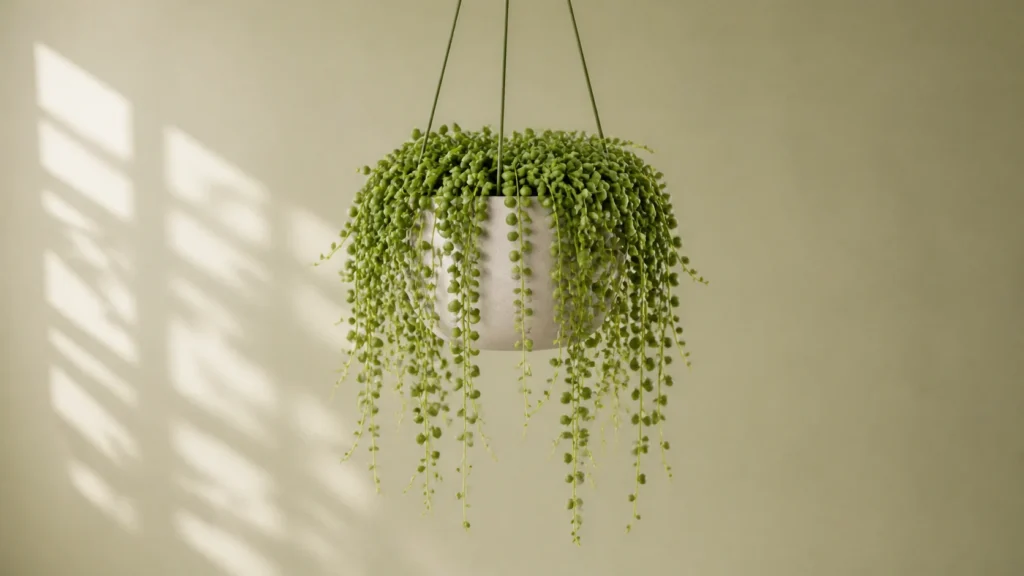
String of Pearls
Curio rowleyanus
A cascading succulent with spherical water-storing leaves that needs strong filtered light, a fast-drying root zone, and restrained watering.
Watering frequency
Every 14-21 days
Ideal temperature
60-80°F / 16-27°C
Humidity
30-50%
Care difficulty
Medium
Air purifying
No/Not Known
Growth rate
Fast
Plant size
1-3 ft trailing / 0.3-0.9 m
Soil type
Gritty succulent mix
Fertilizer need
Every 6-8 weeks while growing.
Care summary
- Light: Give the crown bright indirect light and optional gentle morning sun.
- Water: Water thoroughly after a substantial dry-down, then drain completely.
- Soil: Use a gritty, fast-drying mix in a pot with a drainage hole.
- Shape: Lay healthy stems over the surface to fill a thinning crown.
- Safety: Toxic if chewed; keep every trailing strand away from pets and children.
Common problems
- Shriveled pearls: Check dry soil, damaged roots, heat, and watering history.
- Translucent or mushy pearls: Treat as possible excess moisture or rot.
- Bare crown: Give the top of the pot more useful light and renew stems.
- Thin elongated growth: Increase light gradually.
- Pests: Inspect stem joints and the crown for mealybugs and aphids.
Plant care guide
About String of Pearls
String of Pearls is the familiar retail name for Curio rowleyanus, a trailing succulent formerly—and still frequently—sold as Senecio rowleyanus. NC State Extension’s species profile describes its South African origin, ground-hugging habit, rooting stems, and preference for bright filtered light and a porous mix. The accepted name matters when researching the plant, but the established common name remains the clearest title for shoppers.
Each “pearl” is a modified leaf. Its rounded form stores water while limiting exposed surface area, and a narrow translucent window helps light reach internal tissue. Thin stems creep over soil and root where they maintain contact before cascading over an edge. A hanging basket shows the strands dramatically, but the plant naturally behaves more like a groundcover than a vine climbing toward a support.
This distinction explains two common failures. First, light must reach the crown, not only the hanging ends. Second, the shallow root system needs oxygen; a large volume of wet potting mix can rot roots long before the visible strands look thirsty.
Why You’ll Like It
Few houseplants create such a strong silhouette in so little horizontal space. A healthy pot can soften a shelf, trail from a wall planter, or spill over a bright cabinet. The plant also propagates from stem sections, so a thinning specimen can often be renewed without buying another one.
String of Pearls is not “neglect proof.” It is best for someone willing to assess soil and plant texture rather than water every pot on the same weekday. Once light, pot size, and watering are aligned, care becomes simple: strong filtered light, an airy root zone, and a real dry-down without prolonged drought.
Compare Burro’s Tail for a denser succulent trailer with easily detached leaves, Ponytail Palm for another drought-adapted plant with a storage organ, or Jade Plant for an upright succulent with similarly important drainage needs.
What Kind of Plant Is It?
String of Pearls belongs to the daisy family, Asteraceae, despite looking nothing like a typical daisy. Mature plants may produce small brush-like white flowers with a sweet, spicy scent when light and seasonal conditions are favorable. Flowering is a bonus, not a reliable indoor event.
The root system is relatively shallow, and healthy stems may form new roots at nodes touching the mix. Nodes are the points where leaves attach. Those points are essential in propagation because bare leaf tissue alone cannot rebuild a complete trailing plant as reliably as a section of stem containing several nodes.
Growth usually strengthens in brighter, warmer periods and slows in cool, dim months. Adjust water to the actual drying rate rather than assuming that “succulent” always means the same interval. A small terracotta pot in a sunny window may dry rapidly; a glazed pot in winter may stay moist for weeks.
Related String Succulents
Several unrelated or closely related succulents are sold under “string of” names. They make useful future plant links, but their identity should not be collapsed into one record.
- String of Bananas (Curio radicans): Has curved, banana-shaped leaves and often grows more vigorously.
- String of Tears (Curio citriformis): Produces longer teardrop-shaped leaves rather than round pearls.
- String of Watermelons (Curio herreanus): Has oval leaves with subtle striping and pointed tips.
- String of Turtles (Peperomia prostrata): A peperomia with patterned flat leaves; it has different moisture and safety considerations.
- String of Hearts (Ceropegia woodii): A tuberous vine with heart-shaped leaves, not a bead-leaved succulent.
Confirm botanical identity before transferring care or pet-safety information between them.
Where It Works Best
Choose a position where daylight reaches the soil surface and crown. An east window with gentle morning sun, a bright position near a south or west window with protection from harsh midday rays, or a strong grow light can work. Rotate the pot periodically if growth leans strongly in one direction.
A high shelf is useful only if it is genuinely bright. Light intensity falls quickly with distance from glass, and the top of a tall cabinet may be darker than it appears to human eyes. Sparse nodes, tiny pearls, long gaps between leaves, and a bare crown are common signs of insufficient useful light.
Keep strands away from radiators, air-conditioning outlets, cold glass, and busy walkways. Dry household air is generally acceptable, but hot moving air can dehydrate stems faster than roots can supply them. Humid bathrooms are unnecessary and often too dim.
How to Care for String of Pearls
Light
Provide bright indirect light, with gentle early or late sun if the plant has been acclimated. Increase sun exposure gradually; a plant raised in a shaded nursery can scorch when moved abruptly into intense glass-amplified sun. Stronger light supports compact pearls and denser growth, but heat, pot temperature, and water demand rise with it.
Water
Water only after a substantial dry-down, then soak the mix evenly and let excess escape. Do not rely on a fixed 14- or 21-day promise. Check the pot’s weight, the mix below the surface, and pearl firmness. The original draft’s advice to leave a bone-dry plant for several extra days was too rigid: repeated severe dehydration can kill fine roots and produce chronic shriveling.
Water from the top slowly enough to wet the root ball, moving strands aside gently if necessary. Bottom watering can rehydrate a very dry mix, but remove the pot once moisture has moved through it; do not leave it standing in water. Avoid routinely pouring water onto a crowded crown where it may remain trapped with dead leaves.
Soil and container
Use a gritty succulent mix that drains quickly but can still absorb water. Commercial cactus mix often benefits from extra pumice, perlite, or coarse mineral aggregate. The exact recipe matters less than performance: after watering, the mix should be evenly damp, aerated, and progressively dry—not swampy at the center for many days.
Choose a shallow pot only slightly larger than the root mass, with at least one unobstructed drainage hole. Terracotta speeds evaporation and can help in cool or dim homes; glazed containers may suit very bright, warm rooms. A decorative cachepot is fine if the inner pot drains freely and is emptied after watering.
Humidity and temperature
Ordinary indoor humidity is usually adequate. Misting does not meaningfully raise room humidity and can leave moisture among crowded stems. Favor airflow without a harsh draft. Aim for stable household warmth and protect the plant from frost, cold windows, and sudden temperature swings.
Fertilizer
Feed lightly every six to eight weeks from spring through early fall, while stems are actively extending, with a diluted balanced or succulent fertilizer; pause in winter when growth slows. Do not fertilize dry, damaged, or rotting roots, and do not use food as a substitute for light. Excess salts can damage a small root system and cause decline that resembles drought.
Pruning and grooming
Remove dead stems and collapsed pearls with clean scissors. Shortening healthy strands above nodes encourages branching, and the cut pieces can be propagated. To thicken a bald crown, coil healthy stem sections across the surface and pin nodes gently against the mix. They can root while still attached to the parent plant.
How to Propagate String of Pearls
Take a healthy stem cutting with several firm pearls and multiple nodes. Remove a few pearls from the lowest section without tearing the stem. Either insert the exposed nodes shallowly into a lightly damp, airy mix or lay the cutting horizontally across the surface and secure several nodes in contact.
Keep the cutting in bright indirect light and avoid saturating the container. A large wet propagation pot is a common source of rot. New resistance to a gentle tug, fresh pearl growth, or branching indicates establishment. Water propagation can produce roots, but transferring delicate water-grown roots into a dry succulent mix adds an unnecessary adjustment; direct soil propagation is often simpler.
For a fuller basket, root several cuttings around the crown rather than placing one cutting at the edge. Do not guarantee a fixed rooting time, since temperature, light, stem health, and moisture change the pace.
When to Repot
Repot when roots densely occupy the container, water runs around a shrunken root ball without absorbing, the mix has collapsed, or drainage has become unreliable. Slow growth alone is not proof that the plant needs more pot space; first inspect light, season, pests, and roots.
Handle strands over a tray or towel. Support the crown, loosen the root ball carefully, and move up only one modest pot size. Replant loose healthy strands on the surface. Wait until damaged roots have had a little time to settle before returning to a heavy watering routine.
Toxicity and Pet Safety
String of Pearls is not pet-safe. The plant should be kept away from cats, dogs, and children who may chew the attractive bead-like leaves. NC State Extension identifies toxicity concerns, and the ASPCA’s succulent safety guidance advises that potentially harmful succulents may cause signs such as gastrointestinal upset, vomiting, or lethargy.
A high planter is not automatically safe because strands grow downward and fallen pearls can land within reach. If ingestion occurs or symptoms develop, contact a veterinarian, animal poison-control service, human poison-control service, or appropriate medical professional. Seek urgent help for breathing or swallowing difficulty. Do not rely on a home remedy.
Common Problems and Practical Fixes
Pearls are shriveled
Check below the surface before adding water. Dry, lightweight mix and firm roots suggest thirst. Wet mix with shriveled foliage suggests damaged roots that cannot supply water. Heat, cold injury, and repeated mild sips can also cause shriveling.
Pearls are translucent, yellow, or mushy
This often points to excess moisture, cold wet soil, or rot. Stop watering, improve warmth and airflow, and inspect the crown and roots. Preserve healthy firm strands as cuttings if rot is advancing.
The top is bald
Move the crown into stronger light gradually. Coil healthy strands onto the surface, propagate tip cuttings back into the pot, and remove dead material. Do not hide a dark crown by letting only the tips reach a window.
Stems are thin with wide gaps
Increase useful light and prune weak growth after conditions improve. Fertilizer cannot correct etiolation caused by insufficient light.
Pearls are scorched
Bleached, tan, or corky patches after relocation may indicate sun or heat stress. Pull the plant back from harsh midday glass and acclimate it more gradually.
Mealybugs or aphids appear
Inspect the crown, nodes, and flower stems. Isolate the plant, remove visible pests, and use a houseplant treatment labeled for the pest and succulent. Test any spray on a small area and repeat according to its label.
Frequently Asked Questions
Should the soil become completely dry?
Allow a substantial dry-down, but avoid turning “dry” into repeated prolonged dehydration. Pot size, root condition, light, and season determine the right interval.
Can it live in low light?
No. It may persist briefly, but dense pearls and a full crown require strong filtered light. A grow light is usually better than a decorative dark shelf.
Should I mist the pearls?
No routine misting is needed. It does not replace root watering or room-scale humidity and may keep crowded tissue wet.
Why does it keep dying after I water it?
Inspect the root ball. Oversized pots, dense peat, blocked drainage, cold conditions, and roots already lost to drought or rot can all keep the plant from using water normally.
Can one pearl grow a new plant?
A stem section containing viable nodes is the dependable unit. A detached pearl without suitable stem and node tissue should not be treated as a guaranteed propagation method.
Final Thought
String of Pearls succeeds when the crown receives real light and the shallow roots cycle from a thorough drink to an appropriate dry-down in an airy pot. Learn the difference between thirst and root failure, renew the crown with node-bearing cuttings, and keep every strand out of reach of pets. One unresolved production item remains: the canonical record has no Featured Image, so an approved species-accurate image is still required before migration.