
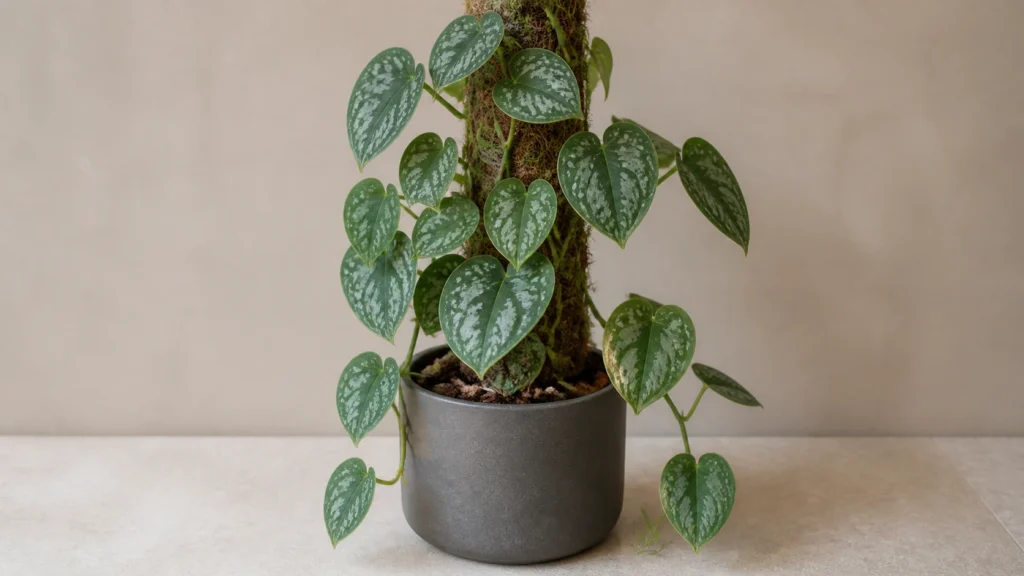
Satin Pothos
Scindapsus pictus
A climbing aroid with velvety green leaves splashed with silver, sold as a pothos though botanically it is a Scindapsus, and loved for its shimmering, near-metallic sheen.
Watering frequency
Every 7-10 days
Ideal temperature
65-80°F / 18-27°C
Humidity
50-70%
Care difficulty
Easy
Air purifying
No/Not Known
Growth rate
Moderate
Plant size
3-8 ft indoors / 0.9-2.4 m
Soil type
Well-draining aroid mix
Fertilizer need
Monthly, spring-summer.
Care summary
- Light: Give bright, indirect light; avoid harsh direct sun.
- Water: Water when the top inch or two of mix dries.
- Humidity: Average to high humidity keeps leaves glossy.
- Support: Offer a moss pole to see shingling growth.
- Safety: Toxic to cats and dogs if ingested.
Common problems
- Curled leaves: Underwatering or low humidity.
- Yellow leaves: Overwatering.
- Brown crispy edges: Low humidity or salt buildup.
- Faded silver: Too little light.
- Leggy growth: Needs more light.
Plant care guide
About
The Satin Pothos is a climbing aroid whose matte green leaves are dusted with irregular patches of silver, giving the foliage a soft, shimmery sheen like satin catching the light. The effect is subtle in dim corners and almost metallic in bright room light, which is exactly why the plant has become a staple of modern plant shelves. It is frequently grouped with the pothos family in garden centers, and it behaves like a pothos in every practical way, but botanically it belongs to a different genus. Its proper name is Scindapsus pictus, and the silver patches are its signature: every leaf is unique, and no two plants look quite alike.
It is one of the easiest climbing vines you can own. It tolerates a wide range of light, forgives missed waterings, and grows steadily without fuss, which makes it a favorite for beginners who want something more interesting than a plain green vine. Its only real demands are that it not be left to sit in wet soil and that it not be expected to stay silver in a dark corner.
Why You'll Like It
The Satin Pothos gives you the look of a rare, velvety tropical plant with the temperament of a workhorse. The silver-splashed foliage is genuinely striking, and because the silver pattern varies from leaf to leaf, the plant has a hand-crafted quality that mass-produced green vines lack. It is also a plant that visibly responds to care: give it a moss pole, and the leaves suddenly grow larger and begin to "shingle," lying flat against the support in overlapping rows, a completely different look from the trailing form.
It is forgiving enough for a first houseplant and interesting enough for a seasoned collector. It trails beautifully from a shelf, climbs a moss pole, tolerates average rooms, and propagates from a single node. Few plants deliver that combination of beauty, ease, and versatility.
What Kind of Plant Is It
The Satin Pothos is Scindapsus pictus, a climbing member of the arum family (Araceae) documented by the North Carolina State Extension. Its native range stretches from Bangladesh through Southeast Asia to the Malay Archipelago, where it grows as a hemiepiphyte: it starts life on the forest floor and climbs tree trunks, sending aerial roots into the bark. The genus name Scindapsus comes from an ancient Greek word for an ivy-like climbing plant, and the species epithet pictus means "painted," a direct reference to the silver markings.
The "pothos" in the common name is a historical accident, but an instructive one. In the nineteenth century, botanists grouped the plants we now call pothos, Scindapsus, and Epipremnum into a single genus called Pothos. As the classification was refined, the group split, and the name Pothos was restricted to a separate genus of true pothos species, while the familiar golden and marble queen vines were placed in Epipremnum and the silver-splashed plant in Scindapsus. The nursery trade never caught up with the botany, so today a garden center tag reading "Satin Pothos" almost certainly refers to a Scindapsus pictus.
The plant has two growth phases. When it trails or hangs, the leaves stay modest in size and spaced along the stem. When it climbs a moist support, its aerial roots grip the surface and the leaves grow larger and press flat against it, a behavior called shingling that is shared with some related aroids. Both forms are beautiful, but the climbing form is the one collectors chase.
History
The species was formally described in 1842 by the German-Dutch botanist Justus Carl Hasskarl, according to Kew's Plants of the World Online, who published the name in a Dutch botanical journal while working in Java. Hasskarl was a prolific describer of Southeast Asian flora, and Scindapsus pictus was among the species he documented from the region. Kew's Plants of the World Online records the native range as Bangladesh to central Malesia, covering much of the wet tropical belt where the plant climbs forest trees.
For most of its botanical history the species was a footnote, a handsome but minor member of a confusing group of genera. Its life as a houseplant began in the twentieth century as tropical plants entered Western living rooms, and it was helped enormously by the cultivar 'Argyraeus,' a form with particularly crisp, dense silver spotting, which received the Royal Horticultural Society's Award of Garden Merit, a formal recognition of its garden worthiness. In the trade the 'Argyraeus' form is so common that many people have never seen the less-variegated wild form.
The plant's popularity accelerated in the 2010s and 2020s alongside the broader houseplant boom. Social media discovered the silver foliage, and the plant appeared in endless "best plants for beginners" and "pothos family" roundups, where its satin texture made it a visual standout even among genuinely popular relatives like the golden pothos. The confusion between the genera also became a talking point among plant influencers, which only deepened public interest in the distinction.
Related Varieties
The Satin Pothos is one member of a large and increasingly popular genus, and the trade now offers several forms worth knowing.
- 'Argyraeus' is the classic form: compact silver spots on a green field, often sold simply as Satin Pothos.
- 'Exotica' has larger leaves with bigger, more connected patches of silver, sometimes covering most of the leaf surface.
- 'Silvery Ann' is a heavier-variegated selection with fine silver speckling across the whole leaf.
- 'Silver Lady' has an almost entirely silver leaf with a thin green margin.
Within the broader "pothos family" the Satin Pothos is most often compared with the true Epipremnum pothos cultivars, including the classic golden pothos, the marble queen pothos, the neon pothos, the manjula pothos, Pothos 'Pearls and Jade', and the pothos glacier. All share the same easy, trailing habit and the same calcium-oxalate toxicity; the Satin Pothos differs mainly in its velvety texture and silver pattern.
Where It Works
The Satin Pothos is flexible about position, which makes it an easy plant to place. It does best in bright, indirect light, where the silver markings are most pronounced, but it tolerates moderate light well, growing a little slower and losing a little silver rather than failing. Avoid direct sun, which scorches the thin leaves, and avoid truly dark corners, where the plant becomes leggy and the silver fades to nothing.
It trails beautifully from a shelf, cabinet, or hanging basket, and it climbs a moss pole, trellis, or even a wall-mounted board if the surface stays moist enough for its aerial roots. It suits living rooms, home offices, and bright bathrooms, and it is happy in the ordinary humidity of a home, though it appreciates a little extra moisture in dry winter air.
How to Care for a Satin Pothos
Light. Bright, indirect light is ideal. The silver patches are produced most densely in good light, so the single best thing you can do for the plant's appearance is give it a bright spot. A few feet back from an east or west window, or near a north window, is usually enough.
Water. Water when the top inch or two of mix has dried, then water thoroughly. The plant dislikes both extremes, but it tolerates occasional dryness better than soggy soil, so when in doubt, wait a day. In practice, water about weekly in summer and every ten days to two weeks in winter, checking the soil rather than following a schedule.
Soil. Use a well-draining aroid mix, such as houseplant soil amended with perlite and orchid bark. The aerial roots and the root system both appreciate the air pockets, and the mix dries at a pace the plant enjoys.
Humidity. Average home humidity is fine. If the leaf edges crisp in dry winter air, raise humidity with a humidifier or pebble tray, or simply group the plant with others.
Fertilizer. Feed monthly in spring and summer with a balanced liquid fertilizer at half strength. The plant is not a heavy feeder; overfeeding causes salt buildup that browns the leaf tips.
Support. If you want shingling growth, provide a moss pole and keep the moss damp. The leaves that press against the moist surface grow larger and lie flat, transforming the plant's appearance.
How to Propagate
The Satin Pothos propagates easily from stem cuttings, the same way as any pothos. Cut a stem with at least one node and one or two leaves, cutting just below the node with clean scissors. Root the cutting in water, which shows progress clearly, or plant it directly into moist mix. In water, roots appear within two to four weeks; move the cutting to soil once the roots are an inch or two long. In soil, keep the mix lightly moist and warm until new growth appears.
Cuttings taken from a climbing stem will start climbing again when given a support, so you can build a full, multi-stemmed plant on a single pole from a few cuttings. Propagation is also the way to refresh a plant that has grown leggy: cut it back, root the pieces, and replant them in the same pot for a fuller plant.
When to Repot
Repot your Satin Pothos every one to two years, in spring, when roots fill the pot or begin circling the drainage holes. The plant is happy to be slightly root-bound, so do not repot on a schedule if the roots are not ready. Step up only one pot size, use fresh well-draining mix, and water in well. If the plant has grown long, this is also the moment to take cuttings and replant them around the edge of the pot for a fuller display.
Toxicity
The Satin Pothos is toxic to cats and dogs, like every member of the arum family. Its tissues contain insoluble calcium oxalate crystals, which are released when leaves or stems are chewed and cause immediate pain, drooling, and swelling of the mouth and throat. The ASPCA's toxic plant database lists the closely related Epipremnum group, the true pothos, under the common name Devils Ivy, recording it as toxic to cats, dogs, and horses, and the same oxalate chemistry applies to Scindapsus, though the database does not carry a species-level entry for it.
In practice, the plant is rarely dangerous in the way that, say, a lily is dangerous to cats. The crystals cause immediate pain, which usually stops a pet after the first bite, and the typical outcome is drooling and mouth discomfort rather than systemic poisoning. Still, keep the plant out of reach, and if your pet chews it, rinse its mouth, offer water, and contact your veterinarian if symptoms are more than mild.
Common Problems
Curled leaves. Usually underwatering or dry air. Check the soil; if it is dry, water thoroughly, and if the air is dry, raise humidity.
Yellow leaves. Almost always overwatering. Let the soil dry further between waterings and make sure the pot drains freely.
Brown, crispy leaf edges. Low humidity, salt buildup from overfeeding, or both. Flush the soil with plain water occasionally, and raise humidity.
Faded, washed-out leaves. Too little light. The silver markings are the first thing to fade in a dim corner; move the plant brighter.
Leggy stems with widely spaced leaves. Insufficient light. Cut the plant back, root the cuttings, and move it to a brighter spot.
Pests. Spider mites and mealybugs are the usual offenders. Check leaf undersides, treat early with insecticidal soap or neem oil, and isolate the plant until clear.
FAQ
Is Satin Pothos a real pothos? No. It is Scindapsus pictus, a different genus from the true pothos (Epipremnum). The common name is a trade leftover from an older, broader classification, but the care is identical.
Why is my Satin Pothos losing its silver? Low light. The plant produces more chlorophyll and less silver pigment in dim conditions. Move it to a brighter spot and new leaves should show the pattern again.
How often should I water a Satin Pothos? When the top inch or two of soil is dry, roughly weekly in summer and every ten days to two weeks in winter. Check the soil rather than following a fixed schedule.
Can Satin Pothos grow in low light? It survives in moderate light but grows slowly, leggy, and less silver. For a healthy plant, give it bright, indirect light.
Why are the leaves curling? Usually a watering issue, either dry soil or dry air. Water thoroughly if the soil is dry, and raise humidity if the air is dry.
Final Thought
The Satin Pothos is one of those plants that quietly earns a place in every room it enters. It asks for the same easy care as any pothos, but its velvety, silver-painted leaves look like something far rarer, and it rewards the extra effort of a moss pole with a completely different, shingling form that few houseplants can produce. It tolerates imperfect conditions without complaint, propagates from a single node, and stays beautiful for years. For a beginner it is an easy win, and for a collector it is a reminder that the most rewarding plants are often the ones that ask for the least. Just keep it out of reach of pets, and give it light.