
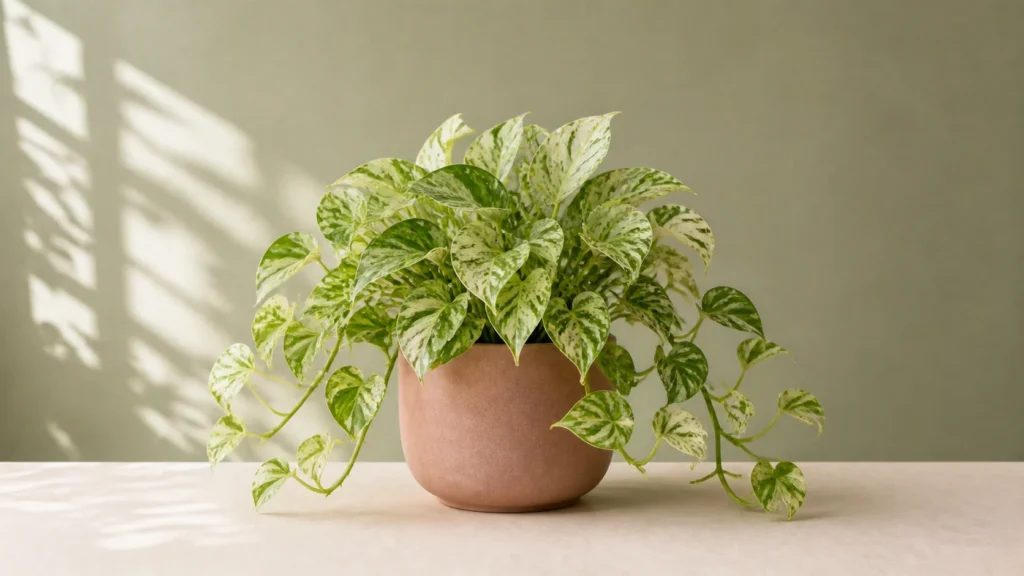
Marble Queen Pothos
Epipremnum aureum 'Marble Queen'
A Golden Pothos cultivar with cream and white marbled leaves that grows a little slower than the green form and needs brighter light to keep its pattern.
Watering frequency
Every 7-14 days
Ideal temperature
65-85°F / 18-29°C
Humidity
40-60%
Care difficulty
Easy
Air purifying
Yes
Growth rate
Moderate
Plant size
2-6 ft / 0.6-1.8 m
Soil type
Well-draining potting mix
Fertilizer need
Monthly, spring-summer.
Care summary
- Light: Bright indirect light is essential to keep the white marbling.
- Water: Let the top 1-2 inches dry, then water thoroughly and drain.
- Soil: Use an airy, well-draining mix in a pot with drainage holes.
- Growth: Slower than Golden Pothos; prune to keep the plant full.
- Humidity: Average household humidity is usually sufficient.
- Safety: Keep away from pets and children who may chew the leaves.
Common problems
- White sections turning brown: Scorch from harsh sun on the palest leaf tissue.
- Leaves reverting to green: Light too dim; cut back fully green vines to protect the pattern.
- Slow growth: Normal for this cultivar, especially in low light.
- Yellow leaves: Usually overwatering or poor drainage.
- Leggy vines with wide gaps: Needs brighter indirect light or pruning.
- Mealybugs or scale: Check the leaf joints and along the stems.
Plant care guide
About Marble Queen Pothos
Marble Queen Pothos (Epipremnum aureum 'Marble Queen') is a cultivated variety of Golden Pothos, the same species that carries the accepted botanical record documented by Kew Plants of the World Online. Where the standard Golden Pothos shows yellow-gold flecks on green, Marble Queen's leaves are marbled with irregular cream and white sections that can cover most of the leaf surface.
It is one of the oldest and most widely sold variegated pothos cultivars, grown for a visual effect that the green species does not offer: a bright, almost painted look that reads as lighter and more delicate in a room. Because the white tissue contains no chlorophyll, the plant grows more slowly than Golden Pothos and needs more light — those two differences are the practical heart of this page.
The care basics are shared with the species, so this guide stays focused on what is different about the cultivar and points you to the Golden Pothos record for the full care, propagation, and repotting detail.
Why You'll Like It
Marble Queen gives you the easy, forgiving nature of pothos with a much more striking leaf. The cream and white marbling brightens dark furniture and neutral walls, and it reads well in hanging planters, on bookshelves, or trained up a small trellis.
It is also a more interesting plant to watch than a solid-green vine. Every new leaf is a slightly different pattern, and the plant visibly responds to its light: give it brighter indirect light and new leaves emerge with whiter, more dramatic marbling.
The trade-off is pace. Compared with the fast-growing Golden Pothos, Marble Queen is a patient plant. If you want quick coverage of a shelf, Golden Pothos or the solid-chartreuse Neon Pothos will fill the space faster. Choose Marble Queen when the leaf pattern is the point.
What Kind of Plant Is It?
Marble Queen is a climbing and trailing aroid vine with a specific genetic quirk: its leaves are chimeras, made up of patches of normal green tissue and patches of white tissue that lack chlorophyll. The white areas can never photosynthesize, so the plant's energy comes from the green sections only.
That single fact explains the cultivar's behavior:
- Slower growth than the green form. Less photosynthesizing tissue means less energy for new vines.
- A real need for light. The white sections are a burden on the plant; bright indirect light lets the green tissue work efficiently enough to support them.
- A tendency to revert. If light is too dim, the plant often responds by producing vines with more green — sometimes plain green leaves. The UF/IFAS cultivar documentation explains that Pearls and Jade, a related selection, arose as a mutation of Marble Queen, which shows how actively this group of cultivars mutates and reverts in cultivation.
Like all Epipremnum aureum cultivars, it is an aroid with nodes along the stem, aerial roots, and juvenile leaves indoors. The NC State Extension profile of the species describes the climbing habit, aerial roots, and larger mature leaves when the plant receives support.
Marble Queen vs. Other Pothos
If you are choosing between pothos varieties, the differences are mostly appearance and growth rate:
- Golden Pothos — green and gold flecks; the fastest, most forgiving, and best in lower light.
- Marble Queen — cream and white marbling; slower, needs brighter light, and the whitest sections scorch easily in harsh sun.
- Neon Pothos — solid chartreuse leaves; nearly as easy as Golden Pothos, with color that intensifies in good light.
- Pearls and Jade — compact, white-gray-green marbling on small leaves; a Marble Queen mutation with a finer pattern.
- Pothos 'Glacier' — small leaves in green, white, and silver; a compact choice for shelves and desks.
- Satin Pothos — matte green leaves splashed with silver on a Scindapsus pictus; softer in texture than the true pothos and not an Epipremnum cultivar.
They share the same watering, soil, temperature, and toxicity profile. Choose by light and look: bright rooms suit the white-heavy cultivars; dimmer rooms favor Golden Pothos.
Where It Works Best
Marble Queen needs more light than you might expect for a pothos. Aim for bright, indirect light for several hours a day — near an east window, or back from a south or west window where the sun is filtered. The houseplant light guide explains how to read a room's light level before placing any plant.
In medium or low light the plant survives but changes character: growth slows further, the white marbling shrinks, and new leaves lean greener. A genuinely dim corner is a poor home for this cultivar — that is where Golden Pothos or a ZZ Plant belongs instead.
Keep the plant away from harsh direct afternoon sun. The white tissue has no protective chlorophyll, so it scorches faster than green leaves, showing up as brown, papery patches on the palest areas.
A note on pattern stability: the marbling is not a fixed snapshot. Each new leaf is a fresh draw from the plant's genetics and its current conditions, so the same plant can produce very different leaves over a year. Bright light produces whiter, more dramatic marbling; dim light produces greener leaves with smaller white sections. This means the plant's appearance is partly under your control — treat light as the dial that tunes the pattern. It also explains a common worry: a plant that loses its marbling is not dying, it is adapting, and it will usually regain the pattern when moved brighter. For the same reason, a cutting taken from a heavily variegated section tends to produce heavily variegated vines, which is why selecting cuttings carefully matters for propagation.
How to Care for Marble Queen Pothos
The basic care routine follows the species — light, watering, soil, humidity, temperature, and fertilizer are covered in depth in the Golden Pothos care guide linked above. The cultivar-specific points are these:
Light: Bright indirect light is the single most important factor for Marble Queen. It drives both growth and pattern. If the white is fading or new leaves are mostly green, raise the light level gradually — move it closer to the window over a few days rather than all at once.
Watering: When the top 1-2 inches of mix feel dry, water thoroughly and drain. Many homes land around every 7-14 days, but pot size, warmth, and light change the interval. Because Marble Queen grows slower, it often uses water a little more slowly than Golden Pothos; check the soil rather than assuming the same schedule. The watering guide covers reading soil moisture reliably.
Soil and container: The same airy, well-draining mix and drainage holes as the species. No special cultivar treatment needed.
Fertilizer: Balanced fertilizer at half strength monthly in spring and summer, paused in winter. Do not feed a plant that is already stressed by low light — fertilizer does not replace light.
Pruning and training: Cut long or bare vines just above a node. If you see fully green shoots, cut them back to encourage variegated growth — this is the standard way to protect the cultivar's pattern.
How to Propagate
Marble Queen roots from node cuttings exactly like Golden Pothos. Cut a healthy vine just below a node, remove the lowest leaf so the node sits under water or in moist mix, and keep the cutting in bright indirect light until roots develop. A cutting with two or three leaves is the easiest size to start with.
One cultivar-specific note: choose cuttings from the most variegated sections you like. Cuttings inherit the parent stem's pattern tendencies, so selecting strong marbling when you take the cutting gives new plants the best start. Water-rooted cuttings transplant to a small pot of moist mix once the roots are several inches long.
When to Repot
Repot when roots circle the pot, grow through the drainage holes, or the mix dries out almost immediately after watering — every 1-2 years in practice, but judge by the roots. Move up only 1-2 inches in pot size and use fresh well-draining mix. The repotting guide covers the full process, including how to handle a root ball gently.
Toxicity and Pet Safety
Like every Epipremnum aureum cultivar, Marble Queen is not pet-safe. The ASPCA's poison-control profile for the species lists insoluble calcium oxalates as the toxic principle, with oral pain or swelling, drooling, vomiting, and difficulty swallowing among the clinical signs in cats, dogs, and horses. Breathing or swallowing difficulty requires urgent veterinary attention.
If a pet chews the plant, remove it from reach and contact your veterinarian or an animal poison-control service promptly. A high shelf is only safe while the trailing vines stay out of reach. For pet-owning households, a genuinely safe trailing alternative is Hoya Carnosa, and Spider Plant is another reliable non-toxic option.
Common Problems and Practical Fixes
- White patches turning brown or papery: Usually sun scorch on tissue without chlorophyll. Move the plant out of direct sun; the damaged areas will not recover, but future leaves will be fine.
- New leaves mostly green: Insufficient light. Increase brightness gradually and prune fully green vines to keep the variegated pattern dominant.
- Very slow growth: Expected for this cultivar, and more pronounced in low light. Improve light, check that the pot is not root-bound, and avoid overfeeding.
- Yellow leaves: Check watering and drainage first; this cultivar is prone to the same overwatering problems as the species. The yellow leaves guide helps compare causes.
- Leggy vines: Long gaps between leaves usually mean the light is too weak. Move it brighter and prune to encourage bushy regrowth.
- Mealybugs or scale: Check the leaf joints and stems, isolate the plant, and treat weekly until no new pests appear.
Frequently Asked Questions
Why is my Marble Queen pothos turning green?
Low light is the usual cause. The plant responds to dim conditions by producing more chlorophyll — greener leaves and less white. Move it to brighter indirect light gradually; existing leaves will not change back, but new growth should show more marbling.
Is Marble Queen pothos hard to care for?
No — it is as easy as Golden Pothos in terms of watering and soil. The only real requirement is more light. Give it a bright spot and it is a very forgiving plant.
Can Marble Queen grow in low light?
It survives in low light but loses its pattern and nearly stops growing. It is a poor choice for a genuinely dim corner. Golden Pothos handles low light far better.
Is Marble Queen pothos toxic to cats and dogs?
Yes. It contains the same insoluble calcium oxalates as all pothos cultivars, and the ASPCA lists the species as toxic to cats, dogs, and horses. Keep it out of reach of pets and children.
Should I cut off all-white leaves?
Usually yes. A leaf with no green at all cannot photosynthesize, so it is a pure burden on the plant — it consumes the energy the green sections produce without contributing any back. If a shoot is producing all-white or mostly-white leaves, cut it back to a node with green in the stem. This redirects the plant's energy to variegated growth that can actually support itself. Fully white leaves are also the most fragile parts of the plant, the first to brown at the edges even under good care.
Can I grow Marble Queen in water permanently?
Technically yes — the plant will survive in a water-filled vase indefinitely, and many people grow it that way. But a water-grown Marble Queen grows slowly and the white marbling tends to fade, because the plant gets no soil nutrients and the constant moisture suits it less than the species. Water propagation for roots, then moving the cutting to soil, gives the best of both: fast rooting and a healthier, better-colored long-term plant.
Final Thought
Marble Queen is a plant with one non-negotiable: light. Everything else about it is the easy pothos routine — dry the top inch, water thoroughly, prune when leggy. Put it in bright indirect light, accept its slower pace, and it will keep producing those white-marbled leaves that make it one of the most recognizable houseplants in the world.