
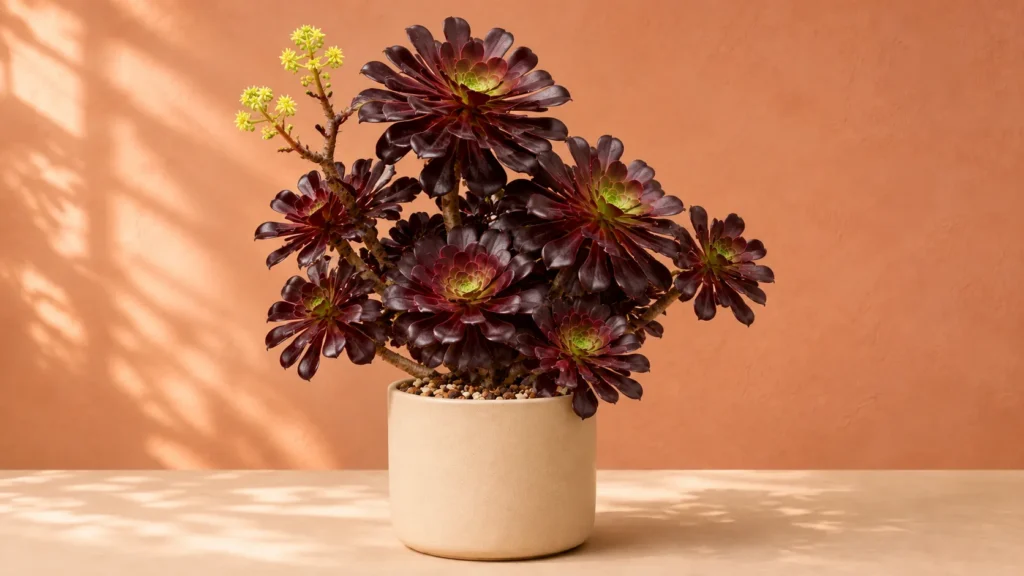
Black Rose Aeonium
Aeonium 'Zwartkop'
A branching Aeonium with nearly black purple rosettes on woody stems, requiring strong light to show its best color.
Watering frequency
Check weekly; water when partly dry during active growth
Ideal temperature
55-75°F / 13-24°C; protect from frost
Humidity
Average room humidity
Care difficulty
Medium
Air purifying
No/Not Known
Growth rate
Moderate
Plant size
Small nursery pots; older branching plants can reach 1-3 ft / 0.3-0.9 m indoors
Soil type
Gritty, free-draining succulent mix
Fertilizer need
Feed lightly during active growth only.
Care summary
- Light: Very bright light maintains compact, dark rosettes.
- Water: Water when the mix partly dries during growth; reduce when resting.
- Soil: Use a gritty mix and a drainage hole.
- Color: Purple-black depth changes with light and season.
- Growth: Branching stems can be renewed from rosette cuttings.
- Safety: Keep away from chewing pets while specific toxicity evidence is unconfirmed.
Common problems
- Green or pale new growth: assess light and normal seasonal color change.
- Loose rosettes and long stems: too little usable light.
- Soft stem base: wet roots or poor drainage.
- Dry burned patches: abrupt move into fierce direct sun.
- Cottony pests: check rosette centers and stem joints for mealybugs.
Plant care guide
About Black Rose Aeonium
Black Rose Aeonium is the near-black, purple-rosetted Aeonium ‘Zwartkop’. It belongs to the Crassulaceae family and grows a branching framework of stems topped with flattened rosettes. In strong light the foliage can look almost black; in weaker conditions new leaves often appear greener. RHS describes ‘Zwartkop’ as a succulent with blackish-purple rosettes held at the ends of woody stems. “Black Rose,” “Black Tree Aeonium,” and “Zwartkop Aeonium” are useful shopping names, but the cultivar name is the clearest identity for this page.
The dark selection is often placed under Aeonium arboreum in older or retail labels. The RHS Aeonium trial lists ‘Zwartkop’ and A. arboreum ‘Atropurpureum’ separately. A dark plant sold as “Black Rose” is not automatically ‘Zwartkop’; a nursery label or good provenance helps when exact cultivar identification matters.
Why You'll Like It
The dark rosettes bring strong contrast to pale pots and green houseplants. An older plant can develop a sculptural shape without needing a very large container. It pairs visually with Tree Aeonium, whose green rosettes make the color difference obvious. The same dry-air tolerance that suits other Aeoniums helps in normal rooms, provided the plant receives enough light and its roots do not sit wet.
Black Rose Aeonium is not a low-light black houseplant. Its best color depends on a brighter position than many tropical foliage plants need. If the only available space is a shaded shelf, the plant may gradually become greener and stretch. That is a placement issue rather than a reason to feed more heavily.
What Kind of Plant Is It?
Each apparent “rose” is a rosette of leaves on a stem. As lower leaves age, they dry and detach, leaving a more visible trunk. Healthy new leaves continue to emerge from the center. A very long internode—the space between leaf attachment points—can be a sign that the plant is reaching for light. Branches may develop after pruning or damage, but the final form varies with age and conditions.
Flowering is possible on mature plants. Aeonium rosettes may die after they flower, so the survival of a branching plant depends on other, unflowered rosettes. This is one reason to keep a cutting from a valued mature plant before a major flowering event. The NC State Extension genus profile describes this rosette-level flowering pattern.
Where Black Rose Aeonium Works Best
Place it close to a sunny south- or west-facing window, or in another very bright exposure with direct sun for part of the day. Acclimate a plant from a shop or winter room before giving it intense outdoor sun. A hot window can overheat a small pot; watch the leaf surface and move it slightly back when the glass becomes very hot. Provide room for the branches to spread as the plant grows. Outdoors in a frost-free mild season, use a sheltered patio position and bring the pot in before cold weather.
Black Rose Aeonium Care
Light and color. Give strong light for the deepest purple-black foliage and compact rosettes. A green center can be normal on new leaves, and color can shift with the season. Evaluate the overall growth habit as well as the color. If the plant is leaning, stretching, and losing contrast, improve light gradually. Sudden severe sun after a long dim period can leave permanent pale scars.
Watering. During active growth, water thoroughly once the mix has partly dried, then empty the saucer. When rosettes contract and growth nearly stops in heat or a low-light season, let the pot remain drier. Do not use a fixed weekly dose as if the plant were always growing at the same rate. A light, dry pot and firm but slightly thinner leaves suggest thirst; a heavy wet pot with soft stems suggests root trouble. The RHS succulent growing guidance stresses drainage and adjusting care to conditions.
Mix and container. A gritty succulent medium and a drainage hole help the roots dry between waterings. Use a stable pot if stems become top-heavy, but avoid a container much larger than the roots. Decorative cachepots must be drained after watering. When repotting, keep the crown above the mix and remove only dead or rotten root tissue.
Temperature and humidity. Ordinary indoor humidity is fine. Protect from frost and prolonged cold, wet soil. In an overheated room, the plant may slow down even though the calendar says it should be growing. Provide bright light, ventilation, and restrained watering until new leaves resume.
Fertilizer and shaping. A small amount of balanced fertilizer during visible growth is sufficient. Feeding more will not deepen dark color without light. Remove crisp, detached lower leaves. If a tall stem needs shortening, cut a healthy rosette with a short section of stem and root it as a replacement. Maintain a clean blade and allow the wound on the parent to dry.
How to Propagate Black Rose Aeonium
Stem cuttings preserve a named cultivar more reliably than seed. Cut a healthy rosette with a short stem, let the cut dry, and set it in a gritty medium in bright filtered light. Keep the mix barely moist until roots develop. Avoid sealing a damp cutting in a humid bag, which encourages rot. A rooted cutting may still need time in brighter light before it regains its darkest color. Do not assume a green cutting is a different cultivar until growth conditions have been reviewed.
Safety Around Pets
This review did not find a cultivar-specific ASPCA ingestion assessment for ‘Zwartkop’. The database uses the conservative “Not pet safe” value because verified safety evidence is missing, not because a particular toxin has been demonstrated. Keep the pot away from pets that chew plants. If ingestion occurs and the animal seems unwell, seek veterinary advice with the cultivar name. The ASPCA plant-list introduction explains that plant material can cause stomach upset even when a species is categorized as non-toxic.
Common Problems and Practical Fixes
- New leaves look green: Compare light, season, and the age of the leaves. Move to brighter light gradually if growth is also loose.
- Rosettes are getting smaller: Check whether heat or low light has slowed growth, then check the mix and roots before adding water or fertilizer.
- Soft, dark stem base: Unpot and inspect roots. Save a healthy upper rosette as a cutting if rot has advanced.
- Pale patches: Consider recent sun exposure. Damaged tissue will not turn black again, but new leaves may grow normally after acclimation.
- Mealybugs or aphids: Inspect the tightly packed center and underside of leaves; isolate and treat before moving the plant near others.
Frequently Asked Questions
Is Black Rose Aeonium a true black flower?
No. The “rose” is a leaf rosette, and the dark color is in the leaves. Flowers, when produced, are separate structures.
Is ‘Zwartkop’ identical to every plant labeled ‘Atropurpureum’?
Do not assume that. Retail descriptions overlap, but RHS lists the names separately in its trial. Use a reliable original label when choosing a cultivar-level identification.
Will the color return after a dim winter?
New growth may darken in stronger light, while already formed leaves may not become uniformly black. Transition gradually so the plant does not scorch.
Final Thought
Black Rose Aeonium rewards a bright position with dramatic dark rosettes. Give its roots drainage, let watering follow actual growth, and preserve the cultivar name when sourcing an image or a replacement plant.