
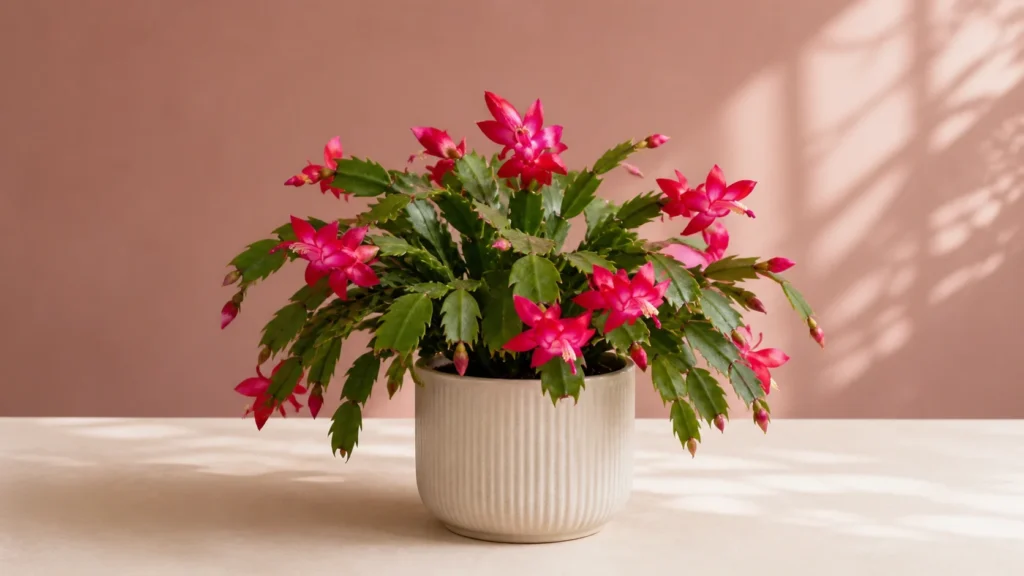
Christmas Cactus
Schlumbergera × buckleyi
A festive, pet-safe bloomer with flat segmented stems and vivid winter flowers — and unlike most cacti, it loves humidity and steady moisture.
Watering frequency
Every 7-14 days
Ideal temperature
60-75°F / 16-24°C
Humidity
50-70%
Care difficulty
Easy
Air purifying
No/Not Known
Growth rate
Moderate
Plant size
1-2 ft / 0.3-0.6 m
Soil type
Well-draining cactus or succulent mix
Fertilizer need
Monthly, spring-early fall.
Care summary
- Light: Bright indirect light; some morning sun in winter.
- Water: Water when the top inch of soil dries — never let it sit soggy.
- Soil: Well-draining cactus or succulent mix.
- Humidity: Higher humidity helps; a bright bathroom is ideal.
- Blooming: 13+ hours of darkness and cool nights in fall.
- Safety: Pet-safe.
Common problems
- Buds dropping: moved, drafts, or inconsistent watering.
- Wilting, shriveled stems: underwatering or root damage.
- Yellowing segments: too much water or too much sun.
- No flowers: needs dark nights and cool fall temperatures.
- Root rot: soil that stays soggy.
Plant care guide
About Christmas Cactus
“Christmas cactus” is used loosely in stores for several Schlumbergera holiday cacti. True Christmas Cactus is generally Schlumbergera × buckleyi, while the earlier-blooming plant most often sold under the same label is Schlumbergera truncata, the Thanksgiving Cactus. Both produce bright tubular flowers in red, pink, purple, orange, or white during the darker months. They are succulent epiphytes derived from Brazilian rainforest plants, so their care differs from sun-baked desert cacti.
Identification is worth checking before you rely on a holiday name. NC State Extension identifies S. truncata as Thanksgiving Cactus: its stem segments have pointed, claw-like margins and it commonly flowers earlier. NC State's true Christmas Cactus record shows the rounder, smoother segment margins typical of S. × buckleyi. Their broad care principles overlap, but identity affects expected flowering season and appearance. This page covers the shared household routine and points out distinctions where they matter.
Unlike many seasonal gift plants, a holiday cactus can remain attractive year-round and live for decades under stable care. It can rebloom when fall light and temperature cues are suitable, and it propagates readily from stem segments. The ASPCA lists Christmas Cactus as non-toxic to cats and dogs, although chewing any plant material may still cause stomach upset.
Why You'll Like It
Christmas Cactus can bring real flowers indoors during the darker months without being treated like a disposable holiday decoration. Reliable reblooming still depends on fall conditions: a bright daytime position, steady watering, cool nights, and long periods of uninterrupted darkness help buds form. The flowers open in succession, so an established plant may stay colorful for weeks.
It's also an attractive plant even when it's not blooming. The flat, segmented stems arch gracefully over the pot's edge, making it a natural choice for a hanging basket or a pedestal. The segments grow in a soft cascade that looks good for eleven months of the year, then disappears under a cloud of flowers for the twelfth.
And it is honest, forgiving houseplant material: it tolerates the occasional missed watering, reblooms reliably even after being neglected, and — the detail that wins over pet owners — the ASPCA lists it as non-toxic to cats and dogs. In a season full of toxic holiday plants, that alone makes it the default choice for homes with animals.
What Kind of Plant Is It?
Three facts explain how this plant behaves.
- It is an epiphytic cactus, not a desert cactus. In the wild it roots into tree branches and crevices in Brazilian rainforests, gathering water from rain and humid air. Indoors, that translates to a plant that wants more water and humidity than a typical cactus — and much less sun. Treat it like a tropical plant that happens to store water, not like a saguaro.
- Its "leaves" are actually stems. The flat, segmented pads are modified stems (cladodes) that photosynthesize, and each segment can root into a new plant. This is why propagation is so simple — a two-segment piece dropped into soil becomes a whole new cactus.
- Its flowering is triggered by darkness, not temperature alone. Like a short-day plant, it sets buds when nights are long — about 13 hours or more of continuous darkness — combined with cool fall temperatures. Get that fall rhythm right, and the winter flowers follow automatically.
Where It Works Best
The Christmas Cactus wants bright, indirect light — near an east or north window, or a few feet back from a south or west window where the sun can't scorch it. NC State notes that direct summer sun will yellow the stems, so filtered light during the growing season is correct, while a brighter position in winter helps the buds develop. It can flower in medium light, but it blooms best with good light through the fall.
Humidity is a genuine preference, not a nicety: the plant comes from rainforest air, and NC State specifically suggests the bathroom as an ideal location. A bright bathroom, a kitchen near a sink, or any room with a humidifier suits it better than a dry living room. If the air is very dry, a pebble tray helps — the humidity guide covers the options.
Temperature is the one thing to manage: comfortable household warmth of 60-75°F (16-24°C) is right, and the plant needs cool fall nights (around 55-65°F) plus uninterrupted darkness to set buds. Keep it away from radiators, heat vents, and cold drafts — the two extremes that make buds drop.
How to Care for Christmas Cactus
Watering: Water when the top inch of soil feels dry — typically every 7-14 days in an average room — then water thoroughly and let the excess drain. The plant hates standing in soggy soil (root rot) but also dislikes drying out completely between waterings; the watering guide explains the "moist, not soggy" rhythm it wants. During bud set and flowering, keep the rhythm steady — sudden dryness or wetness is what makes buds fall.
Light: Bright indirect light year-round, with more direct light allowed in winter. Summer sun through glass burns and yellows the stems. If the plant sits in a dark corner, it grows but rarely flowers.
Soil: Use a well-draining cactus or succulent mix. Because the plant prefers steady moisture, many growers add a little extra organic matter — or simply use a high-quality houseplant mix with added perlite — so the roots stay lightly moist without sitting in water.
Temperature: Comfortable rooms of 60-75°F (16-24°C). For fall bud set, give it cool nights around 55-65°F (NC State even suggests brief exposure to 40°F nights to force blooming) and keep it away from drafts and heat sources.
Humidity: Higher humidity keeps the stems plump and healthy. A bright bathroom, a pebble tray, or a nearby humidifier all work. This is one of the few succulents that genuinely benefits from the humidity-raising techniques most guides reserve for tropicals.
Fertilizer: Feed monthly from spring through early fall with a balanced houseplant or cactus fertilizer at half strength; reduce feeding as the days shorten in fall and winter. The fertilizing guide covers the general timing.
The fall bud-setting routine: From roughly late September through early November, give the plant 13-14 hours of total darkness every night — move it to a closet or cover it — and keep nights cool. This darkness-and-cool rhythm is what sets the buds. Once buds appear, move it back to bright light, keep watering steady, and don't relocate it again until flowering finishes; the plant drops buds when it's moved mid-bloom.
How to Propagate
Stem-segment cuttings make this one of the easiest houseplants to propagate. Twist off a two-to-three-segment piece at a joint, let the cut end dry and callus for a day or two, then press the bottom segment about half an inch into moist cactus mix. Roots form within a few weeks; keep the soil lightly moist and give the new plant bright indirect light. Each segment is genetically identical to the parent, so the cutting blooms in the same colors. NC State recommends exactly this method — a 2-3 segment cutting, dried briefly, then rooted. Take cuttings in spring or early summer for the fastest establishment, and don't be surprised if the young plant blooms in its first or second winter.
When to Repot
Repot only when genuinely needed — every three years or so, and the plant actually flowers best when slightly root-bound, as NC State notes. In spring, after flowering, move up one pot size using fresh well-draining cactus mix. Choose a pot with drainage holes and, if you're growing it as a hanging plant, keep the pot shallow — the roots are shallow and resent deep, water-holding soil. After repotting, water lightly for a week or two while the roots settle. The repotting guide walks through the standard technique.
Toxicity and Pet Safety
The ASPCA lists Christmas Cactus as non-toxic to cats and dogs, and NC State records also carry non-toxic or pet-friendly tags for the holiday-cactus group. Even non-toxic plant material can cause stomach upset when eaten in quantity, so discourage chewing and contact a veterinarian if symptoms occur. The pet-safe plants guide includes other options for pet households.
Common Problems and Practical Fixes
- Buds dropping: The classic Christmas Cactus complaint, and almost always environmental: the plant was moved, exposed to a draft or heat vent, or watered inconsistently while buds were forming. Once buds appear, don't relocate the plant, keep watering steady, and keep it away from temperature swings.
- Wilting, shriveled stems: Underwatering — or root damage from a soggy pot. If the soil is bone dry, water thoroughly and the stems plump up within a day. If the soil is wet and the stems still shrivel, check the roots for rot.
- Yellowing segments: Too much water or too much direct sun. Let the soil dry further between waterings and move the plant out of harsh light.
- No flowers: The plant didn't get its fall rhythm — it needs 13+ hours of darkness and cool nights from late September through November. The light guide explains the short-day mechanism that triggers blooming.
- Root rot: Mushy stems and a foul-smelling pot. Unpot, cut away dark mushy roots, and repot in fresh dry cactus mix with better drainage.
- Pests: Aphids, spider mites, scale, and mealybugs can appear on stressed plants. Treat with insecticidal soap and repeat weekly; the pest guide covers the routine.
Frequently Asked Questions
Why is my Christmas Cactus dropping its buds?
It's stressed — usually by being moved, by a draft or heat vent, or by inconsistent watering during bud set. Once buds form, keep the plant in one spot with steady moisture and stable temperatures, and the remaining buds will open.
How do I force my Christmas Cactus to bloom?
Give it 13-14 hours of total darkness every night from late September through November, with cool nights around 55-65°F. Move it to a closet or cover it nightly, then return it to bright light in the morning. Buds set within a few weeks; once they appear, bring it back to its display spot and don't move it again until after flowering.
How often should I water a Christmas Cactus?
Every 7-14 days, when the top inch of soil dries — more often in a warm, bright room, less in winter. It wants the soil lightly moist, never soggy and never bone dry for long.
What's the difference between a Christmas Cactus and a Thanksgiving Cactus?
The plants most people buy as Christmas Cactus are actually Schlumbergera truncata — the Thanksgiving Cactus — which has pointed, claw-like teeth on its stem segments and blooms in late November. The true Christmas Cactus (Schlumbergera × buckleyi) has smoother, rounder segments and blooms later. Their basic indoor care overlaps, but identity affects the expected flowering window and appearance.
Is Christmas Cactus toxic to pets?
The ASPCA lists Christmas Cactus as non-toxic to cats and dogs. Still discourage chewing because eating plant material may cause stomach upset, and contact a veterinarian if symptoms occur.
Why are the stems turning yellow?
Usually too much water or too much direct sun. Let the soil dry further between waterings and move the plant to brighter-but-filtered light.
Can I keep a Christmas Cactus outdoors?
In mild climates it can summer outdoors in shade or part shade, and NC State notes it tolerates a range of conditions — but indoors is where it belongs for most of us, since it's native to Brazilian rainforests and has no frost tolerance. Bring it back inside before nights cool below about 50°F.
Why hasn't it bloomed in years?
The plant is in a room with artificial light at night, which breaks the darkness it needs to set buds, or the room stays too warm in fall. Move it to a dark closet or cover it for 13+ hours nightly in fall — even a warm, well-lit room will eventually bloom with the darkness treatment.
Final Thought
The Christmas Cactus is the holiday plant for people who don't want a holiday project. It asks for bright indirect light, steady-but-modest water, a bathroom's worth of humidity, and a few weeks of dark, cool nights in fall — and in exchange it fills the darkest month of the year with vivid flowers, year after year, for decades. It is pet-safe, effortless to propagate, and forgiving of the occasional lapse. If the holiday season has room for one plant that actually earns its keep, this is the one.