
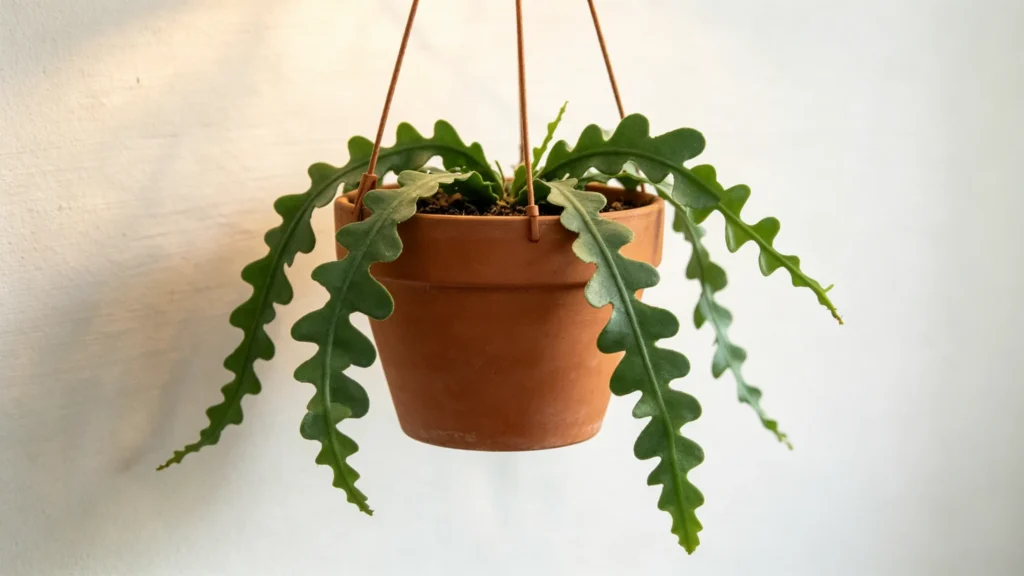
Fishbone Cactus
Disocactus anguliger
A trailing epiphytic cactus with zigzag, fishbone-like stems and fragrant white night-blooming flowers, best grown in bright filtered light and an airy, well-drained mix.
Watering frequency
Every 7-10 days
Ideal temperature
60-80°F / 16-27°C
Humidity
40-60%
Care difficulty
Easy
Air purifying
No/Not Known
Growth rate
Moderate
Plant size
6-12 in tall, 3 ft+ trailing / 15-30 cm tall, 90 cm+ trailing
Soil type
Airy, well-drained epiphyte mix
Fertilizer need
Every 6-8 weeks, spring-early fall.
Care summary
- Light: Bright indirect light; avoid hot direct sun.
- Water: Let the upper 2-3 cm of mix dry, then water and drain well.
- Soil: Use an airy, well-drained epiphyte or orchid-style mix.
- Humidity: Stable moderate humidity helps; a bright bathroom works.
- Blooming: Give a cooler, drier rest in late fall, then bright light.
- Safety: Provisional Pet safe category from same-family evidence; species-specific safety is unverified.
Common problems
- No new growth: allow for seasonal rest; check light, temperature, roots, mix, and pests before feeding.
- Shriveled or wrinkled stems: underwatering or root damage.
- Soft, mushy stems: mix stays wet too long.
- Brown or scorched patches: too much direct sun.
- No flowers: needs cooler, drier fall rest and bright light.
- Bud or flower drop: moved, drafts, or inconsistent watering.
- Pests: mealybugs, scale, or fungus gnats.
Plant care guide
About Fishbone Cactus
Fishbone Cactus (Disocactus anguliger) is an epiphytic cactus in the Cactaceae family, grown for its long, flattened, deeply zigzag stems that resemble a fish skeleton or ric rac trim. Native to southwestern and central Mexico, it grows on tree trunks and branches rather than in desert soil, which is why its care resembles a tropical plant more than a sun-baked desert cactus. It produces large, fragrant white or creamy flowers that open at night, usually in late summer or fall.
The accepted botanical name is Disocactus anguliger. Older literature and nursery labels often place it in Epiphyllum, while its original name was Phyllocactus anguliger. These scientific synonyms refer to the same species, but shared common names can also describe other plants. The naming history explains why gardeners still call it an epiphyllum or an orchid cactus after its scientific classification changed.
Why You'll Like It
Fishbone Cactus is one of the most architectural houseplants you can hang. The flat, deeply notched stems cascade over the edge of a pot in a sculptural zigzag, and because the stems themselves perform photosynthesis, the plant needs no leaves to look complete. It reads as a striking living object on a shelf, plant stand, or hanging basket, and it stays easygoing for an epiphyte.
It also delivers a surprise that most foliage plants cannot: large, fragrant white flowers that open in the evening and attract night-time pollinators such as moths. Blooms can be infrequent indoors, and their display is short-lived, but the display is memorable when it happens. The combination of bold foliage and occasional night blooms makes it a favorite for collectors who want something different from the usual houseplant silhouette.
The tradeoff is modest. This is a forest cactus, not a desert cactus, so it wants more water and humidity than a typical succulent — yet its roots still need air and will rot in a soggy, compacted mix. Getting that balance right is the core of keeping it healthy.
What Kind of Plant Is It?
Fishbone Cactus is an epiphytic cactus: in the wild it roots into tree bark and crevices in humid, shaded forest, gathering water from rain and humid air. Indoors that translates to a plant that wants more moisture and less sun than a desert cactus, but with an airy, fast-draining root zone.
Its "leaves" are actually modified stems (cladodes). The flattened, deeply lobed green segments photosynthesize, and each segment can root into a new plant, which is why stem cuttings are such a reliable propagation method. The stems are initially upright and become more pendulous as they lengthen, so the plant naturally trails over the pot edge with time.
Unlike true desert cacti, it has no spines to speak of, and its flower is the classic "night-blooming cereus" type: large, pale, fragrant, and short-lived. Because it is an epiphyte, it performs best in a pot that mimics its natural situation — coarse, airy, and never waterlogged.
History of Fishbone Cactus
Kew's Plants of the World Online accepts Disocactus anguliger and places its native range in southwestern and central Mexico, extending to Hidalgo. The original name Phyllocactus anguliger dates to 1851; the current combination was published in 2016. Kew records the older Epiphyllum combination as Epiphyllum anguligerum, although labels often shorten the ending to "anguliger."
Its forest habitat does not mean permanently saturated roots. Water can pass quickly through bark pockets after rain, and seasonal changes affect growth. Indoors, use the forest-cactus comparison to choose gentler light and an airy mix, not to justify keeping the pot continually wet.
Fishbone Cactus or a Different Zigzag Cactus?
Fishbone Cactus and Ric Rac Cactus are shared retail names. Kew recognizes Selenicereus anthonyanus as a separate species, not a synonym of Disocactus anguliger. Both can have deeply lobed, flattened stems. Stem outlines alone can be misleading, especially on juvenile or light-starved plants. Keep a reliable species label and compare flowers as well as stems when confirming identity. A common-name match by itself is not enough to merge two database records.
Related Forest Cacti
Fishbone Cactus belongs to a group of forest cacti that share similar care and are often sold side by side.
- Christmas Cactus (Schlumbergera × buckleyi): A Brazilian forest cactus with flat, segmented stems and vivid winter flowers. It shares the epiphytic habit, similar watering and humidity needs, and a pet-safe record.
- Red Orchid Cactus (Disocactus ackermannii): A related species with scalloped stems and red flowers; its profile distinguishes the species from red-flowered hybrids.
- Other Disocactus and epiphyllum species: Many related forest cacti with flattened stems and night-blooming or colorful flowers are sold as "epiphyllums"; keep the full label because flowering habit and size vary.
These related plants are not interchangeable in every detail, but they reinforce the same rule: treat forest cacti like tropical plants that store water, not like desert cacti.
Where Fishbone Cactus Works Best
Give Fishbone Cactus bright filtered light. A position near an east-facing window, a bright north window, or a spot behind a sheer curtain works well. Near strong south- or west-facing glass, increase distance or filter the light; direct hot sun can bleach or scorch the stems. In low light the plant grows slowly and may refuse to flower.
A bright bathroom with a window is often ideal, because the plant enjoys the humidity as long as it also gets light and air exchange. Avoid cold exterior doors, heating vents, and air conditioners that create abrupt temperature swings.
Fishbone Cactus Care
Light
Provide bright indirect light. Fishbone Cactus needs good light for healthy growth and flowering, but direct sun can burn the flattened stems. An east or north window is ideal; a west window with a sheer curtain works; a south window should be filtered or set back. If the stems look pale or the plant stops growing, increase light gradually.
Watering
Check weekly during active growth, but water only when the upper 2–3 cm of mix has dried and the pot is becoming lighter. Seven to ten days is a starting reference for an established indoor plant, not a deadline. A cool room, large pot, or moisture-retentive mix may require a much longer interval. Avoid leaving the entire root ball bone-dry for prolonged periods while new stems are expanding.
Water evenly until excess leaves the drainage holes, then empty the saucer or outer pot. If stems wrinkle while the mix is still wet, inspect the roots instead of watering again. Reduce watering as growth slows in fall and winter, especially during a cooler rest, without treating this forest cactus like a desert cactus that must stay dry for months.
Soil and Container
Use an airy, well-drained mix that mimics an epiphyte's natural home, such as an orchid or succulent mix amended with perlite, fine bark, or coco coir. The mix should hold some moisture while draining promptly and letting air reach the roots. Choose a pot with drainage holes and one that matches the plant's size; an oversized pot stays wet too long for these roots. A hanging basket suits the trailing habit well.
Humidity
Normal to moderately humid indoor air is usually workable. Around 40–60% is a practical household target, not a strict requirement; a healthy plant need not be moved merely because a meter falls outside it. If very dry air is accompanied by stress, consider a humidifier while preserving ventilation. A pebble tray is not a dependable way to control room humidity. Avoid repeatedly wetting the stems or enclosing the plant in stagnant, damp air.
Temperature
Aim for 60–80°F (16–27°C) during growth. Use 50°F (10°C) as a firm minimum for this indoor care routine, not a scientifically established lethal temperature. Keep the plant above that limit near cold windows and never expose it to frost. A brighter, cooler position around 50–60°F (10–16°C) during a seasonal rest can be useful, but avoid abrupt chilling or leaving wet roots in a cold pot.
Fertilizer
Feed lightly every six to eight weeks from early spring through late summer while the plant is actively growing, using a diluted balanced or cactus fertilizer on already moist mix. Do not fertilize in winter, when the plant rests and you do not want to encourage soft new growth.
Pruning and Training
Fishbone Cactus needs little pruning. Remove damaged or withered stem segments with a clean cut, and trim very long stems if you want a fuller, bushier plant. Because it trails, it suits a hanging basket or a tall stand where the stems can cascade. Cut pieces root easily, so pruning is also a way to start new plants.
Propagating Fishbone Cactus
Take stem cuttings in late spring or early summer, when warmth and returning growth favor establishment. Select a healthy, mature segment about 10–15 cm long, make a clean cut, and mark which end was lower. Leave the cut in an airy, shaded place until the wound is dry and sealed; this may take several days rather than exactly twenty-four hours.
Insert the lower end shallowly into a small pot of airy mix, supporting it if necessary. Keep it warm in bright filtered light and the mix only lightly moist, never saturated. Check for gentle resistance after roughly four to eight weeks, without repeatedly pulling the cutting out. That is a practical checking window, not a guaranteed rooting time. Wait for roots and new growth before normal feeding, and do not expect a young cutting to flower immediately.
Repotting Fishbone Cactus
Inspect the roots and mix each spring; many established plants need repotting about every two to three years, not annually. If buds or flowers are present, postpone routine repotting until the display is over. Active rot or failed drainage is a reason to act sooner.
Choose a container only slightly larger than the healthy root system and use fresh airy mix. Keep the original planting depth and do not bury the flat stems. If damaged roots must be trimmed, allow the cuts to dry before resuming careful watering. Keep conditions stable afterward, and remember that a larger pot is not a treatment for slow growth when the existing roots are sparse.
Toxicity and Pet Safety
This database labels this plant Pet safe provisionally under its same-family evidence policy. The ASPCA Christmas Cactus record identifies Schlumbergera bridgesii, a different member of Cactaceae, as non-toxic to cats and dogs. That record does not establish the toxicity of this species, and relatedness alone cannot prove safety. No species-specific veterinary confirmation is supplied here; the label is an editorial classification, not permission to let pets chew the plant.
Keep the pot and trailing stems out of reach. Plant material, pesticides, and fertilizer residues can cause problems even when a plant is not known to contain a particular toxin. If ingestion occurs or a pet develops vomiting or mouth discomfort, contact a veterinarian with the plant's name and a photo.
Common Problems and Practical Fixes
- Little or no new growth: Slow growth during cool or short-day periods can be normal. For a persistent stall in warm, bright conditions, check light, temperature, root health, compacted mix, pests, and genuine root crowding before adding fertilizer or repotting.
- Wrinkling: Compare the stem's firmness with moisture deeper in the pot. Dry mix and healthy roots suggest thirst; wrinkling while the mix is wet suggests impaired roots, so do not automatically add water.
- Soft, mushy tissue: Check the base and roots immediately. If rot is present, simply drying the pot may not stop it; remove affected material with a clean tool and retain only firm, healthy tissue. Replace persistently waterlogged mix and correct the watering conditions.
- Brown or scorched patches: Too much direct sun. Move the plant to filtered light gradually.
- No flowers: Often a lack of a cooler, drier fall rest, or too little light. Give the plant bright light and reduce watering in late fall, then resume as growth picks up.
- Bud or flower drop: Usually a move, a draft, or inconsistent watering. Keep conditions stable once buds form.
- Pests: Mealybugs and scale can hide along the stems and nodes; inspect and treat with a product labeled for indoor plants.
Frequently Asked Questions
Why is it called Fishbone Cactus? The flattened, deeply notched stems resemble a fish skeleton or the zigzag trim called ric rac, giving the plant its common names.
Does it flower indoors? Yes, under bright filtered light and with a cooler, drier rest in late fall, mature plants can produce large, fragrant white flowers that open at night, usually in late summer or fall.
Is it a true cactus? Yes, but it is an epiphytic forest cactus, not a desert cactus. It wants more regular moisture and less harsh sun than a typical desert cactus.
How do I get it to bloom? Give it bright indirect light, a cooler and drier rest in late fall and winter, and let the plant mature. Blooms typically appear in autumn on established stems.
Final Thought
Fishbone Cactus is a distinctive, forgiving forest cactus that rewards consistent care. Give it bright filtered light, an airy root zone, even moisture with good drainage, and stable moderate humidity, and let it rest cooler and drier in late fall to encourage its spectacular night blooms. Its sculptural zigzag stems make it a plant worth having even when it is not flowering.