
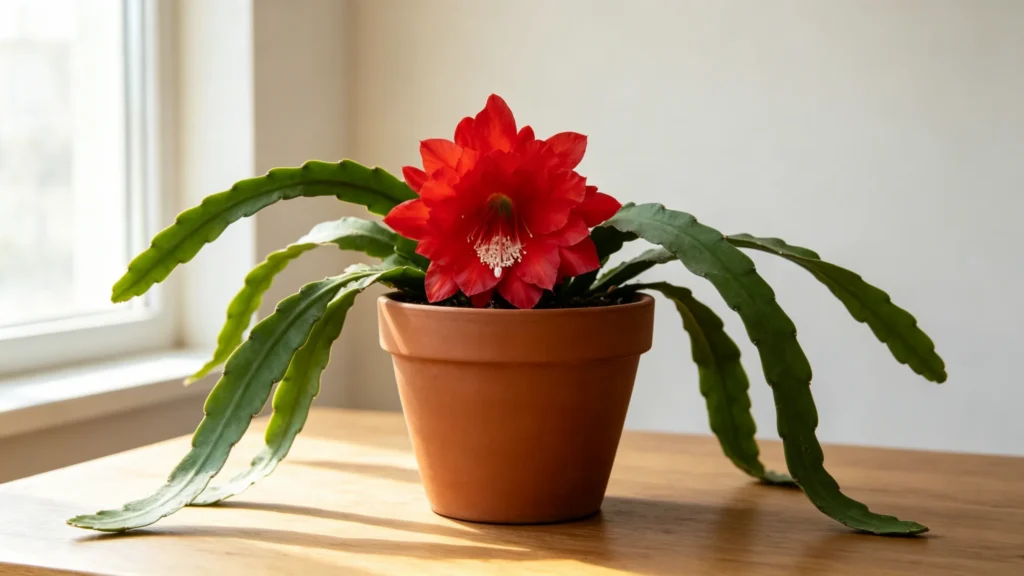
Red Orchid Cactus
Disocactus ackermannii
A forest cactus from southern Mexico with flat scalloped stems and large, showy crimson flowers in spring, best grown in bright filtered light and an airy, well-drained mix.
Watering frequency
Every 7-10 days
Ideal temperature
60-80°F / 16-27°C
Humidity
40-60%
Care difficulty
Medium
Air purifying
No/Not Known
Growth rate
Moderate
Plant size
Trailing stems to 30 in / 75 cm
Soil type
Airy, well-drained epiphyte mix
Fertilizer need
Every 4-6 weeks, spring-early fall.
Care summary
- Light: Bright filtered light; avoid hot direct sun.
- Water: Let the upper 2-3 cm of mix dry, then water and drain well.
- Soil: Use an airy, well-drained epiphyte or orchid-style mix.
- Humidity: Normal room humidity with airflow is suitable.
- Blooming: Give a cooler, drier rest in fall, then bright light.
- Safety: Provisional Pet safe category from same-family evidence; species-specific safety is unverified.
Common problems
- No new growth: allow for seasonal rest; check light, temperature, roots, mix, and pests before feeding.
- Bud or flower drop: moved, drafts, or inconsistent watering.
- Wilting or shriveled stems: underwatering or root damage.
- Soft, mushy stems: mix stays wet too long.
- Brown or scorched patches: too much direct sun.
- No flowers: too little light, or too warm and wet a rest.
- Pests: mealybugs, scale, or fungus gnats.
Plant care guide
About Red Orchid Cactus
Red Orchid Cactus (Disocactus ackermannii) is a forest cactus in the Cactaceae family from southern Mexico. It grows epiphytically and has long, flattened, scalloped stems rather than ordinary foliage leaves. Red to scarlet flowers, reaching about 12 cm (nearly 5 inches) across, are its signature display on a mature plant.
The accepted name is Disocactus ackermannii. Older labels may read Epiphyllum ackermannii or Nopalxochia ackermannii. Red Orchid Cactus, Red Epiphyllum, and Ackermann's Disocactus are common or horticultural names. This profile covers the species, not all plants sold as "orchid cactus" and not every red-flowered epiphyllum hybrid.
Why You'll Like It
Red Orchid Cactus combines dramatic flowers with an attractive year-round shape. Its red blooms can be appreciated in daylight, unlike the fleeting nocturnal display associated with some other forest cacti. Flower longevity varies with temperature and conditions; do not choose the plant on a promise that every bloom will last a fixed number of days.
Even between displays, the scalloped stems arch over a hanging basket or pedestal. Give them room to extend without bending against window frames or being brushed whenever someone passes. A single established plant can become a substantial hanging feature without needing a climbing pole.
The tradeoff is seasonal care rather than constant intervention. Bright filtered light, an airy root zone, and appropriate drying between waterings matter throughout the year. A mature plant may benefit from cooler, drier conditions during its rest, but chilling it or withholding water until the stems collapse is not a flowering technique.
What Kind of Plant Is It?
Red Orchid Cactus is an epiphytic forest cactus. Its flattened green stems perform photosynthesis and become arching or pendant as they lengthen; individual stems may reach about 75 cm (30 inches). A rounded section near the base can give way to broader flattened growth, so the shape is not identical from base to tip.
The RHS species profile describes red to scarlet flowers up to 12 cm across. That species description is a better reference than photographs of giant-flowered hybrids under the same common name. The plant is a true cactus, not an orchid, despite the horticultural nickname. Like Fishbone Cactus, it needs a mixture that holds some moisture while leaving plenty of air around the roots.
History of Red Orchid Cactus
Kew's Plants of the World Online accepts Disocactus ackermannii and dates that combination to 2003. Its older placement in Epiphyllum explains the persistent retail name. This change should not be confused with the 2016 transfer associated with Fishbone Cactus.
Species Labels Versus Red-Flowered Hybrids
"Orchid cactus" is a broad horticultural term. It includes several species and many cultivated hybrids with different flower colors, shapes, and sizes. A red flower and a flat stem do not, by themselves, prove that a plant is true D. ackermannii. Nor does an old handwritten "epiphyllum" label identify a particular species.
Keep the original label and ask the grower whether the plant is a species or a named hybrid. When identity is uncertain, record it as an unidentified orchid-cactus hybrid instead of asserting D. ackermannii. Similar care needs do not make the plants botanical synonyms.
This distinction matters for expectations as well as database accuracy. A hybrid may have different mature dimensions, flowering behavior, or lineage. Its cultivar name should remain attached to it, and a flowering photograph should not be used as proof of species identity without supporting provenance.
Related Forest Cacti
Red Orchid Cactus belongs to a group of forest cacti that share similar care and are often sold side by side.
- Fishbone Cactus (Disocactus anguliger): A closely related forest cactus in the same genus, with deeply zigzag stems and fragrant white flowers that open at night rather than by day.
- Christmas Cactus (Schlumbergera × buckleyi): A Brazilian forest cactus with flat, segmented stems and vivid winter flowers; it shares the epiphytic habit, similar watering and humidity needs, and a well-documented pet-safe record.
These related plants are not interchangeable in every detail, but they reinforce the same rule: treat forest cacti like tropical plants that store water, not like desert cacti.
Where Red Orchid Cactus Works Best
Give Red Orchid Cactus bright filtered light. A position near an east-facing window, a bright north window, or a spot behind a sheer curtain works well. Near strong south- or west-facing glass, increase distance or filter the light; direct hot sun can bleach or scorch the flat stems. In low light the plant grows slowly and may refuse to flower.
A bright living room or a bathroom with a suitable window can work; humidity alone does not make a room appropriate. Check light, airflow, and space for the stems. Avoid cold exterior doors, heating vents, and air conditioners that create abrupt temperature swings.
Red Orchid Cactus Care
Light
Provide bright filtered light. Red Orchid Cactus needs good light for healthy growth and flowering, but direct sun can burn the flat stems. An east or north window is ideal; a west window with a sheer curtain works; a south window should be filtered or set back. If the stems look pale or the plant stops growing, increase light gradually.
Watering
Check weekly during active growth and water once the upper 2–3 cm of mix has dried and the pot has become lighter. Seven to ten days is a starting reference for an established indoor plant, not a mandatory watering appointment. A fine-textured mix, cool room, or oversized container may stay wet considerably longer.
Water thoroughly and allow the pot to drain before returning it to an outer container. Do not keep it standing in runoff. Compared with a dryland cactus, this plant needs more regular moisture during growth, but prolonged saturation still damages its roots. Avoid repeated severe drying while buds are developing.
As growth slows, reduce watering and check the root zone rather than the calendar. A cool resting plant uses less water. If stems wilt while the mix remains wet, investigate root health before giving another drink.
Soil and Container
Use an airy, well-drained mix that mimics an epiphyte's natural home, such as an orchid or succulent mix amended with perlite, fine bark, or coco coir. The mix should hold some moisture while draining promptly and letting air reach the roots. Choose a pot with drainage holes and one that matches the plant's size; a hanging basket suits the trailing habit well.
Humidity
Normal household humidity is generally suitable; approximately 40–60% is a practical reference, not a requirement for continuously humid air. RHS guidance specifically allows moderate-to-low humidity, so a humidifier is not automatically necessary for this species.
Keep air circulating gently and avoid repeatedly misting the stems. A pebble tray should not be presented as a reliable way to raise room humidity. In a very dry room, consider whether heat, direct sun, or prolonged root dryness is causing stress before assuming humidity alone is the problem.
Temperature
Aim for 60–80°F (16–27°C) during growth. Use 50°F (10°C) as a firm minimum for this indoor routine, not a claim about an exact lethal threshold. Protect the plant from frost, cold glass, and abrupt drafts. A rest around 50–60°F (10–16°C) can be useful if the root zone is allowed to dry more between waterings, but wet roots and cold conditions are a poor combination.
Fertilizer
Feed lightly every four to six weeks from spring through early fall while the plant is actively growing, using a diluted balanced or cactus fertilizer on already moist mix. Do not fertilize in winter, when the plant rests and you do not want to encourage soft new growth.
Pruning and Training
Red Orchid Cactus needs little structural pruning. Remove damaged or withered stem segments with a clean cut, and trim very long stems if you want a fuller, bushier plant. Because it trails and arches, it suits a hanging basket or a tall stand where the stems can cascade. Cut pieces root easily, so pruning is also a way to start new plants.
Propagating Red Orchid Cactus
Take stem cuttings in late spring, preferably after flowering, using a healthy mature segment about 10–15 cm long. Make a clean cut and mark the lower end. Leave it in an airy, shaded place until the wound dries and seals; the condition of the cut matters more than a fixed number of days.
Insert the lower end shallowly into a small pot of airy mix. Support the cutting without burying a long section, and keep it warm in bright filtered light. Use light moisture once the wound is healed, never a continuously saturated pot. Begin checking for gentle resistance after roughly four to eight weeks, but treat this as an observation window rather than a guaranteed rooting time.
Wait for roots and renewed growth before normal feeding. A cutting preserves the identity of its source plant, including a hybrid cultivar, so keep its label. Seed-grown offspring of a hybrid are not automatically the same cultivar and should not inherit that name without evidence.
Repotting Red Orchid Cactus
Inspect the root system and mix in spring, with routine repotting about every two to three years if needed. If buds or flowers are present, wait until flowering finishes unless there is an urgent drainage or rot problem. Mild root crowding does not require an immediate upgrade, but badly degraded mix should not be ignored simply to preserve a "pot-bound" condition.
Use a pot only slightly larger than the healthy roots and an airy, moisture-retentive but sharply draining substrate. Keep the old planting depth, allow trimmed roots to dry, and resume watering cautiously. Check basket hooks and supports under the weight of a freshly watered pot.
A Seasonal Flowering Routine
Through spring and summer, prioritize light and healthy stem growth, feeding only while the plant is actively growing. In fall, reduce feeding as growth slows and avoid keeping a cooling pot continually moist. Where a safe cooler room is available, use it for rest without dropping below this guide's minimum.
Once buds are visible, keep the location and care stable. Do not repeatedly rotate the pot, move it between rooms, or repot it to make the display more convenient. If buds drop, compare recent temperature changes, root moisture, and light before adding fertilizer. Young cuttings may need several growing seasons to become flowering plants; the absence of blooms is not by itself evidence of illness.
Toxicity and Pet Safety
This database labels this plant Pet safe provisionally under its same-family evidence policy. The ASPCA Christmas Cactus record identifies Schlumbergera bridgesii, a different member of Cactaceae, as non-toxic to cats and dogs. That record does not establish the toxicity of this species, and relatedness alone cannot prove safety. No species-specific veterinary confirmation is supplied here; the label is an editorial classification, not permission to let pets chew the plant.
Keep the pot and trailing stems out of reach. Plant material, pesticides, and fertilizer residues can cause problems even when a plant is not known to contain a particular toxin. If ingestion occurs or a pet develops vomiting or mouth discomfort, contact a veterinarian with the plant's name and a photo.
Common Problems and Practical Fixes
- Little or no new growth: Slow growth during cool or short-day periods can be normal. For a persistent stall in warm, bright conditions, check light, temperature, root health, compacted mix, pests, and genuine root crowding before adding fertilizer or repotting.
- Bud or flower drop: Usually a move, a draft, or inconsistent watering. Keep conditions stable once buds form.
- Wrinkling: Compare the stem's firmness with moisture deeper in the pot. Dry mix and healthy roots suggest thirst; wrinkling while the mix is wet suggests impaired roots, so do not automatically add water.
- Soft, mushy tissue: Check the base and roots immediately. If rot is present, simply drying the pot may not stop it; remove affected material with a clean tool and retain only firm, healthy tissue. Replace persistently waterlogged mix and correct the watering conditions.
- Brown or scorched patches: Too much direct sun. Move the plant to filtered light gradually.
- No flowers: Often a lack of a cooler, drier fall rest, or too little light. Give the plant bright light and reduce watering in late fall, then resume as growth picks up.
- Pests: Mealybugs and scale can hide along the stems and nodes; inspect and treat with a product labeled for indoor plants.
Frequently Asked Questions
Why is it called Red Orchid Cactus? The large, showy, funnel-shaped flowers resemble orchid blooms, and the plant belongs to the group of forest cacti gardeners have long called orchid cacti or epiphyllums.
Does it flower indoors? Yes, under bright filtered light and with a cooler, drier rest in late fall, mature plants can produce large crimson flowers that open during the day, usually in spring.
Is it a true cactus? Yes, but it is an epiphytic forest cactus, not a desert cactus. It wants more regular moisture and gentler sun than a typical desert cactus.
How do I get it to bloom? Give it bright filtered light, a cooler and drier rest in late fall and winter, and let the plant mature. Keep conditions stable once buds form to avoid bud drop.
Final Thought
Red Orchid Cactus is a spectacular forest cactus that rewards consistent care. Give it bright filtered light, an airy root zone, even moisture with good drainage, and stable moderate humidity, and let it rest cooler and drier in late fall to encourage its large crimson spring blooms. Its scalloped, cascading stems make it a plant worth having even when it is not flowering.