
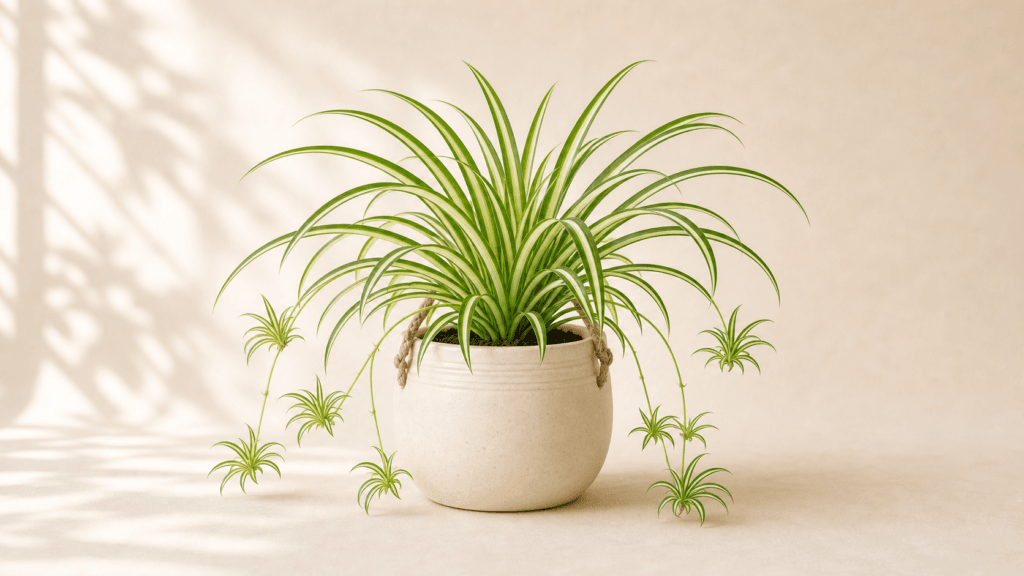
Spider Plant ‘Bonnie’
Chlorophytum comosum 'Bonnie'
A compact curly-leaved Spider Plant cultivar with striped foliage, arching runners, easy plantlets, and verified non-toxic status for cats and dogs.
Watering frequency
Every 7-10 days
Ideal temperature
60-80°F / 16-27°C
Humidity
40-60%
Care difficulty
Easy
Air purifying
Yes
Growth rate
Fast
Plant size
6-12 in / 15-30 cm
Soil type
Light, well-draining potting mix
Fertilizer need
Monthly, spring-summer.
Care summary
- Light: Give medium to bright indirect light for compact striped growth.
- Water: Let the surface dry, then soak and drain thoroughly.
- Soil: Use a light mix in a snug pot with open drainage.
- Propagation: Root attached or detached plantlets once they have nodes.
- Safety: ASPCA lists Chlorophytum comosum as non-toxic to pets.
Common problems
- Brown tips: Check salts, water quality, drought, damage, and roots.
- Yellow leaves: Review saturation, drainage, cold, and natural aging.
- Straight or pale growth: Check cultivar identity, light, and plant vigor.
- Few plantlets: Review maturity, light cycle, feeding, and root health.
- Pests: Inspect leaf folds for mites, scale, and mealybugs.
Plant care guide
About Spider Plant 'Bonnie'
Spider Plant 'Bonnie' is a named cultivar of Chlorophytum comosum selected for arching green-and-cream leaves that curl rather than falling in the mostly straight ribbons of a standard Spider Plant. The compact rosette and coiling runners make it useful in a hanging pot without changing the underlying species-level care.
NC State Extension's Spider Plant profile lists 'Bonnie' and 'Bonnie Variegated' among recognized cultivars and describes the species as an adaptable perennial that produces flowers and plantlets on long stolons. Because this canonical record already identifies 'Bonnie', the consumer-facing name is corrected from generic Spider Plant to Spider Plant 'Bonnie'; the stable URL remains /plants/spider-plant/.
The plant forms fleshy tuberous roots that store some water. They help it survive a missed watering but do not make saturated soil safe. A mature rosette sends out long stems bearing small white flowers and plantlets—the “spiders” behind the common name.
Why You'll Like It
'Bonnie' provides three visual layers: a curled central rosette, looping runners, and miniature plants. It grows quickly under ordinary indoor conditions, tolerates average humidity, and can be multiplied without specialist equipment. Its compact curl also fits a smaller hanging space than many standard cultivars.
It is a strong pet-household choice when correctly identified. ASPCA's exact Spider Plant record classifies Chlorophytum comosum as non-toxic to cats and dogs. A separate ASPCA editorial article has inconsistently called it mildly toxic because ingested material may cause gastrointestinal irritation; the species database is the more specific classification, while chewing should still be discouraged.
Compare Parlor Palm for a larger pet-safe plant in moderate light, Prayer Plant for patterned pet-safe foliage needing steadier humidity, or Ponytail Palm for a brighter, much drier pet-safe plant.
What Kind of Plant Is It?
Spider Plant grows as a basal rosette: leaves emerge from a short crown at soil level rather than a visible trunk. Thick white roots and tubers occupy a pot quickly. Crowding can encourage a full display, but severe root congestion eventually makes watering uneven.
Runners are stolons—specialized stems with nodes capable of carrying flowers and plantlets. A plantlet already contains a small crown and may form root nubs while attached. A bare leaf without crown tissue cannot become a new plant.
Leaf curl varies with genetics and conditions. 'Bonnie' should remain recognizably curly, but new growth can open more loosely in weak light, excessive nitrogen, or stress. One straighter leaf is not proof that the cultivar has reverted.
Popular Spider Plant Varieties
- 'Bonnie': Curled green leaves, sometimes used loosely for the patterned commercial form.
- 'Bonnie Variegated': Curled foliage with a light central stripe; retain the exact nursery label when available.
- 'Vittatum': Broad pale central stripe on mostly straight arching leaves.
- 'Variegatum': White leaf margins with a green center.
- 'Hawaiian': A compact selection whose mature foliage may display a different green-and-cream balance.
- 'Milky Way': A heavily pale-striped named selection.
- Solid green Spider Plant: Vigorous species-type foliage without cream striping.
These are cultivars of the same species, not vague “variegated” identities. Use their names for future internal links and expect pale cultivars to need useful light for strong growth.
Where It Works Best
Place it near an east or north window or behind a sheer curtain at a stronger exposure. Medium light is tolerated, while bright indirect light supports tighter curl, stripe contrast, and plantlet production. Harsh afternoon sun can bleach and crisp narrow leaves.
A kitchen, bedroom, or office works when there is real window light. Hanging displays should remain reachable for moisture checks and drainage. Keep foliage away from hot vents, cold glass, and traffic that repeatedly breaks tips.
Cats may be attracted to grassy leaves even though the plant is non-toxic. Use a secure hook and collect detached plantlets so the pot does not become a toy.
How to Care for Spider Plant 'Bonnie'
Light
Aim for medium to bright indirect light. Gentle morning sun may be accepted after acclimation. Pale, widely spaced, or less-curled new growth suggests insufficient light or excess feeding; bleached tan bands on the exposed side suggest scorch.
Rotate the pot periodically so the rosette and runners develop evenly. Flower and plantlet production also depends on maturity and day length, so constant artificial light can interfere with the normal light-dark signal.
Water
Use seven to ten days as an inspection cue. Let the top inch or so dry, then water the whole root ball until excess drains. Empty the saucer or cachepot. The fleshy roots tolerate modest dry-down but can rot in continuously wet mix.
Pot size, season, root crowding, and light alter the interval. A crowded bright hanging pot may dry quickly; a recently divided plant in winter may stay wet much longer. Combine pot weight with a finger or wooden-skewer check.
Brown tips are often blamed entirely on tap water. Chloride, fluoride, fertilizer salts, drought, physical breakage, and damaged roots can look alike. Correct the watering pattern and salt load before changing every input.
Soil and Container
Use a light houseplant mix amended with perlite, pumice, or fine bark. It should distribute moisture evenly and drain promptly. A pot with holes is mandatory.
Spider Plants often perform well slightly snug. A huge pot surrounds the root system with unused wet soil. Hanging plastic pots retain moisture longer than terracotta; adjust the mix and checks accordingly.
Humidity and Temperature
Average household humidity around 40–60 percent is adequate. Stable moderate humidity may reduce stress, but misting cannot fix salt burn or rotten roots. Keep the plant around 60–80°F (16–27°C) and away from frost or hot HVAC air.
The species tolerates cooler rooms better than many tropical houseplants, but growth slows and wet soil becomes riskier. Reduce winter watering rather than following the summer calendar.
Fertilizer
Feed monthly at a diluted label rate during active spring and summer growth. Excess nitrogen can produce soft foliage and may reduce plantlet formation. Pause during winter slowdown or after root damage.
Flush the mix periodically with plain water. White crust and persistent tip burn are reasons to reduce fertilizer and inspect drainage.
Grooming
Trim fully brown tips by following the natural taper and leaving a fine brown margin. Remove yellow outer leaves at the base. Do not cut healthy green leaves to make the rosette artificially symmetrical.
Runners may be retained for display or removed at their origin. Removing plantlets can redirect some resources to the mother plant, but a healthy mature plant can support both.
How to Propagate Spider Plant 'Bonnie'
Plantlets are the easiest method and preserve the cultivar.
- Choose a plantlet with a visible crown and root nubs.
- Set it on moist airy mix in a small pot while still attached to the runner.
- Pin it gently at the crown without burying leaves.
- Cut the runner after new roots hold the plantlet in place.
Alternatively, detach a mature plantlet and root it in water or mix. Pot water-rooted babies after branching roots develop. Several can share one pot for an immediately full display.
Division also works during repotting. Separate crowns with their own roots and preserve as much root tissue as possible. A leaf cutting alone will not make a new Spider Plant.
When to Repot
Repot when thick roots distort or crack the pot, water rushes around a compacted root mass, the plant dries abnormally fast, or growth declines despite appropriate light. Roots visible at drainage holes alone are not an emergency.
Move up one modest size or divide the plant. Keep the crown at its former depth and use fresh airy mix. Expect a short pause after root disturbance.
Managing Runners and the Mother Plant
A runner begins as a long flexible stem and may first carry small white flowers before plantlets develop. Do not cut it simply because the first section appears bare. Given suitable light and maturity, nodes farther along can produce babies.
A heavily loaded plant may become unbalanced or consume water faster. Support runners where they will not snag, or remove selected ones at the crown with clean scissors. Cutting runners does not harm the rosette. If the mother plant has stopped growing while supporting many large babies, root and remove some plantlets, then review pot space, light, and feeding.
Plantlets can remain attached for months and may themselves produce roots or runners. This layered display is attractive but increases the weight on a hanging hook. Inspect the hanger, pot rim, and ceiling fixing rather than assuming a plastic nursery hook will support an old wet plant indefinitely.
Seasonal Care
In spring and summer, longer days support faster leaf and root growth. Increase water only when the pot actually dries faster, begin light feeding, and propagate vigorous plantlets. A shaded winter plant moved outdoors must be acclimated gradually even if the weather feels mild.
In fall and winter, indoor light often falls before room temperature does. Growth slows while soil stays moist longer. Extend the watering interval, pause fertilizer, and keep the rosette away from cold glass. If a plant continues under a strong grow light, judge its activity rather than applying a mandatory winter drought.
After purchase, expect the moisture pattern to change. Nursery peat, a decorative sleeve, and greenhouse light can behave very differently at home. Remove standing water, observe the first two dry-downs, and postpone repotting unless the existing medium or roots are failing.
Pet Safety
ASPCA's species-specific database lists Spider Plant as non-toxic to cats and dogs. Non-toxic does not mean edible: chewing can cause mechanical or gastrointestinal upset, and potting products can have separate hazards.
If a pet eats a large amount or becomes unwell, contact a veterinarian. Confirm identity because “spider” appears in other unrelated common names.
Common Problems and Practical Fixes
Brown tips
Check watering swings, accumulated salts, water quality, hot air, physical rubbing, and roots. Trim dead tissue and assess improvement in later leaves. A tiny stable brown point is often cosmetic.
Yellow leaves
One old outer leaf may age naturally. Multiple yellow leaves with wet mix indicate possible root stress; yellowing in cold low light can reflect slow water use. Inspect before watering.
Limp or folded leaves
Dry soil may need a thorough watering; wet soil may mean root damage. Heat and severe root crowding can produce similar loss of firmness. Read the root zone rather than assuming thirst.
Less curl or pale pattern
Improve useful filtered light gradually and avoid excess nitrogen. Verify that the plant is truly 'Bonnie'. Existing leaves will not change shape, so judge the next growth.
Few plantlets
The plant may be young, recently divided, underlit, overfed, or receiving an irregular night period. Prioritize mature healthy roots and balanced light instead of a bloom booster.
Pests
Mites cause stippling; scale attaches along leaf bases; mealybugs form cottony clusters. Isolate, identify, rinse the narrow leaves, and use a product labeled for the pest and indoor plants.
Frequently Asked Questions
Is 'Bonnie' naturally curly?
Yes. Curl is a cultivar trait, although light, feeding, and plant vigor influence how tightly each new leaf coils.
Can Spider Plant live in low light?
It can tolerate medium and temporarily lower light, but growth, stripe contrast, curl, and plantlet production improve in brighter indirect light.
Should I cut off the babies?
Only if you prefer a cleaner shape or the mother plant is stressed. Healthy runners can remain or be used for propagation.
Why do the roots look like white tubers?
Thickened roots store water and are normal. They do not justify permanent drought or an oversized wet pot.
Does it purify indoor air?
The database retains an air-purifying category, but ordinary numbers of plants do not replace ventilation or filtration. Grow 'Bonnie' for its foliage and easy propagation.
Can I plant several babies together?
Yes. Combining several rooted plantlets creates a full pot faster. Use a snug draining container and avoid burying the small crowns. Mixed sizes may dry unevenly until their roots occupy the same volume.
Why is my plant splitting its plastic pot?
The thick roots and tubers can exert pressure as they fill the container. Repot one modest size larger or divide the clump. Do not cut away healthy storage roots solely to return it to the same tight pot.
Final Thought
Spider Plant 'Bonnie' is easy when its named identity and root anatomy guide care: give useful indirect light, partial dry-down, thorough drainage, and restrained fertilizer. Its curly foliage and plantlets provide a distinctive display without turning a recognized cultivar into a vague adjective-based plant name.