
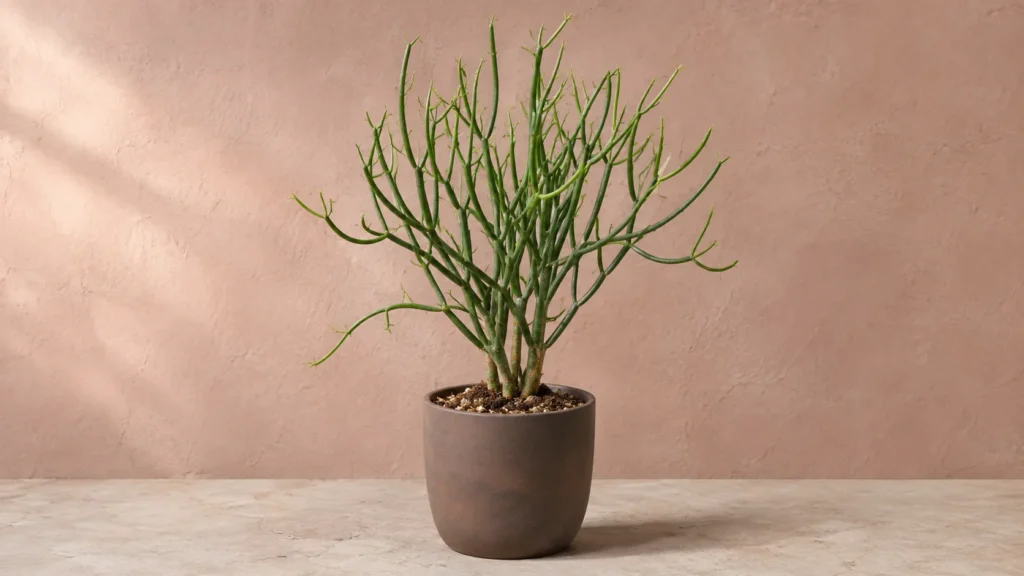
Pencil Cactus
Euphorbia tirucalli
A branching succulent spurge with thin pencil-like green stems, tiny short-lived leaves, and highly irritating milky latex.
Watering frequency
Water thoroughly only after the mix has dried; water less in winter
Ideal temperature
About 65-80°F / 18-27°C; keep frost-free
Humidity
Dry to average indoor air
Care difficulty
Medium
Air purifying
No/Not Known
Growth rate
Moderate
Plant size
Often 2-6 ft / 0.6-1.8 m indoors; much larger outdoors in suitable climates
Soil type
Gritty, fast-draining succulent mix
Fertilizer need
Feed sparingly during active growth; avoid fertilizing a stressed plant.
Care summary
- Light: Strong bright light and gradual acclimation to direct sun.
- Water: Allow the mix to dry before watering again.
- Soil: Use a fast-draining mix and a pot with a drainage hole.
- Form: Thin green stems branch into a pencil-like silhouette.
- Identity: A Euphorbia, not a true cactus.
- Safety: Milky latex can seriously irritate skin and eyes; keep away from pets.
Common problems
- Soft or dark stem base: inspect for wet roots and poor drainage.
- Thin weak growth: move toward stronger light gradually.
- Brown, dry branch tips: review drought, sun transition, and root condition.
- Sap exposure: rinse affected skin or eyes promptly and seek medical advice for eye contact.
Plant care guide
About Pencil Cactus
Pencil Cactus (Euphorbia tirucalli) is a succulent shrub or small tree with masses of slim, green, branching stems. It is also called Pencil Tree or Milkbush. The cactus name is a common-name shortcut: this plant is a spurge in Euphorbiaceae, not a true cactus. Kew accepts Euphorbia tirucalli and records Madagascar as its native range; it has been introduced widely elsewhere.
The green stems do much of the photosynthesis. Small leaves may appear on new growth and fall quickly, so a mostly leafless plant can be normal. The white latex inside the stems is strongly irritating, particularly to eyes. This safety issue should shape where you place and how you prune the plant. NC State Extension's profile describes its stem form and sap hazard.
Why You'll Like It
Few houseplants offer such a fine, branching silhouette. A single established pot can resemble a sketch made from green lines, adding height without broad leaves. It suits bright spaces and tolerates ordinary dry indoor air. With a gritty mix, its watering routine is simple: water well, then let the mix dry.
It is not a good choice for a crowded desk, narrow walkway, or a home where pets can reach it. A stem can break when brushed, leaving latex on skin or furniture. Plan enough room around the plant before it becomes large.
How to Identify Pencil Cactus
The stems are narrow, cylindrical, smooth, and repeatedly branched. Small leaves appear briefly near shoot tips, but older branches are usually bare. Unlike African Milk Tree, Pencil Cactus lacks prominent paired spines and thick, angular ribs. RHS describes E. tirucalli as a much-branched, largely leafless shrub with pencil-like stems.
The orange and red plant commonly sold as “Firesticks” is a selected horticultural form associated with E. tirucalli. Do not label an ordinary green Pencil Cactus as Firesticks from species identity alone. Color can also shift with sun and temperature, so a reliable nursery label matters when recording a cultivar.
Pencil Cactus vs. Zig Zag Plant and Fishbone Cactus
The Pencil Cactus has many thin, round branches. A plant sold as Zig Zag Plant may be a different Euphorbia with angled, zigzag stems; Fishbone Cactus usually refers to a true cactus with flattened, lobed stems. These names can overlap in image searches, but the stem shapes are distinct. Use the botanical name on the label whenever possible. Do not cut an unknown plant to test for latex, because the sap can be hazardous.
Where It Works Best
Choose the brightest practical position, with direct sun introduced gradually. A south-facing window can work for an acclimated plant, but one grown in shade should not be moved into intense midday light overnight. Rotate the pot occasionally for more even growth. Keep branches clear of curtains, walking routes, and places where a falling pot could expose someone to sap.
Pencil Cactus grows larger in suitable outdoor climates, but outdoor planting introduces climate, local spread, and handling considerations. For a houseplant collection, a container gives better size control and allows you to protect it from cold.
Pencil Cactus Care
Light. Give strong bright light. Weak, thin new stems and leaning growth suggest the plant needs more. Acclimate to direct sun in stages to reduce scorch. The RHS profile recommends full sun and a sharply draining medium under cultivation.
Water. Water until excess runs out, then wait until the mix dries before repeating. The interval depends on pot size, temperature, season, and light. Reduce water during cool, dim periods. Do not leave the pot standing in a cachepot full of water. Soft, dark stems at the base are a reason to inspect roots and moisture.
Soil and pot. A gritty succulent mix and drainage hole are essential. Avoid a pot much larger than the roots; excess damp medium can stay wet too long. As the crown grows, choose a stable container that will not tip when branches are nudged.
Temperature and humidity. Keep it frost-free and protect it from prolonged cold wetness. Dry to average indoor humidity is suitable. A heated room is fine if the plant gets enough light, but avoid putting stems against hot glass or directly over a heater.
Feeding. Use diluted fertilizer sparingly during active growth. More fertilizer will not correct low light or soggy roots. Stop feeding when growth pauses.
Pruning and Propagation
Pruning is sometimes needed for height or broken branches, but prepare before cutting. Wear gloves and eye protection; cover the work surface; keep pets and children away; and use clean, controlled cuts. The latex may squirt or drip from injured stems. Allow a cutting to stop bleeding and dry before trying to root it in a gritty medium. Avoid handling cut material with bare hands.
If the plant has become too large to prune safely, seek help rather than working at face height around brittle branches. Dispose of cuttings securely. After handling, clean tools and wash hands even if gloves were worn.
Is Pencil Cactus Safe for Pets?
No. Its milky latex can irritate skin, mouth, and eyes. NC State Extension specifically warns that eye contact can be serious. Keep the plant beyond the reach of pets and children. If sap gets in an eye, rinse with water immediately and seek urgent medical advice. Contact a veterinarian if a pet chews a stem; do not wait for severe symptoms before asking for guidance.
Common Problems
- Soft, dark base: Check for wet mix and root damage. Drain the pot and inspect the root system.
- Weak, stretched branching: Increase light gradually and avoid excessive fertilizer.
- Dry brown tips: Review both watering and sun exposure; a recently moved plant may scorch while a neglected pot may be too dry.
- Tiny leaves disappear: This can be normal. Judge health by stem firmness and new growth rather than leaf retention alone.
- White cottony patches: Check branch joints for mealybugs; isolate and treat while avoiding broken stems.
Frequently Asked Questions
Is Pencil Cactus a cactus? No. Its accepted botanical name is Euphorbia tirucalli, a member of the spurge family.
Is it the same as Firesticks? Firesticks refers to a colorful horticultural form associated with this species, not every green specimen.
Why does it have no leaves? Its tiny leaves are short-lived; the green stems are the main visible photosynthetic structures.
Can it grow in low light? It may survive for a while, but growth is usually stronger and sturdier in a bright position.
Pencil Cactus is most rewarding when its strong sculptural form is paired with sufficient light, dry intervals between waterings, and strict care around its latex.