
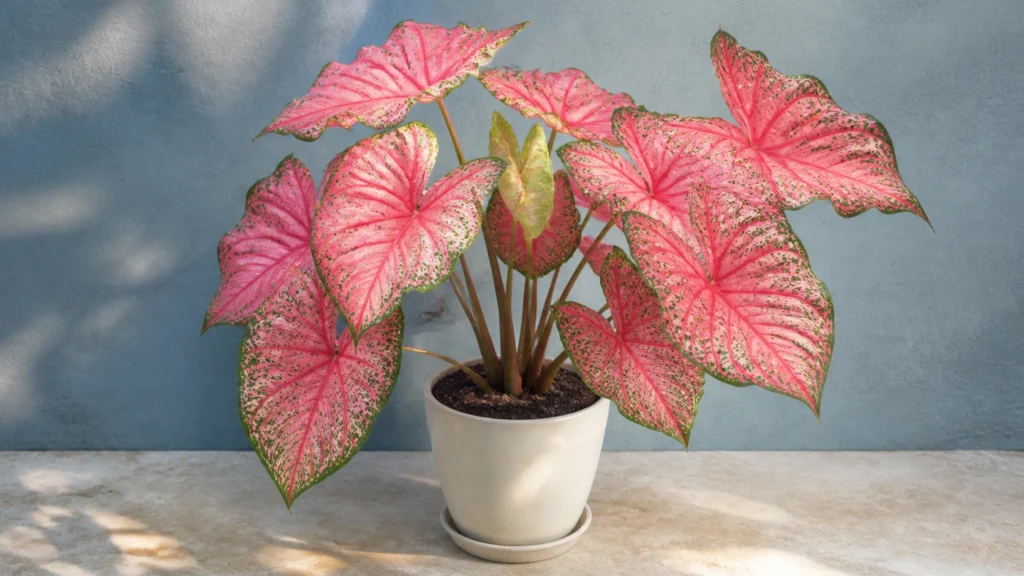
Caladium ‘Carolyn Whorton’
Caladium bicolor 'Carolyn Whorton'
A longstanding fancy-leaf caladium with large pink leaves, prominent red veins, green margins, and an important role in later breeding.
Watering frequency
Every 5-7 days during active growth
Ideal temperature
70-85°F / 21-29°C
Humidity
50-80%
Care difficulty
Medium
Air purifying
No/Not Known
Growth rate
Moderate
Plant size
1.5-2 ft / 0.45-0.6 m tall during active growth
Soil type
Moisture-retentive but well-draining mix
Fertilizer need
During leaf growth; stop at dormancy.
Care summary
- Light: Bright filtered light; tolerates both shade and gentle sun better than white fancy-leaf cultivars.
- Water: Keep evenly moist while leaves are active, without saturating the tuber.
- Warmth: Protect from cold rooms, drafts, and cold irrigation water.
- Dormancy: Reduce watering as foliage naturally yellows and collapses.
- Safety: Contains irritating calcium oxalate crystals; keep away from pets and children.
Common problems
- Wilting with dry mix: Water thoroughly and monitor more often during active growth.
- Yellowing with wet mix: Check drainage and the tuber for rot.
- Brown or torn edges: Dry air, irregular moisture, salts, or physical damage to thin leaves.
- Color looks weak or bleached: Review both insufficient light and excessive direct sun.
- Gradual seasonal collapse: May be normal dormancy rather than a care failure.
- No spring growth: Tuber may be cold, dry, dormant, or rotted.
Plant care guide
About Carolyn Whorton Caladium
Carolyn Whorton Caladium (Caladium bicolor 'Carolyn Whorton') is a longstanding fancy-leaf cultivar whose large, heart-shaped leaves combine rosy pink centers, red veins, and green margins. Its origin and original breeder are not documented clearly in the authoritative sources reviewed for this page, so its importance is better established through production and breeding records than through an invented discovery story.
Like every Caladium, it is a tuberous aroid grown from an underground storage organ, a member of Caladium bicolor and its hybrids native from Central America through much of tropical South America. Kew Plants of the World Online accepts Caladium bicolor and describes it as a tuberous geophyte. The foliage is seasonal: it rises in warm, bright months, then yellows and collapses as the tuber enters dormancy.
This page covers the single cultivar. The rest of the genus, including the white Caladium 'White Christmas' and the lance-leaf Florida Sweetheart Caladium, is split across separate pages so each variety keeps an accurate identity.
Why You'll Like It
'Carolyn Whorton' delivers the full fancy-leaf experience: big leaves, saturated color, and a presence that a small lance-leaf cultivar cannot match. A single plant fills a tabletop, and the pink-red-green contrast stays vivid from spring through the first cool nights. It is also one of the more adaptable pink cultivars, described by growers as comfortable in both shade and sun, which makes placement easier than the white fancy-leaf types that must hide from direct light.
It is a piece of Caladium history you can grow. The cultivar's role as a parent in the University of Florida breeding program means that when you buy 'Carolyn Whorton', you are growing a plant whose genetics appear in some of the most popular modern Caladiums. For gardeners who like provenance, that is a genuine pleasure.
What Kind of Plant Is It?
'Carolyn Whorton' is a fancy-leaf Caladium: broad, heart-shaped blades carried on upright petioles, in the group that makes the fullest and most dramatic container displays. The leaf is large, roughly 8 inches (20 cm) across on mature plants, and the plant reaches about 1.5 to 2 feet (0.45 to 0.65 m) tall in a clumping, fountain-like habit.
The color layout is the cultivar's signature. The center of each leaf is rosy pink, crossed by darker red veins and framed by a green margin. Light affects both color and plant form, but the response is not a simple more-light-equals-more-pink rule: deep shade can weaken growth, while harsh direct sun can bleach or burn the thin blade.
As a fancy-leaf type, it sits in the group that University of Florida / IFAS production guidance suggests growing with roughly 40 to 50 percent light exclusion. It is more forgiving of shade than sun, though the cultivar is noted for tolerating some direct light in practice.
History of the Carolyn Whorton Caladium
The original breeder, selection date, parentage, and reason for the name 'Carolyn Whorton' are not established in the authoritative public records reviewed here. The spelling 'Carolyn Wharton' also appears in horticultural publications and retail catalogs, but UF/IFAS breeding and production records consistently use 'Carolyn Whorton'. This page therefore treats Wharton as a searchable trade spelling, not a separate cultivar.
What is documented is its influence. The UF/IFAS cultivar table identifies 'Carolyn Whorton' as a parent of four released cultivars: 'Florida Cardinal', 'Florida Roselight', 'Florida Elise', and 'Florida Calypso'. That repeated use provides a verifiable breeding history even though the cultivar's own ancestry remains unknown.
The cultivar also became a reference plant in Caladium genetics. Research on leaf blotching used 'Carolyn Whorton' among the blotched parents and found the trait to be under simple genetic control and closely linked to vein color. This gives the patterned center a documented breeding context rather than treating it as damage or disease.
Related Caladium Cultivars
'Carolyn Whorton' is the pink fancy-leaf anchor, and the other cultivar pages in this series make useful comparisons:
- Caladium 'White Christmas': The classic white fancy-leaf and the anchor page for the genus. Same leaf form, opposite color, and a much lower tolerance for direct sun.
- Florida Sweetheart Caladium: A rose-toned lance-leaf cultivar selected from a 1977 UF cross. It has narrower leaves and documented shade and sun uses.
- Miss Muffet Caladium: A compact dwarf fancy-leaf with chartreuse leaves covered in burgundy speckles, the closest small-format alternative for tight containers.
If the pink fancy-leaf look is the goal but space is short, 'Miss Muffet' trades the large leaf for a tighter habit; if light is strong, the lance-leaf 'Florida Sweetheart' is the more sun-tolerant pink.
Where It Works Best
Indoors, 'Carolyn Whorton' wants a warm position with bright filtered light. An east window, a bright room just back from stronger glass, or a bathroom with a genuinely bright window all work. The cultivar is described as tolerating both shade and some sun, which gives it more placement freedom than a white fancy-leaf, but strong midday sun can still bleach the pink and crisp the thin leaves.
Outdoors, use a sheltered container or shaded-to-part-sun bed after nights are reliably warm. Dappled shade with some morning light keeps the pink richest. The large leaves tear easily in wind and hail, so protection matters. Do not place the pot where roof runoff keeps it saturated.
How to Care for a Carolyn Whorton Caladium
Light: Give bright filtered light as the default. UF and extension references list 'Carolyn Whorton' for shade and some sun use, but indoor glass can intensify heat. If new growth is weak or leaning, increase useful light gradually; if pale patches become crisp, add protection from direct exposure.
Watering during growth: Keep the mix evenly moist while the plant carries a full set of leaves. Water when the surface begins to dry, soak the root zone thoroughly, and let excess drain. A small pot in warm bright conditions may need frequent checks; a large glazed pot in a cooler room dries much more slowly.
Soil and pot: Use a loose mix that holds some moisture but drains freely—quality houseplant mix amended with perlite and fine bark is a practical starting point. A drainage hole is essential. Keep the top of an established tuber at roughly its previous depth.
Humidity: Moderate-to-high humidity helps the large thin leaves remain open and reduces rapid edge drying. A humidifier or grouping plants with adequate spacing is more reliable than occasional misting.
Temperature: Warmth is fundamental. Aim for roughly 70-85°F / 21-29°C during active growth and avoid cold drafts. Cool wet soil is particularly risky because the tuber uses little water while decay organisms remain active.
Fertilizer: Feed lightly with a balanced fertilizer while new leaves are developing, following the label at reduced frequency or strength. Stop feeding when growth slows or dormancy begins.
Grooming: Remove a leaf only after it is badly damaged or mostly yellow, cutting the petiole near the base with clean scissors. Healthy leaves are supplying the tuber with energy for future growth.
How to Propagate
Division of a mature tuber is the reliable method. During dormancy, inspect the tuber for distinct buds or growing points. Cut only when each section can retain at least one viable bud, use a clean blade, and allow cut surfaces to dry and callus before planting in fresh mix.
Small divisions have fewer stored reserves and need careful warmth and moisture management. Keep the medium barely and evenly moist until roots and shoots are active; a wet, inactive tuber is more likely to rot. Seed propagation does not reliably reproduce the cultivar, so divisions are the dependable way to get true 'Carolyn Whorton' plants.
When to Repot
Repot before active growth when the tuber cluster has crowded the container, the mix has compacted, or drainage has become unreliable. Move up only enough to accommodate the tuber and a modest root zone. Oversized pots hold unnecessary wet soil around a relatively compact storage organ.
If buying a leafy plant in summer, avoid disturbing it solely because the nursery pot looks small. A disruptive midseason repot can damage fine roots and fragile petioles.
Toxicity and Pet Safety
Caladium is not pet-safe. ASPCA lists Caladium as toxic to dogs, cats, and horses because it contains insoluble calcium oxalate crystals. Chewing can cause oral irritation, pain and swelling of the mouth, drooling, vomiting, and difficulty swallowing. NC State Extension likewise identifies Caladium bicolor as having medium-severity poison characteristics and notes that sap can irritate skin.
Wear gloves when dividing tubers if your skin is sensitive, wash hands after handling sap, and keep every plant part away from children and pets. If chewing or ingestion occurs, remove access and contact a veterinarian or poison-control service as appropriate.
Common Problems and Practical Fixes
- Leaves droop and the mix is dry: Water thoroughly and let the pot drain. Recheck sooner while the plant is actively growing.
- Leaves droop while the mix is wet: Check temperature, roots, and the tuber. More water will worsen oxygen-starved roots.
- Color weakens or looks bleached: Check both ends of the light range. Deep shade can weaken growth, while harsh direct sun can wash out or burn thin tissue. Adjust gradually and judge the next leaves.
- Bleached or crispy patches: Too much harsh sun for the position. Move to filtered light; burned tissue will not recover.
- Brown edges on the large leaves: Consider irregular moisture, low humidity, fertilizer salts, hard water, heat against glass, and physical abrasion.
- Yellow leaves during warm active growth: Inspect drainage and watering first. One aging leaf is normal; widespread yellowing in saturated mix is not.
- Torn leaves: Protect from pets, traffic, fans, and outdoor wind.
- No growth after planting: Confirm warmth and patience before watering more. If the tuber remains inactive, inspect it for firmness and viable buds.
Frequently Asked Questions
Who was Carolyn Whorton?
The reviewed authoritative sources do not document the person's identity or explain why the cultivar received the name. They do consistently document the cultivar spelling and its later use in breeding, so this page does not repeat an unsupported biographical story.
Is Carolyn Whorton Caladium easy to grow?
It is a moderate-care Caladium, easier than a white fancy-leaf because it tolerates both shade and some sun. The essentials are warm conditions, bright filtered light, even moisture, and a rest period.
How is it different from Florida Sweetheart Caladium?
'Carolyn Whorton' is a fancy-leaf with large pink heart-shaped leaves, red veins, and green margins. Florida Sweetheart is a lance-leaf selection from a 1977 UF cross, with narrower leaves and documented shade and sun uses. Both are pink, but their leaf form and placement behavior differ.
Why is my Carolyn Whorton losing its pink?
Check both insufficient useful light and excessive direct exposure. Move a weak plant gradually toward brighter filtered light, but add protection if the tissue is bleaching or crisping. Judge the adjustment by new leaves.
Should I keep watering after all the leaves die?
No. Once dormant, the tuber uses far less water. Keep it warm and relatively dry, then increase moisture cautiously when growth resumes.
Final Thought
Carolyn Whorton Caladium is the pink fancy-leaf classic that keeps its place in the trade because it is beautiful and reasonably forgiving. Give it warm conditions, bright filtered light, an airy mix kept evenly moist, and a proper rest, and it delivers the big hand-painted leaves that define the fancy-leaf group. Its genetics live on in modern UF cultivars, but the original still grows like it has nothing to prove.