
Caladium ‘Miss Muffet’
Caladium bicolor 'Miss Muffet'
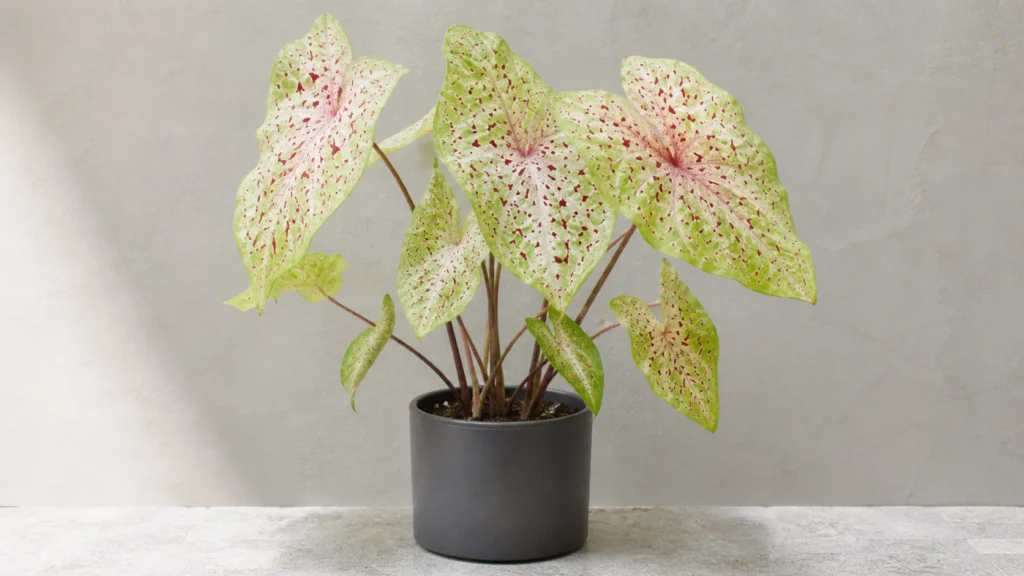
A compact dwarf fancy-leaf caladium whose chartreuse leaves are covered in burgundy speckles, with pale veins and a puckered texture on a plant that stays small.
Watering frequency
Every 5-7 days during active growth
Ideal temperature
70-85°F / 21-29°C
Humidity
50-80%
Care difficulty
Easy
Air purifying
No/Not Known
Growth rate
Moderate
Plant size
8-14 in / 20-35 cm tall during active growth
Soil type
Moisture-retentive but well-draining mix
Fertilizer need
During leaf growth; stop at dormancy.
Care summary
- Light: Bright filtered light keeps the dwarf clump dense; moderate sun tolerance for a caladium.
- Water: Keep evenly moist; a small pot dries quickly, so check often while leaves are active.
- Warmth: Protect from cold rooms, drafts, and cold irrigation water.
- Dormancy: Reduce watering as foliage naturally yellows and collapses.
- Safety: Contains irritating calcium oxalate crystals; keep away from pets and children.
Common problems
- Wilting with dry mix: Water thoroughly and monitor more often during active growth.
- Yellowing with wet mix: Check drainage and the tuber for rot.
- Brown or crisp leaf edges: Dry air, drought in a small pot, or hot direct sun.
- Leggy, weak petioles: Too little useful light for the compact habit.
- Gradual seasonal collapse: May be normal dormancy rather than a care failure.
- No spring growth: Tuber may be cold, dry, dormant, or rotted.
Plant care guide
About Miss Muffet Caladium
Miss Muffet Caladium (Caladium bicolor 'Miss Muffet') is a compact dwarf fancy-leaf cultivar whose chartreuse to lime-green leaves are densely covered with burgundy and dark pink speckles, laced with pale veins and a softly puckered texture. It is the Caladium for small spaces: a plant that delivers the full fancy-leaf pattern experience while staying around 10 to 14 inches (25 to 35 cm) tall, small enough for a tabletop, a windowsill, or a tight container where larger cultivars would take over.
Like every Caladium, it is a tuberous aroid grown from an underground storage organ, a member of Caladium bicolor and its hybrids native from Central America through much of tropical South America. Kew Plants of the World Online accepts Caladium bicolor and describes it as a tuberous geophyte. The foliage is seasonal: it rises in warm, bright months, then yellows and collapses as the tuber enters dormancy.
This page covers the single cultivar. The rest of the genus, including the white Caladium 'White Christmas' and the lance-leaf Florida Sweetheart Caladium, is split across separate pages so each variety keeps an accurate identity.
Why You'll Like It
'Miss Muffet' gives you the most pattern per square inch of any Caladium in this series. Every leaf is a hand-painted confetti of burgundy freckles on yellow-green, and because the plant produces many small leaves rather than a few large ones, the effect reads as dense texture from across the room. It is playful rather than dramatic, which makes it easy to place in kitchens, offices, and mixed tropical planters.
Its small format makes it practical for containers and shelves, although a compact pot can dry faster than a large one. UF and extension references document 'Miss Muffet' as a longstanding commercial cultivar used in breeding and report some useful tolerance to brighter landscape conditions. Indoors, warmth, filtered light, and even moisture during active growth remain safer defaults than assuming the plant is effortless.
What Kind of Plant Is It?
'Miss Muffet' is classified in breeding literature as a fancy novelty Caladium. Its leaves are broad rather than truly lance-shaped, but the plant stays short and dense, forming a compact clump of smaller leaves instead of the taller display associated with Carolyn Whorton Caladium. Retail listings vary between dwarf, fancy-leaf, and strap-type categories, so the documented fancy novelty classification is the clearest database description.
The leaf is the signature. The ground color is chartreuse to lime green, and the surface is scattered with burgundy to dark pink speckles that range from fine dots to larger marks, so the yellow-green background shows through in different amounts on every blade. The veins are pale, and the blade has a puckered, quilted texture that gives the pattern depth. The speckles are a stable feature of the cultivar, not a sign of pests or disease.
As a fancy-leaf type, it sits in the group that University of Florida / IFAS production guidance suggests growing with roughly 40 to 50 percent light exclusion, but the cultivar's compact habit and reported sun tolerance make it workable in brighter positions than the largest fancy-leafs.
History of the Miss Muffet Caladium
The trade name resembles the nursery-rhyme character Little Miss Muffet, and some catalogs expand the name to 'Little Miss Muffet'. No authoritative breeding source reviewed for this page documents that story as the actual naming origin, so it should be treated as a name association rather than established cultivar history.
The cultivar's history is documented more clearly in later University of Florida breeding papers. A 2019 HortScience cultivar paper identifies 'Miss Muffet' as a nonpatented commercial cultivar developed by Frank M. Joyner in Tampa, probably in the 1940s or early 1950s, while noting that its ancestry is unknown. The historical attribution ultimately relies on grower communication cited by the researchers, so the approximate date should not be presented as a precise release year.
The same peer-reviewed source describes 'Miss Muffet' as nonpatented. Its long commercial history is independently visible in production records: the cultivar ranked in Florida industry surveys decades after its probable development and has continued to appear as a parent in UF breeding work.
Related Caladium Cultivars
'Miss Muffet' is the compact member of this cultivar series, and the other pages make useful comparisons:
- Caladium 'White Christmas': The classic white fancy-leaf and the anchor page for the genus. Much larger leaves, opposite color, and a much lower tolerance for direct sun.
- Florida Sweetheart Caladium: A lance-leaf cultivar with pink centers and ruffled green edges, bred by UF in 1977. Sun-tolerant and vigorous, but larger than 'Miss Muffet'.
- Carolyn Whorton Caladium: The pink fancy-leaf classic with large leaves. Where 'Carolyn Whorton' fills a tabletop, 'Miss Muffet' fits a shelf.
If space is the constraint, 'Miss Muffet' is the smallest of the four; if you want the most pattern per leaf, its burgundy speckling has no rival in this group.
Where It Works Best
Indoors, 'Miss Muffet' wants a warm position with bright filtered light. A bright kitchen counter, a shelf near an east window, or a bathroom with a genuinely bright window all work. The small pot dries quickly, so a spot you can check often is better than a far corner. It tolerates gentle morning sun, and its compact habit makes it easy to move and turn.
Outdoors, use a small container, border edge, or mixed planter in part shade to part sun after nights are reliably warm. The low clump reads well at the front of a bed or as edging. Protect the thin leaves from wind and heavy traffic, and do not let the pot sit where roof runoff keeps it saturated.
How to Care for a Miss Muffet Caladium
Light: Give bright filtered light as the default. The compact clump stays dense with more useful light, and the cultivar tolerates gentle sun better than most fancy-leaf Caladiums. Watch for stretched, weak petioles: that is the classic sign that a 'Miss Muffet' is too dark.
Watering during growth: Keep the mix evenly moist while the plant carries a full set of leaves. A small pot in warm bright conditions can dry within days, so check often; water when the surface begins to dry, soak thoroughly, and let excess drain. Do not let the pot sit in a saucer of water.
Soil and pot: Use a loose mix that holds some moisture but drains freely—quality houseplant mix amended with perlite and fine bark is a practical starting point. A drainage hole is essential. Keep the tuber at roughly its previous depth.
Humidity: Moderate humidity is usually enough. The many small leaves benefit from stable conditions, and a humidifier or grouping with other plants helps in a very dry room. Occasional misting is a minor help, not a substitute.
Temperature: Warmth is fundamental. Aim for roughly 70-85°F / 21-29°C during active growth and avoid cold drafts. Cool wet soil is particularly risky because the tuber uses little water while decay organisms remain active.
Fertilizer: Feed lightly with a balanced fertilizer while new leaves are developing, following the label at reduced frequency or strength. Stop feeding when growth slows or dormancy begins.
Grooming: Remove a leaf only after it is badly damaged or mostly yellow, cutting the petiole near the base with clean scissors. Do not mistake the cultivar's burgundy speckles for damage; they are the point of the plant.
How to Propagate
Division of a mature tuber is the reliable method. During dormancy, inspect the tuber for distinct buds or growing points. Cut only when each section can retain at least one viable bud, use a clean blade, and allow cut surfaces to dry and callus before planting in fresh mix.
Small divisions have fewer stored reserves and need careful warmth and moisture management. Seed propagation does not reliably reproduce the cultivar, so tuber division is the dependable way to retain the named plant's traits. Use clean tools and avoid leaving inactive divisions in saturated mix.
When to Repot
Repot before active growth when the tuber cluster has crowded the container, the mix has compacted, or drainage has become unreliable. Move up only one modest size; the compact habit does not need a large pot, and an oversized pot holds unnecessary wet soil around a relatively small tuber.
If buying a leafy plant in summer, avoid disturbing it solely because the nursery pot looks small. A disruptive midseason repot can damage fine roots and fragile petioles.
Toxicity and Pet Safety
Caladium is not pet-safe. ASPCA lists Caladium as toxic to dogs, cats, and horses because it contains insoluble calcium oxalate crystals. Chewing can cause oral irritation, pain and swelling of the mouth, drooling, vomiting, and difficulty swallowing. NC State Extension likewise identifies Caladium bicolor as having medium-severity poison characteristics and notes that sap can irritate skin.
Wear gloves when dividing tubers if your skin is sensitive, wash hands after handling sap, and keep every plant part away from children and pets. If chewing or ingestion occurs, remove access and contact a veterinarian or poison-control service as appropriate.
Common Problems and Practical Fixes
- Leaves droop and the mix is dry: Water thoroughly and let the pot drain. A small pot dries fast, so recheck sooner while the plant is actively growing.
- Leaves droop while the mix is wet: Check temperature, roots, and the tuber. More water will worsen oxygen-starved roots.
- Crisp brown leaf edges: Check for hot direct sun, drought in the small pot, dry air, or a combination. Move to filtered light and restore even moisture; later leaves should open clean.
- Leggy, weak petioles: The classic sign of too little light for a compact cultivar. Move the plant gradually to a brighter position without harsh midday sun.
- Speckles fading: Weak light can soften the contrast. Brighten the position gradually; the burgundy speckles should return on new growth.
- Yellow leaves during warm active growth: Inspect drainage and watering first. One aging leaf is normal; widespread yellowing in saturated mix is not.
- No growth after planting: Confirm warmth and patience before watering more. If the tuber remains inactive, inspect it for firmness and viable buds.
Frequently Asked Questions
Is Miss Muffet Caladium small?
Yes. It stays around 10 to 14 inches (25 to 35 cm) tall and wide, which makes it the most compact of the cultivars in this series and a good choice for shelves, tabletops, and small containers.
Why are the leaves speckled?
The burgundy and dark pink speckles on chartreuse are the cultivar's stable leaf pattern, not a pest or disease. The spotting ranges from fine dots to larger marks, and every blade shows a slightly different arrangement.
Is Miss Muffet Caladium easy to grow?
Its compact habit makes it manageable, but it still follows the Caladium growth cycle. The main demands are warmth, bright filtered light, even moisture while leaves are active, and much less water during dormancy.
How is it different from Carolyn Whorton Caladium?
Carolyn Whorton is a large pink fancy-leaf with red veins and green margins; 'Miss Muffet' is a small chartreuse leaf covered in burgundy speckles. Both are fancy-leaf types, but the size and the pattern could not be more different.
Should I keep watering after all the leaves die?
No. Once dormant, the tuber uses far less water. Keep it warm and relatively dry, then increase moisture cautiously when growth resumes.
Final Thought
Miss Muffet Caladium delivers a dense display of burgundy-spotted chartreuse leaves in a genuinely compact plant. Keep it warm, provide bright filtered light, maintain even moisture during active growth, and reduce watering as dormancy begins. Its size is the main advantage: it brings a documented old commercial cultivar into spaces where larger Caladiums are awkward.