
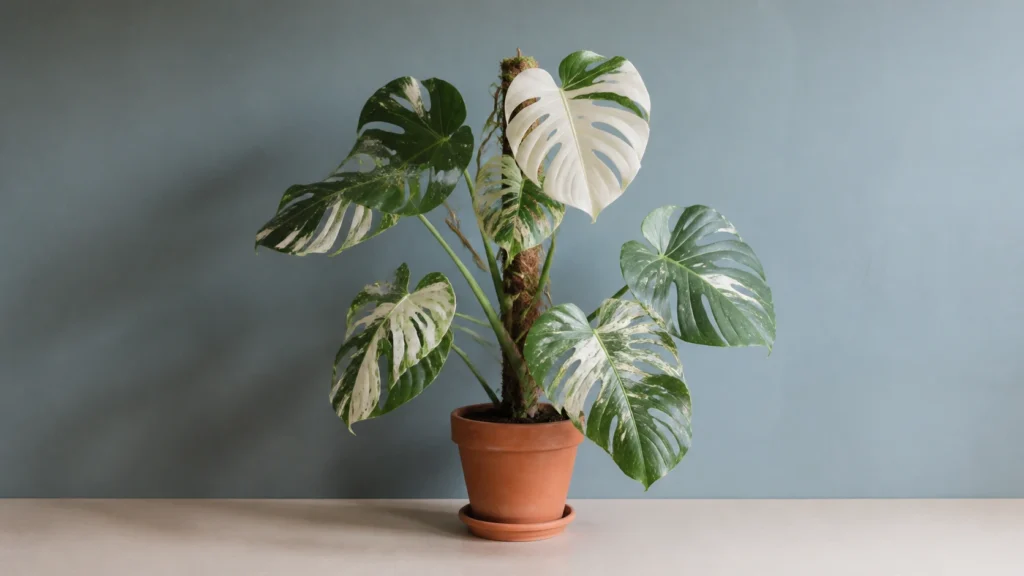
Monstera ‘Albo Variegata’
Monstera deliciosa 'Albo Variegata'
The white-variegated Monstera whose leaves carry stark white sectors and half-moon patches, a chimeral mutation that is stunning when it cooperates and unpredictable when it does not.
Watering frequency
Every 7-10 days
Ideal temperature
65-80°F / 18-27°C
Humidity
60-80%
Care difficulty
Hard
Air purifying
No/Not Known
Growth rate
Slow
Plant size
2-4 ft indoors / 0.6-1.2 m, larger with support
Soil type
Chunky, well-draining aroid mix
Fertilizer need
Monthly, spring-summer.
Care summary
- Light: Give the brightest indirect light you can without direct sun.
- Water: Water when the top inch or two dries; white tissue slows the plant's metabolism.
- Humidity: Maintain high humidity; white areas brown first in dry air.
- Pruning: Remove reverted green shoots and all-white leaves to protect the pattern.
- Safety: Monstera is toxic to cats and dogs if ingested.
Common problems
- Reverted green growth: Increase light or prune the green shoot.
- All-white leaves: Expect them to brown; cut back to a variegated node.
- Brown edges: Check humidity and water quality.
- Yellow leaves: Inspect saturated mix and drainage.
- Pests: Check undersides for mites, thrips, and scale.
Plant care guide
About
The albo variegata monstera is the white-patterned form of Monstera deliciosa that most people picture when they hear "variegated Monstera." Its leaves carry pure white sectors, streaks, and the prized half-moon shape where one side of the leaf is white and the other green. Unlike the cream-speckled Thai Constellation, the white here is stark and blocky, and the contrast between the deep green and the white is what makes the plant so arresting. It is also a chimeral mutation, which means the pattern is not stable: every new leaf is a fresh roll of the dice, and managing that unpredictability is the real skill in growing one.
Why You'll Like It
Nothing in the houseplant world photographs like an albo with a good half-moon leaf. The white sectors turn every leaf into a graphic object, and because no two leaves are alike, the plant keeps surprising you. For collectors, there is also the appeal of the chase: a node with strong white, a cutting that roots and throws a perfect half-moon, a plant that holds its pattern for years, these are small victories that a stable plant like the Thai Constellation never offers.
It has also become a recognizable collector plant. The unstable distribution of white tissue makes uniform large-scale production more difficult than production of a consistently patterned cultivar, so buyers need to judge the actual stem, node, roots, and growth point rather than relying on the name alone.
What Kind of Plant Is It
The albo variegata monstera is a cultivated form of Monstera deliciosa, a climbing aroid in the arum family (Araceae) documented by the North Carolina State Extension. The trade designation does not represent a botanical variety. Albo plants are generally described as chimeras, with chlorophyll-producing and non-green tissues developing together in the growing point. The white pattern is not reliably reproduced from seed, so named plants are propagated clonally, most often from node-bearing stem cuttings.
The pattern depends on which tissues remain in the active growing point, so the balance can shift as the plant grows or branches. A shoot may become greener, more heavily white, or remain balanced. All-white leaves contribute little useful photosynthesis and usually decline, while an all-green shoot can outgrow more weakly photosynthetic variegated growth. This is why the pattern on the stem and around the node matters when choosing or pruning a plant.
History
The species behind the albo has a well-documented trail. Monstera deliciosa was described in 1849 by the Danish botanist Frederik Liebmann, according to Kew's Plants of the World Online, and became a fixture of European greenhouses within decades. The albo's own history is vaguer, because white variegation is a mutation that has appeared in Monstera cultivation many times, in many places, with no single origin event on record.
The name problem starts with Monstera borsigiana. In 1862 the German botanist Karl Koch described a form with smaller leaves and longer internodes, naming it after the Borsig nursery in Berlin, and in 1908 the botanist Adolf Engler reduced it to a variety, Monstera deliciosa var. borsigiana. Modern taxonomy has gone further: Kew's Plants of the World Online now treats Monstera borsigiana as a synonym of Monstera deliciosa, meaning it is no longer considered a distinct taxon at all. The retail world has never caught up. Many albo plants are sold as Monstera borsigiana 'Albo Variegata,' others as Monstera deliciosa 'Albo Variegata,' and the two labels describe plants that are close enough that most growers treat them as one.
When the white form first appeared is not reliably recorded, and the broad trade label may have been applied to more than one independently occurring variegated clone. White-sectorial Monsteras circulated among collectors before the recent social-media boom, then became far more visible and expensive during the late 2010s and pandemic-era rare-plant market. Precise claims about the first country, grower, or propagation program should be omitted unless a traceable historical record is found.
Related Varieties
The albo variegata monstera's closest comparison in cultivation is the Thai Constellation Monstera. Thai Constellation usually offers more consistent cream speckling, while the albo produces sharper white sectors with less predictable distribution. Neither plant guarantees a particular pattern on every leaf, but an albo requires closer attention to the stem and growing point.
Two other variegated color forms complete the family. Aurea forms carry yellow-gold sectors instead of white, and mint forms show pale green and white marbling; both are chimeral like the albo and behave with the same instability. There are also "sport" Monsteras, ordinary green plants that spontaneously throw a variegated branch, which is exactly how albo plants enter the world in the first place. The parent species, the Monstera Deliciosa, and its smaller-leaved cousin the Swiss Cheese Vine (Monstera adansonii) are the plain-green reference points for the whole group.
Where It Works
An albo is a display piece. Put it where it receives strong indirect light, such as near a large east or west window with protection from intense midday sun. Good light supports the green tissue that powers the plant, but it does not rewrite the genetic composition of the growing point or guarantee more white on the next leaf. Pale tissue can scorch when a plant is moved abruptly into direct sun.
Give it a moss pole or totem from the start. Climbing growth can support larger leaves and more mature fenestration than a plant left to trail, and the vertical form displays the pattern clearly. Because the plant is compact when young, it also works on a plant stand or side table.
How to Care for an Albo Variegata Monstera
Light. Give strong, indirect light to support the green tissue and healthy growth. Light cannot force the growing point to produce more white, and direct afternoon sun can scorch pale tissue, especially after an abrupt move.
Water. Water when the top inch or two of mix has dried, usually every 7 to 10 days. White tissue does not photosynthesize, so an albo uses water more slowly than a green Monstera and is prone to root rot if kept soggy. Let the mix dry a little more between waterings in winter.
Humidity. Aim for 60 percent or higher. The white areas are the first to show brown, crispy edges in dry air, and once a white sector browns it cannot recover. A humidifier near the plant is the most effective fix.
Temperature. Keep it in the 65 to 80°F (18 to 27°C) range and away from cold drafts and heating vents. Steady warmth supports the slow metabolism of the variegated tissue.
Soil. Use a chunky, well-draining aroid mix with bark and perlite. Good drainage is non-negotiable because the plant cannot outgrow a soggy root zone the way a green Monstera can.
Fertilizer. Feed monthly at half strength during spring and summer with a complete, balanced fertilizer. Deliberately restricting nitrogen does not reliably control a chimera and can weaken the green tissue on which the plant depends.
How to Propagate
Propagation is where the albo reveals its character. Take a stem cutting that includes a node and, ideally, a visible white sector in the leaf or stem, because the pattern follows the axillary bud. A cutting from a section with white tissue has a good chance of producing variegated growth; a cutting from an all-green section usually gives you a plain green plant.
Root in water or directly in moist aroid mix. In water, change it weekly and pot up when roots reach a couple of inches. The slow metabolism means rooting can take longer than with a green Monstera, and cuttings that are more than half white may fail entirely, since the white tissue cannot feed the new roots. As the plant grows, remove any shoot that reverts to all green before it outcompetes the variegated growth, and cut back all-white leaves, which are doomed anyway. Every albo owner eventually learns to prune with a cold heart.
When to Repot
Repot every one to two years in spring, moving up one pot size at most. The albo does better slightly snug, and a too-large pot holds moisture that the slow-growing roots cannot use. Use fresh chunky aroid mix, and check the roots while the plant is out: healthy roots are firm and pale, while soft, dark roots signal rot. After repotting, keep the soil evenly moist and hold fertilizer for about a month.
Toxicity
The albo is as toxic as any Monstera. The ASPCA lists Monstera deliciosa among plants toxic to cats and dogs, and the culprit is insoluble calcium oxalate crystals in the leaves. Chewing releases needle-like crystals that cause immediate oral irritation, drooling, pawing at the mouth, and vomiting. The white sectors are no exception; they are just as irritating as the green tissue. Keep the plant out of reach of pets that chew, and call a veterinarian if a large amount has been eaten.
Common Problems
Reverting to green. A growing point can lose the white tissue and continue as an all-green shoot. Adequate light keeps the plant healthy but cannot restore white tissue that is absent from that point. If the stem becomes consistently green, prune back to a healthy node that still shows both green and pale patterning.
All-white leaves. They cannot photosynthesize and will brown and die. Remove them when they appear; they are a sign the white cell line is dominating, and the plant needs the balance corrected.
Brown, crispy edges on white tissue. Low humidity or hard water. Raise humidity and switch to filtered or rainwater.
Yellowing leaves. Overwatering or poor drainage. Check the pot, let the mix dry further, and make sure water runs out freely.
Pests. Spider mites, thrips, and scale all favor stressed plants. Inspect leaf undersides regularly, since the white tissue hides damage well.
Splitting or tearing leaves. New leaves on any Monstera can tear as they unfurl, and the white sectors are thinner and more brittle than green tissue, so an albo tears more easily. Low humidity makes it worse. It is cosmetic, not fatal, and the leaf still photosynthesizes through its green areas.
FAQ
Will my albo revert to green? It can. Watch the stem and successive leaves rather than reacting to one greener leaf. Strong indirect light supports healthy growth; pruning to a node that still carries visible variegation is the practical response to a consistently green shoot.
Why is it so expensive? Every albo must be propagated by cuttings, growth is slow, and a share of cuttings fail or revert. Supply is inherently limited, which kept prices high even after the pandemic boom cooled.
What is the difference between the albo variegata monstera and Thai Constellation? The albo has stark white sectors and is chimeral and unstable. Thai Constellation has cream speckling that is stable and rarely reverts. Albo for drama, Thai for reliability.
Is Monstera borsigiana a different plant? Kew treats Monstera borsigiana as a synonym of Monstera deliciosa. In the trade the name still appears on many albo plants, but botanically there is no separate species.
How can I encourage more white variegation? You cannot reliably feed or light an albo into producing a chosen amount of white. Provide strong indirect light and balanced nutrition for healthy growth, then select and prune according to the pattern visible on the stem and active node. Even then, the next leaf is not guaranteed.
Final Thought
The albo variegata monstera is the plant equivalent of a wild card: magnificent when the pattern lands, frustrating when it does not, and never fully under your control. That unpredictability is precisely what makes it so desired. If you want a variegated Monstera you can relax with, buy a Thai Constellation. If you want one that keeps you on your toes, and rewards good care with leaves that look like works of graphic design, the albo is the one to grow.